%203.svg)
Key Takeaways
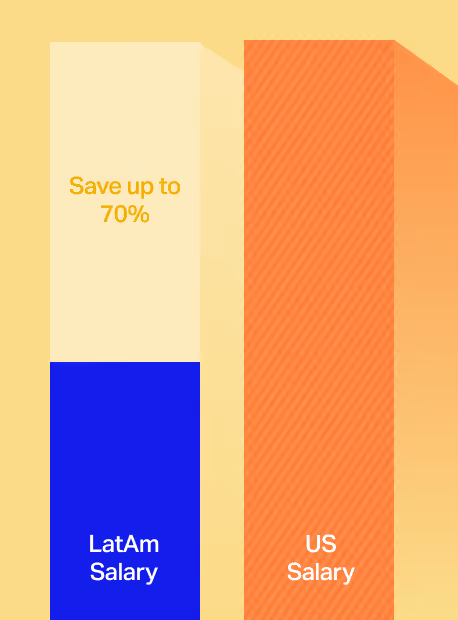
- You can hire software developers in Chile who work a near-full overlap with your US business day, bring senior engineering experience, and cost 30–70% less than comparable US hires.
- Chile’s edge is quality and stability, not the lowest price: it’s one of Latin America’s most stable, highest-income tech economies and an OECD member, with real-time collaboration that far-offshore teams cannot match.
- The fastest path to a great long-term hire is a staffing and recruiting partner that sources, vets for skill and English, and handles payroll and compliance in one relationship.
When global enterprises and high-growth startups look to hire developers in Chile for engineering expansion, they aren’t just looking for 30–70% cost savings. Their biggest advantage is tapping into Latin America’s most stable, OECD-backed economy.
Chile is a technical landscape anchored by elite engineering universities and an operating environment aligned directly with Eastern US working hours. Known as “Chilecon Valley,” Santiago has transformed from a regional innovation hub into a premier destination for high-caliber, nearshore engineering talent.
Whether you need senior full-stack engineers or specialized cloud architects, in this guide, I break down real developer salaries, core technical strengths, the four primary hiring models, and the local compliance essentials you need to know before making your first hire.
Why Should I Hire Software Developers in Chile?
US companies hire software developers in Chile for four reasons: time zone overlap, a stable and mature engineering market, cost savings without a drop in quality, and communication and cultural fit.
Chile is one of Latin America’s most stable, highest-income tech economies, which makes it a quality and stability play rather than a race to the lowest rate.
A stable, mature market to hire into
Chile is an OECD member with a mature engineering workforce, strong institutions, and a startup ecosystem that has produced real companies. That means you’re hiring into an established professional market, not an experiment.
That maturity shows up in the numbers. Chile’s startup ecosystem ranks 39th globally with roughly 875 tracked startups, and the country runs Start-Up Chile, the world’s first government-funded startup accelerator, which has supported more than 3,000 startups from over 80 countries since its launch in 2010.
Real-time overlap with your workday
Another major reason US teams look south is the clock. A developer in Chile is online and working during your business day, wherever your team sits, so you get live standups, same-day code review, and handoffs that happen while everyone is at their desk.
See how time zones overlap in the table below:
Continental Chile operates on Chile Standard Time (UTC-4) in its winter and shifts to Chile Summer Time (UTC-3) for its summer. Because Chile is in the Southern Hemisphere, its Daylight Saving Time schedule runs opposite to the US, moving clocks forward in September and back in April. This causes the time overlap with US working hours to shift by 1 to 2 hours depending on the season.
The time zone overlap between Chile and the US is the opposite of the far-offshore model, where the workday barely touches yours. This is a documented driver, not a hunch. Hire With Near’s research on why US companies hire in Latin America found that 30% made the move specifically to switch from far-offshore teams in Southeast Asia to nearshore ones for real-time overlap.
Cost savings without a quality trade-off
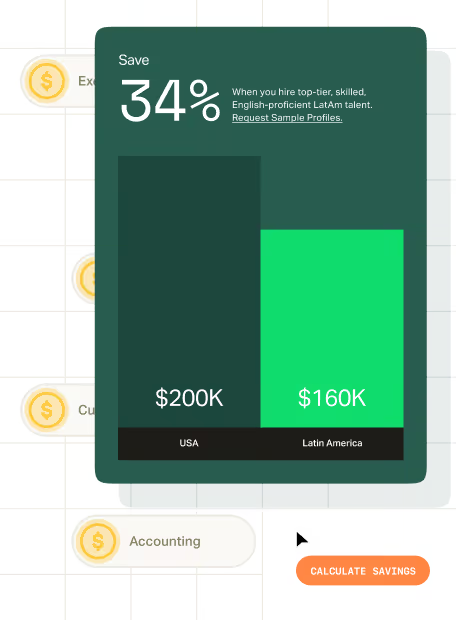
Chile’s cost of living is lower than in the US, so salaries in the country typically run below US levels for the same seniority. That means companies hiring there get more engineering capacity for the same spend. For most companies, Chile fits a specific need: senior engineering capacity, in their time zone, without US base salaries.
The reason salaries are lower in Chile is cost of living, not lower quality, as you can see in the table below:
Source: Numbeo.com
A quick honesty note on scale: Chile is a smaller-volume market for Latin American hiring than Colombia, Argentina, and Brazil, which together account for most nearshore placements.
Communication and cultural fit
Technical skill gets a candidate to the interview. What determines whether the hire truly works out day to day is communication: whether someone flags a blocker without being asked, pushes back when a decision doesn’t make sense, and explains their work clearly to people who aren’t developers. This is where Latin American talent, including Chile’s, tends to stand apart from other offshore regions.
In the video below, Hayden Cohen, Hire With Near’s co-founder and CEO, explains how to spot cultural fit in a job interview:
What Chile offers is depth and stability, and it sits inside a much larger picture of hiring developers across Latin America that gives you room to scale across countries later. If you’re still weighing the model itself, this free guide to hiring remotely in Latin America is a good place to start.
What Technical Skills Do Chilean Developers Have?
Chilean developers work across the same modern stacks US teams hire for, with particular depth in web, backend, and cloud engineering. Most of the talent pool skews toward experienced professionals who have shipped production systems for real companies, though entry-level developers are available too if that’s what a role calls for.
Expect strong coverage across these areas:
- JavaScript and TypeScript, including React and Node.js for full-stack work
- Python, Java, and .NET for backend and enterprise systems
- Front-end and back-end specializations, plus full-stack generalists
- Cloud and DevOps: AWS, containers, CI/CD, and infrastructure as code
- Growing data and machine-learning capability as the local market matures
Chile also has notable depth in the fintech industry and in mining and industrial technology, two sectors where local engineers have built and maintained large, high-reliability systems.
From the editorial work I do interviewing our recruiters, one point comes up repeatedly: a title like “full-stack engineer” tells you almost nothing on its own. The real signal is what someone built and owned, not the keywords on the resume.
In fact, Federico Bilello, Software Engineering Recruiter at Hire With Near, explains that claiming too many skills can itself be a red flag:
A big red flag is when a candidate claims proficiency with an enormous variety of tools, to the point where it just doesn’t make sense. There’s no way someone has six years of experience with six different languages. I look for equilibrium: someone proficient with specific tools but with a background using different frameworks, so I know they’re resourceful, not just a jack of all trades. — Federico Bilello, Software Engineering Recruiter, Hire With Near
What Developer Roles Can I Hire in Chile?
The roles US companies hire most from Chile map directly to the country’s strengths in web, backend, and cloud engineering. Whether you’re building your first product or scaling an existing team, here’s where most companies start and what each role covers.
- Software engineer: Builds and maintains the core product across the full development lifecycle, from architecture decisions to shipping features. It’s typically the first hire for teams building out their engineering function in Chile.
- Full-stack developer: Works across both front end and back end, which suits lean teams that need range without splitting the hire into two roles.
- Back-end developer: Owns the servers, databases, and APIs your product runs on. Chile’s depth in fintech and high-reliability systems makes it a strong market for senior back-end talent specifically.
- Front-end developer: Builds the interfaces users interact with.
- DevOps engineer: Keeps deployments reliable and infrastructure costs in check, with solid coverage of AWS, GCP, and Azure alongside containerization and CI/CD tooling.
- Data engineer: Builds and maintains the data pipelines your product or analytics depend on.
- Remote developer: A generalist option if you’re not yet sure which specific role fits, or if you want to start with one flexible hire before defining more specialized positions.
Companies hiring for IT and tech talent tend to build a mix of these over time rather than a single role.
Developer salaries in Chile fall within Latin America’s broader ranges, which Hire With Near benchmarks across the region. Here’s how those figures compare to equivalent US hires:
For the most up-to-date figures, see Hire With Near’s US vs Latin America Salary Guide.
According to Hire With Near’s 2026 State of LatAm Hiring Report, companies save an average of $35,000 to $64,000 per hire each year.
If your team needs engineering leadership rather than an individual contributor, Hire With Near also runs executive search for roles like engineering managers and directors of engineering.
Where Is the Developer Talent in Chile?
Most of Chile’s software talent is concentrated in Santiago, with Valparaíso as a secondary hub. Santiago is the center of gravity for the country’s tech scene, sometimes called “Chilecon Valley,” and it’s home to the Start-Up Chile ecosystem that has drawn founders and engineers from across the region for over a decade.
That concentration works in your favor. A dense local market means a deeper pool of engineers who have worked at funded startups and established tech companies, and who are used to remote collaboration with teams abroad.

Santiago
Santiago concentrates the highest density of tech firms, universities, and corporate headquarters in the country, which shortens decision cycles and makes collaboration easier. That density is why most international companies establish their first Chilean engineering teams here.
The city’s engineering pipeline runs through strong universities like Universidad de Chile, Pontificia Universidad Católica de Chile, and Universidad de Santiago (USACH), which together produce tens of thousands of graduates a year and maintain close ties with tech companies through research centers, internship programs, and industry partnerships.
Government investment in the ecosystem, especially through Start-Up Chile, has shaped how local developers work: engineers here are used to agile methods, international product teams, and English-language collaboration, since so many of them have worked directly with founders and companies from outside Chile.

Valparaíso
Valparaíso, a coastal city about two hours from Santiago, is Chile’s secondary tech hub, anchored by strong academic institutions rather than sheer company density. Universidad Técnica Federico Santa María and Pontificia Universidad Católica de Valparaíso are both well-regarded for engineering and computer science, and they feed a talent pipeline focused on software development, data analytics, and applied technology.
The city’s tech scene is smaller than Santiago’s, but it has its own character, shaped by a mix of academic research, a growing startup and incubator presence, and a more affordable cost of living than the capital. That combination makes Valparaíso a solid secondary option for companies that want strong technical fundamentals without competing directly for Santiago’s most in-demand talent.
Related reading: Why Chile Is a Top Destination for Software Development Outsourcing
How Can a US Company Hire Software Developers in Chile?
US companies have four ways to hire software developers in Chile: freelance marketplaces, hiring directly, a nearshore staff augmentation company, or a staffing and recruiting firm. The right choice comes down to one question: do you need short-term help on a project, or a long-term, full-time developer on your team?
Here they are, from most complex to simplest:
Freelance platforms and marketplaces
Freelance platforms like Upwork, Toptal, and Arc give you fast access to contractors for short, project-based work. The trade-off is that these are people juggling several clients at once, not embedded engineers who learn your codebase and stay.
For a defined one-off task, they can work, but for anything ongoing you will feel the churn.
Hire directly
Hiring directly means you source and vet candidates yourself and take on the employment relationship. For a cross-border hire in Chile, that requires one of two mechanisms:
- Set up a legal entity: Registering a Chilean subsidiary gives you full control, but it takes months to set up and carries real legal and accounting overhead. Chile also requires that at least 85% of a company’s local workforce be Chilean nationals unless you employ fewer than 25 people, which is worth factoring in if you’re planning a larger local team. This route only makes sense once you’re building a substantial in-country presence, not hiring one or two developers.
- Use an employer of record: An employer of record is a company that becomes the legal employer on paper, handling contracts, payroll, and compliance without you needing your own entity. In Chile specifically, that means managing mandatory severance obligations, which accrue at one month’s salary per year of service, along with pension fund contributions and statutory paid vacation. The catch: an EOR handles employment logistics, not recruiting. You still source and vet every developer yourself, through job boards for hiring in Latin America or your own network.
Related reading: 10 Best Employer of Record (EOR) Companies
Nearshore staff augmentation
A nearshore staff augmentation company places a vetted engineer onto your team to work under your direction while the firm stays the legal employer and handles payroll, benefits, and compliance.
The engineer works as if they’re part of your team day to day, taking direction from your managers and joining your standups, but their employment sits with the augmentation firm rather than with you.
That structure makes it a strong fit for flexible or project-based capacity: a sprint push, a defined build, or extra hands while you’re between full-time hires. Most staff augmentation firms are built for exactly that model, with engineers rotating between clients every few months, which makes it a weaker fit when you want someone to stay long-term and grow with your product.
If you want to understand the model in depth, it helps to read about IT staff augmentation and how staff augmentation compares to outsourcing for software teams.
Staffing and recruiting firm
A staffing and recruiting partner is the simplest option for most companies hiring a long-term developer, because it does both jobs at once: it finds and vets the talent and handles employment, payroll, benefits, and compliance in a single relationship.
You describe the role, the partner presents pre-vetted candidates, and once you hire, the professional joins your team as a permanent member.
This is where most companies hiring full-time remote talent end up, and you can compare providers among the best LatAm staffing firms and the companies that hire developers in Latin America.
Hire With Near does both. We offer nearshore staff augmentation for flexible capacity and nearshore staffing and recruiting services for permanent hires, with a first shortlist of vetted developers within three to five days.
{{prevetted-banner}}
What US Companies Need to Know Before Hiring in Chile
Before you hire in Chile, three things matter most: time-zone overlap, intellectual property protection, and who handles local compliance. The good news is that Chile scores well on all three, and a staffing partner absorbs most of the operational detail.
Time zones
One of Chile’s biggest hiring advantages is its natural alignment with North American work schedules. Because Santiago operates on a seasonal UTC-4/UTC-3 cycle, Chilean tech talent stays within 0 to 2 hours of the US East Coast year-round.
For US managers, this minimal gap eliminates delayed feedback loops, ensuring your remote engineers are online during your core business hours for live standups, synchronous pairing, and real-time code reviews.
Compare that to a far-offshore team working while your office is closed, where a question sent in the afternoon waits until tomorrow, and the difference is a day of momentum on every loop.
“Will they join our standups?” is one of the most common questions our recruiters hear. You already know the answer to that one, but there are plenty more in our roundup of the questions tech leaders ask about hiring developers in Latin America.
Intellectual property
Chile is a comparatively safe place to hold sensitive work. As an OECD member with strong rule of law, it offers solid IP protection, and in practice, placements sign NDAs and IP-assignment agreements so your source code and credentials are contractually protected from day one. A staffing partner structures those agreements as part of the engagement.
Local compliance
Compliance is real but not your problem to solve alone. Chile has statutory benefits and severance rules that a local expert needs to manage. When you hire through a staffing and recruiting partner or an employer of record, they handle payroll, local benefits, and compliance, and the developer works as part of your team under your direction.
How Hire With Near Helps You Hire Developers in Chile
Hire With Near sources and vets developers so the person who reaches you is already close to a yes. Here’s how the process works, start to finish.
We start with an intake call to understand the role, the stack, and what an A-player looks like on your team. From there, our recruiters source and screen candidates, running first-round interviews that check for technical depth, seniority, and English communication before anyone reaches you.
If you want a technical assessment or case study assignment on top of that, we can help administer it and advise on what it should look like.
You get a first shortlist within three to five days, and most clients make a hire in under three weeks. Once you hire, payroll and compliance are handled in the background, so the developer simply joins your team.
The work that usually buries hiring managers, sorting through dozens of unvetted resumes, happens before anything reaches you. In dozens of conversations with Hire With Near’s recruiting team this year, the same theme comes up: the gap between a resume and a real engineer is where most hires go wrong, and closing it early is the whole job.
That screening is deliberately more than a coding test. Natasha Tarapow, Recruitment Consultant at Hire With Near, describes what she looks for:
We always ask candidates to tell us about a project they’ve worked on, not just that they use this language and that one, but what their role was and what they actually did. It’s important that they can explain their work to someone who isn’t a developer. If they can do that, that tells me a lot. — Natasha Tarapow, Recruitment Consultant, Hire With Near
That matters because the failure mode companies describe is consistent. As one talent acquisition leader at a mid-market SaaS company told us:
Right now, [our current vendor] is sending us candidates, and their resumes do look good, but when they do make it to our technical assessment and our interview rounds, our hiring team is finding that they’re maybe not as senior as we’re hoping for.
Real technical vetting is what closes that seniority gap.
Bonfire, a Richmond-based e-commerce and fundraising platform, is a good example of how Hire With Near works. Their design leader had been spending two to three months per hire, sourcing engineering talent by hand across LinkedIn and job boards.
When Hire With Near took over sourcing and screening, the hire closed in six weeks instead of months, saving about $53,000 a year compared to an equivalent US hire, and the hire stayed on the team for over two years.
Thomas Elliott, their VP of Product Management, put it simply:
It was shocking to see the difference between the talent Hire With Near brought versus other firms I worked with. Our hires are extraordinary and a great cultural fit. — Thomas Elliott, VP of Product Management, Bonfire
Final Thoughts
Chile gives US companies a rare combination: highly-qualified engineering talent, a near-full overlap with your workday, and strong economic and IP stability, at 30–70% less than comparable US salaries. It’s a quality-and-stability choice inside the broader Latin American market, and it rewards teams that hire for the long term rather than the quick contract.
When you’re ready, Hire With Near can hire software engineers in Latin America at every level, sourcing, vetting, and managing the hire through our nearshore staffing and recruiting services.
If you want to explore hiring developers in Chile, the best next step is to book a free consultation to talk through your specific requirements with our team. We’ll share salary benchmarks and walk you through the process, so you have what you need to decide if it is right for you.
If you’re weighing Chile against other markets in Latin America, our guides to hiring developers in Brazil, hiring developers in Colombia, hiring developers in Mexico, hiring developers in Argentina, and hiring developers in Paraguay cover the same ground for each country: costs, skills, and how to hire.
{{latam-hiring-cta-v2}}
Frequently Asked Questions
How much does a software developer make in Chile?
Software developers hired through a nearshore partner in Latin America typically earn between $30,000 and $108,000 a year depending on role and seniority, below the $66,000 to $238,000 range for comparable US hires.
These are standard regional benchmarks from Hire With Near’s salary data rather than Chile-specific figures, and the exact number depends on stack, seniority, and how specialized the role is.
The savings come from a lower cost of living, not from underpaying engineers.
How long does it take to hire a developer in Chile?
Most companies hiring through Hire With Near get a first shortlist of vetted candidates in about five days and make a hire in under three weeks.
The reason it moves that fast is that sourcing, screening, and technical assessment happen before candidates reach you, so you go straight to final interviews instead of wading through unvetted applications.
A do-it-yourself search across job boards more commonly takes two to three months.
How good is their English, and can they communicate technically with my team?
Chile has solid regional English, though it sits mid-pack in Latin America in absolute terms, so blanket national fluency isn’t a safe assumption.
That is exactly why vetting for English matters: placed developers are screened specifically for spoken and written English, so the engineer on your team can hold their own in stand-ups, explain why a pull request broke something, and survive an architecture review.
The honest version is that English varies across the country, and a good partner filters for it rather than leaving it to chance.
Does Chile have strong intellectual property protections?
Yes, Chile offers strong intellectual property protection, backed by OECD membership and a strong rule of law. In practice, developers placed through a staffing partner sign NDAs and IP-assignment agreements, so your source code, repositories, and credentials are contractually protected from the start.
A partner structures those agreements as part of the engagement, which removes the guesswork of drafting cross-border contracts on your own.
Is it better to hire freelance or full-time developers in Chile?
For ongoing work, a full-time developer almost always beats a freelancer. Freelancers fit short, defined projects, but they split their attention across multiple clients and rarely stay long enough to learn your codebase deeply.
A full-time developer, whether through staff augmentation or direct-hire recruiting, becomes an embedded member of your team who builds context over time. If the work is core to your product, hire full-time.
Related reading: The Best Alternative to Freelancing Platforms for Hiring Full-Time Talent in Latin America
What other developer roles can I hire from Latin America?
Beyond general software developers, US companies hire a wide range of engineering roles in Latin America, including nearshore Angular developers, remote mobile developers, Shopify developers, and nearshore Flutter developers.
Talent in these roles typically brings the same technical depth as US-based professionals, with far better time-zone overlap than offshore alternatives and meaningful cost savings. Most companies build a mix of these roles as their teams grow.
What’s the best way to hire software developers in Chile?
The best way to hire software developers in Chile for a long-term role is to work with a nearshore staffing and recruiting partner that sources, vets, and employs the developer for you.
It removes the two hardest parts of a cross-border hire at once: finding a genuinely senior engineer and handling local payroll and compliance.
You describe the role, review pre-vetted candidates, and once you hire, the developer joins your team while the partner manages the employment logistics.









%203.svg)
.avif)





%20(1).avif)

%20(1).png)