

%203.svg)
Key Takeaways
- US companies hire in Chile for professional talent in one of Latin America’s most institutionally settled markets: an OECD member since 2010, with the region’s highest Human Development Index, a working day that overlaps the US business day, and English in Santiago far above the national average.
- Hiring in Chile means choosing one of three legal engagement methods: register your own entity, use an employer of record, or work with a specialist staffing and recruiting partner that both finds the person and employs them.
- Chile’s employer costs move: there’s a legally mandatory profit-sharing bonus instead of a 13th-month salary, and the employer pension contribution rises every August through 2033.
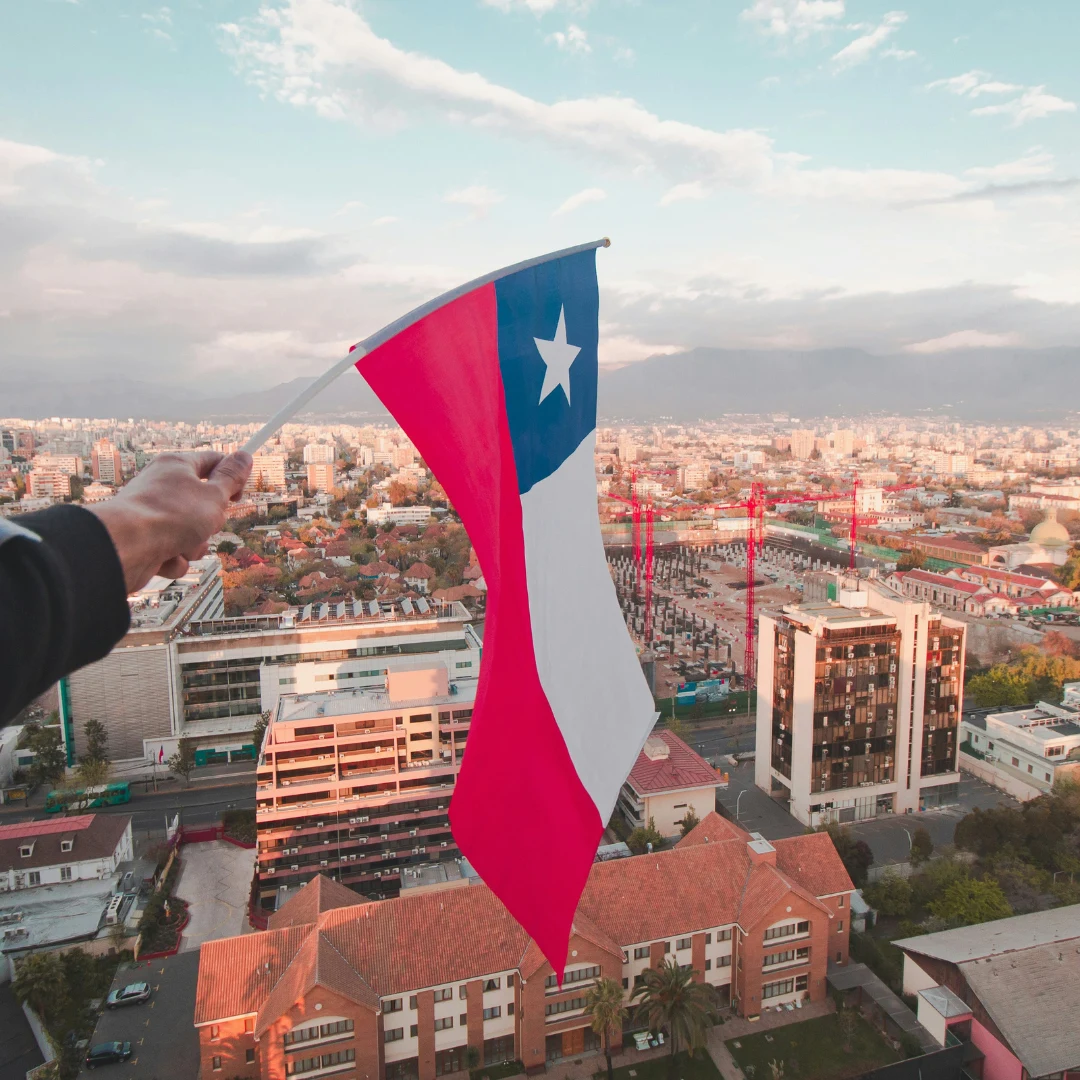
Chile doesn’t get talked about as much as Colombia or Argentina in conversations about nearshore hiring, but ask a company that’s actually done it, and a different picture emerges: one of the most stable, well-regulated economies in Latin America, with a professional workforce trained to operate inside exactly the kind of structured, compliance-heavy environments US companies recognize.
Chile was the first South American country admitted to the OECD, joining in 2010, a full decade before Colombia became the region’s second member. Its institutions are consistently ranked among the most transparent in the region and its universities have produced generations of professionals in finance, mining, and technology who are used to working alongside multinational operations.
This guide covers what you need to know before you hire in Chile: how to structure the engagement, what the talent looks like, which roles Chile is strongest in, what you’ll pay, and the parts of Chilean employment law that tend to catch US employers off guard.
Why Are US Companies Hiring in Chile?
US companies hire in Chile for four reasons: institutional stability, real-time overlap with the US workday, strong English proficiency in Santiago, and access to precise, technically deep talent. Cost savings is also a factor when comparing the country with the US, even though salaries run higher than in most neighboring countries.
Institutional stability
Chile has been an OECD member since May 7, 2010, one of only four in Latin America alongside Mexico, Colombia, and Costa Rica. It also holds the region’s highest Human Development Index, at 0.878 and 45th in the world, according to the UNDP’s 2025 Human Development Report.
OECD membership means Chile has been independently vetted on governance, labor standards, and economic policy by an international body, not just described that way in a company’s own marketing.
For a US company making its first hire outside the country, that’s a meaningfully lower level of uncertainty to manage.
The cost still works, even at a premium
Hiring in Chile costs more than some of its regional neighbors. But for roles where precision, regulatory fluency, or technical depth matter more than rock-bottom savings, that premium tends to pay for itself, especially when comparing to salaries paid in the US.
When Hire With Near analyzed more than 2,000 conversations with US companies exploring Latin American hiring, budget was the primary driver for 41% of them, ahead of switching from an offshore arrangement at 30% and US talent scarcity at just 7%. Our research on why US companies are hiring in Latin America shows this is rarely about trimming a payroll line: for most of these roles, the alternative wasn’t a US hire; it was no hire at all.
A working day that overlaps yours
The other driver is simple: a working day that overlaps yours, whatever US time zone you run on. Santiago sits within a workable range of the US Eastern band, which means live standups and same-day answers.
You can see how Chile aligns with the main US time zones in the table below:
That’s a completely different arrangement from offshoring hiring in distant locations in Eastern Europe or Southeast Asia, like India and the Philippines. One growth-stage company in the clean energy sector, which had been running its finance team through a firm in India, put it this way:
We learned very quickly that nearshoring is a much better option for us at this size. Moving to LatAm and staying within the same reasonable time zone just makes so much more sense for us.
Strong English proficiency in Santiago
The capital Santiago carries some of the strongest English proficiency in Spanish-speaking Latin America, which matters directly for client-facing and technical roles where miscommunication is costly.
Chile ranks 9th in Latin America and 54th globally on the 2025 EF English Proficiency Index, placing the country as a whole in the Moderate band. Read the city-level data instead of the national figure, and the picture changes: Santiago, Viña del Mar, and Valparaíso all score well above the national average, landing solidly in the High proficiency band.
Since the overwhelming majority of professional hiring happens in and around these three cities, the national figure understates the English proficiency of the candidates you’ll actually interview.
That proficiency, combined with the time zone overlap above, is why so many US companies end up comfortable putting Chilean hires directly in front of customers and stakeholders, not just behind the scenes.
Hire With Near’s COO, Franco Pereyra, unpacks what makes Latin American professionals stand out to US companies in the video below:
How Can a US Company Hire Employees in Chile?
US companies have three options for hiring employees in Chile: register a legal entity, use an employer of record, or work with a specialist staffing and recruiting company. For most organizations, the third is the fastest route to a good hire.
Here they are in order from most complex to simplest.
Option 1: Register a legal entity in Chile
Registering an entity means setting up a Chilean company so you can employ people directly under your own name, with a local tax presence and compliant payroll and benefits systems. It’s the right answer if you’re building a genuine in-country presence: dozens of employees, a local management layer, a long horizon.
This path has many disadvantages: the costs are substantial, setup commonly runs three to six months, and you’ll need ongoing local legal and accounting support as rules change. For a company hiring two or five people, it’s a lot of machinery for little benefit.

Option 2: Use an employer of record
An employer of record is a third-party company that becomes the legal employer of your hire on paper while you manage the work day to day, handling employment contracts, payroll, tax withholding, benefits administration, and compliance with Chilean labor law.
Well-known EOR companies include Deel, Globalization Partners, Remote, and Oyster, and how these arrangements are structured is covered in this guide to hiring remote foreign employees.
An employer of record will absorb the administration (but not the cost) of two Chilean specifics for formal local employment arrangements that are worth naming. Both cost real money, but neither shows up in a salary figure:
- Gratificación, a legally mandatory share of company profits that works out as an annual bonus.
- Employer pension contribution, which a 2025 reform is phasing in over nine years, so the rate you budget this year isn’t the rate you’ll pay in three.
It’s important to note that an employer of record handles employment logistics, not recruiting. You’ll still need to find, screen, and interview every candidate yourself, whether through LinkedIn, referrals, or a job board for hiring in Latin America.
If your bottleneck is sourcing rather than payroll, this route leaves the hard part with you.
Option 3: Work with a specialist staffing and recruiting company
This is the simplest route for most US companies, because one relationship covers both jobs. Working with one of the specialist staffing firms for LatAm hiring, like Hire With Near, you describe the role, we present pre-vetted candidates, and once you hire, the employment obligations are ours to run.
That distinction is the one buyers most often ask us to explain: some providers only find people, which leaves payroll, benefits, and local compliance with you, and some do both. Payroll, benefits administration, and compliance are standard in our nearshore staffing and recruiting services, not an upgrade you buy later.
If you’ve used platforms like Upwork or Toptal for work you now want a permanent person on, specialist staffing gives you fundamentally different results for full-time remote hires.
Whichever route fits, the mechanics of a first cross-border hire barely change across the region, and our free guide to hiring remotely in Latin America walks through them.
What Can US Companies Expect from Chilean Professionals?
Chilean professionals are concentrated in Santiago, with Valparaíso and Viña del Mar as secondary markets, working your business hours, with English in the capital running far ahead of Chile’s national average. Chile is a smaller market than Colombia or Brazil, and it behaves like a quality market rather than a volume one.
Seniority comes up on nearly every call, usually as a worry that nearshore hiring means junior people. Across the 2,000-plus placements in Hire With Near’s 2026 State of LatAm Hiring Report, 84% were mid-level or senior.
Franco Pereyra, COO at Hire With Near, describes what clients notice first when hiring Latin American professionals:
What sets Latin American talent apart from other regions is that you’ll find people who are proactive and creative. People who come up with ideas and new solutions. If you’re looking for folks who can bring something to the table, who will push back if they think your idea doesn’t make sense, that’s what you find in Latin America.
Data and analytics: Chile’s clearest strength
Chile is one of five countries Hire With Near’s recruiters go to first when sourcing a remote data analyst and it’s named among the region’s growing artificial intelligence and data communities. Recruiters screen for degrees in mathematics, physics, or computer science, which they treat as the strongest signal for analyst work.
The detail that comes up most often from the recruiting team: analysts with seven or more years in the discipline are rare anywhere in the region, because most have branched into data science or engineering by then. That’s often the same path behind a strong data engineer hire in Latin America, or broader data and AI roles.
Related reading: How to Hire Data and AI Talent in Latin America in 2026
A strong general professional market beyond analytics
Beyond analytics, Chile’s talent pool covers the roles most US companies build nearshore teams around. Finance and accounting professionals here are trained on rigorous reporting standards, similar to what you’d find in Argentina or Colombia, and many have direct experience with international companies given Chile’s role as a regional hub for mining, banking, and multinational operations.
Operations and executive support candidates tend to come from the same structured, process-driven environments, which shows up in how they handle documentation and follow-through.
Customer support professionals and marketing talent in Chile skew smaller in volume than markets like Colombia or Brazil, but the quality bar is consistent with everything else described above: strong English, mid-to-senior experience, and direct exposure to US or multinational clients.
If your priority is a general professional hire rather than a specialized technical one, Chile gives you the same caliber of candidate you’d find elsewhere in the region, just from a smaller, more concentrated pool.
Software development: a different cost profile
Software development is the one area where Chile behaves differently from the rest of the roles covered here. Salaries for developers run higher, closer to what you’d expect in Argentina than in lower-cost markets like Colombia, so the broader cost advantage described elsewhere in this guide doesn’t apply the same way to engineering roles.
If you’re interested in hiring software developers in Chile, we’ve covered that specifically in our guide to nearshore software development in Chile.

Top universities to recognize on a resume
A handful of universities show up consistently on strong Chilean resumes:
- Universidad de Chile: The country’s top-ranked university and the strongest general signal across finance, engineering, and analytical roles.
- Pontificia Universidad Católica de Chile: Consistently ranked alongside Universidad de Chile, with particular strength in business and engineering.
- Universidad de Santiago: A major public institution known for strong technical and analytical graduates.
- Universidad Adolfo Ibáñez (UAI): Chile’s oldest and top-ranked business school, with campuses in Santiago and Viña del Mar. A strong signal for finance, business administration, and management candidates specifically.
- Universidad Técnica Federico Santa María: One of Chile’s premier engineering schools, consistently producing strong technical and analytical graduates alongside Universidad de Chile.
What Are the Salary Ranges for Chile Hires?
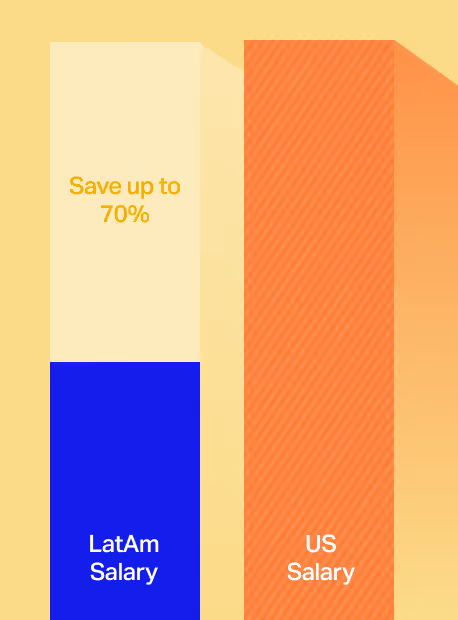
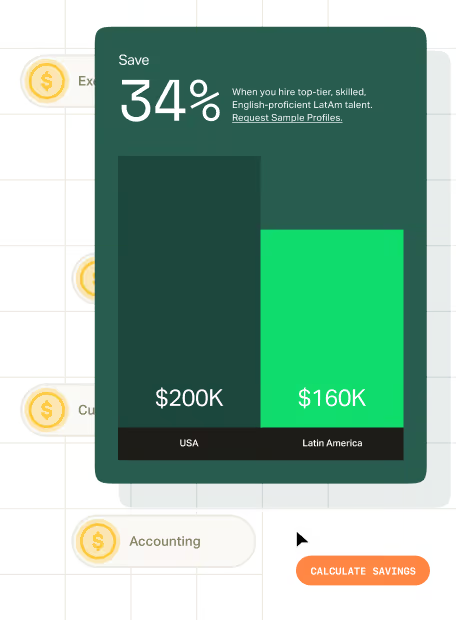
Hiring a professional in Chile typically costs 30–70% less than hiring for the same role in the US, according to our own salary data.
The figures below are Hire With Near’s regional Latin America benchmarks rather than Chile-specific numbers. Since Chile is among the wealthier economies in the region, expect salaries here to land toward the higher end of these ranges rather than the lower end.
Here’s what hiring the roles US companies most often fill in Chile costs against equivalent US hires, according to Hire With Near’s salary benchmarks:
For the most up-to-date figures, see Hire With Near’s US vs Latin America Salary Guide.
Paying at the upper end of the Chilean market still lands well below the US figure. The average annual savings per hire run between $35,000 and $64,000 in the region. That gap reflects the cost of living in each market, not a difference in skill or output.
Here’s how Santiago, Viña del Mar, and Valparaíso compare to Atlanta, Georgia, a benchmark US city with a comparable role mix, on everyday costs:
Source: Numbeo.com
What Do US Companies Need to Know Before Hiring Employees in Chile?
Chilean professionals are used to certain statutory benefits under local labor law, like a mandatory profit-sharing bonus in place of a 13th-month salary, and a pension contribution rate that rises annually under a 2025 reform. Whether these apply to your hire depends on how you structure the engagement.
Either way, they’re worth understanding: Chilean professionals know exactly what the local market provides, and they factor it into their compensation expectations. Planning for both upfront makes for a smoother offer conversation.
Paid leave in Chile
Employees with more than a year of service get 15 working days of paid annual leave. Working days, not calendar days, so it lands closer to three weeks than two, in line with Colombia and well short of Peru’s 30.
Maternity leave runs 18 weeks, six before birth and 12 after, followed by a statutory parental postnatal permit of a further 12 weeks, so plan around roughly 30 weeks of protected paid leave rather than 18. Paternity leave is five paid days.
{{salary-guide-cta}}
Public holidays in Chile
Chile grants 16 nationwide statutory public holidays per year. While most civic and historical observances stay on exact calendar dates, religious holidays and long-weekend adjustments move on the calendar from year to year.
These are the fixed calendar holidays, observed on the same date every year:
- January 1: New Year’s Day
- May 1: Labor Day
- May 21: Navy Day (Día de las Glorias Navales)
- July 16: Our Lady of Mount Carmel
- August 15: Assumption of Mary
- September 18: Independence Day (Fiestas Patrias)
- September 19: Army Day (Día de las Glorias del Ejército)
- November 1: All Saints’ Day
- December 8: Immaculate Conception
- December 25: Christmas Day
These are the holidays that shift on the calendar depending on liturgical calendars or statutory long-weekend rules:
- Easter Weekend (Good Friday & Holy Saturday): Follows the ecclesiastical calendar, falling between late March and mid-April.
- National Day of Indigenous Peoples: Observed annually around the June winter solstice (typically the Monday closest to June 21 or June 24).
- Saint Peter and Saint Paul & Meeting of Two Worlds (October 12): Under Chilean law (Ley 19.668), if either of these falls mid-week (Tuesday–Friday), the official day off is moved to the preceding Monday.
- Day of the Evangelical Churches: Observed near October 31, but shifts to the nearest Friday if October 31 falls mid-week to avoid sandwiching with All Saints’ Day.
Five of Chile’s 16 holidays are legally classified as “irrenunciable” (January 1, May 1, September 18, September 19, and December 25).
- What this means: Under Chilean labor law, these five days mandate the complete physical closure of commercial and retail establishments.
- Impact on remote/tech hires: For white-collar, corporate, and software engineering roles, all 16 public holidays operate as standard statutory paid days off. The strict commercial closure rules primarily impact physical storefronts, though your local employees will naturally expect to be offline.
The mandatory bonus, and it isn’t a 13th month
Chile has no statutory 13th-month salary. What it has instead is the gratificación, a mandatory profit-share written into the Labor Code. Any employer that operates for profit, keeps accounting records, and turns a net profit in the fiscal year owes it.
There are two ways to satisfy it. Under Article 47, you distribute at least 30% of net profits among employees in proportion to what each earned that year, with no ceiling. Under Article 50, you pay each employee 25% of their annual earnings, capped at 4.75 monthly minimum wages, which exempts you from the profit-proportional calculation. Most employers take the capped route because it’s predictable.
Contributions and severance
Most of Chile’s payroll contributions sit on the employee’s side of the payslip. Model these components rather than looking for a single “employer cost is X% of salary” multiplier, which the pension ramp makes wrong within twelve months.
- Pension: The employee contributes 10% of taxable salary to their individual account. The new employer contribution stands at 3.5% of taxable pay from the August 2026 payroll, with the disability and survivorship insurance now absorbed inside that figure rather than charged separately. It rises each August and reaches 8.5% at full phase-in in August 2033, so read this year as a step up from roughly 2.5% to 3.5%.
- Health: 7% of salary, employee-side, with a choice between the public system, Fonasa, and a private insurer, an Isapre.
- Unemployment insurance: The employer contributes 2.4% on indefinite contracts and 3% on fixed-term contracts.
- Severance: On dismissal for business need, one month’s salary per year of service, capped at 11 years, though that cap is currently under legislative review.

What can go wrong?
The most common budgeting miss our recruiting team flags on a first Chile hire is the gratificación being treated as a nice-to-have. The second is modelling cost off one year’s pension rate when it rises every August for the next seven.
The third isn’t about money: companies read Chile’s national English score, decide the market is a stretch for client-facing work, and skip it, when Santiago is a different pool entirely.
Our recruiters set expectations on both sides before an offer goes out: on pay, on hours, and on how much live English the role needs, which is a large part of why offers get accepted and placements stay. Nine lessons from hiring in Latin America has the rest.
If you have other concerns, visit our article covering the common questions US companies have about hiring remote talent offshore.
How Does Hire With Near Help US Companies Hire in Chile?
Hire With Near helps US companies hire in Chile and across Latin America more broadly. Our recruiters know the market from working it: which cities to source which roles from, and what candidates at each level expect to earn.
What makes the process different is how much time your dedicated recruiter spends on the role before anyone is shortlisted, digging into the work, the team, and what a strong first six months looks like. That groundwork separates a shortlist you want to interview from a stack of resumes.
How is the hiring process with Hire With Near?
We start the hiring process with a kickoff call, where we get a sense of the role you need and the type of professional you’re looking for. Within three to five days, your recruiter sends a shortlist of pre-vetted candidates with video introductions, so you can hear how each person communicates before you interview the candidate yourself.
English is assessed on every placement. If your search calls for a technical assessment or case study, we can help design and administer it, though most clients run their own once they have a shortlist. From kickoff to accepted offer usually takes about three weeks.
Once someone is hired, we handle payroll, benefits administration, and compliance if you work with us under the staffing model. If you prefer to manage employment yourself, we can also work as a recruiting partner: you source through your own entity or EOR, and we focus on finding and vetting the person.
Either way, our placements stay 66% longer than the typical US hire.
How an agency hired 15 people and saved $781,000 a year
The pattern holds across departments. Conversion Logix, an Inc. 5000 digital advertising agency in Austin, promoted internal staff into senior roles and was suddenly short across five functions at once, with US hiring priced out of reach.
Working with us, they cut their sourcing and interviewing time in half, filling roles in an average of 22 days. All told, they built a 15-person team across marketing, engineering, finance, customer support, and administration. The total savings: $781,000 per year.
Their Client Services Manager put it this way:
I think the main benefit of LatAm talent is the ease of integration. It’s been so easy to work together without really noticing any kind of difference from somebody that’s in the States. — Tawnya Morse, Client Services Manager, Conversion Logix
For director-level and leadership positions, Hire With Near also handles executive search in Latin America across all departments.
If you’re ready to explore hiring in Chile, book a free consultation to talk through your requirements with our team. We’ll walk you through salary benchmarks for the roles you’re considering and show you what a search in Chile looks like in practice.
If you’re also interested in learning about other markets in Latin America, check our How to Hire in Brazil and How to Hire in Argentina guides.
{{latam-hiring-cta-v2}}
Frequently Asked Questions
Can a US company hire employees in Chile without setting up a legal entity?
Yes, you can hire employees in Chile with no Chilean entity of your own, either through an employer of record, which becomes the legal employer on paper while you manage the work, or through a staffing and recruiting partner that finds the person and employs them.
Is Chile in a compatible time zone with the US?
Yes. A Chile-based hire works during your business day, whether your team runs on Pacific, Mountain, Central, or Eastern time, giving you live meetings and same-day answers rather than overnight handoffs.
Sitting on the eastern edge of Latin America’s span, Chile is just zero to two hours ahead of the US East Coast depending on the season. Because it observes daylight saving opposite to the US, the exact gap shifts smoothly through the year.
Is a 13th-month salary required in Chile?
No, Chile has no statutory 13th-month salary, but it has something US employers find more surprising: a legally mandatory profit-sharing bonus called gratificación. Employers that turn a net profit must either distribute at least 30% of net profits among employees or pay each employee 25% of annual earnings, capped at 4.75 monthly minimum wages, which is the route most take.
What roles do US companies most commonly hire in Chile?
Data and analytics roles are Chile’s strongest suit, but US companies hire across every department here. The most common are data analysts in Chile, data engineers in Latin America, financial analysts for remote teams, and nearshore executive assistants, along with accounting, customer support, and marketing.
What level of English can US companies expect from professionals in Chile?
Expect strong professional English from the Santiago pool, and don’t judge it by the national figure. Chile scores 517 on the 2025 EF English Proficiency Index, 54th globally, but Santiago scores 578, and that’s where almost all of these hires come from.
How long does it take to hire in Chile through Hire With Near?
About three weeks from kickoff call to accepted offer, with a shortlist of pre-vetted candidates and video introductions within three to five days. That holds because sourcing and vetting happen before you’re involved: our recruiters work from a pool of 160,000+ pre-vetted candidates rather than starting a search from zero.




.webp)




%203.svg)
.avif)





%20(1).avif)

%20(1).png)