.webp)


%203.svg)
Key Takeaways
- Chile is one of Latin America’s strongest nearshore locations for software development outsourcing, offering qualified, English-speaking engineers who overlap your working day and cost 30–70% less than comparable US hires.
- The real challenges are manageable ones: confirming a developer’s English holds up in a technical discussion, verifying real seniority behind the resume, and finding niche specialists, all of which come down to how rigorously candidates are vetted.
- Before you sign with a third-party agency, it is worth weighing whether to build your own dedicated Chile or wider Latin America development team instead, since owning the relationship usually means more control and better retention, with engineers who stay and build context over time.
Software development outsourcing to Chile gives US companies a fast way to add highly-qualified, English-speaking engineers in Latin America who can build features, harden infrastructure, and take ownership of QA without a multi-month domestic search.
The best part: Chilean developers work during your business day and earn less than US hires. That means software development outsourcing to Chile gets more engineering capacity for the same budget and the same real-time collaboration you’d expect from a domestic hire.
This guide covers why Chile is a strong place to outsource, the challenges to plan for, where to find partners, and the option most guides skip: building your own dedicated development team instead of handing the work to a third-party shop.
Why Is Chile a Good Place to Outsource Software Development?
Chile is a strong outsourcing destination because it combines a well-trained developer pool, real-time overlap with US working hours, a maturing tech ecosystem, and stable legal protections. Here is what each of those looks like in practice.
A deep, well-trained developer talent pool
Chile’s universities and government tech initiatives have produced a steady supply of developers experienced in web, mobile, and enterprise work across a wide range of programming languages.
Universities like Universidad de Chile, Pontificia Universidad Católica de Chile, and Universidad de Santiago (USACH) anchor that pipeline, backed by government programs like Start-Up Chile that have shaped how local engineers work with international teams.
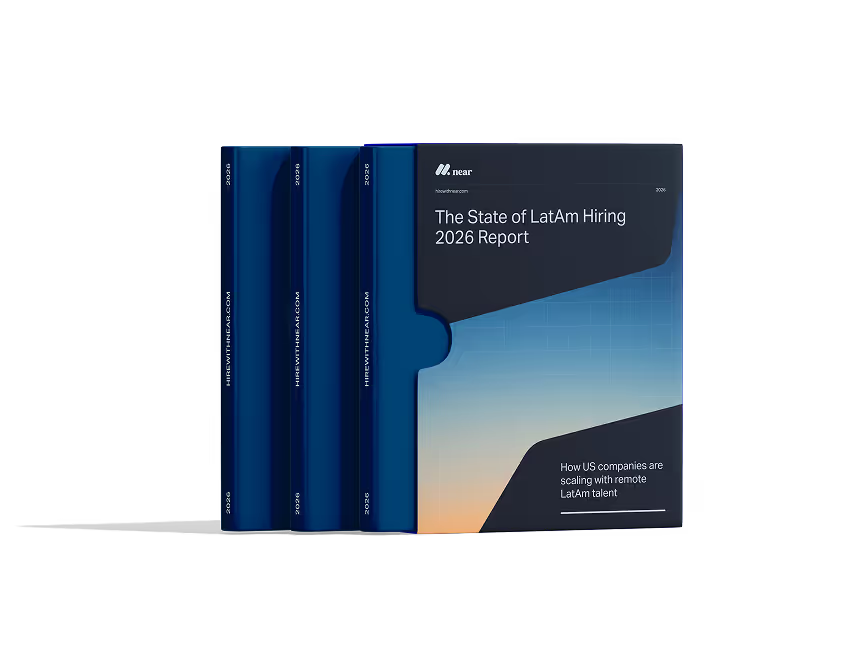
The bigger point for a US company is seniority: when companies come to Latin America, they typically aren’t settling for less experience; they’re accessing more of it. According to Hire With Near’s 2026 State of LatAm Hiring Report, 98% of our engineering placements were mid-level or senior professionals.
That matters because it means the region isn’t a shortcut around training junior talent. It’s a way to reach engineers who can ship from day one, though you can hire at whatever level you actually need: if a junior developer fits the role, that talent is available too.
{{state-latam-hiring}}
Real-time overlap with your team’s workday
Chile offers near-complete workday overlap for US teams, which is the single biggest practical advantage over offshore hiring.
Because Chile observes Southern Hemisphere Daylight Saving Time, its clocks shift opposite to the US, moving forward in September and back in April. That keeps Chile between Eastern Standard Time (UTC-4) and Argentina/Brazil time (UTC-3) year-round, so the overlap with your team shifts by only 1 to 2 hours depending on the season, never disappearing.
Here’s how it works:
The time zone overlap means live standups, same-hour answers to a blocked pull request, and handoffs that happen while everyone is at their desk.
The contrast with offshore is the whole point. When your team works a full day ahead of an engineer in Asia, a question you send in the afternoon sits unanswered until your next morning, while a colleague in Chile clears it before you log off.
A thriving tech ecosystem
Chile has one of the most developed startup scenes in the region, anchored by Start-Up Chile, one of the world’s earliest and best-known public accelerators. Since launching in 2010, the program has supported more than 3,000 startups from over 80 countries, drawing founders and engineers to Santiago and building a talent pool used to working alongside international teams from day one.
The market keeps growing: the U.S. International Trade Administration, citing IDC, projects Chile’s total software market to grow roughly 13% in 2025 to about $2.49 billion, on the back of an IT market worth $9.89 billion in 2024.
That depth is why Chilean developers and teams have delivered for companies across fintech, health tech, and e-commerce, and why SaaS recruiting in Latin America so often points here.
Strong legal protections and stability
Chile pairs political stability and a steady economy with strong intellectual property laws, which matters when you’re handing outside engineers access to your codebase and product.
Clear IP protection keeps ownership of what your team builds unambiguous, and gives you a dependable footing for long-term work rather than a one-off project.
Reliable infrastructure and connectivity
Chile’s internet infrastructure is among the most reliable in the region, so video calls, large data transfers, and day-to-day collaboration hold up without the connectivity friction that can impact other locations.
That reliability isn’t incidental. Chile has consistently ranked among the top Latin American countries for internet speed and connectivity, backed by government investment in digital infrastructure that has made remote collaboration a non-issue rather than a risk factor to plan around.
Cultural compatibility with US teams
Chilean engineers and Latin American developers in general tend to work the way US teams expect, and that fit is a big part of why companies choose the region: proactive communication, regular status updates, and a habit of flagging blockers early rather than going quiet.
Franco Pereyra, COO of Hire With Near, describes what sets the region apart:
What sets Latin American talent apart from other regions is that you’ll find people who are proactive and creative. People who come up with ideas and new solutions. If you’re looking for folks who can bring something to the table, who will push back if they think your idea doesn’t make sense, that’s what you find in Latin America.
— Franco Pereyra, COO, Hire With Near
That combination of working-hours overlap and shared professional norms is what makes day-to-day collaboration with a Chilean team feel much closer to working with someone down the hall than managing a distant vendor.
What Are the Challenges of Software Development Outsourcing in Chile?
Outsourcing to Chile comes with three main challenges: confirming real language and communication skills, verifying that seniority claims hold up, and finding niche technical talent when your stack is less common.
None of them are dealbreakers, but each needs a deliberate check rather than an assumption. Here’s how to handle each one.
Language and communication
Business English is common among Chilean developers, but you should test for articulation, not accent. What matters is whether an engineer can explain why a pull request broke production, hold their own in an architecture review, and write a clear update, none of which depends on sounding like a native speaker.
Screen for real technical communication in the interview: ask a candidate to walk you through a past project and to explain a technical decision to a non-developer. That tells you far more than a resume line claiming fluency.
Verifying real seniority and skill
Resumes lie, and AI-generated CVs have made that worse, so the only reliable signal to confirm whether a developer is truly senior is technical, not resume-deep. Use coding assessments and project walk-throughs to confirm an engineer can really build in production, and treat the ability to explain their work clearly as part of the test.
Two red flags worth watching for: candidates who can’t go deep on work they claim to have led, and candidates juggling several parallel full-time jobs.
Another important note: do not gate on a degree. Many of the strongest Latin American engineers were working professionally before they finished school, taking on real production work at a company rather than staying in school to complete a degree they’d already outgrown the need for.
If you want the questions US tech leaders ask most before they hire, we cover them in questions tech leaders ask when hiring in Latin America.
Talent availability in niche fields
Chile has a strong general developer pool, but very specialized skills can be thinner locally, like Shopify or blockchain experience (even though that is a global scarcity, not just in Chile).
The fix is to widen the search beyond Chile to the broader Latin American talent pool while keeping the same time-zone band, or to work with a partner who already has those specialists in their network rather than starting a niche search from scratch.
How To Effectively Outsource Software Development to Chile
If you decide software development outsourcing to Chile is the right model for you, a few practices separate the partnerships that last from the ones that fall apart. Treat them as the supports that hold the whole thing up.
Map out your vision
Start by defining what success looks like. What problem are you solving, and which milestones are important for your business?
A detailed project scope sets the tone for the partnership and heads off the misalignment that surfaces months in, when it’s expensive to fix.
Write down the specific features, the technical constraints, and what “done” really means before you talk to a single vendor, so every proposal you receive can be measured against the same bar rather than whatever the vendor pitches you.
Choose the right partner
Choosing the right outsourcing partner goes beyond technical skill. They should understand your product, your goals, and how your team works, because the engineers who thrive are the ones who fit how you operate, not just the ones who clear a coding test.
Ask to see how a prospective partner has handled a past project that went sideways, not just their highlight reel. How they talk about a mistake tells you more about how they’ll handle yours than any case study will.
Related reading: 15 Best Software Development Outsourcing Partners
Prioritize legal clarity
Treat your agreement as a safety net. Make sure the contract clearly covers intellectual property rights, timelines, and deliverables. Keep the terms simple but complete, so both sides know where they stand, and confirm who owns the code and any proprietary tooling built during the engagement before work begins, not after a dispute forces the question.
Foster strong communication
Frequent check-ins, shared tools, and open channels keep everyone aligned. Even with Chile’s strong working-hours overlap, regular updates and honest feedback loops are what keep a project on track.
Agree upfront on how blockers get flagged and how fast you expect a response, since a vendor’s default communication style rarely matches your expectations unless you set them explicitly.
Plan for post-launch support
A launch is the start, not the finish. Build in ongoing support for bug fixes, updates, and improvements so the software keeps performing after the initial push.
Clarify this before signing, since post-launch support is often priced and staffed differently than the initial build, and a vendor that disappears after go-live leaves you holding a codebase nobody on your side fully understands yet.
Where to Find Software Development Partners in Chile and Latin America
“Software development outsourcing” can mean three different things, and each one points you toward a different kind of partner. Rather than ranking individual firms here, it helps to know the three categories and where each fits.
- Outsourcing a project to an agency: If you want to hand off a defined build and have someone else manage delivery, the broader Latin American market gives you far more choice than Chile alone. Our roundup of the best Latin America outsourcing companies is a good place to compare providers across the region.
- Adding engineers to your own team: If what you want is developers who become part of your team long-term, look at the best companies to hire developers in Latin America, which focus on placing full-time talent rather than delivering projects.
- Scaling capacity around a project: If you need to flex a team up or down without committing to permanent headcount, the region’s top staff augmentation companies in Latin America are worth a look.
Each of those paths solves a different problem. The next section is about weighing an in-house team against outsourcing, because for many US companies the smartest move is not outsourcing at all.
Should You Build Your Own Development Team in Chile Instead of Outsourcing?
For many US companies, building their own dedicated development team in Chile or the wider Latin America beats outsourcing to a third-party agency on control, retention, and often cost.
When you outsource to a dev shop, the agency owns the relationship: it supervises the engineers, sets their priorities, and can rotate people off your project.
When you build your own team, the engineers are yours. They learn your codebase and product deeply, and they stick around. In dozens of conversations with Hire With Near’s recruiting team this year, that is the pattern that comes up most from US engineering leaders who tried the agency route first, and it’s also what top developers prefer, as Hayden Cohen, Hire With Near’s CEO and Co-founder, explains in the video below:
The data backs it up. Hire With Near’s research on why US companies are hiring in Latin America found that 12% made the move specifically to get off the outsourcing-agency model and build their own dedicated teams.
One enterprise engineering leader at a US manufacturing and technology company described exactly that journey:
We’d had experience with contracted labor before, going to an agency. They provide the talent, but they’re the supervisors; they run everything. It was a bad experience. They didn’t meet our expectations on quality.
A founder of a US e-commerce holding company put the ownership point even more simply:
With the other company, everything went through them, and there was too much back and forth. That was a big issue for me. I also like the idea of being able to onboard them as our own.
What does it cost to build your own development team?
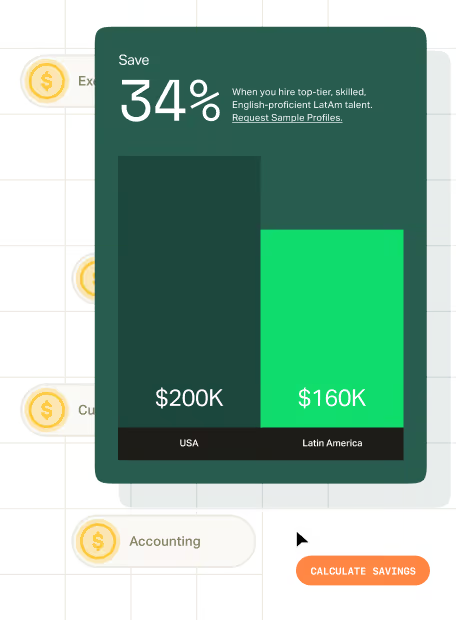
Hiring developers in Latin America typically costs 30–70% less than in the US, which is what makes building your own team affordable in the first place. To put concrete numbers on it, here’s what these roles earn annually compared to US hires, according to Hire With Near’s salary data:
For the most up-to-date figures, see Hire With Near’s US vs Latin America Salary Guide.
Read that as budget enablement, not cheap labor: for what a junior back-end developer costs in the US, you can often hire a mid-level or senior one in Latin America, whether that means hiring a front-end developer, hiring a full-stack developer, or another specialist.
The savings come from Latin America’s lower cost of living, not from paying people less than the work is worth.
How To Build Your Own Software Development Team
There are two ways to build your own software development team in Chile: hire directly yourself, or work with a specialist staffing and recruiting partner who does both the sourcing and the employment for you.
Option 1: Hire directly
You find candidates on your own through LinkedIn, referrals, or a job board for hiring in Latin America, then work out how to employ them legally. For a cross-border hire in Chile, that comes down to one of two mechanisms:
- Set up a legal entity in the country: Gives you full control, but takes months to establish, carries real legal and accounting costs, and only makes sense once you’re planning a substantial in-country presence.
- Use an employer of record (EOR): A third party that becomes the legal employer on paper while you manage the work day to day, handling contracts, payroll, taxes, and compliance.
Either way, the catch is the same: an EOR handles employment logistics, not recruiting. You still have to find and vet every candidate yourself, which is the hardest and slowest part of the whole process.
This route works best for companies with internal recruiting capacity and enough hiring volume to justify building that muscle in-house.
Related reading: 10 Best Employer of Record (EOR) Companies
Option 2: Work with a specialist staffing and recruiting partner
This is the option that combines both jobs into one relationship: finding and vetting the talent, and handling employment, payroll, benefits, and compliance. For most companies focused on hiring software engineers and building a lasting team, it's also the fastest and least resource-intensive path.
You describe the role, the partner runs a search specifically for it, and presents pre-vetted candidates, so your team’s time goes into final interviews rather than filtering resumes.
Once you hire, the partner manages payroll and compliance through services like nearshore staffing and recruiting, and the developer joins your team directly, works for you full-time, and stays as long as the role does, not just for the length of a contract. That’s exactly what Hire With Near does.
The trade-off is minor compared to what it solves: you’re relying on a partner to run the search well, so the vetting process should be very detailed and rigorous. A partner that only checks a coding test and calls it done isn’t meaningfully different from sourcing candidates yourself.
If you want to compare providers, our roundups of the best nearshore staffing companies and specialist staffing firms for LatAm hiring are a good place to start.
Hire With Near also handles executive-level engineering hiring when you need an engineering manager or CTO rather than an individual contributor.
If you want the country-specific version of this hiring process, our guide to how to hire software developers in Chile walks through costs, technical skills, and the hiring models in more depth.
What building your own team looks like in practice
A fast-growing US health tech startup shows what this can deliver. With demand climbing, it needed senior engineers to harden its backend, improve deployment reliability, and strengthen QA, but its two-person recruiting team couldn’t keep pace without lowering a deliberately high hiring bar.
Working with Hire With Near to take over sourcing, screening, and candidate coordination, the company kept its full 8-step technical process, still averaged 14 days to hire, and built a 7-engineer Latin American team spanning backend, DevOps, QA, mobile, and frontend. The result was $323,000 in annual savings against US salaries, a 33% reduction, with no compromise on quality.
ParkMobile, part of the global mobility platform Arrive, tells a similar story at a larger scale. For years, its back-end and platform work had been handled by outside development agencies, and every time those developers rolled off, their knowledge of the systems left with them.
Working with Hire With Near, ParkMobile brought that work in-house, hiring 9 senior engineers across platform, backend, and iOS roles in Bogotá, Colombia, a market they’d never recruited in before.
The first candidate shortlists arrived within a week, 8 of the 9 roles closed in under 30 days, and the average time to hire was 24 days. The result: $1,066,085 in annual savings, a 73% reduction against US rates. As Akshay Gokarnakar, ParkMobile’s TA Lead, put it:
Their deep understanding of the local talent landscape is what allows them to source and vet top-tier candidates efficiently.
— Akshay Gokarnakar, TA Lead, ParkMobile
Final Thoughts
Software development outsourcing to Chile can get US companies skilled engineers, real cost savings, and collaboration inside your own working day.
But before you hand the work to a third-party agency, it’s worth asking whether you would be better served building your own dedicated Chile or Latin America development team, with engineers who feel like part of your company, stick around, and often cost less than an agency’s markup.
That’s the route most companies we talk to end up preferring once they’ve tried both.
If you want to explore it, the best next step is to book a free consultation to talk through your requirements with our team. We’ll give you developer salary benchmarks and walk you through how the process works, so you have what you need to decide if it’s the right choice for your business.
{{latam-hiring-cta-v2}}
Frequently Asked Questions
How much does it cost to hire software developers in Chile and Latin America?
Hiring developers in Chile and the wider Latin America typically costs 30–70% less than the US equivalent, with most roles landing between roughly $30K and $108K a year, depending on seniority and specialty.
In practice, that often means hiring a mid-level or senior engineer for what a junior US developer would cost.
The savings come from a lower cost of living in the region, not from underpaying people, so you can pay a fair, competitive local rate and still spend far less than a comparable US hire.
For role-by-role figures, see our US vs Latin America Salary Guide.
How do you make sure a developer is as senior as their resume says?
Real vetting is technical, not resume-deep: coding assessments, project walk-throughs, and a check on whether the candidate can explain their work clearly. Because AI-generated resumes are now common, the only reliable proof is watching an engineer reason through a real problem and go deep on work they claim to have led.
A strong process also screens for communication (can they explain a technical decision to a non-developer?) and watches for red flags like candidates running several parallel full-time jobs.
Degrees matter less than demonstrated ability, since many excellent Latin American engineers were working professionally before graduating.
How good is the English of developers in Chile?
Strong business English is common among Chilean developers, especially those who have worked with US teams, and the thing to test for is articulation rather than accent.
What matters is whether an engineer can explain why a change broke production, hold their own in a code review, and write a clear status update, not whether they sound like a native speaker.
Screen for it directly by asking candidates to walk through a past project and explain a technical decision in plain terms. That surfaces real communication ability far better than a resume line.
What software development roles can I hire in Chile and Latin America?
You can hire the full range of software roles in Chile and Latin America, including software engineers in Latin America, DevOps engineers in Latin America, mobile developers in Latin America, JavaScript developers, and general remote developers, along with cloud developers and QA specialists in Latin America.
Is Chile a good country for outsourcing software development?
Yes, Chile is one of the best countries in Latin America for software development, thanks to a well-trained developer pool, strong IP protections, reliable infrastructure, and working hours that overlap the US business day. It’s a particularly good fit if stability and time-zone alignment matter to you.
The main limit is scale: for very specialized skills or larger teams, casting the search across the wider region rather than Chile alone gives you more depth without giving up the nearshore time-zone advantage.
If you’re also interested in hiring developers in other countries in Latin America, check our guides for each:







.webp)


%203.svg)
.avif)






%20(1).avif)

%20(1).png)