


%203.svg)
Key Takeaways
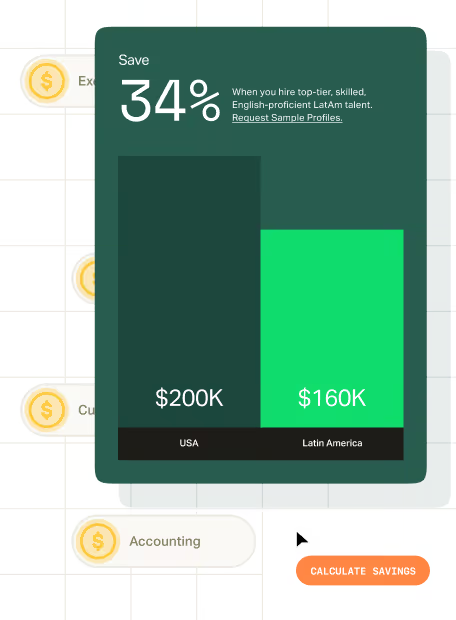
- US companies hire vetted finance and accounting talent in Latin America at 30–70% below US salaries, fluent in US GAAP and IFRS, working your hours through the month-end close. The same budget that covers one US hire often funds a more senior professional or a small team.
- The roles you can hire span the whole function: bookkeepers, staff accountants, financial analysts, controllers, tax accountants, and CFOs, sourced mainly from Colombia, Mexico, and Argentina.
- Standards fluency and real-time collaboration during the close are the two things that decide whether a nearshore finance hire works, and both are screenable before you commit. The risk in this decision is lower than it feels from the outside.
You’ve heard that companies are building finance and accounting teams in Latin America, and now you’re sitting with some practical questions. Which roles can you hire this way? What’s the salary difference compared to a US controller or analyst? And the one that keeps you up at night: will they know US GAAP well enough to be trusted with your month-end close?
These are fair concerns. The US accounting talent pipeline has thinned, the candidates who clear your bar want salaries the budget won’t stretch to, and if you’ve tried an offshore team before, you already know what a 12-hour time difference does to your reporting cycle. That’s why Latin America keeps coming up.
In this guide, I’ll walk through everything you need to know about how to hire finance and accounting talent in Latin America: why companies are doing it, the models for getting someone on your team, the roles and what they cost, which countries to source from, and how to handle the GAAP and compliance questions head-on.
Why Are US Companies Hiring Finance and Accounting Talent in Latin America?
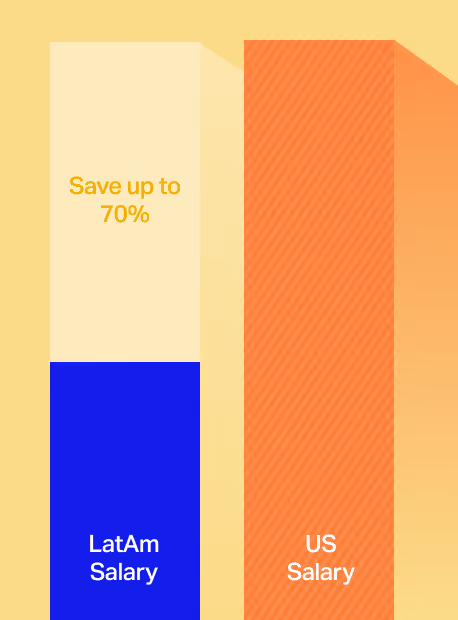
US companies hire finance and accounting talent in Latin America for three reasons: the talent knows US accounting standards, it works your hours, and it costs 30 to 70% less than a comparable US hire. For finance teams, all three matter, but the time zone overlap is what makes the rest of it work.
The close demands real-time collaboration
When your accounting team works during your hours, journal entries get reviewed the same day, reconciliations don’t sit overnight waiting for someone 11 hours ahead, and a question about an accrual gets answered before the deadline instead of after it.
Latin America makes that overlap easy. You can hire talent in Bogotá, Mexico City, Buenos Aires, or São Paulo who will be in your time zone or just an hour or two off, depending on where you are in the US, and the time of year (e.g., most countries in Latin America don’t observe Daylight Saving Time).
A finance hire in any of these hubs is easily reachable during your core business hours without anyone working a graveyard shift or restructuring their day to meet yours.
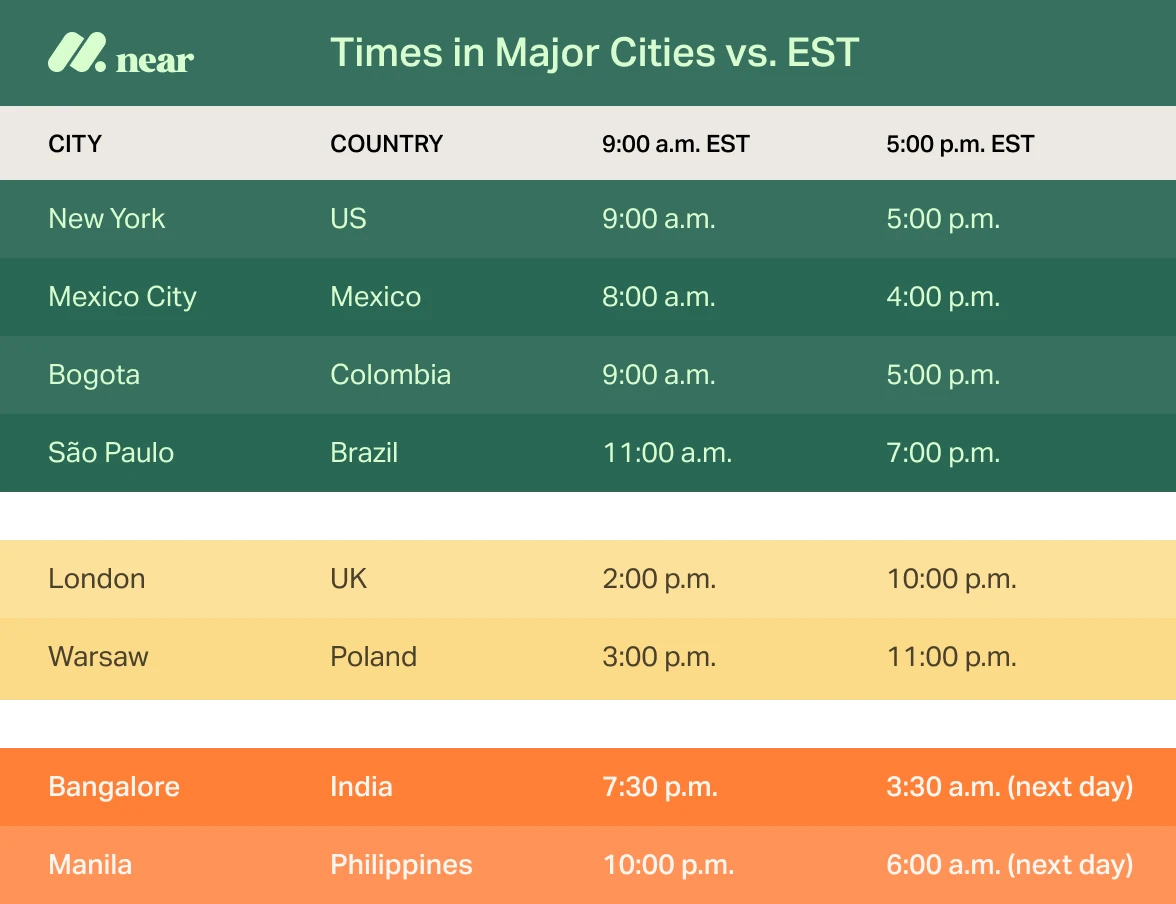
This is the specific reason finance and accounting was the second-most-common function among companies switching from offshore to nearshore in Hire With Near’s analysis of more than 2,000 hiring conversations, at 29%. That buyer-motivation pattern is the heart of why US companies are hiring in Latin America.
The US talent pipeline is shrinking
According to Accounting Today, the number of candidates sitting for the CPA exam has fallen 27% over the past decade and in the 2023-24 academic year, accounting graduates declined 6.6%, following a 9.6% drop the year before, according to the AICPA’s 2025 Trends Report.
Total accounting completions hit a 20-year low in 2023–24, with just 55,152 degrees awarded. The pipeline of new accountants entering the field is contracting while demand holds steady, which is part of why finding finance talent at sustainable US rates has gotten harder.
Latin America gives you a deep, growing pool of credentialed accountants to draw from instead. Argentina, Colombia, and Brazil produce tens of thousands of accounting and finance graduates each year, many with Big Four exposure and direct experience supporting US-based clients. That’s exactly the profile the US domestic pipeline is no longer generating at scale.
For broader context on why the nearshore model works, our guide to hiring remotely in Latin America covers it in full.
LatAm finance talent knows US accounting standards
Latin American accounting programs, particularly in Argentina, are five-to-six-year university degrees with rigorous technical training that covers IFRS alongside local GAAP equivalents. On top of that, all Big Four have a strong regional presence, which means a large share of the candidate pool has worked to US GAAP and IFRS standards before they ever join a US company.
That’s the reason US finance leaders are sourcing here, not just hoping the standards knowledge transfers. It already has. Hire With Near’s finance and accounting recruiters screen for that fluency before a candidate reaches you, so it’s confirmed in vetting, not discovered after the hire.
The budget goes further than you expect
Hiring in Latin America typically puts finance and accounting salaries 30 to 70% below US market rates. For example, according to Hire With Near’s salary benchmarks, a mid-level controller in Latin America runs $42,000–$60,000 per year. The US equivalent is $110,000–$192,000.
That gap isn’t about paying less for the same role. It’s about what the freed-up budget lets you do: hire the senior controller you couldn’t justify at US rates, add an AR specialist alongside your bookkeeper, or build out a three-person accounting team for what one US hire would cost.
That’s reflected in who companies are actually hiring: according to Hire With Near’s 2026 State of LatAm Hiring Report, 84% of LatAm placements in 2025 were mid-level or senior roles.
This is why companies across the broader finance industry increasingly build their teams this way.
How Do You Hire Finance and Accounting Talent in Latin America?
US companies have three real options for hiring finance and accounting talent in Latin America: hire directly and employ the person yourself, use an employer of record, or work with a specialist staffing partner that finds and employs the talent for you. For most companies, the third is the fastest path to a great hire.
Here they are in order from most hands-on to simplest:
Option 1: Hire direct
You source the candidate yourself, through LinkedIn, a job board for hiring in Latin America, or referrals, and then you become their legal employer, handling contracts, payroll, and compliance for an international hire.
For a cross-border hire, that last part is the catch. You either set up a local legal entity in the country you’re hiring from, which means real upfront cost, three to six months of incorporation filings, and ongoing local legal and accounting support, or you handle the employment some other way.
Hiring the professional yourself gives you full control, but you carry the entire sourcing, vetting, and employment burden alone, which is a heavy lift for a finance team that needs the role filled now.
Option 2: Use an employer of record
An employer of record is a third-party company that becomes the legal employer of your hire on paper, while you manage the work day to day.
The EOR handles everything on the back end: employment contracts, payroll processing, tax withholdings, benefits administration, and compliance with local labor laws. You pay the EOR, and they pay your employee according to local requirements. No entity setup required.
The catch to name clearly: an EOR handles employment logistics, not recruiting. You still have to source and vet every finance candidate yourself. For a role where US GAAP fluency and proactivity are non-negotiable, that’s the hard part. An EOR solves the paperwork, not the hiring.
Popular EOR companies include Deel, Globalization Partners, Remote, and Oyster.
For a full breakdown of how EOR arrangements work, see this guide to hiring remote foreign employees.
Option 3: Work with a specialist staffing partner
This is the simplest option for most US companies, because it closes the gap the other two leave open. You partner with one of the specialist staffing firms for LatAm hiring, like Hire With Near, that does both jobs at once: finding and vetting the talent and handling all the employment logistics.
You describe the role, we present pre-vetted finance and accounting candidates screened for US standards, and once you hire, we manage payroll, benefits, compliance, and local employment requirements through our nearshore staffing services.
For a finance leader, the appeal is that the GAAP-and-compliance vetting and the employment headache are both handled in one relationship.
If you want to compare providers, our roundup of the best companies to hire LatAm finance talent is a useful starting point.
Here’s how the three options compare:
What Are the Most In-Demand Accounting and Finance Roles (and What Do They Cost)?
You can hire the full finance and accounting function from Latin America, from transactional roles to the C-suite, usually at 30 to 70% below US salaries, which usually translates to $35,000 to $64,000 per hire annually.
According to the 2026 State of LatAm Hiring Report, finance and accounting is the most common function US companies hire for in Latin America, accounting for 23.4% of more than 2,000 placements.
Here are the roles US companies hire most often:
- Bookkeeper: Keeps the day-to-day records clean: transactions, bank reconciliations, and the ledgers your accountants build on. The most commonly requested finance role in Latin America, and one where Colombia and Argentina both have deep candidate pools. For more information, don’t forget to check our how to hire a bookkeeper guide.
- Staff accountant: Handles journal entries, accruals, AP/AR support, and monthly close work. This is the backbone hire for a growing finance team and the role where US GAAP fluency matters most day to day. Most companies hiring their first LatAm finance hire start here.
- Financial analyst: Builds the budgets, forecasts, and models leadership runs on. FP&A analysts from Latin America frequently come out of multinational or investment banking environments and arrive fluent in three-statement modeling and US reporting expectations. Check our how to hire a financial analyst full guide.
- Accounts payable specialist: Manages outgoing payments, vendor invoices, and payment schedules. A high-volume role where accuracy and same-day communication with vendors benefits directly from time zone overlap.
- Accounts receivable specialist: Manages incoming payments, invoice follow-up, and collections. AR lag is one of the most common cash flow pain points companies bring to us, and it’s a problem that gets worse when the person chasing invoices is 11 hours ahead. For more information, read our how to hire accounts receivable specialists in Latin America article.
- Payroll specialist: Runs payroll accurately and on time across pay periods, with proficiency in platforms like ADP, Gusto, and Rippling. A role where precision matters and issues mid-cycle need to be resolved during your business day, not the next morning.
- Tax accountant: Handles filings, provisions, and compliance. The strongest LatAm candidates bring direct experience with US tax work, including 1040s, 1120S returns, and expat filings, often developed while working under a US CPA or at a firm serving US-registered businesses.
- Controller: Owns the close, financial reporting, and internal controls. A senior, GAAP-critical role that most companies couldn’t justify hiring in the US on a mid-market budget. Latin America changes that calculation without changing the caliber of the hire. Check our how to hire an outsourced controller in 9 Steps article.
- CFO: Sets financial strategy and steers the company’s overall financial operations. For senior finance leadership at this level, our executive search for finance leaders handles CFO and VP of Finance hiring specifically.
To put the cost difference in concrete terms, the figures below come from Hire With Near’s salary data, comparing what these roles run in Latin America against equivalent US hires:
For the most up-to-date figures, see Hire With Near’s US vs Latin America Salary Guide.
What that spread means for your budget is the real point. The same spend gets you more capability: the budget that covered one mid-level US accountant can fund a senior LatAm controller, or a controller plus a staff accountant. This is also why companies in the accounting industry increasingly build their teams this way.
For a fuller breakdown by role, see our Finance Roles Salary Guide and the companion Accounting Roles Salary Guide.
Which Latin American Countries Are Best for Hiring Finance and Accounting Talent?
Colombia, Mexico, and Argentina are the strongest countries for hiring finance and accounting talent in Latin America, each with deep accounting pools, strong English, and close US time-zone overlap. They consistently rank at the top for finance and accounting placements, and they cover the full range from transactional roles to senior leadership.
Argentina
Argentina is the finance hiring market with the deepest technical foundation. An accounting degree here takes five to six years, which the US generally recognizes as equivalent to a university degree plus postgraduate training.
All Big Four firms have strong regional presences, so a significant portion of the candidate pool has worked directly to US GAAP and IFRS standards before joining a US company.
Lucas Stepanenko, Hire With Near’s sourcing manager for finance and accounting, puts it plainly:
Almost 80% of the accountants I place are from Argentina. To get a university degree in accounting in Argentina, you need to study for five or six years. We have great public universities there, and that’s reflected in the talent pool.
Argentina is the strongest choice for controllers, senior accountants, and FP&A roles where technical depth and standards fluency are non-negotiable.
Related reading: Hiring in Argentina: Great Talent, Significant Savings, and What US Companies Need to Know
Colombia
Colombia became the number one source country for finance and accounting placements in 2025, surpassing Argentina for the first time. Bogotá aligns with US business hours, providing an identical match to the East Coast from November to March and running just one hour behind from March to November.
The talent pool skews strong for bookkeepers, staff accountants, and AR and AP specialists, and the pipeline moves fast: Hire With Near has placed accountants from Colombia in as little as one day.
A strong choice when time zone alignment is the priority and you need to move quickly.
Related reading: Hiring in Colombia: What US Companies Need to Know About the #1 Nearshore Talent Market
Mexico
Mexico City aligns closely with US Central time, matching it exactly from November to March and running just one hour behind from March to November, and has a deep pool of finance professionals shaped by decades of cross-border business with US companies.
Familiarity with US business norms and US-facing client work is built into the market, which shortens ramp time for roles that involve direct collaboration with US teams.
A strong option across bookkeeping, staff accounting, and payroll roles.
Related reading: Hiring in Mexico: Deep Talent, Close Time Zones, and What US Companies Need to Know
The common thread is that all three put your finance team within an hour or two of US business hours, which is exactly what the close requires. For a wider view of where to source, see our list of the best countries to hire remote finance talent.
{{state-latam-hiring}}
What Skills and Qualifications Should You Screen for When Hiring LatAm Finance Talent?
The right screening criteria depend on the role, but across finance and accounting hires, these are the qualifications that consistently separate a good candidate from one who can actually run without supervision.
US accounting standards fluency
For any role touching the month-end close, financial reporting, or client-facing accounting work, verify the specific application, not just familiarity with GAAP. Ask what kind of close they’ve owned, what reporting they’ve prepared, and who the end audience was.
A candidate who has handled multi-entity consolidations or investor-grade reporting is a different hire than one who knows the principles but hasn’t applied them at that level.
Tool proficiency
If you’re hiring a QuickBooks expert remotely, the LatAm candidate pool is one of the strongest sources available, particularly among accountants who’ve worked with US-based clients. Ask candidates to walk you through their experience specifically: which modules, what reconciliation work, whether they’ve managed chart of accounts setup or just done data entry.
Sage Intacct is available but the pool is smaller, typically among candidates who’ve worked with US nonprofits or PE-backed companies. NetSuite experience exists but takes longer to source. Payroll platforms like Gusto, ADP, and Rippling are relevant for payroll specialist hires.
Increasingly, fluency with the tools sitting on top of these systems matters too. Kavin Soni, Senior Financial Analyst at Google, makes the case for SQL, Python, and Power BI as core finance skills now, not specialized ones: “The ability to translate complex data into a clear business narrative is the single most valuable skill. Providing a spreadsheet to business partners is rarely enough,” he told the Association for Financial Professionals.
Specify your stack at the intake conversation so sourcing targets the right profile from the start.
Proactivity and independent judgment
This is the single most important screening criterion for finance roles, and it’s the failure mode that burned most companies with their previous offshore hires. The question to ask: “Walk me through a time the information you received wasn’t complete. What did you do?”
The answer tells you whether you’re looking at someone who escalates immediately, sits on it, or investigates independently. For a role that needs to run without supervision, you want the third: someone who investigates independently.
English communication quality
For roles with any client-facing or cross-functional component, written and spoken English needs to go beyond functional fluency into professional clarity. Ask candidates to explain a complex accounting concept or walk you through a reconciliation discrepancy they’ve resolved.
How they structure the answer, not just whether they can answer it, tells you whether they can communicate with your team and your clients without friction.
This is also where the broader profession is shifting. Ashley Merritt, R&D and Portfolio Governance Finance Leader at W. L. Gore & Associates, told the CFA Institute that once the technical bar is cleared, communication becomes the differentiator: the ability to explain financial information “in an articulate, concise, non-technical manner is what allows people to understand, accept and act on the guidance you provide.”
That standard applies whether the accountant is down the hall or in Bogotá.
Multi-client or multi-entity experience
Particularly relevant for CPA firms and fractional CFO practices. A candidate trained to manage work across multiple client entities simultaneously is a fundamentally different profile from a staff accountant at a single company. Specify this requirement at intake rather than discovering the gap after the hire.
Forecasting and forward-looking analysis
The expectation for finance hires has shifted from producing accurate historical reports to building forecasts leadership can actually act on. Syed Nadeem, Director of Budgeting and Cost Management at Zain KSA, frames the shift directly in an interview with the Association for Financial Professionals: “Finance is not just reporting the past; it’s influencing the future. You create value only when numbers lead to decisions.”
For roles like financial analyst and FP&A, ask candidates to walk through a forecast or scenario model they’ve built: what assumptions they used, how they handled uncertainty, and how leadership used the output.
A candidate who can only describe pulling and formatting historical numbers is a different hire than one who can describe building a model that changed a budget decision.
This is also where AI literacy is starting to matter. The CFA Institute’s research points to forecasting and scenario planning as one of the areas where finance professionals increasingly work alongside AI tools to integrate historical performance with real-time and external data, rather than building projections by hand.
What Are the Most Common Concerns About Hiring Accounting and Finance Talent in Latin America?
The hesitations US finance leaders raise about hiring in Latin America are consistent, and each has a concrete answer. Here are the three we hear most:
“Will they know US GAAP and our compliance requirements?”
Yes, but the honest answer has some nuance. GAAP fluency exists across the LatAm candidate pool, as Lucas Stepanenko says:
LatAm finance professionals have strong academic training and a lot of exposure to Big Four firms. That gives them experience with international markets and makes them very well versed in key accounting standards like US GAAP and IFRS, which are among the most common requirements we see from our clients.
Where the question gets more specific is around application: a candidate trained on IFRS who has crossed over to US GAAP for multinational work is different from one who’s owned a full US close independently, which is different again from someone with experience on investor-grade reporting or multi-entity consolidations.
The concern is valid and worth taking seriously in the screening process. When you brief a recruiter, be specific about what your close actually requires: what you’re reporting, who the audience is, and what standards exposure matters most. That specificity is what separates a good LatAm finance hire from a great one.
CyberFortress, a cybersecurity company that couldn’t find or afford senior-level finance professionals in the US, is a clear example: the LatAm finance team Hire With Near built for them included a director of accounting and financial reporting with 15-plus years of IFRS and local GAAP experience and a director of global tax who came from Ernst & Young. The standards fluency was there before the hire, not hoped for after.
“We tried offshore before, and the time zone and quality didn’t work.”
Offshore and nearshore are different models. Offshore typically means a team in the Philippines or India, 11 to 14 hours removed from US business hours. Nearshore (the model Hire With Near operates in) means Latin America: one to four hours from any US time zone, working during your business day, reachable in real time.
For accounting, a question asked at 4 p.m. doesn’t get answered until the next morning, a reconciliation flagged on day two of the close sits overnight, and any back-and-forth during the month-end cycle gets stretched across multiple days.
A niche real estate tax consulting firm that had used offshore CPAs described the failure this way:
The CPAs they sent me were from the Philippines, and the problem was they didn’t want to work on our time zone, and then they started sending me people with no experience, no knowledge of how U.S. tax works.
The time zone problem compounds the quality problem, because even a skilled accountant working the graveyard shift operates under conditions that don’t match how your finance function runs.
Hiring in Latin America closes both issues: your team overlaps your workday, so the close happens in sync, and candidates are screened for US accounting knowledge before you see them.
“Is our financial data secure?”
Yes, a LatAm finance hire is a full-time member of your team, working in your systems under your access controls and policies, the same as a US employee.
When you hire through a staffing partner like Hire With Near, the person works directly for you day to day, and the partner handles the employment relationship and local compliance behind the scenes.
The candidate goes through the same vetting, signs the same confidentiality agreements, and operates under the same data policies as any other remote hire on your team.
For more on the specific questions finance leaders ask, our piece on the questions finance leaders ask about hiring accountants in Latin America goes deeper.
What Does Hiring Finance and Accounting Talent in Latin America Look Like in Practice?
The clearest proof of how this works is CyberFortress: the company that saved an estimated $1.2 million a year by building its finance team in Latin America.
During a year when it doubled headcount, CyberFortress couldn’t fill senior finance and accounting roles in the US at sustainable rates, and CFO Seema Chacko, who had worked with talent from Europe, India, and the Philippines, wanted the overlapping working hours that Latin America offered.
Through Hire With Near, the company built a 20-person Latin American finance and accounting team, including a director of accounting and financial reporting with IFRS and local GAAP expertise, an accounting team lead with 20-plus years of experience and a background at Accenture, and a director of global tax from Ernst & Young.
The result wasn’t just cost savings. The team cut the month-end close from 15 days to 10, the kind of operational gain that real-time, in-time-zone collaboration makes possible. Seema Chacko described the experience this way:
We hired 20 team members who share our core values: great attitude and desire to learn, resourcefulness, and adaptability. Hire With Near’s team was very responsive, and their easy-going communication fostered a seamless hiring process.
A real estate investment firm saw a similar payoff: a single financial specialist hire in Latin America it brought on for fund accounting ended up leading $9 million loan closings and owning the firm’s asset management reporting company-wide.
Another impressive case was FinanceWithin, a fractional CFO services firm. They had built an offshore team in India to handle delivery for their growing client base. The problem wasn’t the work quality at the outset; it was the turnover. Constant churn meant constant retraining, and the time and cost of bringing new hires up to speed on client accounts was subtly eroding the savings the offshore model was supposed to deliver.
They switched to Latin America through Hire With Near, hiring 8 roles on a nearshore model. The result was $535,000 in annual savings, and more importantly, a team that stayed, which for a fractional CFO firm where client relationships depend on consistency, is the outcome that matters most.
Sheena Malson, their Director of Accounting, praised the partnership:
When we saw the quality of candidates coming through, it became clear that these were truly top-tier professionals—better than what we were finding on our own.
Most of those hires have stayed two or more years, which speaks to the other half of the value: not just filling roles, but building a team that sticks.
Final Thoughts
The US finance talent market is tight, expensive, and getting worse. The CPA pipeline is shrinking, the candidates who clear your bar want salaries that don’t fit the budget, and the offshore model most companies tried first created a different set of problems. Latin America is the answer a growing number of finance leaders are landing on, not as a compromise, but because the talent is genuinely there.
Controllers, staff accountants, FP&A analysts, and AR specialists who know US GAAP, work your hours, and cost 30 to 70% less than their US counterparts. That’s a better hiring market than the one you’ve been working with.
The two things that decide whether it works, standards fluency and real-time collaboration through the close, are both things you can screen for before you commit. The risk in this decision is lower than it feels from the outside, and the companies that have made the move wouldn’t go back.
If you want to explore building your LatAm finance team, the best next step is to book a free consultation with our team to explore your finance and accounting hiring options.
We’ll walk you through salary benchmarks, how the vetting for US standards works, and the hiring process, so you have what you need to decide whether it’s right for your company.
{{latam-hiring-cta-v2}}
Frequently Asked Questions
How much does it cost to hire an accountant or finance professional in Latin America?
Finance and accounting professionals based in Latin America typically command salaries 30 to 70% below US market rates, which means the same budget covers a more senior hire or a larger team.
In our experience placing these roles, a staff accountant runs roughly $30K to $60K a year against $71K to $110K in the US, and a controller runs about $42K to $90K versus $110K to $230K, according to Hire With Near’s Salary Guide.
The difference comes from lower regional cost of living, not lower caliber, so the practical effect is that your budget stretches to a more senior hire or a larger team.
How do you hire finance and accounting talent in Latin America, step by step?
You hire finance and accounting talent in Latin America in one of three ways: hire directly and become the legal employer, use an employer of record to handle employment while you source the candidate, or work with a specialist staffing partner that both finds the talent and manages employment.
With a partner like Hire With Near, you describe the role, review pre-vetted candidates screened for US standards, interview the ones you like, and hire, with payroll and compliance handled for you.
Most companies choose the partner route because it closes the sourcing-and-compliance gap the other two leave open.
Are LatAm accountants experienced with US GAAP and IFRS?
Yes, Latin America has a deep pool of accountants fluent in IFRS and US GAAP, many trained at Big Four firms and multinationals. Standards fluency is the first thing a good recruiter screens for, so candidates reach you already vetted for the accounting frameworks you work in.
This is consistently the top concern US finance leaders raise, and it’s the most screenable one.
Which Latin American countries are best for hiring finance and accounting talent?
Colombia, Mexico, and Argentina are the strongest countries for hiring finance and accounting talent, each combining deep accounting pools, strong English, and close US time-zone overlap.
Colombia and Mexico align with US Eastern and Central business hours, and Argentina brings a highly educated finance workforce with strong multinational experience. All three keep your team within an hour or two of US business hours, which is what the month-end close needs.
How long does it take to hire a finance professional through Hire With Near?
Most finance and accounting roles are filled in weeks, not the months a US search often takes. Because the talent is pre-vetted, including for US GAAP and IFRS fluency, you review qualified candidates 3–5 days after defining the role rather than starting a search from scratch. Overlapping working hours also make interviewing simple, since candidates are available during your business hours.
Do I need a local entity to hire finance staff in Latin America?
No, you don’t need to set up a local entity to hire finance talent in Latin America. You can hire through an employer of record or a specialist staffing partner that acts as the employer of record and handles contracts, payroll, taxes, and local compliance.
Setting up your own entity only makes sense at a significant scale. For most companies hiring a handful of finance professionals, a partner is faster and far less expensive.
What other finance and accounting roles can I hire in Latin America?
Beyond the core accounting team, US companies hire a wide range of finance and accounting roles in Latin America, including nearshore bookkeepers, remote accounts payable specialists, accounts receivable specialists in Latin America, LatAm payroll specialists, and nearshore tax accountants.


.webp)


.webp)

.webp)


%203.svg)
.avif)





%20(1).avif)

%20(1).png)