


%203.svg)
Key Takeaways:
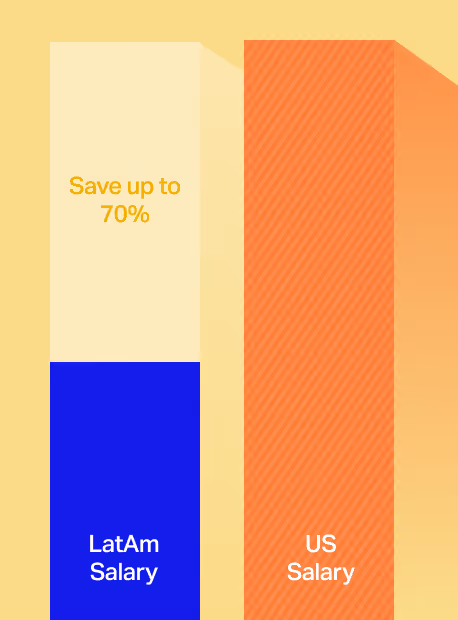
- Among the best countries to hire remote finance talent, Latin America offers US finance teams the best combination of time zone alignment and cost savings: most LatAm countries sit within 1–3 hours of US Eastern time, and companies typically save 30–70% compared to equivalent US hires.
- Finance professionals based in Colombia and Argentina have strong Big Four exposure, training in US GAAP and IFRS standards, and multi-year degree programs that produce credential depth comparable to what US companies expect.
- India and the Philippines offer deep finance talent pools, but time zone gaps of 9–15 hours create real friction for finance functions that require real-time collaboration. Month-end close, FP&A reviews, and audit responses can’t wait until the next day.
For US companies, the best countries to hire remote finance talent are Colombia, Argentina, Brazil, and Mexico. These Latin American countries offer a US time zone overlap, strong English proficiency, and professionals trained to US GAAP and IFRS standards.
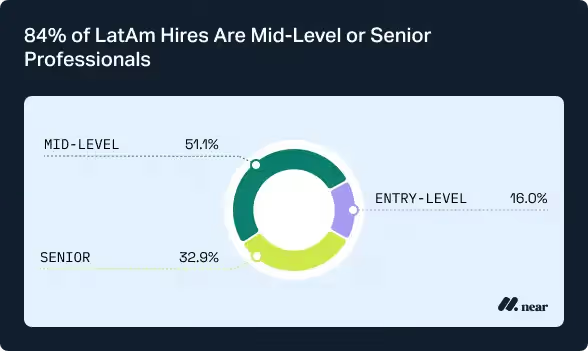
According to Near’s 2026 State of LatAm Hiring Report, 84% of all LatAm placements are mid-level or senior professionals, which counters the assumption that hiring abroad means settling for junior talent.
India and the Philippines are also established options with deep talent pools, but both sit 12–15 hours ahead of US Eastern time, creating friction for finance teams that need real-time collaboration.
This article covers the top countries for hiring remote full-time finance professionals, what makes each one a fit for US companies, and how to choose based on your team’s operational needs.
Why Countries in Latin America Stand Out for Hiring Finance Talent
The domestic supply of qualified finance talent is shrinking, and Latin America offers a ready pool of credentialed accounting and finance professionals who work in US time zones, understand US accounting standards, and cost significantly less than comparable US hires.
According to Accounting Today, the number of candidates sitting for the CPA exam has fallen 27% over the past decade, and accounting graduates declined 17% between 2016 and 2022. For many finance leaders, with domestic hiring getting harder and more expensive, looking abroad has become a solid alternative plan.
In our experience placing finance talent across the region, Colombia and Argentina consistently lead as the top sources for senior accountants, controllers, and FP&A professionals. These aren’t entry-level hires. They’re credentialed professionals with the kind of experience US finance leaders are struggling to find domestically.
Access to a broader talent pool
Expanding your search to Latin America opens access to professionals trained in IFRS and US GAAP, often through rigorous multi-year degree programs and exposure to Big Four firms operating in the region.
For some roles, the credential depth in LatAm is significant. For example, Argentine accounting degrees require five to six years of study.
Cost that reflects market rates, not compromises
Salary expectations in Latin America reflect the local cost of living, not lower capability. A senior controller who would cost $130K or more in the US may be hired in LatAm for $42K–$60K. That’s not a corner-cutting decision. It’s how labor markets work across different economies.
Operational fit
Latin American finance professionals bring an understanding of cross-border financial issues, multi-currency environments, and regional compliance frameworks that are directly useful for US companies with international operations or growth ambitions.
For a broader view of the factors driving US companies toward LatAm hiring, the why US companies hire in Latin America guide covers the full picture.
What Skills Do Remote Finance Professionals Require?
The skills that matter most for a remote finance hire depend on the role, but four requirements come up consistently across the finance leaders we work with. Here is what each looks like in practice.
US accounting software proficiency
QuickBooks, NetSuite, Sage Intacct, and Excel are the tools US finance teams run on. For most hiring managers, this is the first gate: A candidate who can’t work fluently in your stack creates friction from day one.
When evaluating candidates, ask for specific examples of the tools they’ve used and the environments they’ve worked in (single-company or multi-client). The answer tells you a lot.
LatAm finance professionals, particularly those who’ve worked with US companies or through Big Four satellite offices, are more likely to have this proficiency than most US hiring managers expect.
Proactivity and ownership mentality
This is the requirement finance leaders feel most strongly about, and it’s the most common gap in offshore hires from other regions. The professionals who work best in remote finance roles don’t wait to be asked. They flag issues before they become problems, follow up without prompting, and take ownership of deadlines without being managed into them.
A remote controller or FP&A analyst who misses a month-end close or loses track of a compliance filing creates downstream problems that are hard to reverse. The hire needs to be someone who owns their workload.
US GAAP and IFRS fluency
For most finance roles supporting US companies, familiarity with US GAAP is non-negotiable. IFRS knowledge is a strong secondary requirement for companies with international operations or multi-entity reporting.
LatAm finance professionals with Big Four exposure or experience supporting US-based clients typically have both, which is one of the reasons Near’s finance placements skew so heavily toward Colombia and Argentina, where that training is embedded in the degree programs themselves.
Communication that works in real time
Remote finance professionals need to communicate clearly with US colleagues, clients, and leadership. For client-facing roles like controllers and FP&A analysts, professional English that holds up under pressure matters as much as the technical skills.
Lucas Stepanenko, Near’s Sourcing Manager for Finance & Accounting, puts it plainly:
When you’re listening to a candidate, you can just tell they’re a rock star by the way they express themselves — when they give you very straightforward, sharp answers to specific questions and they’re not bumbling around without getting to a point.
Near screens all finance candidates on communication directly, so by the time you’re interviewing, that bar has already been cleared.
Best Countries to Hire Remote Finance Talent
When it comes to hiring remote finance talent, US companies have more options than ever. The countries below represent the strongest combination of talent quality, English proficiency, cost advantage, and time zone alignment for US finance teams.
The list leads with Latin America, where Near places the majority of finance and accounting professionals, followed by Asia-Pacific options with honest trade-off framing.
.webp)
1. Colombia
In our experience placing finance and accounting talent, Colombia has become the top destination by a significant margin, capturing 23% of all placements in 2025, jumping from third place and nearly doubling its share from the prior year.
The talent base is strong. Colombian universities produce large classes of accounting and finance graduates trained in both IFRS and US GAAP. The country has a well-established public accounting infrastructure, with Colombia’s national accounting institute (INCP) affiliated with IFAC, the global federation of accounting bodies.
Colombian professionals are increasingly experienced with multinational clients through the growth of shared services centers and Big Four satellite offices in Bogotá and Medellín.
When it comes to language skills, Colombia ranked 76th globally in the 2025 EF English Proficiency Index, a moderate score that has improved steadily. In practice, finance candidates screened for US companies typically operate at a professional working proficiency level, and Near’s screening process evaluates communication directly.
Colombia operates at UTC-5 year-round. During US Eastern Daylight Time, Colombia sits one hour ahead. During US Eastern Standard Time, it’s on the same clock. This is among the tightest time zone alignments available for US finance teams anywhere in the world.
2. Argentina
Argentina has historically been Near’s deepest source of finance and accounting talent. Lucas Stepanenko, Sourcing Manager for Finance & Accounting at Near, explains why:
Almost 80% of the accountants I place are from Argentina and some from Brazil. To get a university degree in accounting in Argentina, you need to study for five or six years. [LatAm] finance professionals have strong academic training and a lot of exposure to Big Four firms. That gives them experience with international markets and makes them very well versed in key accounting standards like US GAAP and IFRS…
Argentina ranked 26th globally and first in Latin America in the 2025 EF English Proficiency Index, reflecting a population with higher English exposure than most of its regional peers.
Argentina operates at UTC-3, putting Buenos Aires 1–2 hours ahead of US Eastern time for most of the year, within comfortable same-day working hours for a US finance team.
3. Brazil
Brazil is the largest economy in Latin America and the third most common source country for Near’s finance and accounting placements. Brazilian finance professionals bring deep experience in complex multi-entity environments, which aligns well with US companies managing multiple subsidiaries, international subsidiaries, or consolidated reporting.
The country’s finance sector has scale: São Paulo functions as one of Latin America’s primary financial centers, home to major banks, audit firms, and shared services operations.
Brazilian universities produce a substantial volume of accounting and finance graduates, and a Big Four presence in São Paulo and Rio de Janeiro gives candidates exposure to international reporting standards.
One calibration point: Brazil’s English proficiency, while functional at the professional level for screened finance candidates, is lower than Argentina’s on the 2025 EF index. Near screens communication directly, but it’s worth flagging for roles where English-heavy executive communication is a daily requirement.
Most Brazilian major cities (São Paulo, Rio de Janeiro, Brasília) operate at UTC-3, the same as Argentina. This puts finance professionals 1–2 hours ahead of US Eastern time for most of the year.
.webp)
4. Mexico
Mexico offers a combination of geographic proximity, cultural alignment with US business norms, and a growing bilingual professional class. Mexican finance professionals are recognized for their cross-cultural fluency, strong interpersonal skills, and familiarity with US accounting and tax frameworks.
Mexico City is home to a mature finance and accounting sector, with shared services centers, audit firms, and a substantial community of CPA-equivalent (CP) professionals. The country’s long history of cross-border business with US companies means many finance professionals have direct experience supporting US-based clients or parent companies.
For roles that require Spanish-English bilingual capacity, Mexico is the strongest option on this list. A bilingual controller or FP&A analyst who can move between English and Spanish in client communications or multi-entity reporting is a common Near placement request, and Mexico delivers well on that profile.
When it comes to time zone alignment, most of Mexico operates at UTC-6, which puts Mexico City 1–2 hours behind US Eastern time, depending on daylight saving season.
5. India
India has one of the world’s largest accounting populations, with the Institute of Chartered Accountants of India (ICAI) recognized as the second-largest professional accounting body in the world.
The Big Four maintain major Global Capability Centers in cities like Bangalore, Hyderabad, and Mumbai, giving candidates exposure to international reporting standards and multinational finance work.
For high-volume transactional accounting, payroll processing, and regulatory compliance work, India’s talent depth is difficult to match.
The trade-off is time zone. India Standard Time is UTC+5:30, putting Mumbai 10.5 hours ahead of US Eastern Standard Time. Research published by Harvard Business School and INFORMS found that each additional hour of time zone difference reduces real-time communication between distributed team members by 11%.
For a finance team that needs real-time collaboration on month-end close, investor reporting, or audit responses, that friction isn’t trivial, as one finance leader told us:
The talent is solid...but boy, trying to manage someone in such a different time zone has been hard. Hiring in LatAm and staying kind of within the same reasonable time zone just makes so much more sense for us.
India works best for finance functions that are async by design, like transaction processing, invoice management, or back-office reporting support.
6. Philippines
The Philippines has a well-developed finance and accounting workforce, particularly in areas like bookkeeping, payroll, audit support, and accounts payable. English is an official language, the education system follows a US-aligned curriculum, and Filipino finance professionals are familiar with US business practices.
The time zone gap is the central constraint. The Philippines operates at UTC+8, which puts the capital Manila 12–13 hours ahead of US Eastern time, depending on daylight saving season. For most finance functions that require real-time collaboration, that gap is significant.
A CFO hiring controller-level staff summed it up:
We looked at the Philippines, but my team pushed back. With a 15-hour difference, they knew it wouldn’t work. The controller-level staff already had huge workloads. What they needed wasn’t just another body. It was someone they could work with in real time, side by side, to get through it. That’s why we moved the search to LatAm.
The Philippines is best suited for finance roles that run on a defined async cycle: Transaction processing, bank reconciliations, and routine reporting, where the team doesn’t need real-time access to the finance professional during US business hours.
7. Poland
Poland is the strongest European option for US companies that need finance professionals operating in EU time zones, particularly for roles supporting European subsidiaries or EU-headquartered parent companies.
Polish accounting and finance professionals have solid training, high English proficiency (Poland ranks among the top 10 countries in Europe on the EF English Proficiency Index), and familiarity with IFRS standards used across the EU.
Warsaw and Kraków have become regional hubs for shared services centers operated by global corporations, giving local finance talent exposure to multinational reporting environments. Poland is a practical option for US companies with a European footprint that need finance staff available during CET business hours.
.webp)
The trade-off for US-headquartered teams: Poland operates at UTC+1 in winter and UTC+2 in summer, putting Warsaw 5–6 hours ahead of US Eastern time. Morning overlap is available, but real-time collaboration during US afternoon hours is limited.
Salary Benchmarks: What Does a Remote Finance Hire Cost?
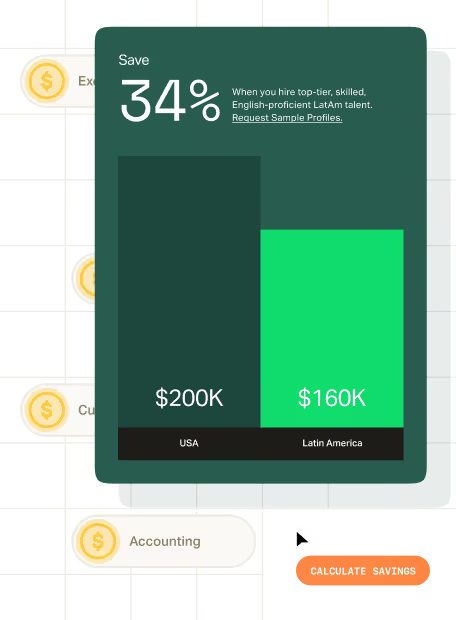
When sourcing remote finance talent from Latin America, one of the best regions for US companies hiring remote finance talent, you can typically save 30–70% compared to equivalent roles in the US.
The table below shows what that looks like across five common roles, based on current compensation benchmarks for Latin American professionals.
The range reflects real variation across countries and experience levels, and covers base salary, but the savings hold up across the board.
For a full breakdown by role and seniority level, the finance and accounting salary guide has detailed ranges. You can also compare LatAm and US rates directly using Near’s salary guide.
How to Choose the Best Country to Hire Remote Finance Talent
The best countries to hire remote finance talent share five practical criteria. Get these right, and the specific country almost selects itself.
1. Assess skill level and expertise
Credential depth varies more than most hiring managers expect. Argentine accounting degrees require five to six years of study, producing graduates with a level of technical rigor comparable to a US CPA program. Colombian professionals increasingly have Big Four exposure through shared services centers in Bogotá and Medellín.
For senior roles, controller-level or above, prioritize countries with strong university programs and a history of multinational firm presence. For mid-level accounting and bookkeeping, the talent pool across Colombia, Argentina, Brazil, and Mexico is broad.
2. Evaluate economic stability
A stable economy correlates with a more predictable hiring environment. In LatAm, Colombia and Mexico have maintained relative macroeconomic stability over the past several years, which translates into a steady supply of professionals who aren’t likely to relocate or shift markets unpredictably.
Argentina has experienced significant currency volatility, but the professional talent market has remained strong. Most finance professionals there have client-facing work that is USD-denominated, shielding them from the local inflation dynamics that affect other industries.
{{offshore-talent}}
3. Analyze cost effectiveness
Factor in the full cost of the hire, not just base salary. Beyond the salary benchmarks in the table above, the cost structure depends on whether you’re using an Employer of Record, a direct contractor arrangement, or a placement partner.
EOR fees typically run $300–$600 per month on top of salary. For mid-level roles where the LatAm salary is already 55–65% below US equivalents, that fee still leaves substantial savings.
See the compliance sub-section below for more on how the structure affects total cost.
4. Technology infrastructure
Colombia, Argentina, Brazil, and Mexico all have reliable broadband infrastructure in major cities and strong adoption of cloud-based financial platforms, including QuickBooks, NetSuite, SAP, and Xero.
For roles that require daily use of US-based financial systems, prioritize candidates with direct experience on your specific stack. Our screening process at Near includes platform-specific technical evaluation for finance roles.
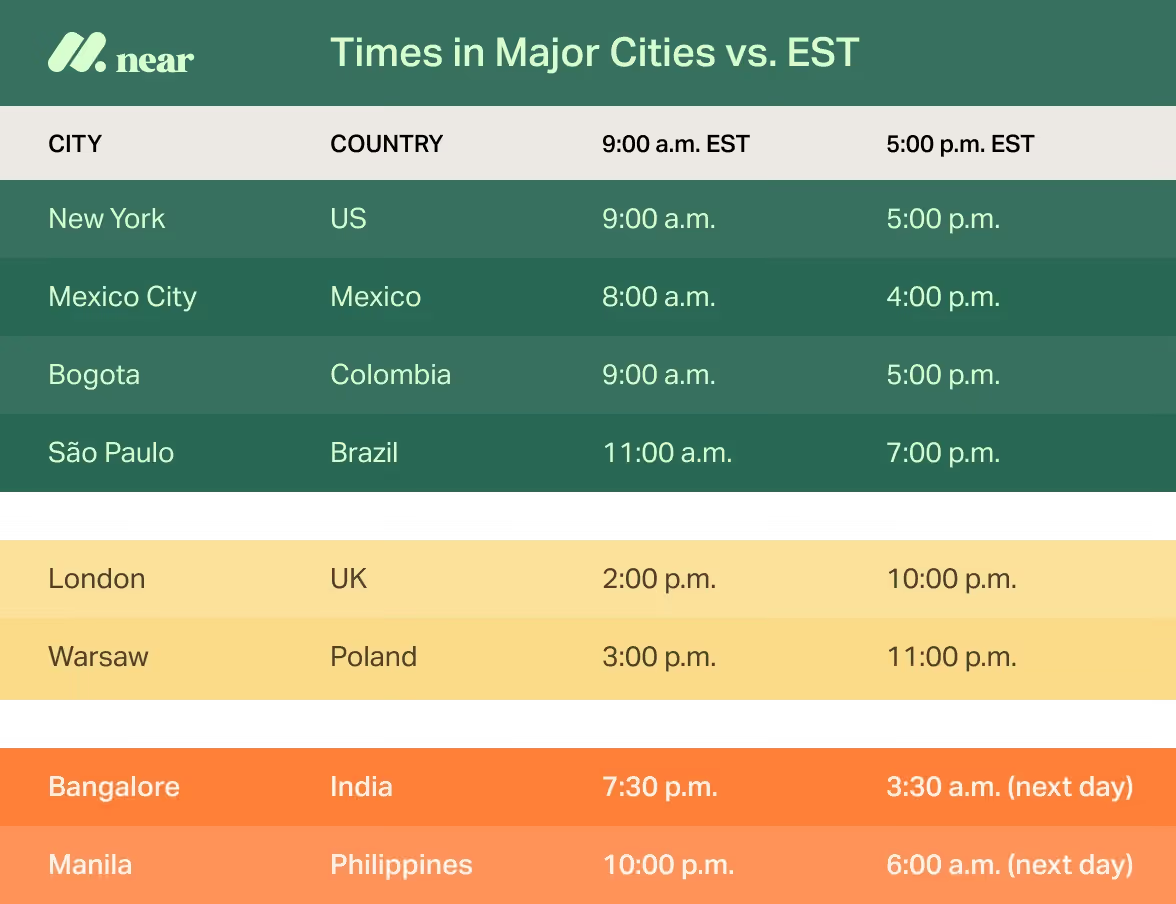
5. Time zone and operational overlap
The time zone gap between your US team and your remote finance hire is the single most important operational factor. Finance functions that require real-time collaboration, month-end close, investor reporting, audit support, and FP&A review cycles work best when both teams are on the same clock.
The table below shows how each region stacks up:
Compensation and Compliance: What To Know Before You Hire Abroad
Whether you need an Employer of Record depends on how you structure the hire.
If you’re bringing someone on as a full-time employee in their home country, an EOR handles local payroll, benefits, and legal compliance on your behalf. You pay the EOR, the EOR pays your hire in local currency, and you avoid the complexity of setting up a local legal entity.
If you’re hiring as an independent contractor, an EOR isn’t required, but a proper contractor agreement is. The contractor structure is simpler but carries misclassification risk if the working relationship resembles employment under local law.
For US companies hiring in Colombia, Argentina, Brazil, and Mexico, the legal and EOR ecosystem is well developed. Each country has established frameworks for foreign-company employment arrangements, and multiple EOR providers specialize in LatAm compliance.
The key is deciding on your preferred structure before posting the role, since it affects how you onboard, how you handle benefits, and how you calculate total compensation.
How to Manage Remote Finance Teams Across Time Zones
Time zone alignment isn’t just a hiring convenience. For finance teams, it determines whether your remote hire can function as a full team member on the truly important decisions.
Here are a few practices that make remote finance teams work well across time zones:
- Run a daily standup at the start of the US workday so your LatAm hire is plugged into priorities before your domestic team gets deep into execution.
- Set clear deadlines for async-friendly work (transaction processing, reconciliations, accounts payable and receivable, and routine reporting), so handoffs don’t require real-time coordination.
- Reserve real-time collaboration for the work that needs it: Month-end close, FP&A reviews, audit responses, and any decision that can’t wait until the next day.
- Use a shared project management tool to track status between sessions, so nothing falls through overnight.
Final Thoughts
When CyberFortress couldn’t find or afford senior finance professionals in the US, they built a 20-person team through Near, saving $1.2 million annually and closing their books 33% faster. The team included a CFO, a director of accounting, and a treasury manager, all placed from Latin America.
If you’re evaluating the best countries to hire remote finance talent for your team, a 20-minute call is enough time to walk through the specific roles you need, share salary benchmarks, and explain how our process works.
If you’re ready to explore what that looks like for your team, Near’s finance and accounting roles page is a good starting point. You can also browse Near’s Finance industry page and Accounting industry page for more on how we place professionals in your sector.
Schedule a free consultation to get started.
Frequently Asked Questions
How much does a remote finance hire from Latin America cost vs. a US hire?
US companies typically save 30–70% hiring finance professionals from Latin America compared to equivalent US roles. Based on current compensation benchmarks for Latin American professionals, a mid-level financial analyst costs $36K–$48K annually in LatAm versus $87K–$133K in the US. A mid-level controller runs $42K–$60K in LatAm versus $110K–$192K in the US.
For a full breakdown by role, see the salary benchmarks table above or the LatAm vs. US salary guide.
Which of the best countries to hire remote finance talent have the strongest English-proficient professionals?
Colombia and Argentina lead for English proficiency combined with finance expertise. Argentina ranks 26th globally and 1st in Latin America on the 2025 EF English Proficiency Index, the highest of any LatAm country. Colombia and Mexico both have improving scores driven by the growth of multinational shared services operations in Bogotá, Medellín, and Mexico City.
The Philippines also has strong English proficiency as an official language, but the 12–15-hour time zone gap creates collaboration friction for most US finance teams.
For roles requiring daily English communication with US executives or clients, Argentina and Colombia are the most consistent options.
What’s the best time zone overlap for finance teams supporting US operations?
Latin America offers the strongest time zone overlap for US finance teams, with most countries within 1–3 hours of US Eastern time. Colombia sits on the same clock as US Eastern Standard Time for most of the year. Argentina and Brazil run 1–2 hours ahead. Mexico City runs 1–2 hours behind.
India and the Philippines are 9–15 hours ahead of US Eastern time, which creates real collaboration challenges for finance functions that require real-time decision-making.
What other finance and accounting roles can I hire remotely from these countries?
Beyond the general finance professionals mentioned in this guide, companies successfully hire a wide range of specialized roles from Latin America and other regions.
These include bookkeepers for daily transaction management (see Hire With Near’s remote bookkeeper guide for a full breakdown), financial analysts for forecasting and reporting, payroll specialists for employee compensation management, accounts receivable specialists for invoice and payment tracking, and staff accountants for general ledger maintenance. Companies also hire accountants and controllers for oversight of the full accounting function.
The same benefits of cost savings and time zone alignment apply across all these roles.
Which industries hire remote finance professionals from Latin America?
All industries hire remote finance professionals, but demand is especially strong in sectors where financial complexity or scale makes US-only hiring cost-prohibitive.
SaaS companies rely on LatAm finance talent for FP&A, revenue recognition, and financial reporting as they scale. Insurance companies hire remote financial analysts and controllers for claims reserves and statutory reporting. Real estate firms use LatAm professionals for property accounting and multi-entity consolidations.
Fintech companies hire for compliance-heavy financial roles, while manufacturing and oil and gas companies bring on finance professionals for cost accounting and capital project reporting.







.webp)


%203.svg)
.avif)





%20(1).avif)

%20(1).png)