


%203.svg)
Key Takeaways
- Finance outsourcing engages financial services or talent from outside your organization, usually through a third-party firm or by hiring dedicated, full-time remote professionals.
- The goal of finance outsourcing is to reduce costs and access specialized expertise.
- Latin America offers a middle path between traditional outsourcing and expensive in-house hiring, with employees who work exclusively for your company, in your time zone, at a fraction of the US cost.
Finance outsourcing has gone mainstream, but many companies still land on the wrong model. They pay for an accounting firm that bills by the hour and treats them as one of fifty clients, or they hire offshore in Asia and spend the next six months chasing responses across a 10-hour time gap.
So, while there’s nothing wrong with outsourcing finance, the version most companies try first is inadequate for their needs.
According to ManpowerGroup's 2024 Global Talent Shortage survey, 75% of employers worldwide report difficulty finding skilled talent. Meanwhile, qualified finance professionals based in Latin America are actively looking to work with US companies.
This guide covers what finance outsourcing is, the real pros and cons, and why hiring finance and accounting talent in Latin America has become the most practical option for US companies that want the cost savings of outsourcing without giving up control over their team.
What Is Finance Outsourcing?
Finance outsourcing refers to engaging financial services or talent from outside your organization. Instead of using your finance department in-house, you hire a third party to take on finance functions, including:
- Financial analysis
- Financial planning
- Investing
- Risk management
Keep in mind that financial services are not necessarily accounting services. While financial services focus on planning and directing financial transactions, accounting records and reports those transactions. Finance professionals also do not usually take on accounting functions. This is a critical distinction to keep in mind when outsourcing your finance roles.
You may need to outsource your financial management functions for several reasons, which we'll discuss in the next section.
What Are the Benefits of Outsourcing Finance?
Whether you use an outsourcing company or a freelancer, finance outsourcing gives you access to experienced professionals at a lower cost, without the overhead of building an in-house team from scratch. Outsourcing also gives you access to better talent and established technologies and systems.
Your budget goes further with LatAm finance talent
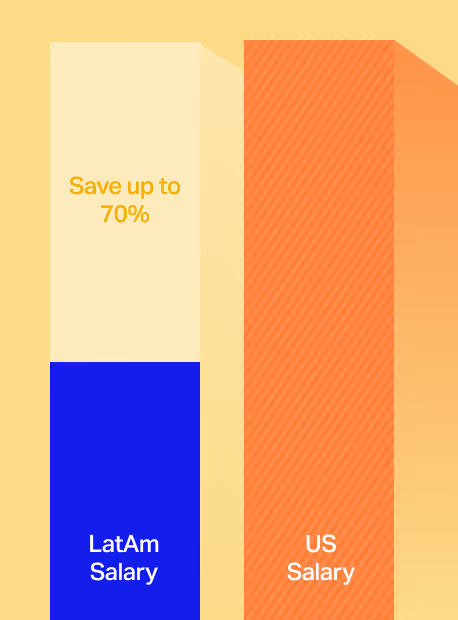
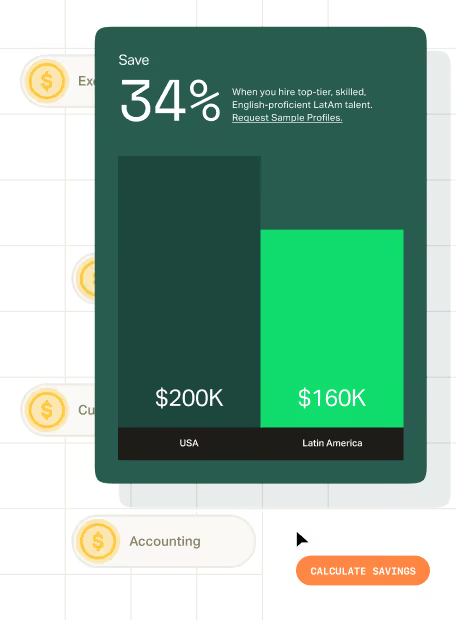
The biggest driver for most companies is cost. Hiring a senior financial analyst in the US typically costs $87,000–$133,000 per year. A financial analyst based in Latin America with equivalent experience typically earns $24,000–$60,000 per year, a savings of 48–70%.
According to Hire With Near's research on why US companies hire in LatAm, 41% of US companies turn to Latin America specifically because budget constraints make domestic hiring unfeasible. For many of these companies, the alternative to outsourcing or LatAm hiring isn't a US hire. It's no hire at all.
Training costs also disappear. An outsourced finance professional or a direct LatAm hire will already have the expertise to get started. You onboard them to your company and processes, not to the fundamentals of their job.
What finance roles cost in Latin America versus the US
The salary table below shows representative benchmarks across Finance & Accounting roles. Note that these are compensation ranges based on industry data; actual figures vary by seniority, country, and specific experience.
For a full breakdown of compensation benchmarks by seniority, see our finance roles salary guide.
You skip the upfront technology investment
Hiring a finance team in-house requires you to invest in technologies, software, and systems for them to use. Outsourcing doesn't come with those costs. Your outsourced talent typically already has the technology platforms they need. They'll update their software knowledge and skills independently to stay current.
This lets you access the output of new technologies and systems without purchasing or building them yourself.
You reach a wider talent pool
In-house hiring has real limits: geography, salary expectations, and competition. A mid-market company in a smaller US city may simply not have access to the finance talent a Fortune 500 can attract.
Finance outsourcing removes those barriers. You can access candidates with strong qualifications from top universities across Latin America, regardless of your company's size or location. What you can't offer a senior financial analyst in Austin, you may be able to offer a senior analyst in Buenos Aires.
What Are the Risks of Outsourcing Finance?
Traditional finance outsourcing has three well-documented failure modes:
- Loss of process control
- Time zone gaps that slow everything down
- Finance professionals unfamiliar with US compliance standards
Here's what each risk actually looks like, and what determines whether it's a real problem or a manageable one.
Autonomy
The core problem with outsourcing to a firm (as opposed to hiring a dedicated professional) is that the firm serves multiple clients at once. Their processes, systems, and timelines are theirs, not yours.
One business owner in media and e-commerce described it directly: "When you use these accounting firms that you work with, they're good, but they put a lot of burden back on you, and it's not your team that's aware of it. So it ends up falling back on the principles of the company."
You lose some control with an outsourced team compared to having a fully in-house department you can shape according to your company's standards. If you want full control over how finance functions are carried out, the outsourcing firm model creates friction. A dedicated hire, someone who works exclusively for you, is a different proposition entirely.
One SMB owner in professional services explained it like this: "I want to own the employee. I want them to work for me."
Response time
Working with talent across distant time zones creates delays that are especially painful for finance work. A question sent at 3 PM your time shouldn't sit unanswered until the following morning. However, that's the default when your finance team operates on a 10–12 hour difference.
A niche real estate tax consulting firm that tried Asia-based offshore hiring described the pattern:
The CPAs they sent me were from the Philippines, and the problem was they didn't want to work on our time zone. And then they started sending me people [from other countries] with no experience and no knowledge of how the US tax system works. They just didn't send me very highly qualified candidates.
If fast responses and work overlap matter to you, the answer is hiring finance talent based in nearshore Latin American countries. Because LatAm professionals work during US business hours, your team in Buenos Aires is never more than 2 hours ahead of your New York team. The time zone gap that derails Asia-based offshore arrangements simply doesn't exist.
Experience with US laws
Finance functions in the US need to comply with US Generally Accepted Accounting Principles (US GAAP), while most other countries use the International Financial Reporting Standards (IFRS).
Not every finance professional based outside the US will have direct US GAAP experience. That's true. But the concern is far more manageable for Latin American talent than it is for Asia-based offshore candidates, for a specific reason.
In my five years sourcing finance and consulting talent at Hire With Near, the US GAAP concern comes up in almost every conversation. And the answer I give clients every time is the same: LatAm finance professionals have strong academic training and significant exposure to Big Four firms. That gives them experience with international markets and makes them very well versed in key accounting standards like US GAAP and IFRS (the most common requirements we see from our clients).
Big Four exposure (PwC, EY, Deloitte, KPMG) is one of the strongest signals I look for when screening tax accountants and financial analysts. Argentina, in particular, has a deep talent pool of finance professionals with that background. If US GAAP compliance matters for your role, it should be in the job description. But it's a requirement that narrows the field, not one that closes it.
Why Hiring in Latin America Offers the Best of Both Worlds
Traditional outsourcing has one major appeal, and that’s the cost savings. Hiring an in-house US team has another major appeal—control. Latin America direct hiring, done through a staffing partner like Hire With Near, gives you both.
Here's how these options stack up:
Traditional outsourcing firm: It offers lower cost, but you're one of many clients. They follow their processes, not yours. There are delays when priorities shift, and the burden of coordination falls back on you.
In-house US team: You get full control and team integration. But at $80K–$150K per financial analyst, the cost is prohibitive for most SMBs, and the hiring timeline can stretch for months.
Dedicated LatAm hire through Hire With Near: You’ll pay salaries 40–70% lower than US rates. They work exclusively for your company, follow your processes, and work in your time zone. Talent integrates with your team the same way a US employee would.
Across the LatAm finance market, where roughly 80% of the candidates I place are based in Argentina, the quality of candidates consistently exceeds what companies expect. According to Hire With Near's 2026 State of LatAm Hiring Report, 84% of placements were mid-level or senior. Companies aren't hiring junior talent to cut costs. They're hiring experienced professionals at rates that simply wouldn't be possible in the US.
FinanceWithin, a fractional finance services firm in Austin, Texas, had tried both US hiring and India offshore before switching to Hire With Near. US candidates were too expensive, and their India-based placements led to high turnover and inconsistent quality.
After a client referral, they built a full finance team through Hire With Near, including Senior Bookkeepers, Accounting Managers, External Accounting Managers, and Financial Analysts. The pre-vetted pipeline eliminated resume screening and cut their time-to-hire from 3 weeks to 7 days. They took on 10 new client engagements at once without adding internal recruiting headcount, and reduced their annual hiring costs by $535,000. (That’s a 64% reduction versus US-based hires.)
Sheena Malson, Director of Accounting at FinanceWithin, shared more details. "When we saw candidate quality, it became clear these were truly top-tier professionals, better than what we found independently."
The finance industry recruiters who work with Hire With Near see this pattern consistently. Once they understand what it actually involves, companies that have tried both outsourcing firms and US hiring choose LatAm direct hiring. For executive-level finance hires (CFO, VP of Finance, Director of Accounting), Hire With Near also offers executive search in Latin America, including full sourcing, vetting, and placement support.
If you're evaluating finance talent options, Hire With Near's nearshore staffing service gives you the dedicated-employee model with the cost structure of outsourcing.
{{state-latam-hiring}}
What Finance Services Can You Outsource?
If you're considering outsourcing all your finance functions to a single individual, that's not the right approach. Finance professionals have specific fields of expertise. That’s why you should choose which specific functions to outsource or hire for, including the following.
Financial controller
A financial controller takes on a broad scope of responsibilities, and they typically report to the chief financial officer (CFO). Outsourcing this function or hiring a dedicated controller can help yield accurate financial reports and analyses, and give you access to strategic guidance to improve your finances.
A financial controller's responsibilities include the following:
- Audit reporting
- Compliance management
- Employee and vendor communication
- Management reporting
- Policy and procedures guidelines and adherence
- Transactional processing oversight
Financial planning and analysis (FP&A)
FP&A professionals take on activities that support your business's financial health. These include:
- Planning and budgeting
- Integrated financial planning
- Management and performance reporting
- Forecasting and modeling
For a growing company, that might mean building a 12-month cash runway model or identifying which cost centers to trim before a fundraise.
Business intelligence analyst
Business intelligence professionals use technology and systems to analyze data and convert it into actionable information. While perhaps not always thought of as a finance role, a strong business intelligence analyst in your finance department is key to having the data the CFO needs to make financial decisions. Among their responsibilities:
- Assisting in software and hardware launches
- Creating policies and procedures for data collation and analysis
- Evaluating and screening data
- Building executive dashboards and financial reports for the CFO
- Overseeing the use and collection of data
- Improving business operations
Chief financial officer (CFO)
A CFO is the highest-ranking professional in a company's finance team. They are primarily responsible for overseeing all finance functions to ensure the financial health of your organization.
Their roles include:
- Tracking the company's cash flow
- Analyzing financial strengths and weaknesses
- Creating corrective action plans
- Preparing financial forecasts
CFOs must have the expertise to lead a company into solid financial health. Hiring a freelance CFO can be of great benefit, allowing you to focus on growing your business while your CFO monitors your financial situation and makes sure cash flows stay healthy.
In addition to outsourcing your CFO, you can use Private Equity Analysts to access specialized investment expertise without the cost of in-house staff.
Related reading: How Nearshore Hiring Strategies Increase Company Valuation
Final Thoughts on Finance Outsourcing
The case for finance outsourcing is strong and includes cost savings, access to specialists, and flexibility. But the traditional outsourcing firm model comes with tradeoffs that frustrate most companies over time. You may end up with processes you don't control, communication lags, and the sense that your finance needs are one item in someone else's queue.
Hiring dedicated full-time finance professionals based in Latin America through Hire With Near gives you the savings without those inconvenient tradeoffs.
The Bureau of Labor Statistics projects employment of financial managers to grow 15% between 2024 and 2034. Demand for finance talent isn't slowing down, and neither is the cost of US-based hiring.
If you want to explore what that looks like for your specific roles and budget, the best next step is to book a free consultation to talk through your requirements with our team.
They'll give you salary benchmarks and explain the process so you have the information you need to decide if it's right for you.
Book a free consultation with our team.
{{latam-hiring-cta-v2}}
Frequently Asked Questions
Are finance jobs being outsourced?
Yes, this practice is widespread and growing. Companies outsource roles ranging from bookkeeping and accounts payable to financial analysis, FP&A, and fractional CFO services. The trend has accelerated as companies seek to reduce hiring costs and access qualified finance professionals without committing to the full cost of a US-based hire. Many companies that start with a third-party firm eventually transition to hiring dedicated full-time remote finance professionals because of the control and alignment benefits.
What are the best finance and accounting outsourcing companies?
Several strong providers offer finance and accounting outsourcing at different scales. Companies like Hire With Near, IBM, Deloitte, and PwC offer a range of services from basic bookkeeping to strategic CFO advisory. Each brings different strengths, with some specializing in technology integration and others in specific industries. Many offer global reach. For a detailed comparison of the top finance and accounting outsourcing companies, including specializations and key features, see our comprehensive guide.
Should I use a staffing agency instead of an outsourcing company for my finance needs?
A staffing agency is the better option if you want full control over your finance team. These agencies help you build your own dedicated team with professionals who work exclusively for your company, giving you direct oversight of processes, deadlines, and quality. Outsourcing companies, on the other hand, provide project-based services where you're typically one of many clients. If you want dedicated professionals integrated with your team, specialized finance staffing agencies give you access to pre-vetted candidates quickly while keeping you in control.
What finance and accounting roles can I hire remotely in Latin America?
Latin America offers a deep talent pool for hiring remote finance professionals across all levels and specializations. Companies successfully hire roles such as accountants, bookkeepers, financial analysts, payroll specialists, accounts receivable specialists, accounts payable specialists, private equity analysts, tax accountants, credit analysts, investment analysts, and treasury analysts from the region.
Further reading: Why More US Businesses Are Hiring in Latin America: What We Learned from Talking to 2,000 Hiring Managers
Does hiring offshore finance professionals work well for US companies?
Yes, and for finance roles specifically, the model translates well. Stanford economist Nick Bloom, who has spent two decades studying remote and distributed work, argues companies should evaluate remote arrangements on profitability, not just productivity. On that metric, distributed teams have a clear advantage with no office overhead and access to talent beyond local geography.
Why is Latin America a strong alternative to traditional outsourcing?
Latin America gives you the economic advantages of outsourcing with the control of in-house hiring. LatAm finance professionals work during US business hours (no waiting overnight for responses) and have strong academic training and Big Four exposure that covers US GAAP and IFRS requirements. When hired as dedicated full-time employees, they work exclusively for your company following your processes.
What industries commonly outsource finance functions to Latin America?
Finance outsourcing is practiced across virtually every industry, but the driver is usually company size and transaction volume rather than sector. That said, some industries are consistently most active.
- Finance companies (investment firms, family offices, and asset managers) outsource analyst and FP&A roles to control headcount costs.
- Fintech companies need finance professionals comfortable in fast-moving, tech-forward environments.
- SaaS businesses outsource financial reporting and modeling to stay lean during growth phases.
- Healthcare and insurance organizations outsource finance functions to manage complex billing and compliance reporting.
- Real estate companies commonly outsource financial analysis and cash flow management for their portfolios.







.webp)


%203.svg)

.avif)





%20(1).avif)

%20(1).png)