


%203.svg)
Key Takeaways
- A clean energy technology company hired a data and operations specialist based in Latin America for $2,500 a month ($30,000 a year), a 62% savings against the $79,000 annual salary a similar US hire would command.
- The hire hadn't started out in data. She built her technical skill set in stages, moving from customer and technical support into data analysis and then data engineering, before joining the client with a mix of SQL, Python, and cloud data tools most companies would expect from a much more expensive resume.
- Hire With Near sources and screens data and operations talent across Latin America, provides country-specific salary ranges before a search starts, and charges no fee until placement.
A clean energy technology company had built a software platform that manages onsite solar, battery storage, and other distributed energy resources for multi-tenant properties, generating an individualized monthly bill for every tenant based on utility, tariff, and consumption data.
That billing engine only works if the data behind it is accurate: rent rolls have to reflect who lives where, solar activations with the utility have to be tracked and confirmed, and tariff changes have to be caught before they throw off a bill.
The company needed someone who could own that operational and data layer full-time, but for a growing clean energy platform still building out its back office, a US hire was out of reach: a comparable professional in the US typically runs in the high $70,000s to low $80,000s a year, once you factor in the SQL, Python, and SaaS-operations background the role called for.
To solve that, the company turned to Hire With Near to hire data and AI talent in Latin America, landing on a data and operations specialist based in Argentina.
Why Did This Clean Energy Platform Look to Latin America for Data and Operations Support?
Latin America wasn't a new experiment for this company. It had already built a small Latin America-based team, and working with talent in the region was already part of how the company operated.
What mattered for this specific role was the schedule. The team runs on a Pacific business day, and the work itself doesn't tolerate a delay: a tenant billing question, a utility activation that needs following up, or a tariff change that needs flagging can't sit overnight.
That ruled out the kind of support model many companies build around offshoring to a distant region, like a Southeast Asian country, where a large time difference means a data issue caught at the end of the US business day waits until the next one to get resolved.
Latin America closed that gap. A data and operations hire based in the region can structure a full working day around US business hours, so the same person who is reviewing rent rolls in the morning is also the one flagging a tariff change in the afternoon.
That kind of same-day coverage is a core reason nearshore staffing has become the default model for US companies running time-sensitive operations.
Related reading: Why More US Businesses Are Hiring in Latin America
What Does a Data and Operations Specialist From Latin America Look Like?
For this particular role, Hire With Near sourced and screened for a specific combination: hands-on SQL and Python experience, not just familiarity with the terms, plus a background in SaaS operations or data management, and the ability to explain a technical data issue to a non-technical colleague without losing them.
That last part was tested directly, not assumed. Candidates get a live technical exercise, not just a resume claim, because a candidate who says they're “comfortable with SQL” after a short course reads very differently from one who has had to use it on the job.
The person hired had built his data expertise across earlier roles, rather than arriving with a single technical credential. . She built her technical skill set across earlier roles, moving from operational and support work into data analysis and engineering, working across CRM, operations, and engineering teams to build integrations, self-serve dashboards, and automated alerting.
By the time she joined this client, she was working comfortably with Python, SQL, cloud data tools, REST APIs, and BI platforms, on top of the operations instincts she built early in her career.
That progression, from support to analyst to engineer, meant he could sit with a rent roll report or a tariff change and immediately understand both the data problem and the operational consequence if it went unresolved.
A Data and Operations Hire at $30,000 a Year vs. $79,000 for a US Equivalent
The hire took over the core data and billing operations work: reviewing rent roll reports and updating tenant billing agreements, making sure move-out bills were processed correctly, tracking utility rate and tariff changes, and flagging solar activation issues with utilities before they became billing problems.
She also started identifying where manual work could be automated instead of just executed by hand, the same instinct she showed throughout her earlier data and engineering work.
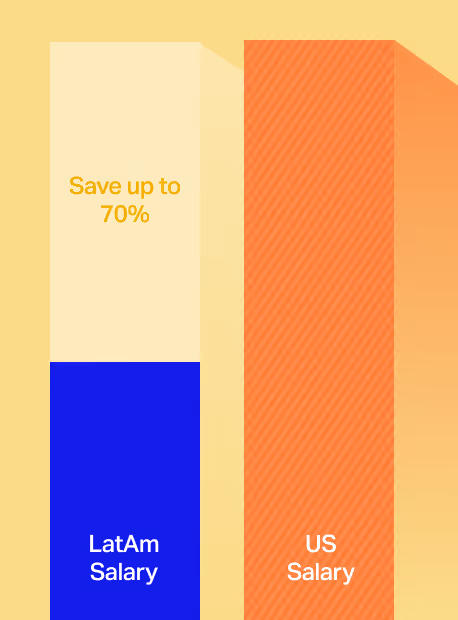
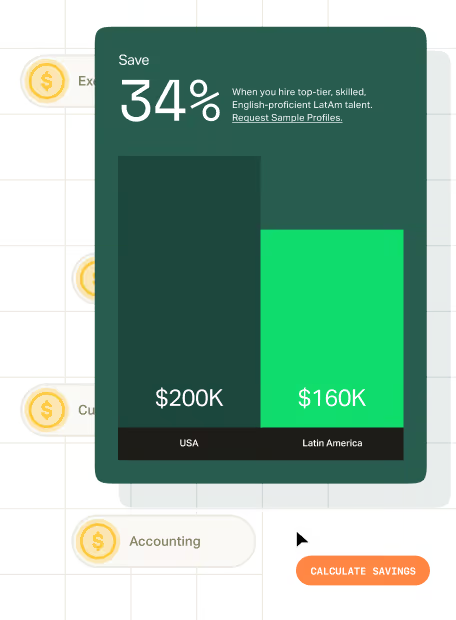
At $2,500 a month, or $30,000 a year, against a $79,000 US equivalent salary, the company covered a role that touches every tenant's bill at a 62% savings, without asking a single person to juggle data accuracy, billing operations, and utility coordination as an afterthought.
That savings rate also lines up with what companies typically see when hiring in Latin America more broadly, not just for this kind of role. Across the roles we place, companies typically save 30 to 70% compared to a US equivalent salary, translating to $35,000 to $64,000 per hire on average.
{{prevetted-banner}}
Salary Benchmarks: Data and Operations Roles in Latin America
Hire With Near's salary benchmarks for data and operations roles in Latin America show the following:
For the most up-to-date figures, see Hire With Near's US vs Latin America Salary Guide.
Actual compensation depends on experience, scope, and country. We'll give you a specific range at the start of a search.
How One Hire Became a Trusted Part of the Team, Not Just a Filled Role
The clearest sign this Argentine hire worked out came well after onboarding. The company continued growing its Latin America-based team, and this hire played a role in that process, contributing to interviews and assessments for later searches.
That's not something a company does with a role it sees as a temporary fix. It's what happens when a hire has shown, repeatedly, that they understand the work well enough to help judge it in someone else.
Related reading: Hiring in Argentina: Great Talent, Significant Savings, and What US Companies Need to Know
Why Does Latin America Work for Clean Energy and Proptech Data Operations Hiring?
Clean energy and proptech platforms need data to be accurate, current, and tied to a real-time operational process. That's exactly what a strong Latin American hire can bring to the table.
A support-to-data-engineering career path is common across the region's tech talent market
Plenty of strong data and operations candidates in Latin America didn't start in a data role. They built their technical skills in stages, often starting in a customer or technical support role and picking up SQL, Python, and integration work along the way because the job demanded it.
That path tends to produce professionals who are equally comfortable with the data and with the operational reason the data matters, which is exactly what a billing or utility-coordination role needs.
Time zone overlap keeps billing and utility work moving in real time
A tariff change, a stuck utility approval, or a billing discrepancy doesn't wait for a convenient time zone. Latin America's overlap with US business hours means these issues get caught and flagged the same day, instead of sitting in a queue until the next morning.
You can see how time zones overlap in the table below:
Note: Most Latin American countries don't observe Daylight Saving Time, so these times shift by one hour outside of March–November, when the US reverts to standard time.
SaaS and data-operations experience transfers directly to clean energy platforms
The underlying skills (SQL, data validation, API integrations, process automation) aren't specific to one industry. A candidate with a strong SaaS operations or data background can pick up the specifics of solar billing, utility tariffs, or NEM-style activation processes quickly, because the harder skill (structuring and trusting a messy data process) is already there.
Companies looking for a SaaS recruiting agency that understands this kind of data-heavy operational hiring will find the same sourcing approach works well for energy and proptech platforms built on similar data infrastructure.
How to Hire a Data and Operations Specialist Through Hire With Near
To hire a data and operations specialist in Latin America through Hire With Near, the process is simple and moves quickly. Most companies hire a candidate within 7–21 days.
We start with a kickoff call to understand the specific data and operational processes the role needs to own: what systems it touches, what “accurate” looks like for your billing or reporting cycle, and how much SQL, Python, or API experience the work requires versus what's nice to have.
From there, we source from our pool of 160,000+ pre-vetted candidates and run fresh sourcing against that specific profile, so you're not limited to whoever happens to be available. We run first-round interviews that verify English proficiency and prior experience before you see a shortlist in 3–5 days.
If your search calls for a technical assessment or case study, we can help design and administer it, though most clients run their own once they have a shortlist.
If you're new to hiring internationally, payroll, benefits administration, and compliance are handled as part of our staffing service, so the hire integrates into your team without you having to build that infrastructure yourself. And if a hire doesn't work out, our 180-day replacement guarantee means the search doesn't start over from scratch.
There's no retainer and no fee until you hire.
If you need to hire a data and operations specialist and want to know exactly what that role costs in the country you want to hire from, book a free discovery call today. We'll give you specific salary ranges and answer all your questions.
In the meantime, check our “How to Hire Data and AI Roles in Latin America” guide. We share the most hired roles and their salaries, top countries, and how the process works.


.webp)

.webp)





%203.svg)
.avif)





%20(1).avif)

%20(1).png)