%203.svg)
Key Takeaways
- To hire a strong financial analyst, prioritize advanced Excel proficiency, demonstrated financial modeling experience with US clients or markets, and a clear specialty area (FP&A, M&A, investment analysis). These three signals separate excellent candidates from average ones.
- Specialized nearshore staffing firms can present qualified candidates in 3–5 days and complete most placements within 3 weeks, significantly faster than DIY recruiting, which typically takes 6–12 weeks.
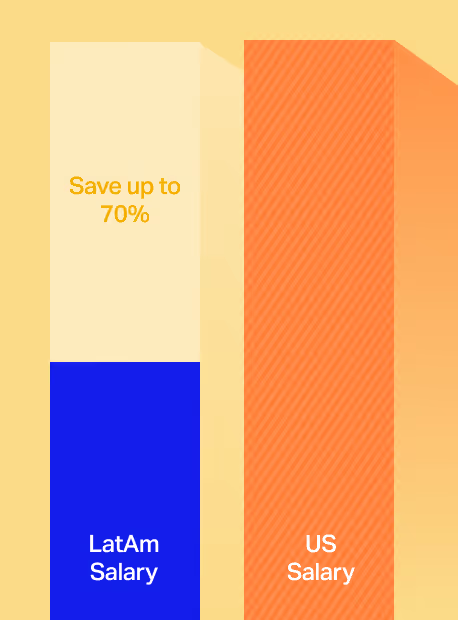
- Financial analysts based in Latin America typically cost $24,000–$60,000 per year, compared to $80,000–$150,000 for equivalent US hires, a savings of 35–80% depending on seniority level.
If your company needs sharper forecasts, cleaner budget discipline, or faster readouts on unit economics, it's time to hire a financial analyst: someone who can turn numbers into plans your operators can really use. The challenge is that strong financial analysts are increasingly hard to find at a price that makes sense, and the hiring process moves fast enough that slow decisions lose good candidates.
To hire a financial analyst, you need to define the specialty first: whether FP&A, corporate finance, or investment analysis. Then, decide between hiring in the US or in Latin America based on your budget, set up a practical skills assessment, and move within 48 hours of your final interview.
In this guide, I cover what a financial analyst does, the realistic compensation for both US and Latin American hires, the skills that matter, where to find great candidates, how to run a tight hiring process, interview questions that reveal fit, the mistakes to avoid, and when a recruiting partner makes sense.
If you're considering hiring a financial analyst in Latin America, whether to reduce costs or access a deeper talent pool, this guide is for you.
What Does a Financial Analyst Do?
A financial analyst turns raw financial data into the forecasts, models, and budget analyses your leadership team needs to make decisions.
Core responsibilities include:
- Analyze and manage budgets: Thoroughly evaluate fiscal strategies to identify potential savings and ensure efficient resource allocation aligned with company financial goals. This includes variance analysis and budget optimization recommendations.
- Inspect financial reports: Regularly analyze financial reports to provide insights into the company's financial health, helping stakeholders make informed decisions based on current fiscal data and trending patterns.
- Craft financial models: Create sophisticated financial models for forecasting and strategic planning. These models predict future financial scenarios and guide companies in making prudent financial choices across different market conditions.
- Conduct financial analyses: Perform in-depth analysis to forecast economic conditions and market trends.
- Generate financial reports: Produce comprehensive reports highlighting financial trends, irregularities, and projections that enable data-driven decisions and maintain fiscal health.
- Conduct market research: Analyze industry trends and market intelligence using advanced tools, providing valuable insights that influence corporate strategy and investment decisions.
The role can look different depending on the industry and company size. In smaller organizations, financial analysts often wear multiple hats, handling everything from budget analysis to investment research. In larger companies, they might specialize in specific areas like corporate finance, investment analysis, or risk management.
Regardless of the setting, their core mission remains the same: turning data into decisions that drive business growth.
And the demand for these skills continues to grow: the US Bureau of Labor Statistics (BLS) projects 6% employment growth from 2024 to 2034, faster than the average for all occupations. With a shrinking domestic talent pipeline, more US companies are turning to Latin America to find the financial analysts they can't hire fast enough domestically.
What Skills Should You Look For When Hiring a Financial Analyst?
Across the financial analysts I've placed for US clients, three skills consistently separate strong hires from average ones: demonstrated experience with US-market financial modeling, advanced Excel proficiency, and a clear specialty area.
Candidates who have all three are the ones clients come back to hire again.
Hard skills (the must-haves)
- Financial modeling and analysis: Look for proven experience building comprehensive financial models, particularly those involving US markets or clients. This includes DCF analysis, scenario planning, and sensitivity analysis capabilities. US-market modeling experience is the most reliable signal of quality: it tells you the candidate has already worked within the same financial frameworks, reporting standards, and business context you're operating in.
- Advanced Excel proficiency: Beyond basic spreadsheet skills, seek candidates comfortable with advanced functions, pivot tables, and financial modeling techniques. Advanced Excel is non-negotiable. ERP tool experience is secondary.
- Industry expertise and clear specialty: Understanding your specific sector enables analysts to interpret data accurately, ensure compliance with industry regulations, and provide relevant insights. In interviews, ask candidates directly which area of finance they specialize in: investments, financial modeling, due diligence, FP&A, or M&A. A candidate with a clear specialty has usually gone deeper in that area.
- Financial reporting and compliance: Strong grasp of financial statement preparation, regulatory requirements, and accounting principles. US GAAP familiarity is valuable for US companies. In the LatAm talent pool, Big Four exposure tells you the candidate has had the rigorous technical training clients are looking for.
Soft skills
Hard skills get a financial analyst through the door. But the ones who deliver consistently do it because of their soft skills. Here are the ones that predict performance:
- Communication excellence: Financial analysts must clearly convey complex financial concepts to diverse stakeholders. How a candidate explains their work in an interview previews how they'll explain it to your CFO or board.
- Strong analytical thinking: The ability to synthesize data and identify patterns that drive strategic decision-making. In practice, this means a candidate who doesn't just report what the numbers say but asks why they look that way and what to do about it.
- Attention to detail: Critical for accuracy in financial analysis and reporting. A single misplaced figure in a financial model can cascade through an entire forecast.
Technology proficiency
Financial analysis requires comfort with various software platforms and collaboration tools. Look for experience with:
- Advanced financial software (QuickBooks, SAP, Oracle, Bloomberg Terminal)
- Data visualization tools (Tableau, Power BI)
- Cloud collaboration platforms (Google Workspace, Microsoft 365)
- Project management and communication tools
For companies hiring internationally or managing distributed teams, familiarity with video conferencing platforms and asynchronous collaboration methods becomes particularly valuable.
How Much Does It Cost to Hire a Financial Analyst?
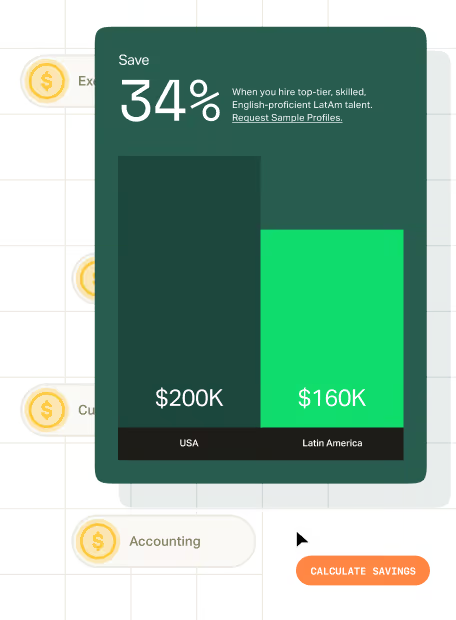
Hiring a financial analyst in Latin America typically costs 35–80% less than the equivalent US hire, without sacrificing technical depth or analytical quality.
According to Hire With Near's 2026 State of LatAm Hiring Report, companies hiring financial analysts from Latin America save between $33,000 and $102,000 annually compared to equivalent US hires.
Here's how the numbers break down by seniority level, based on 2026 compensation benchmarks:
Sources: Hire With Near 2026 Salary Guide; Bureau of Labor Statistics
Hire With Near's analysis of 2,000+ hiring conversations found that 41% of US companies turn to Latin America specifically because budget constraints make US salaries impossible or impractical for the role they need.
One finance manager at a PE-backed startup in field services described it this way:
I need another analyst. But we're limited in our budget and need to run leaner. I'm just finding that I need more skill sets than I'm being given the budget to fill.
That budget flexibility changes what's possible. You can bring on a senior-level analyst for roughly the cost of a junior hire in the US, or build out an entire FP&A function for what one US-based analyst might cost.
For a deeper look at salary data across all finance and accounting roles, see the Finance Roles Salary Guide or the main Salary Guide for US vs. LatAm roles.
{{salary-guide-cta}}
Where Can You Find Financial Analyst Candidates?
The most effective approach combines multiple sourcing channels tailored to your specific requirements and timeline. Different platforms and methods attract different types of candidates, so diversifying your search increases your chances of finding the ideal professional.
That search is getting harder domestically. According to Accounting Today, the number of candidates sitting for the CPA exam has fallen 27% over the past decade, and accounting graduates declined by 17% between 2016 and 2022. This structural decline in the talent pipeline is why expanding your search to remote candidates is increasingly practical rather than optional.
Freelance platforms
Platforms like Upwork, Toptal, and Freelancer offer access to financial analysts available for specific projects or contract work. This approach works well when you need specialized expertise for a defined period or want to evaluate a candidate's work before committing to full-time employment.
The primary advantage lies in flexibility and the ability to review portfolios and client feedback before making decisions. However, finding candidates for long-term positions through these platforms can be challenging, as many freelancers prefer project-based work.
Recruitment platforms
For comprehensive hiring support, finance staffing agencies streamline the entire process from candidate sourcing through onboarding and payroll management. This approach proves particularly valuable when hiring internationally, when you lack internal recruiting capacity, or when you need help with executive-level hiring for roles like Finance Director or CFO.
Some platforms specialize in nearshore professionals, offering benefits beyond basic placement.
For example, Hire With Near connects companies with financial analysts based in Latin America who can work for 35–80% less than US-based talent while maintaining strong qualifications and English proficiency.
Professional job boards and networks
LinkedIn remains the gold standard for finding financial professionals. Use targeted searches, engage with industry groups, and leverage your existing network for referrals. Specialized finance job boards like eFinancialCareers can connect you with candidates actively seeking opportunities.
Industry associations like the CFA Institute and local finance professional groups often have job boards and networking events where you can connect with qualified candidates. These venues tend to attract serious professionals committed to their field.
{{prevetted-banner}}
Why a Specialized Recruiting Partner Fills Finance Roles Faster
Specialized recruiting partners accelerate the hiring process while ensuring better technical and cultural matches, and the difference is especially pronounced when hiring finance roles, where a bad placement is expensive to undo.
A recruitment partner experienced with placing financial analysts understands the nuances of different specializations, whether you need someone focused on investment analysis, corporate finance, or risk management. This expertise helps them identify candidates whose background aligns with your specific requirements rather than presenting generic finance professionals.
FinanceWithin, a fractional finance services firm in Austin, experienced this firsthand. After struggling with high turnover from offshore hires in India and slow internal recruitment, they partnered with Hire With Near to hire financial analysts and other finance professionals.
The results were clear: FinanceWithin saved $535K annually and reduced time-to-hire from 3 weeks to 7 days, and streamlined their interview process from three stages to two, allowing them to support 10 new client engagements at once. Their Director of Accounting, Sheena Malson, put it plainly:
The talent pool from Hire With Near has been outstanding — far beyond what I could find on LinkedIn. The process has been a pleasure.
For international hiring, specialized agencies handle complications like salary benchmarking, legal compliance, and reference checks that can derail internal efforts. They understand local markets and can guide you to competitive offers that attract top talent while delivering the cost savings you're seeking.
Hire With Near works with companies at both ends of this decision: those building a dedicated LatAm finance team for the first time, and those moving away from outsourcing firms in favor of full-time, direct hires.
For a comparison of the outsourcing model, see our guide to finance and accounting outsourcing providers.
How to Run a Tight Financial Analyst Hiring Process
A structured hiring process for financial analysts combines clear criteria, practical skills assessment, and speed: the best candidates rarely wait more than a week before accepting an offer.
Define your needs before sourcing
Clarity drives successful hires. Before posting job descriptions or reaching out to candidates, define exactly what you need.
Are you looking for someone to focus on budgeting and forecasting, or do you need expertise in investment analysis and due diligence?
Consider your industry requirements, company size, and growth stage. A startup might need a generalist who can handle multiple financial functions, while an established enterprise might require specialized expertise in a specific area like FP&A or corporate development.
Structure your evaluation process
Develop a systematic approach to candidate assessment that goes beyond resume review. Create standardized evaluation criteria focusing on specific technical skills, relevant experience, and demonstrated results. Use consistent assessment methods across all candidates to enable fair comparisons.
Test practical skills appropriately
A short case study or practical assessment reveals more about a candidate's abilities than any resume can. Provide them with a realistic business scenario that mirrors the type of analysis they'd perform in your role: evaluating a potential investment, analyzing budget variances, or forecasting revenue based on historical data.
Focus on evaluating how they approach the problem. What assumptions do they make? Can they identify key insights and translate them into actionable recommendations? Look for candidates who can think critically about the data, question underlying assumptions, and draw meaningful conclusions.
The analytical thinking behind the work matters more than which software they use to present it.
Assess cultural fit and communication skills
Cultural fit determines long-term success more than technical skills alone. A financial analyst who doesn't align with your company's working style, values, or communication preferences will struggle regardless of their Excel proficiency or modeling expertise.
This becomes even more critical for remote-first companies or distributed teams. Building a strong company culture across distances requires intentional hiring decisions that prioritize candidates who thrive in your specific environment.
Remote financial analysts need to be self-directed, proactive communicators who can build relationships without face-to-face interaction.
Evaluate how candidates approach collaboration, handle ambiguity, and align with your company's decision-making style. Do they ask thoughtful questions about your business? Do they demonstrate curiosity about your industry challenges?
Pay attention to how they explain complex concepts and respond to feedback during the interview process. These interactions preview how they'll integrate with your existing team and contribute to your company culture rather than just complete tasks.
Move quickly with a competitive offer
The best financial analyst candidates often have multiple opportunities and won't stay available long. Speed becomes a competitive advantage in securing top talent.
Once you've identified your preferred candidate, act decisively. Prepare competitive offer packages in advance, streamline your internal approval processes, and be ready to extend offers within 24–48 hours of final interviews.
Delays often mean losing great candidates to companies that move faster, forcing you back to square one in an already challenging talent market.
Top Interview Questions for Hiring Financial Analysts That Reveal the Right Fit
The best interview questions reveal how candidates think through complex financial challenges and communicate their insights. Structured questions that combine behavioral scenarios with technical problem-solving help you evaluate both analytical capabilities and communication skills in realistic contexts.
"Walk me through your experience with financial modeling. What's your process for building a model from scratch?"
What this reveals: Technical competency and systematic thinking. Listen for structured approaches that include data gathering, assumption setting, sensitivity analysis, and validation steps.
Strong answers include: Discussion of specific modeling techniques, mention of stress testing, and examples of how their models informed business decisions. Red flags include vague processes or the inability to explain technical steps clearly.
"In which industry or specific area of finance do you have the most experience? Tell me about a challenging analysis you've completed in that area."
What this reveals: Depth of expertise and ability to handle complex scenarios. You're evaluating both technical knowledge and communication skills.
Strong answers include: Specific examples with quantifiable outcomes, explanation of challenges faced, and demonstration of industry-specific knowledge.
In my experience screening financial analyst candidates, this is one of the most revealing questions. Strong candidates give you sharp, specific answers: they name the area, describe the problem, and walk through their methodology without rambling.
When I'm listening, I'm looking for candidates who get to the point. If they're bumbling around without arriving at a clear answer, that tells me something important about how they'll communicate with your team too.
"Describe a time when your analysis contradicted popular opinion or initial expectations. How did you handle it?"
What this reveals: Intellectual courage, communication skills, and ability to influence stakeholders with data-driven insights.
Strong answers include: Clear explanation of the situation, methodology used to reach conclusions, and how they presented contrary findings diplomatically yet persuasively.
"How do you ensure accuracy when working with large datasets, especially under tight deadlines?"
What this reveals: Attention to detail, time management skills, and systematic thinking under pressure. This question helps you understand their quality control processes and how they maintain high standards when time is limited.
Strong answers include: Specific quality control processes like cross-referencing data sources, using validation formulas, or implementing review checkpoints. Look for candidates who mention backup verification methods, describe how they prioritize critical accuracy points when time is short, and demonstrate experience maintaining precision under deadline pressure.
Common Mistakes To Avoid When Hiring Financial Analysts
The most expensive mistake in financial analyst hiring is evaluating candidates subjectively rather than using a structured skills framework: a single bad hire in this role can cost more than the annual salary itself in lost time, rework, and re-recruiting.
Relying too heavily on subjectivity in evaluation
In my experience, relying too much on subjectivity can cause you to overlook candidates with strong potential.
Why it's problematic: Personal bias can overshadow objective qualifications, leading to poor hiring decisions based on superficial impressions rather than actual capabilities.
Solution: Develop structured evaluation criteria focusing on specific technical skills, relevant experience, and demonstrated results. Use standardized assessment methods and involve multiple team members in the decision process.
One finance manager at a PE-backed startup described the hidden cost of getting this wrong: “The last person I hired… after 10 weeks, literally nothing I got from this person was correct. I was spending more time reviewing their work than actually getting helped by their presence.”
Structured evaluation up front: a practical skills assessment, a clear scoring rubric, and multiple reviewers. This is the best protection against that outcome.
Setting unrealistic salary and seniority expectations
Why it's problematic: Expecting senior-level expertise at junior-level compensation leads to failed searches and missed opportunities with qualified candidates.
When crafting your financial analyst job posting, transparency pays dividends: SHRM research shows that 70% of organizations listing salary ranges see more applications, with 66% reporting higher-quality candidates.
For financial analyst roles where candidates compare multiple opportunities across markets, including compensation details is essential for competitive positioning.
Solution: Research current market rates for your target experience level and location. Balance cost savings with realistic compensation that attracts and retains quality talent. Consider hiring promising junior candidates and investing in their development rather than seeking impossible combinations of high experience and low cost.
Limiting your search to local talent only
Why it's problematic: Restricting your candidate pool to your immediate geographic area significantly reduces your options in an already competitive market. Companies that restrict their search to local candidates miss out on exceptional talent due to misconceptions about the quality or complexity of nearshore hiring.
This limitation becomes particularly costly when considering regions like Latin America, where you can access highly educated finance and accounting professionals who work in overlapping time zones with minimal cultural barriers. The talent quality often matches or exceeds what you'd find locally, at 35–80% lower cost, depending on seniority level.
Solution: Expand your search to include nearshore candidates, especially in Latin America, where time zone alignment makes collaboration straightforward. Research the educational standards and professional experience available in these markets before making assumptions about quality or feasibility.
Final Thoughts
At this point, you have a comprehensive roadmap for finding and hiring financial analysts who can transform your data into strategic insights. Whether you choose professional networks, job boards, freelance platforms, or recruiting partners, the key is systematic evaluation that goes beyond technical skills to assess analytical thinking and cultural fit.
If your timeline is tight and you need to start interviewing qualified candidates quickly, there's a faster path forward. Rather than spending weeks sourcing and screening, you could interview financial analysts based in Latin America within days of an initial discussion.
These are professionals who've already been evaluated for financial modeling expertise, communication skills, and experience working with US companies, and companies that have made this switch regularly save $33,000–$102,000 annually compared to equivalent US hires.
Hire With Near works handles finance recruiting in Latin America across industries: fractional finance firms like FinanceWithin, PE-backed companies managing lean FP&A teams, SaaS companies scaling their financial operations, and professional services firms building dedicated finance functions.
If hiring a financial analyst in Latin America is something you’re considering, book a free consultation to talk through your requirements with our team. We'll give you salary benchmarks and walk you through the process so you have the information you need to decide if it's right for you.
{{latam-hiring-cta-v2}}
Frequently Asked Questions
How much does it cost to hire a remote financial analyst?
A remote financial analyst in Latin America earns $24,000–$60,000 per year, depending on seniority, which is 35–80% less than equivalent US hires. In the US, mid-level analysts typically earn $87,000–$133,000 annually.
For a full breakdown by seniority level, see the financial analyst salary comparison table earlier in this article or the US vs. LatAm Salary Guide.
How long does it typically take to hire a remote financial analyst?
DIY hiring typically takes from six to 12+ weeks. Working with a specialized recruiting partner can reduce that to 2–3 weeks. Hire With Near presents candidate profiles within 3–5 days of kick-off, and most clients make a hire within 3 weeks.
Why should I consider hiring a financial analyst in Latin America?
The primary reason is budget: you get the same analytical depth for 35–80% less cost, with US time zone alignment and strong English proficiency included. Many analysts also hold Big Four firm backgrounds (PwC, EY) that give them rigorous US GAAP and IFRS training.
The region produces finance professionals who bring the same analytical depth you'd expect from US-based talent, at significantly less cost.
Should I outsource financial analysis or hire a full-time analyst?
Hiring a full-time financial analyst almost always delivers better long-term value than outsourcing, because full-time analysts develop deep institutional knowledge of your business and provide ongoing strategic input rather than one-off deliverables.
Additionally, hiring a dedicated analyst in Latin America often costs the same or less than using a finance and accounting outsourcing provider, while giving you dedicated expertise and stronger cultural alignment.
Should I hire a remote financial analyst?
Yes. Financial analysis is one of the most remote-friendly roles in finance, and there is no meaningful quality tradeoff when hiring this role remotely. The core work relies on data, software tools, and digital communication rather than physical presence.
Limiting yourself to local, in-office candidates unnecessarily restricts your talent pool in an already tight market. Remote hiring opens access to top-tier analysts worldwide, often at better rates than local options, while modern collaboration tools make real-time coordination straightforward regardless of location.
Will AI replace financial analysts?
AI will change the financial analyst role significantly, but it won't replace skilled analysts in the foreseeable future.
AI excels at data processing, pattern recognition, and generating first-pass outputs, but it struggles with judgment-intensive work: contextualizing data within a specific business, explaining findings to leadership, making assumptions in uncertain models, and synthesizing qualitative factors alongside numbers.
The analysts whose jobs are most at risk are those doing repetitive, formulaic work. Analysts who specialize in complex modeling, strategic interpretation, and stakeholder communication will remain indispensable.
In practice, AI is already making strong analysts faster: it's not making them obsolete.
Do financial analysts work remotely?
Yes. Financial analysts are among the most remote-friendly roles in finance, and remote financial analyst positions have become standard across most industries. The work is inherently digital: building models in Excel, analyzing data in cloud-based platforms, and presenting in shared documents. Most financial analysts can do 90%+ of their core responsibilities with a laptop and a reliable connection.
The shift to remote work in finance accelerated significantly after 2020, and companies hiring analysts today often have no geographic restrictions.
Latin America is particularly well-suited for remote financial analysts: most LatAm countries align closely with US working hours, which means your analyst is available during the same core hours as the rest of your team.
What other finance and accounting roles can I hire from Latin America?
Beyond financial analysts, US companies regularly hire a full range of finance and accounting professionals from Latin America. If you're looking to hire a controller, hire a bookkeeper, or bring on an accounts payable specialist, credit analyst, finance manager, business analyst, investment analyst, private equity analyst, or treasury analyst from Latin America, the same advantages apply: strong technical training, US GAAP familiarity, time zone alignment, and 30–70% cost savings versus equivalent US hires.







.webp)


%203.svg)
.avif)





%20(1).avif)

%20(1).png)