


%203.svg)
Key Takeaways
- Hiring accountants in Latin America means access to professionals who know QuickBooks Online, Sage Intacct, and US GAAP. Tool proficiency and US accounting knowledge are among the first things we screen for before you see a resume.
- Latin America is 1–4 hours from any US time zone, which means month-end close, client calls, and AR follow-ups all happen during your business day, not while you’re asleep.
- The order-taker mentality that burned you with offshore teams elsewhere is the exact thing we filter against: proactivity, ownership, and the ability to work without constant supervision are non-negotiable criteria in every finance search we run.
You’re doing reconciliations on Sunday nights, or you’ve had to turn down new clients because you don’t have the capacity to serve them. Maybe you’ve already tried a Philippines agency and spent three months waiting for candidates who never showed up. You’ve clearly hit a ceiling.
Then you hear some peers in your accounting community talking about how Latin American hires are different, and you’re ready to find out for yourself. So you start looking into hiring finance and accounting talent in Latin America. And then the questions start.
Do they know QuickBooks? What about US GAAP: is their training relevant here? Will they take initiative without being managed, or will I spend more time checking their work than doing my own? Can they email a client without me reviewing every message first?
And behind these questions is the real fear: a bad finance hire doesn’t just waste your time. They touch your books, your client files, and your reporting. A mistake in a controller hire shows up in the audit. A bookkeeper who misses AR follow-ups creates a cash flow problem that takes months to unwind.
In my five years sourcing finance and accounting talent for US clients at Hire With Near, I hear some version of all these questions on nearly every call. Here are my direct answers.
“Do they know QuickBooks? What about Sage Intacct or NetSuite?”
Yes. QuickBooks Online and QuickBooks Desktop proficiency are common across the LatAm finance talent pool, and we screen for tool-specific experience before any candidate reaches your shortlist.
This is the question I hear most often from first-time hirers, and it’s the right one to ask. For most US accounting firms and SMBs, the hire only works if the person can open QuickBooks on day one and get to work, not learn the tool on their own time.
QuickBooks Online is well-represented in the candidate pool we source from, particularly in Argentina, Mexico, and Colombia. Accountants who’ve worked with US-based firms or US-based clients have almost always used it.
When I screen candidates, I ask them to walk me through their QuickBooks experience specifically, not just whether they’ve used it, but which modules, what kind of reconciliation work, and whether they’ve managed the chart of accounts setup or just done data entry.
Sage Intacct is available, but the pool is smaller. It tends to appear in candidates who’ve worked with US nonprofits, PE-backed companies, or multi-entity operators: the same organizations that typically need it. If Sage Intacct is a hard requirement, we’ll tell you upfront how deep the pipeline is so you’re not waiting weeks for a shortlist that misses the mark.
NetSuite is the most difficult to find. Candidates with hands-on NetSuite experience exist, but they’re in demand and the search takes longer. If it’s essential, we factor that into the timeline conversation at intake, not after you’ve already waited two weeks.
The broader point: US software knowledge is part of the standard screening criteria we apply. The candidates you see have already cleared that bar.
“Do they understand US accounting rules? What about GAAP and US tax?”
LatAm accounting programs, particularly in Argentina, produce graduates with US GAAP exposure and strong technical foundations. Big Four alumni are especially well-prepared for US tax and reporting work. For most bookkeeping and staff accounting roles, a formal Big Four background isn’t a requirement.
This concern usually breaks into two distinct questions, depending on who’s asking.
For CPA firms and fractional CFO practices, the question is usually: “Will they understand the accounting principles I’m applying to client work?” The answer is yes, with nuance by role level.
Across the LatAm finance market, roughly 80% of the candidates I place come from Argentina. Argentinian accounting programs are five-to-six-year university degrees with rigorous technical training that covers IFRS alongside the local equivalent of GAAP.
Candidates who have worked for multinationals or Big Four-adjacent firms (PwC, EY, Deloitte, and KPMG all have a strong regional presence) arrive with explicit US GAAP and IFRS training built into their professional background. For staff accountants, controllers, and financial analysts, that foundation transfers well to US client work.
For CPA firms specifically, the question that often comes up is: “Do they have a CPA?” LatAm candidates usually don’t hold US CPA licenses, but the Argentinian accounting degree is equivalent, by most assessments, to a US accounting degree plus postgraduate training. The credential gap is real in a licensing sense, but it doesn’t represent a skills gap for most of the work these firms need done.
Solo and boutique CPA firms tend to ask this question most, and it’s the right one. For specialized work like 1040s, 1120S returns, trust returns, and high-net-worth individual filings, the answer depends on what the candidate has specifically worked on. I always ask candidates directly about their US tax exposure.
When I’m placing for a tax firm, I look for candidates who’ve worked under a US CPA or at a firm serving US expats or US-registered businesses, because that’s where US tax fluency develops. It’s findable, but it requires the right sourcing criteria.
The mistake is treating LatAm accounting talent as one pool with one qualification level. Argentina, Mexico, and Colombia all have strong accounting professionals, but the best-fit candidate for a fractional CFO firm isn’t the same candidate you need for a high-net-worth expat tax practice. We ask about your specific technical requirements at intake, so we’re sourcing for the right profile from the start.
“Will they be proactive, or will I spend more time checking their work than doing my own?”
Proactivity is the single most important screening criterion we apply in every finance search, because it’s the specific failure mode that burned most of our clients with their previous offshore hires.
This question comes from experience. Most finance leaders who reach out to Hire With Near have already tried offshore hiring. Usually, it was Philippines-focused agencies and sometimes India teams. The consistent report is the same: technically competent people who wait for instructions, don’t follow up independently, don’t flag problems until they’ve compounded, and require more oversight than the owner has time for.
One accounting firm owner described it plainly: “This is why, in the Philippines, they’re having a hard time finding someone for me. They’re used to people who just do what they’re told, who don’t actually know accounting, don’t know how to put financial statements together.” Another said: “I’m tired of constantly looking over my shoulder and worrying: what ball did they drop? What did they not see?”
That’s the problem we’re screening against. When I evaluate candidates, I use the intake call to assess ownership mentality before I go deep on technical skills. I ask how they handled a situation where client communication went quiet: did they follow up, how many times, what was their approach? I ask about a month-end close that didn’t go as planned: what did they catch, did they surface it proactively, or wait to be asked?
The answers reveal what you can’t see on a resume. Someone who says “I flagged it to my manager” without describing what they caught, when they caught it, and what happened next is showing you their ceiling. Someone who says “the client wasn’t responding and I had three outstanding items, so I called instead of emailing and got it resolved the same day” is showing you a different kind of professional.
Proactivity isn’t a nice-to-have in these searches. It’s a disqualifier when it’s absent.
{{prevetted-banner}}
“Do they work my business hours, or is there still a time zone gap?”
Latin America is 1–4 hours from any US time zone. Your LatAm accountant works your hours, is available for same-day questions, and joins your month-end calls live. No 12-hour gap, no graveyard shift.
For clients who’ve worked with Asia-Pacific offshore teams, this is often the moment the LatAm value proposition clicks. The graveyard shift model, where your offshore team works while you’re sleeping and you’re reviewing their output the following morning, creates a feedback delay that shows up in every part of the accounting function.
Latin America removes that delay. Mexico City is on Central Time. Buenos Aires and São Paulo are 1–2 hours ahead of New York, depending on the time of year. Colombia is on Eastern Time year-round. The overlap with your workday is nearly complete.
What that means for finance work specifically: month-end close calls happen live, not async. Client AR follow-ups go out during your business hours, which is when clients respond. When there’s a discrepancy in the books at 3 p.m. on a Tuesday, you can get it resolved before the end of the day.
One client who had previously managed a Philippines bookkeeping team put it this way: “Working during the normal day, your mind is alert, you’re fresh. Not pulling the graveyard shift.” The quality of work from someone operating during their own daytime hours is different from someone on a forced overnight schedule.
Accounting firms and fractional CFO practices in particular benefit from this. Client-facing accounting work requires responsiveness: to questions, to missing documents, to unexpected variances. That responsiveness only works when your team is online when your clients are online.
“How is their English? Can they handle client-facing communication without me reviewing every email?”
For client-facing roles, we screen specifically for professional written English and the nuanced communication quality that client work requires, not just fluency in the technical sense.
This concern often comes from experience with offshore teams where the hire was technically competent, but the English in client emails required editing before sending. The concern is valid and specific: an accounting hire who can do the work but can’t communicate independently creates more overhead than they solve.
The distinction that matters is not accent. It’s whether the professional communication reads as natural to a US business audience. Can they write a client email about an overdue invoice that doesn’t sound stiff or translated? Can they handle a client call where the conversation goes off script?
LatAm professionals tend to perform better on this dimension than offshore teams in Southeast Asia or India. One client described the difference directly: “Filipinos or Indians just want to do a process. They won’t actually put a lot of thought into the action... If you’re looking for a nuanced employee that is going to grow and that’s actually going to care, then I would say Latin America is stronger.”
I verify it rather than assume it. When I evaluate candidates for any role involving client communication, I ask for writing samples, I listen to how they handle open-ended questions in the screening call, and I’m specifically listening for whether responses feel natural or constructed. I also send a video introduction with every shortlist so you can hear candidates speak before you spend time on interviews.
{{salary-guide-cta}}
Three more questions worth asking before you hire
The questions above are the ones most finance leaders start with. These are the ones that predict whether a hire will work.
Can they manage multiple client accounts simultaneously, or do they only have single-employer experience?
For accounting firms and fractional CFO practices, this is the question that separates the right candidate from the wrong one. Managing work across ten clients with different deadlines, different software environments, and different reporting requirements is a different skill set than being a staff accountant at a single company.
Most Philippines-focused agencies specifically struggle here because their candidate pools are trained for single-employer work. When I source for an accounting firm, I ask candidates directly: How many client accounts were you managing simultaneously, what was the variation between them, and how did you prioritize when multiple clients had overlapping deadlines?
How do they handle incomplete information or ambiguous client communication?
The gaps are where the real work happens in accounting. A client sends over incomplete bank statements. An AR aging report has a line item that doesn’t match the invoice. A month-end package has an unexplained variance.
The question I always ask: “Walk me through a time the information you received wasn’t complete: what did you do?” The answer tells you whether you’re looking at someone who escalates immediately, sits on it, or investigates independently. For a role that needs to run without supervision, you want the third one.
What specific US tax form experience do they have?
If you’re a CPA firm or an expat tax practice, “US tax experience” isn’t enough specificity. The candidate who prepared 1040s for expats living in Argentina has different training than the candidate who handled 1120S returns for S-corps or managed trust returns for high-net-worth clients. Ask for the specific form types and the volume they were processing. It matters more than years of experience.
Further reading: 7 Best Countries to Hire Remote Finance Talent in 2026
Final thoughts
The concerns about software knowledge, US GAAP, proactivity, and English quality are all real. They’re all addressable with the right sourcing criteria and screening process.
What makes LatAm finance hiring work at the level accounting firms and CFO practices need is a partner who sources for the specific profile you need, screens against the criteria that predict success in finance, and gives you candidates who can run without supervision.
Firms like Stull CPA, Finance Within, ORBA Cloud CFO, and Northstar, all accounting or CFO services businesses, have used Hire With Near to build LatAm finance teams and seen results ranging from $159,000 to $535,000 in annual savings without sacrificing the quality or autonomy they needed from those hires.
Ready to find a finance hire who handles the work without you checking every line?
Recruiting for finance and accounting roles is one of our highest-volume specializations.
Schedule a free, no-commitment consultation call to talk through what you need.
{{latam-hiring-cta-v2}}
Frequently Asked Questions
What does it cost to hire an accountant in Latin America?
The all-in cost depends on the role and experience level. Based on current market rates, here’s a general range for common finance roles:
- Bookkeeper/staff accountant: $2,000–$3,500/month
- Senior accountant: $3,000–$4,500/month
- Controller: $4,000–$6,500/month
- Financial analyst: $3,500–$6,000/month
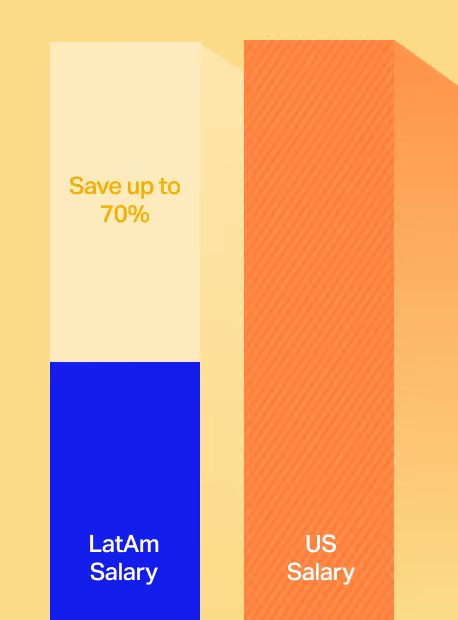
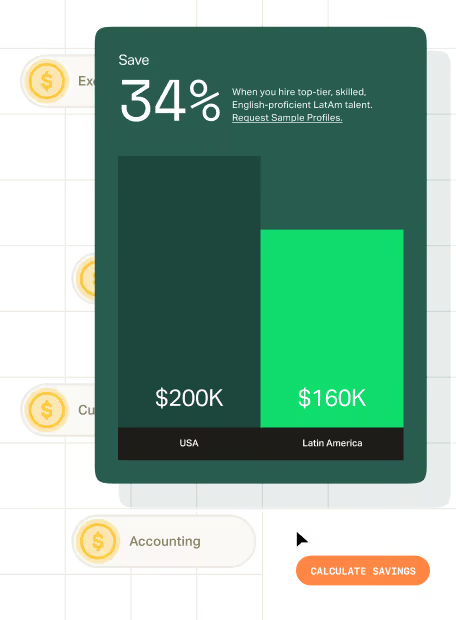
These figures represent what candidates earn. They don’t include Hire With Near’s placement fee. The savings compared to equivalent US hires typically range from 30–70%, depending on the experience level and location.
For a detailed breakdown by role and country, the LatAm vs. US salary guide has current benchmarks.
How long does it take to hire a remote accountant in Latin America?
With Hire With Near, you’ll have a shortlist of pre-vetted candidates within 3–5 business days of the intake call. These aren’t resumes from a job board. They’re professionals already screened for technical skills, tool proficiency, English fluency, and cultural fit.
Most clients make a hire within two to three weeks from the initial call. That’s significantly faster than sourcing LatAm talent independently, and much faster than the timelines most Philippines-focused agencies quote (and often miss).
If you have a hard deadline, tax season, an audit, or a month-end close, tell us at intake. We build timeline expectations around your actual constraints.
How does payroll and compliance work when hiring a LatAm accountant?
You have two options, and which one makes sense depends on how much you want to own.
Hire With Near’s staffing model: We handle payroll, benefits, and employment compliance. You manage the work, while we manage the employment relationship. This is the approach most clients prefer when they’d rather focus on running their business than on international HR.
Recruiting model (one-time placement fee): We place the candidate and hand off. You manage the employment relationship directly, typically through an Employer of Record platform like Deel or Remote that handles international payroll and compliance, or by structuring the engagement as an independent contractor where applicable.
If you’re an accounting firm owner with strong opinions about how your people are structured, we’ll walk you through both options and the tradeoffs. There’s no single right answer. It depends on your margin model, how many hires you’re planning, and how much operational overhead you want to own.









%203.svg)
.avif)





%20(1).avif)

%20(1).png)