Key Takeaways
- Nearshore software development means working with developers in a nearby country whose workday overlaps most of yours, which for US and Canadian companies usually means Latin America, and for Western European countries it means Central and Eastern Europe.
- According to our salary data, a mid-level developer in Latin America earns $54K to $72K a year against $115K to $195K in the US, and a dev shop's hourly rate adds margin and overhead on top of what the developer earns.
- The four engagement models are project outsourcing, a managed team, staff augmentation, and direct hire. In the first two, the vendor employs and manages the developers, and in the last two, the developers work under your direction.
Nearshore software development means building software with developers in a nearby country who work during your business day. For US and Canadian companies, that usually means Latin America, where salaries are 30 to 70% lower than in the US, while for Western European countries, it means Central and Eastern Europe.
Many companies turn to the region after having a bad experience with a dev shop (an outsourcing software company) or an offshore team. The code arrives, but only overnight. A question you send after lunch gets answered the next day, a bug found on Tuesday gets fixed on Thursday, and nobody on your side really owns the codebase.
That lag adds up. Sprints slip, your senior engineers spend their mornings untangling handoffs, and the roadmap you promised the board moves a quarter to the right. That's where Hire With Near comes in. We're a staffing and recruiting company that helps US businesses hire software engineers from Latin America who join their team full-time.
I’m sure you have plenty of questions about what nearshore software development is, how it compares with offshore and onshore, and what nearshore developers cost. In this guide, I’ll cover each of them and walk you through how to bring developers onto your team.
What Is Nearshore Software Development?
Nearshore software development is a model in which a company works with software developers in a nearby country whose working hours overlap most or all of the company's workday. The main point is location and overlap, so the developers are online when your team is.
Day to day, it looks a lot like working with a remote developer in another US city. Your nearshore developers join stand-ups live, review pull requests while the author is still online, and jump on an incident call when production breaks during your afternoon.
Because Latin America spans roughly the same band of hours as the continental US, developers in Mexico City, Bogotá, or São Paulo share most of your workday. That holds whether your team runs on Pacific, Mountain, Central, or Eastern time, as you can see in the table below:
The exact gap shifts by an hour or so through the year, since most of Latin America doesn't observe daylight saving time.
Nearshore vs. Offshore vs. Onshore Software Development: How Do They Compare?
Onshore development gives you the most overlap at the highest cost, offshore development gives you lower costs with little or no overlap, and nearshore development sits in between: most of your workday in common, with salary expectations well below US levels.
The three terms describe where the developers are in relation to you:
- Onshore: Developers in your own country. For a US company, that means US-based developers, working in the same or a nearby time zone at US salaries.
- Nearshore: Developers in a nearby country, usually within a few hours of your time zone. For US companies, that means Latin America, in countries like Mexico, Colombia, Brazil, and Argentina.
- Offshore: Developers in a distant country, typically six or more hours away, such as in Eastern Europe or Asia.
Here's how the three compare on the factors that shape a software team's day:
Each model fits a different situation:
Onshore makes sense when the work needs people in your office or a security clearance tied to US residency.
Offshore works well for well-specified projects that can run on overnight handoffs, and offshore teams and dev shops ship good software for plenty of companies.
Nearshore fits when the work is collaborative and changes fast: product engineering, platform work, and anything that depends on daily back-and-forth with your own team.
That's the pattern we see in engineering hiring. In Hire With Near's analysis of 300 calls with US companies hiring engineers between September 2025 and September 2026, 30% of the companies that reached out to us were moving engineering work off an offshore team in a distant time zone, such as Asia or Eastern Europe, to a nearshore model in Latin America.
For a deeper look at the trade-offs, see our guide to nearshore vs. offshore software development, or this broader explainer on nearshoring vs. offshoring vs. onshoring.
What Are the Benefits of Nearshore Software Development?
The main benefits of nearshore software development are working-hours overlap, a wider talent pool, lower salary expectations, and better retention. Here's what each looks like in practice.
Your developers are online when you are
Nearshore developers work during your business hours, so stand-ups, code reviews, and incident calls happen live, and a question gets an answer in minutes instead of the next morning. Misunderstandings about requirements get cleared up on a call the same day, before they turn into rework. A UK team working with developers in Poland or Romania shares nearly the whole day, and so does a US team working with Latin America.
A 2024 study in Organization Science by researchers at Harvard Business School, Georgetown University, and Rice University looked at more than 12,000 employees at a large multinational and found that larger time zone gaps push more of the work outside normal business hours for one side of the pair.
The authors suggest that companies distributing workers north and south avoid that cost, and a US and Latin America team is exactly that kind of north-south setup.
A wider talent pool
Hiring across several nearby countries instead of one local market gives you more developers with the stack and seniority you need, so you're more likely to find the right person quickly.
The pools are large: GitHub’s Innovation Graph counts about 8.3 million developer accounts in Brazil, 2.9 million in Mexico, and 2.1 million in Poland as of Q1 2026.
The need is real. In our analysis of 300 calls with US companies hiring engineers, 10% said they couldn’t find the engineers they needed in the US, double the rate in non-technical departments.
Lower salary expectations
Salary expectations in nearshore markets sit below those of the company’s home market because of differences in cost of living.
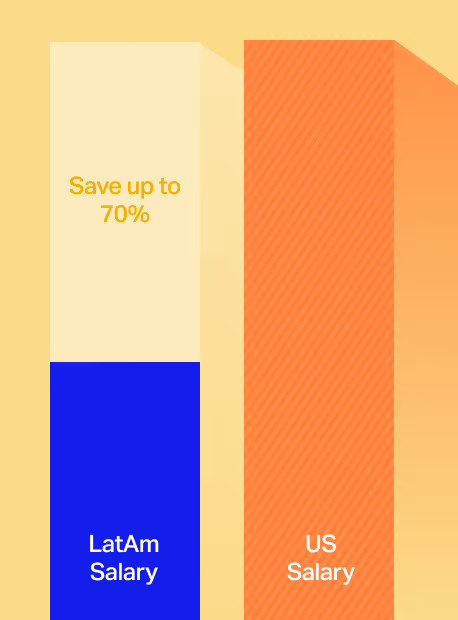
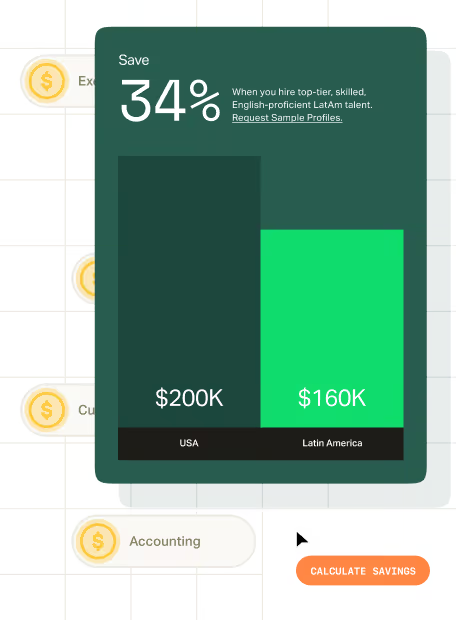
For US companies working with Latin America, for example, they run 30 to 70% below comparable US salaries. That makes it possible to hire experienced engineers on a budget that wouldn’t cover them at home.
Latin American developer salaries run 30 to 70% lower than comparable US salaries, because of differences in cost of living. The savings support the case, but they work best when you pay competitive rates for the local market, which keeps good developers from leaving for the next offer.
Better retention
In what we see at Hire With Near, a US company’s offer is often higher than what a developer can earn locally, and the work can offer more opportunity than local employers do, such as bigger products and teams. Both give a developer a reason to stay, and every year a developer stays is a year of codebase context you keep.
The pay only works as a retention tool when it’s competitive for the local market, since the next offer is often a local one.
Of the developers we place, 80% stay two years or more.
What Are the Four Nearshore Engagement Models?
The four nearshore engagement models are project outsourcing to a full development agency, a managed team, staff augmentation, and direct hire. They run from most hands-off to most ownership: the first two keep the vendor in charge of the work, and the last two put developers on your own team, under your direction.
Project outsourcing to a dev shop
A dev shop is a software company that delivers a finished product to you. You contract the company, not the people: it scopes the project, staffs it with its own developers, manages them, and hands you the result. Those developers work for the dev shop, not for you, and you pay the shop’s agreed price, not the developers. That gives you a delivery commitment without managing anyone, which works for a bounded build.
The trade-off is distance from the code. The team answers to the vendor and may be reassigned to other clients’ projects, and the knowledge of how the product was built leaves with them when the contract ends.
Our guide to software development outsourcing covers this model in Latin America in more depth.
Managed team
A managed team is a group of developers that a vendor dedicates to your product on an ongoing basis. The developers work for the vendor, not for you, and the vendor manages them day to day, usually through its own team lead. You set the priorities and the roadmap, and you pay a recurring fee for the team, usually billed monthly.
The difference from project outsourcing is the scope. A dev shop delivers a defined project and the engagement ends at handover, while a managed team keeps working on your product for as long as you need it, so it learns your codebase and can take on new work without a new contract.
Because the vendor still manages the people, it suits companies that want a product area covered without building management capacity in-house.
Staff augmentation
Nearshore staff augmentation adds developers to your team for a project or a flexible period. A partner recruits and vets them, and they work full-time under your direction: they join your stand-ups, take tickets from your managers, and commit code to your repositories.
The developers stay the partner’s resource, not your permanent employees, and the partner handles payroll, compliance, and local benefits for a monthly fee, so you get capacity without a long hiring process.
The difference from a dev shop or a managed team is who runs the work. Here you do: you set the priorities, manage the day-to-day, and are accountable for the result. That makes it a good fit when you already have a technical lead and need more hands, and a poor fit when you need someone else to take responsibility for delivery.
Direct hire
With direct hire, you employ the developer yourself, permanently. The new hire reports to your managers, and the knowledge they build stays with your company. That separates it from staff augmentation, where the developer remains the partner’s resource. You can find the developer yourself, through nearshore job boards, referrals, and your own network, or a recruiting partner can find and vet candidates for you.
Employment usually runs through your own entity or an employer of record. If a partner finds the developer, you pay a one-time recruiting fee and then the developer’s salary; if you find the developer yourself, there’s no recruiting fee, but you carry the search and the vetting. It’s the model for core roles you plan to keep for years. Hire With Near places developers this way through its nearshore staffing and recruiting services.
The choice between the last two models usually comes down to cost shape and flexibility:
- Staff augmentation spreads cost into a monthly fee and keeps payroll and compliance off your plate.
- Direct hire costs more up front and less over time, and the developer stays on your team for the long term.
If you've tried a dev shop or a managed team, these last two are the usual next step. An engineering leader at a large US manufacturing and technology company, whose team chose Latin America for the time zone overlap, described what pushed them away from a vendor-run model:
And we've had experience with contracted labor where we go to an agency. They provide us talent, but they are the supervisors. They run everything. And it's been a bad experience. They haven't met our expectations on quality.
Top-performing companies are moving the same way. According to the McKinsey Global Tech Agenda 2026, nearly half of top-performing companies plan to increase insourcing to bring strategic technology expertise back in-house, compared with 37% of other companies. It's one reason why US companies hire in Latin America for engineering roles they want to own.
The developers’ side matters too. Hayden Cohen, Hire With Near’s CEO and Co-founder, explains why top developers prefer direct hire over dev shops in the video below:
How Much Does Nearshore Software Development Cost?
Hiring a software developer in Latin America typically costs $36K to $54K a year at junior level, $54K to $72K at mid-level, and $72K to $108K at senior level, according to Hire With Near's salary data. That's up to 66% less than comparable US salaries for junior developers and up to 52% less for senior ones.
Three factors move the number:
- Region: Salaries follow each local market’s cost of living and how many employers compete for engineers there, so they differ by country and by city. In Argentina, for example, Buenos Aires sets the top of the market. Our data covers Latin America, so the figures here apply there; Central and Eastern European salaries follow their own market.
- Seniority: Senior developers own architecture decisions, work with little supervision, and mentor others, and fewer of them are available, so they cost roughly twice what junior developers do.
- Engagement model: What you pay on top of the developer’s salary depends on who handles the work around the developer. A dev shop bills by the hour, month, or project, and its rate includes its own margin and project management. A staffing partner charges a monthly fee on top of salary that covers payroll, benefits, and compliance. A direct hire costs salary plus a one-time recruiting fee, with employment costs handled by you or a provider. I'll explain the models in the next section.
Using Hire With Near's salary benchmarks for software developers as a worked example, here's how Latin America compares with the US:
For the most up-to-date figures, see Hire With Near's US vs Latin America Salary Guide.
The savings are largest at the junior level, but most companies hire experienced developers. According to Hire With Near's 2026 State of LatAm Hiring Report, 98% of the engineering roles we filled went to mid-level or senior engineers.
Our breakdown of IT and developer salaries in Latin America covers more roles, and this look at how much US companies save by hiring in Latin America puts the numbers in context.
Why a vendor's hourly rate isn't the developer's salary
A dev shop's hourly rate and a developer's salary are two different numbers. The rate a nearshore dev shop bills you covers the developer's pay plus the shop's margin, its project managers and account team, its offices and equipment, and the bench time it carries between projects.
That means the salary table above doesn't tell you what a dev shop will charge. When you compare quotes, ask each vendor what share of the rate goes to the developer. When you hire directly or through staffing, the developer's salary is the largest part of your cost, and you can see it.
{{latam-hiring-calculator}}
What Are the Risks of Nearshore Software Development, and How Do You Reduce Them?
The main risks of nearshore software development are IP and contract gaps, payroll and compliance across countries, security, code quality, and attrition, and each one has a concrete fix. Most problems come from skipping these steps.
IP and contracts
The risk: The developer’s country has its own rules on who owns the code, and they can differ for employees and contractors. A US-style contract may not clearly transfer ownership under local law.
The fix: Use IP assignment and confidentiality clauses written for the developer’s country, and have local counsel or your partner confirm they transfer ownership there.
Compliance and payroll across countries
The risk: Each country has its own labor law, tax rules, and required benefits, and getting them wrong is expensive.
The fix: Let an employer of record company or a staffing partner handle payroll, compliance, and local benefits while the developer works as part of your team under your direction. This comparison of an employer of record vs. a staffing agency explains how the two differ.
Security
The risk: A remote developer works outside your office network, often on a device you don’t control, while holding access to your code, your production systems, and sometimes customer data. If their laptop is lost or compromised, or if their access is never removed after they leave, someone else can reach all of it. This applies to any remote hire, wherever they’re based.
The fix: Give each developer only the access the job needs (least privilege), so one compromised account can’t reach everything. Issue company-managed devices with disk encryption, so a lost laptop doesn’t expose your code. Require single sign-on (SSO) and multi-factor authentication, so a stolen password isn’t enough to log in. And keep an offboarding checklist that revokes every credential on the last day, including repositories, cloud accounts, and shared tools.
Code quality
The risk: A strong resume hides weak engineering.
The fix: Run a real-world technical assessment before you hire, then hold the developer to the same code review standards as the rest of your team.
Attrition
The risk: A developer leaves after six months and takes your context with them.
The fix: Pay competitive local rates, treat nearshore developers as full members of the team, and work with a partner whose replacement terms cover you if a hire doesn't work out.
Where Do Companies Nearshore Software Development?
US and Canadian companies nearshore software development mostly in Latin America, while Western European companies mostly nearshore to Central and Eastern Europe. The best country for software development nearshore depends on your stack, the seniority you need, and how much overlap matters.
Latin America

Latin America shares most of the US workday and has some of the fastest-growing developer communities in the world. Here's a quick view of the five countries US companies hire from most:
- Mexico: The second-largest developer pool in the region, with about 2.9 million developer accounts on GitHub’s Innovation Graph in Q1 2026, up 35% in a year. Universities like the IPN, known for systems-level engineers who excel at backend infrastructure, and Tec de Monterrey, known for bilingual technical talent, feed it. Hiring in Mexico through Hire With Near grew more than 80% in the first half of 2026. Our guide to hiring developers in Mexico goes deeper.
- Brazil: The region’s largest developer community, with about 8.3 million developer accounts on GitHub in Q1 2026, up 36% in a year. It’s also where most of our engineering hires come from: Brazil was the top country in our placements in the first half of 2026, and it leads our IT and engineering hiring. Universities like Unicamp, known as the “Brazilian Silicon Valley,” and USP supply deep talent for complex software. Our guide to software hiring developers in Brazil covers the market in detail.
- Colombia: The fastest-growing of these markets, with about 1.7 million developer accounts on GitHub, up 37% in a year, and Medellín is its recognized tech hub. ParkMobile, a US parking platform, hired nine senior engineers there through us, in a country it had never recruited in before. See our guide to hiring software developers in Colombia.
- Argentina: The strongest English proficiency in the region, ranking 26th of 123 countries in the EF English Proficiency Index 2025, and the largest concentration of senior engineers with enterprise experience, from companies like Mercado Libre and Globant. It has about 1.6 million developer accounts on GitHub, up 31% in a year. Our guide to hiring developers in Argentina covers it in detail.
- Costa Rica: A smaller market, with about 231,000 developer accounts on GitHub, up 30% in a year, but about 200 multinationals run regional or global service hubs there, including Intel, Microsoft, and Amazon. That makes it a strong fit for a compact team of engineers used to working in global companies. See our guide to hiring developers in Costa Rica.
The top country for hires rotates among Brazil, Colombia, and Argentina, as Hire With Near's latest hiring trends show. Julieta Gorodetzky explains:
What surprises clients is the quality of the developers. Most of the engineers we target have already worked with US clients, so they're used to the pace. And the level of engineering in countries like Argentina, Colombia, Brazil, and Mexico is top tier [...] and the quality they get for what they invest is hard to match.
— Julieta Gorodetzsky, Tech Recruiter, Hire With Near
For the practical side of building a team in the region, see our guide to hiring remotely in Latin America.
Central and Eastern Europe

For companies in Western Europe, Central and Eastern European countries such as Poland and Romania are the main nearshore option, with strong engineering traditions and business hours that line up with London, Paris, and Berlin. The region sits within zero to two hours of Western European time zones, so teams share nearly the whole workday.
- Poland: The largest developer community in the region, with about 2.1 million developer accounts on GitHub’s Innovation Graph in Q1 2026, up 29% in a year. English proficiency is very high, at 15th of 123 countries in the EF English Proficiency Index 2025. Warsaw runs on the same time as Paris and Berlin and is one hour ahead of London.
- Romania: About 800,000 developer accounts on GitHub in Q1 2026, up 28% in a year, and 11th in the EF English Proficiency Index 2025, the highest of the three countries here. Bucharest runs seven hours ahead of US Eastern time. Bucharest runs one hour ahead of Paris and Berlin and two hours ahead of London.
- Bulgaria: A smaller market, with about 362,000 developer accounts on GitHub, up 28% in a year, and 18th in the EF English Proficiency Index 2025. Sofia also runs seven hours ahead of US Eastern time, which makes it a better fit for compact teams that can work a shifted schedule. Sofia shares Bucharest’s time zone, which makes it a better fit for compact teams than for large-scale hiring.
For a closer comparison of the two regions, see our guide to hiring in Latin America vs. Eastern Europe.
How Do You Choose a Nearshore Software Development Partner?
Choose a nearshore software development partner by how it vets developers, how its technical assessment works, what its replacement terms are, how it handles payroll and compliance, and how it protects your code. Ask these questions on the first call:
- How do you vet developers? Ask for every step, in order. A real filter includes an English assessment, a technical evaluation, and experience verification.
- How does the technical assessment work? Ask who designs it, whether it's a real-world task, and whether you can see the results.
- What happens if a hire doesn't work out? Get the replacement terms in writing, including how long they last.
- How are payroll, compliance, and benefits handled? Ask who runs payroll in each country and how local benefits and labor rules are covered.
- What are your security practices? Ask about devices, access control, and offboarding.
Vetting is where weak partners show. A digital product studio that hired a senior full-stack engineer had worked with two generalist staffing vendors whose candidates arrived with too little pre-vetting, so its own engineering leaders spent hours screening.
After an English assessment, an architecture-focused technical evaluation, and experience verification, it hired a senior engineer in Argentina in 34 days, at a salary 47% below the US equivalent. That engineer now owns backend architecture for an enterprise account.
For names to put on your shortlist, see our roundups of the best nearshore development firms and nearshore staffing companies.
How Do You Hire Nearshore Software Developers?
To hire nearshore software developers, define the role and stack, pick your engagement model, source and screen candidates, run a technical assessment, and make an offer with a real onboarding plan. Here's how to hire nearshore developers, step by step:
1. Define the role and the stack
Write down what the developer will own, the languages and frameworks they'll use, and the seniority you need. Focus on core skills over exact framework versions, because experienced developers pick up a new version fast.
2. Pick the engagement model
Decide between staff augmentation and direct hire, or a vendor model if you don't want to manage the work. The table in the earlier section helps you match the model to the role.
3. Source and screen
Source through referrals, job boards, LinkedIn, or a specialist partner. In screening, ask candidates to walk you through a full-stack project: the stack, the hard problems, and how they solved them.
Watch for red flags, such as a candidate who can't explain their own role in past projects or avoids talking about mistakes.
4. Run a technical assessment
Use one small, real-world task: debugging code, refactoring for scalability, or building a basic API with tests. It can be live or take-home, but review it together on a call so you hear how the candidate thinks.
Keep the process short, because strong developers drop out of long processes with several technical tests. Julieta recommends a specific order:
We always recommend that clients meet the candidate first and then do the assignment or the live coding exercise. It's better for the candidate and more engaging. They do better once they know you. You can explain in your own words what you want from the assessment, and they can meet another engineer on the team or the CTO, whoever they'll need to work well with.
— Julieta Gorodetzky, Tech Recruiter, Hire With Near
If AI coding tools are part of your workflow, test for them too. Here's how hiring managers test developers for AI skills.
5. Make the offer and onboard
Make a competitive offer for the local market, and move fast once you've decided. Developers often have notice periods, so agree on a start date early and have equipment and access ready for day one.
How Do You Manage a Nearshore Development Team?
Manage a nearshore development team the way you'd manage any remote team on your own payroll: agree on core overlap hours, run your agile rituals live, document decisions, and onboard developers properly. The overlap makes most of this easier than it is with offshore teams.
Set core overlap hours
Pick a block of three or four hours when everyone is online, and hold meetings inside it. Outside that block, let developers keep flexible schedules, the same way you would for US hires.
Run agile rituals live
Hold stand-ups, sprint planning, and retros during the overlap. Pair on hard problems over video, and review pull requests the same day they're opened.
Use async tools for everything else
Write decisions down in your tracker and docs, record short videos for walkthroughs, and keep architecture notes current. Good async habits mean nobody waits on a meeting to unblock work.
This piece on how LatAm developers keep teams moving shows what that looks like day to day.
Onboard like it's a local hire
Set up access with least privilege, walk through your security policies and, if needed, ship equipment before day one. Assign an onboarding buddy, a teammate who answers day-to-day questions and shows the developer how the team works, and a first ticket the developer can finish in their first week.
Scale from one developer to a team
Start with one developer on a well-defined part of the codebase. Once that works, add developers to the same squad, then promote a strong senior into a lead role.
Our guide to building nearshore teams covers team structures as you grow.
How Does Hire With Near Help You Hire Nearshore Developers?
Hire With Near recruits full-time Latin American developers who join your team, through direct hire or staffing, and runs the search for you from kick-off to start date. Our recruiters source from our pool of 160,000+ candidates, plus run fresh sourcing to find exactly what you’re looking for.
They also run first-round interviews and can help administer your technical assessments or case study assignments. You interview a shortlist and choose who joins your team.
Once you hire, you choose the model that fits. Direct hires through Hire With Near are backed by a 180-day replacement guarantee: if a hire doesn't work out in that window, we find a replacement at no additional cost. Under our staffing model, we handle payroll, compliance, and local benefits, and replacements have no time limit.
ParkMobile is an example of what we can achieve for you. The global mobility platform had relied on agency developers for its back-end and platform work for years and wanted senior engineers of its own in Colombia, a market it had never recruited in.
We ran sourcing, English screening, and vetting inside ParkMobile's own applicant tracking system, and first shortlists arrived within a week of kickoff.
ParkMobile replaced agency developers with nine in-house engineers across platform, backend, and iOS, with a 24-day average time to hire and $1,066,085 in annual savings against US rates. Colombia became its strongest new hiring hub.
Akshay Gokarnakar, their Talent Acquisition Team Lead, said:
The engineers we hired are performing exceptionally well. They show up, they take accountability, and they take a genuine interest in the team.
— Akshay Gokarnakar, Talent Acquisition Team Lead, ParkMobile
We work with startups and enterprises across sectors, with deep experience in IT and tech recruiting in Latin America.
Final Thoughts
Nearshore software development gives you developers who work your hours, with salary expectations well below US rates, and the biggest gain comes when those developers sit on your own team instead of a vendor's.
Start by deciding how much of the work you want to own: a dev shop or managed team for a defined build, or staff augmentation or direct hire for the core engineering roles you plan to keep.
Hiring software developers nearshore works best when you test English and technical skills before the offer, agree on overlap hours early, and onboard every developer the way you would a local hire.
If you want to hire a dedicated developer or build a full engineering team, book a free consultation to talk through your requirements with our team. You can also request pre-vetted candidate profiles to see the caliber of engineers we place.
{{prevetted-banner}}
A nearshore software development company is a firm that provides developers located in a country near its clients, so their working hours overlap. For US and Canadian companies, most are based in or recruit from Latin America.
They come in different forms: dev shops that build projects for you, vendors that run managed teams, staff augmentation firms that place developers on your team, and recruiting partners that help you hire developers directly.
The right company depends on whether you want to hand off the work or own it.
Nearshore software development usually has higher hourly rates than offshore, but it can cost less in total once you count the cost of working across time zones.
With an offshore team, questions and code reviews often wait overnight, so fixes and decisions take longer. With nearshore developers, that work happens during your workday.
Compared with the US, Latin American developer salaries run 30 to 70% lower than comparable US salaries.
Hiring a nearshore software developer through a specialist partner usually takes under three weeks: most of our clients hire in that time. On 84% of our engineering searches, the first shortlist arrives within five days of kick-off.
The start date depends on the developer's notice period with their current employer, so agree on it early in the offer stage and plan onboarding around it.
Yes, Agile works well with nearshore software development teams because their workday overlaps yours, so ceremonies happen live. Stand-ups, sprint planning, backlog refinement, and retros fit inside shared hours without anyone joining at midnight. Pair programming and same-day code reviews are practical too.
The teams that do best set core overlap hours, keep sprint ceremonies inside them, and document decisions so async work stays unblocked.
You can protect your IP with a nearshore development team through contracts written for the developer's country plus strict access controls. Use IP assignment and confidentiality clauses that local counsel confirms are enforceable there.
Then, limit access to what each developer needs, issue company-managed devices, require SSO and multi-factor authentication, and revoke every credential on the last day.
Treat these as controls that lower risk, and review them with your own legal team.
You can hire nearly every software development role nearshore, from individual contributors to engineering leads. Companies often hire nearshore full-stack developers, back-end developers in Latin America, remote front-end developers, and Android app developers.
Language specialists such as nearshore Python developers and Java developers for enterprise applications are common too, along with QA engineers for manual and automated testing and DevOps engineers for cloud and release pipelines.
All of them share most of your workday.
Yes, you can start with one nearshore developer and scale to a full team, and it's the lowest-risk way to begin. Hire one developer for a well-defined part of your product, see how the collaboration works, then add developers to the same squad. Working with one partner keeps your hiring bar consistent as you grow.
ParkMobile started with a few senior roles in Colombia, then expanded into team leads as other divisions pushed to hire there.
If a nearshore developer doesn't work out, a good partner replaces them under the terms in your agreement, so check those terms before you sign. Ask how long the guarantee lasts and whether it applies to every model.
Direct hires through Hire With Near are backed by a 180-day replacement guarantee, and we find a replacement at no additional cost. Under our staffing model, replacements have no time limit.
Related Posts


Discover why hiring in LatAm is a cheat code. Download our free guide now.