%203.svg)
Key Takeaways
- An employer of record handles payroll, compliance, and legal employment in Latin America, so you don’t have to set up a local entity. A staffing agency finds and vets candidates and manages their payroll and compliance. You only need one partner, not two.
- The decision comes down to where you are in the hiring process. If you already have a candidate, an EOR handles compliant onboarding. If you still need to find the right person, a staffing agency handles both the search and the employment.
- Hire With Near provides both services as an integrated nearshore staffing and compliance partner, so most clients don’t need to coordinate between two vendors.
You’re trying to hire someone based in Latin America. You’ve worked out the budget and the time zone fits. Now, the compliance questions start: who pays them, who files taxes in their country, and who handles the employment contract if something goes wrong?
Two models exist to answer those questions: an employer of record (EOR) and a staffing agency. They’re frequently treated as competing options, but the difference is scope.
An EOR handles payroll, compliance, and legal employment for a professional you’ve already found. A nearshore staffing agency finds the right person and handles payroll and compliance once you’ve made the offer.
In dozens of conversations with the recruiting team at Hire With Near this year, the same confusion comes up consistently: companies assume finding talent and employing talent are two separate problems that need two separate vendors. With the right staffing partner, they’re not.
Understanding which starting point fits your situation is what this article is for.
EOR vs. Staffing Agency at a Glance
For most Latin American hiring decisions, the choice between an EOR and a staffing agency comes down to one question: Do you already have the candidate, or do you still need to find them?
Here’s how the two models compare across the main dimensions:
If you already have the candidate, an EOR handles compliant onboarding.
But if you still need to find the right person, a staffing agency handles sourcing, payroll, and compliance through one relationship.
What Does an Employer of Record Do?
An EOR is the legal employer for your workers on paper. Once you’ve decided to hire someone, the EOR steps in and formally employs that person in their country.
The EOR takes on the compliance obligations that come with that relationship: payroll processing, tax filings, employment contracts, benefits administration, and any legal liabilities tied to the employment.
Here’s what a typical employer of record handles once an offer is made and accepted:
- Processing payroll in local currency
- Issuing and managing employment contracts
- Filing and depositing local taxes
- Managing unemployment and workers’ compensation insurance
- Administering employee benefits (health insurance, mandatory local benefits)
- Employee onboarding
- Pre-employment background checks
- Handling terminations in compliance with local law
The key phrase: once an offer is made and accepted. An EOR doesn’t find the candidate.
What Does a Staffing Agency Do?
A staffing agency handles both the search and the employment.
The sourcing side comes first: defining and posting roles, sourcing candidates, screening resumes, running initial interviews, benchmarking salaries against the local market, and presenting a shortlist of people who can do the job and communicate well with your team.
Once you’ve made the offer, the staffing agency manages payroll, compliance, and the ongoing employment relationship in the worker’s country.
In the context of Latin America specifically, a staffing agency’s value is in its regional knowledge: which countries have the strongest talent pools for which roles, what local salary ranges look like by seniority and country, how to screen for genuine English fluency versus resume English, and whether the candidate’s working hours will overlap with your team.
As our recruiters consistently point out, those filters don’t happen automatically. They require a recruiter who knows the LatAm market deeply.
Why Choosing the Right EOR Model Is Important for Hiring in Latin America
Hiring across borders without an EOR exposes you to real compliance risk.
Each Latin American country has its distinct labor laws, mandatory social contributions, severance structures, and payroll tax requirements. Getting them wrong means penalties, back-pay obligations, and potential legal exposure.
An EOR for hiring in Latin America removes that risk. You don’t need to register a legal entity in Brazil or Colombia to hire someone based there. The EOR holds the entity, runs the payroll, and handles the local employer obligations. You pay the EOR; the EOR pays and legally employs the worker.
For early-stage companies or those hiring their first LatAm team member, this is often the simplest path: no entity setup costs, no local legal infrastructure, and no need to hire someone who understands Colombian labor law.
{{prevetted-banner}}
When Should You Use an EOR for Latin America Hiring?
Use an EOR when you’ve already identified your candidate and need a compliant way to pay and employ them. The typical scenarios:
- You sourced the candidate yourself. Your extended network found someone great in Chile. You’ve done the interviews and you want to make an offer, but you don’t have a legal entity in Chile and you don’t want to set one up. An EOR lets you hire that person without the entity overhead.
- You want to test a country before building infrastructure. Before setting up a local subsidiary in Colombia, you want to hire one or two people and see how it works operationally. An EOR gives you that option without locking in long-term legal commitments.
- Your existing team member wants to relocate internationally. If a US team member moves to Brazil and you want to keep employing them legally, an EOR handles the conversion.
One nuance worth flagging: Natasha Tarapow, Recruitment Consultant at Hire With Near, notes that EOR isn’t always what LatAm talent prefers.
Latin American developers often prefer being hired as contractors rather than employees, even when clients think they’re offering a benefit by putting them on an employer of record. Because of the currency exchange, the salary difference is so large when they’re a contractor that they keep far more of the money. It’s counterintuitive for some clients, but that’s just how it works.
In some cases, a contractor arrangement with a clear compliance structure serves both parties better than a formal EOR employment arrangement.
Related reading: The Top 10 Employer of Record (EOR) Companies to Consider
When Should You Use a Staffing Agency for Latin America Hiring?
Use a LatAm staffing agency when your challenge is finding the right candidate and you want one partner handling employment and compliance too.
The typical scenarios:
- You don’t have a candidate yet. You know you need to hire a bilingual customer support rep or hire a financial analyst in LatAm. You have no idea who to hire, where to source, or what a competitive salary looks like. A staffing agency handles the full sourcing process and takes over payroll and compliance once you’ve hired, so you’re interviewing qualified candidates, not sorting through cold applications.
- You’ve tried sourcing independently and it hasn’t worked. The Society for Human Resource Management (SHRM) 2025 Recruiting Benchmarking Report puts the average cost per hire at $5,475 for non-executive roles, and that doesn’t include the time your team spends screening. When the candidate pipeline isn’t producing the right people, the cost of continuing to try to solve it in-house climbs fast.
- You need quality filtering, not just volume. Generic job boards in Latin America generate volume. They don’t filter for English proficiency, full-time availability, US-client experience, or salary alignment. A staffing agency that specializes in LatAm does all of that before you see a resume.
- You want the candidate to be part of your team, not feel like an agency hire. This is the distinction that matters most operationally. A staffing agency that places someone as a full-time dedicated hire, fully integrated into your team’s communication channels, working your hours, and managed directly by you, is fundamentally different from an agency that manages workers on your behalf.
One RevOps lead at a mid-market SaaS company described the same issue after running a CS team through an external agency: “It ends up not feeling like they’re part of the team, like they’re an agency that works with us”.
The friction showed up in the smallest things: a sick day required a chain of communication through an account manager before the team lead found out.
Why Is Regional Expertise Important When Hiring in Latin America?
Relying on a LatAm-focused staffing agency presents an undeniable advantage: finding the right person in a market you don’t know takes longer and gets worse results than most companies expect.
According to ManpowerGroup’s 2026 Global Talent Shortage Survey, 72% of US employers report difficulty finding the talent they need. That’s in the domestic market, where they know the talent pool.
Sourcing in Latin America without regional expertise multiplies that challenge: You’re evaluating candidates in a market where salary norms, resume conventions, and interview expectations are different from what you’re used to.
Here are some other staffing agency advantages:
- Access to a regional talent pool: Not just profiles on LinkedIn, but warm relationships with candidates who are actively looking and have already been screened for English proficiency and professional conduct.
- Salary benchmarking by country: What a senior software engineer earns in Bogotá is different from Buenos Aires or Mexico City. A good agency gives you accurate numbers, not US-market assumptions applied to LatAm.
- Cultural and time zone fit screening: A candidate who has worked with US companies before adapts faster. That’s something an agency screens for, a job board doesn’t.
- Pre-vetting that filters out resume inflation: The frustration most companies describe after hiring through generic platforms is candidates presenting themselves as fully available and experienced when they’re juggling four part-time contracts. A staffing agency that handles LatAm full-time hiring specifically knows this problem and filters for it.
Can You Use an EOR and a Staffing Agency Together?
Yes, and some companies do. This typically makes sense when you already have an EOR relationship in place and want a staffing partner for sourcing only. The staffing agency finds and vets the candidate. Your existing EOR handles employment and payroll once the offer is accepted.
The problem is this combination introduces coordination overhead. Two contracts, two vendors, two points of contact, and two different timelines that have to stay in sync during onboarding. When something needs to change, whether a salary adjustment, a contract amendment, or a termination, you’re managing it through two organizations instead of one.
A fast-growing health and beauty supplement company in Nevada ran into the multi-vendor coordination problem before finding a simpler model.
They had tried outsourcing through Upwork and Philippines-based firms before reaching Hire With Near, and both produced the same problems: inflated resumes, candidates with multiple part-time commitments rather than genuine full-time availability, and no accountability from the placing agency.
Then, the company switched to Hire With Near, which handled both the sourcing and the employment infrastructure under one relationship, eliminating the coordination problem entirely.
Their Operations Manager described what made the partnership successful:
Once a candidate comes from Hire With Near, we know they’re definitely worth looking at. This is generally not the case for all outsourcing companies.
They hired their ideal candidate in under a month, saving $26,000 annually and hiring five times faster than their previous attempts. The difference was having a single partner responsible for finding and delivering someone fully committed to the role.
How to Choose: EOR vs. Staffing Agency for Latin America Hiring
The right model for your business depends on where you are in the hiring process. In the conversations our recruiters have with US hiring managers, the pattern that emerges is consistent:
- If you already have the professional: Use an EOR. The problem you need solved is compliant onboarding and payroll, not talent sourcing. An EOR handles that without requiring you to build local legal infrastructure.
- If you need to find the professional: Use a staffing agency. The problem you need solved is identifying the right candidate in a market you don’t know well, pre-vetted for English, availability, and salary alignment. A staffing agency handles payroll and compliance too, so you’re not coordinating two vendors.
Most clients choose the staffing model for this reason: one partner handles everything.
Hire With Near’s nearshore staffing service handles talent acquisition and full employment compliance through a single relationship.
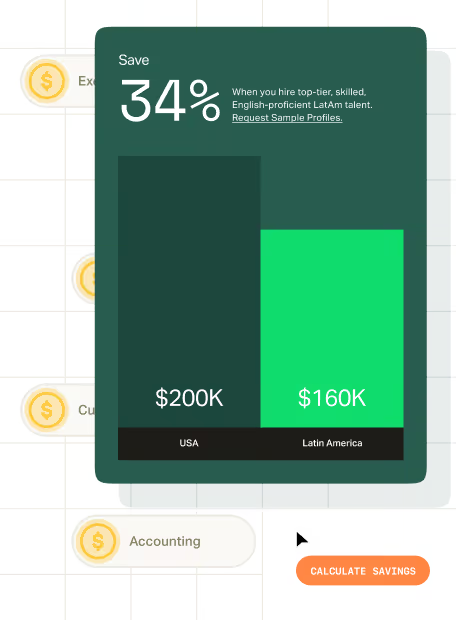
And that’s not the only benefit: The 2026 State of LastAm Hiring Report found companies consistently save $35,000–$64,000 per hire annually compared to US equivalents, a 30–70% reduction depending on the role and seniority level.
For a deeper breakdown of cost savings by role and seniority, see how US companies save by hiring in Latin America. If you’re still working through which hiring model fits your situation, the offshore vs. nearshore vs. onshore outsourcing guide covers the full comparison.
Final Thoughts
The EOR vs. staffing agency decision is really a question of where you stand in the hiring process.
If you already have someone in mind and just need a compliant employment infrastructure, an EOR is the right tool. If you still need to find the right person, a staffing agency is where to start. It handles the search and, once you’ve made a hire, the employment side as well.
Hire With Near works as a staffing agency with built-in EOR capability, which means most clients don’t need to manage two separate vendor relationships for the same hire.
If you want to understand what the staffing agency model looks like in practice for your specific roles and budget, book a free consultation with Hire With Near’s team.
We’ll walk you through salary benchmarks, explain how the sourcing and compliance process works, and give you a clear picture of whether it’s the right fit.
You can also read the most common questions about nearshoring to Latin America if you’re still working through the details of the process.
{{latam-hiring-cta-v2}}







.webp)


%203.svg)
.avif)






%20(1).avif)

%20(1).png)