


%203.svg)
Key Takeaways
- Belize is the only country in Central America where English is the official language and it works US Central hours year-round, which makes it an excellent place to hire one specific kind of engineer and a poor place to run a volume search.
- Hiring a developer in Latin America costs $30K–$108K a year depending on role and seniority, against $67K–$238K for the equivalent US hire.
- Belize's engineering pool is small and concentrated, so the practical way to hire there is a recruiting partner working across 20 countries: one that searches Belize properly and tells you when the right person is actually sitting in a neighboring market instead.
Finding developers who write clean code and can talk directly with your team is hard enough locally. When expansion plans demand real-time collaboration without a domestic price tag, many companies turn to nearshore markets, and that search often leads them to hire developers in Belize.
Belize is the only country in Central America with English as its official language, and it’s aligned with Central and Mountain time, the same as much of the US. That combination lets a Belizean engineer join a client call, lead an architecture review, or write documentation without a translation step in between.
Still, Belize’s talent pool is smaller than the region’s bigger markets, so scaling a team there takes a more targeted search.
This guide covers what you need to source, vet, and onboard engineering talent in Belize: what a developer earns, which technical skills the market actually has, where that talent is concentrated, and the four ways to hire software engineers in Latin America, Belize included.
Why Should I Hire Developers in Belize?
Three things make Belize worth considering for a US engineering hire. English is the country’s official language, its working hours alternate between US Central and Mountain time, and its currency has been pegged 2:1 against the US dollar for fifty years.
English is the official language, not just widely spoken
English is the official language of Belize, the only country in Central America where that’s the case, and it’s the reason many US teams land on Belize. Belize also carries no score in the EF English Proficiency Index, which ranks every other market in the region.
Treat that as a strong starting point and screen for it anyway. Official language is a fact about the country, not a guarantee about an individual candidate, which is why Hire With Near recruiters assess English on every placement.
Real-time collaboration between Central and Mountain Time
Belize alternates between US Central and Mountain time, so a developer there is at their desk during your business day, wherever your team is based.
Because Belize keeps one schedule year-round while most of the US shifts its clocks, the exact gap moves by an hour twice a year depending on where you are in the US, as you can see in the table below:
That overlap is why US companies look at the region, and that includes Belize. Hire With Near’s research into why US companies hire in Latin America found that 30% were switching away from offshore markets, almost always because the time zone gap was breaking real-time work.
The Belize dollar has been pegged to the US dollar since 1976
The Belize dollar has been pegged at BZ$2 to US$1 since 11 May 1976. The Central Bank of Belize marked fifty years of exchange rate stability in May 2026, and a salary agreed against that rate doesn’t move.
Neither side carries FX exposure: you’re not hedging against a rate swing, and the developer isn’t watching their pay lose value in dollar terms either.
How Big Is Belize’s Developer Talent Pool?
Belize’s tech talent pool is lean. With a national population of roughly 420,000, the technology workforce represents a small, specialized segment.
Most of the country’s software engineering talent is concentrated in two hubs:
- Belize City (commercial and ITES hub): Belize’s economic center houses most of the country’s private enterprise, digital services companies, and commercial technology infrastructure. Talent here tends to specialize in web development, database management, IT services, and client-facing system operations. It’s home to the University of Belize’s Engineering Department, which offers associate-level engineering programs.
- Belmopan (public sector and computer science hub): As the capital, Belmopan is the center for e-governance projects and public-sector tech work, and it’s Belize’s main hub for tech education. It houses the University of Belize’s main campus, which offers a Bachelor of Science in Information Technology, and Galen University, which offers a Bachelor of Science in Computer Science with a focus on software engineering, Java, C++, and database design.

Two things shape how you recruit in a market like this:
- Strong talent is usually already employed: Many of Belize’s best engineers already work remotely for companies outside the country. They’re not browsing local job boards waiting to be found.
- You’re competing for people, not applicants: At any given time, only a handful of candidates match a specific senior brief.
That changes what a working search looks like. A small pool needs a targeted, hands-on approach: a clear brief, direct outreach to the specific people who fit it, a short interview process, and an offer that’s ready to move fast once you find the right person.
What doesn’t work in a market like Belize is posting a role and expecting fifty applications. If your hiring process depends on volume, Belize will look empty. That’s not because the talent isn’t there. It means you’ve hit a market you have to work candidate by candidate instead of screening a stack of resumes.
Which Engineering Roles Make Sense in Belize?
Belize is strongest for engineering roles where communication is part of the job, and weakest where you need several similar engineers at once. The real worry behind “am I picking the wrong country?” is putting a role in a market that can’t fill it.
The failure this fixes is a familiar one. A managing director at a managed IT services company building a Latin American service center described what he kept running into:
We do have specific requirements in terms of the experience for these positions. And when we do find someone with the technical skills, they don’t have the English level to communicate with the U.S.-based clients. They either focus on the technical skills or the language. Most of the times they have challenges with communication. So I believe they’re too focused on the technical part and we haven’t found the balance.
Four roles clear that bar particularly well in Belize:
- The senior engineer who talks to customers: If the brief is someone who can run a technical call and then build what was agreed, hire a senior software engineer in Latin America. Treat the call itself as part of the test.
- The solutions or support engineer: Debugging live with a US customer is half technical work and half interpretation.
- The front-end developer embedded with a US product team: Daily contact with designers, PMs, and support means constant back and forth. That’s why the role recurs in nearshore SaaS recruiting, and why it suits a market like this if you want to hire a remote front-end developer.
- The QA lead who owns English test documentation: Test plans, bug reports, and release notes are artifacts other people depend on, so writing quality is part of the output when you hire a QA engineer in Latin America.
The inverse deserves the same honesty. Three back-end engineers on a deadline, or a specialization that’s rare anywhere, is a wider regional brief. See how hiring Latin American developers works at scale, or how teams hire developers in Mexico when they need a squad.
What Technical Skills Do Developers in Belize Have?
Software engineers in Belize skew toward full-stack web development, enterprise systems, and cloud infrastructure work. The local market mostly serves North American clients and digital service operations, so the skill set leans practical: common web frameworks paired with the enterprise tools those clients already run on.
- Core languages and frameworks: Proficiency is highest in JavaScript/TypeScript (Node.js, React), Python (Django, REST Framework), Java, and .NET. PHP is still common in legacy web systems and regional enterprise tools.
- Full-stack and web development: Building responsive web applications and RESTful APIs, and implementing the front-end interfaces that sit on top of them. This is where most full-stack developers in the market work.
- Enterprise and database systems: Designing relational database schemas in PostgreSQL and MySQL, and handling enterprise software configuration.
- Cloud and DevOps: Managing infrastructure, serverless functions, and deployments on AWS, along with automated testing.
- Newer skills: Talent Up Belize, a national digital skills program backed by BELTRAIDE, the IDB, and Google Cloud, is training a growing group of developers in cloud computing, cybersecurity, and data analytics.
What stands out about technical talent in Belize isn’t cutting-edge research work. It’s reliable execution on modern web stacks, from developers who communicate in English natively and work almost entirely inside US business hours.
What Does It Cost to Hire Developers in Belize?
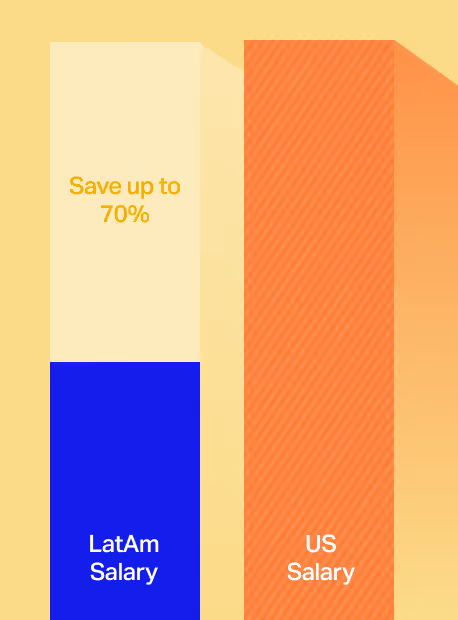
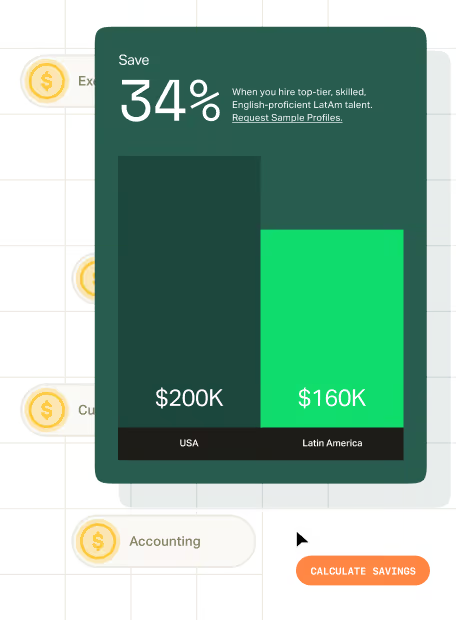
Hiring a developer in Latin America costs $30K–$108K per year depending on role and seniority, compared to $67K–$238K for the same hire in the US.
There’s no software developer salary benchmark for Belize we’d stand behind, so these are our regional figures, and they’re the right basis for a Belize offer.
To put that in concrete terms, here’s what hiring each engineering role costs compared with equivalent US hires, according to Hire With Near’s salary benchmarks:
For the most up-to-date figures, see Hire With Near’s US vs Latin America Salary Guide.
Across the 2,000+ placements in Hire With Near’s 2026 State of LatAm Hiring Report, US companies saved an average of $35,000 to $64,000 a year per hire. Our developer salaries in Latin America versus the US breakdown has the role-by-role picture.
That gap between salaries in Latin America and the US is a result of the differences in cost of living, as you can see in the table below, comparing Belize City and Mobile, Alabama:
Source: Numbeo.com
Paying at the top of the Latin American range for a genuinely senior engineer is a better trade than paying at the bottom for someone you’ll have to backfill. For example, if you hire a DevOps engineer in Latin America at a fair local rate, they tend to stay.
How Can a US Company Hire Developers in Belize?
US companies have four ways to hire developers in Belize: freelance marketplaces, hire directly, a nearshore staff augmentation company, or a staffing and recruiting firm.
In a market this small, the choice matters more than it does elsewhere, because the hard part isn’t employing the person. It’s how you find developers in Belize at all.
Option 1: Freelance and contractor platforms
Platforms like Upwork, Toptal, and Arc give you direct access to freelance software engineers across Belize and Latin America. You can start an engagement within days, pay hourly or by milestone, and scale up or down without a long-term contract. That makes marketplace sourcing a good fit for a specific deliverable, a short sprint, or testing a proof of concept.
The trade-off is focus and retention. Freelancers on open marketplaces are usually working for several clients at once, so your project is competing for their attention. Day-to-day code quality, priorities, and whether the person sticks around all fall on your own team to manage.
If you want to add a full-time engineer to your core product team for the long run, a specialized recruiting partner is a better fit.
Option 2: Direct employment
Hiring directly means your company handles sourcing, technical vetting, and the legal employment relationship yourself. In Belize, that happens one of two ways:
- Set up a local entity: Registering a business in Belize gives you full control, but it takes real legal work and capital to set up. Belize’s Labour Act also sets strict rules on employee protections, including notice periods and severance pay. This route only makes sense if you’re building a real regional office, not hiring one or two developers.
- Use an employer of record: An EOR becomes the legal employer on paper, handling contracts, payroll, and statutory contributions without you needing your own entity. Worth knowing: an EOR only handles the employment side. Sourcing and vetting candidates is still on you.
If you’re comparing EOR companies or working through the mechanics of hiring remote foreign employees, you probably have a candidate in hand already.
Option 3: Nearshore staff augmentation
Staff augmentation gives you pre-screened developers who work inside your day-to-day operations. You keep full technical control, setting priorities, running sprint planning, and making architecture decisions, while the provider handles payroll and benefits on its side.
Unlike outsourcing a whole project to an outside agency, staff augmentation keeps engineering leadership inside your company. It’s a good fit for quickly adding engineering capacity or filling a short-term skill gap. Because these placements are built around a project’s timeline, though, developers may rotate off once the contract ends, which makes this a weaker option if you want someone who builds years of context in your codebase.
Staff augmentation compared with software outsourcing covers the distinction that trips most buyers up.
Option 4: Full-service nearshore staffing
For a long-term, dedicated hire, a nearshore staffing firm handles both the search and the ongoing employment relationship. Partners like Hire With Near run the candidate search from the start, screen people against your exact technical requirements, and hand you a shortlist ready for your own final interviews.
Once you pick someone, the staffing partner manages legal compliance, local payroll, and benefits on your behalf. The engineer works only for your company, full time, becoming a permanent part of your team and your codebase for as long as you need them.
This is the simplest route for most US companies hiring a permanent engineer.
If you’re comparing providers, put specialist staffing firms for LatAm hiring and companies that hire developers in Latin America side by side. Ask each how they source, how they screen, and what happens if a placement doesn’t work out.
{{prevetted-banner}}
What Should US Companies Know Before Hiring Developers in Belize?
Three things are worth knowing going in: protecting your intellectual property, understanding Belize’s labor rules, and what English fluency delivers.
Intellectual property and data security
Your engineer will have access to your repos, customer data, and system credentials. Under Belizean law, IP an employee creates belongs to the employer automatically if that’s specified in writing, but a contractor relationship needs its own IP assignment clause and NDA up front.
A staffing partner builds these protections into the agreement from the start. If you’re hiring directly, that’s on you to draft and get signed.
Employer costs and statutory obligations
This part depends entirely on how you structure the hire.
If you employ someone directly, whether through your own entity or an EOR, Belize’s labor rules apply: social security contributions are split between employer and employee, severance pay kicks in after two years of continuous service, and statutory annual leave can’t be paid out instead of taken while the person is still employed.
Misclassifying a full-time employee as a contractor to avoid these obligations carries real penalties from the Ministry of Labour.
None of this applies if you’re hiring through a freelance marketplace or a staffing partner that engages the person as a contractor, since there’s no direct employment relationship to trigger it.
Native English communication
English is Belize’s official language, so engineers can join a technical discussion in real time without a translation step. That’s less onboarding friction, faster code reviews, and fewer misunderstandings in client meetings than markets where English is a second language.
For more information, the questions tech leaders ask about hiring developers in Latin America cover stand-ups, on-call, and code review directly.
How Does Hire With Near Help US Companies Hire Developers in Belize?
Hire With Near runs the search and handles the employment side once you hire, so a Belize hire takes about as much of your time as a local one. From the editorial work I do interviewing our recruiters, the part clients underestimate most is how much of the timeline sits in sourcing.
Here’s the process. We take a role intake to understand the work, the team, and what a strong hire looks like in your context, then run a fresh search against that brief for every role. We assess every candidate’s English, and our recruiters run the technical screen before anything reaches you.
You get a shortlist in 3 to 5 days, and most companies make a hire in under three weeks.
The technical screen is a real filter, not a resume check. Natasha Tarapow, Recruitment Consultant at Hire With Near, describes what it looks like:
We always ask candidates to tell us about a project they’ve worked on, not just that they use this language and that one, but what their role was and what they actually did. It’s important that they can explain their work to someone who isn’t a developer. If they can do that, that tells me a lot.
— Natasha Tarapow, Recruitment Consultant, Hire With Near
In practice, that means a project walkthrough where they explain a real decision they made, not just the tools they used. If you want a coding exercise or a take-home task added to the process, a debugging exercise, a refactor for scalability, a basic API with tests, we can build that in and review it together with you on a call.
That screening standard is what made the difference for ParkMobile, part of the Arrive mobility platform. Their back-end and platform engineering had run through third-party agencies for years, and leadership wanted their own senior engineers instead.
We placed 9 senior engineers in 24 days, saving ParkMobile over $1 million a year against US rates, a 73% reduction. Akshay Gokarnakar, ParkMobile’s TA Lead, put it simply: Hire With Near “basically cracked” the problem of finding the right people for that kind of team.
You can hear Akshay describe the collaboration in his own words in the video below:
Every placement carries a 180-day replacement guarantee. We handle engineering leadership through executive search in Latin America when the role is a VP of Engineering or a CTO, and we work with US tech companies building engineering teams in Latin America across the region.
The difference that matters for Belize: we recruit across 20 countries and have made 3,500+ placements, so you aren’t betting the search on one small market. If the strongest candidate is in Honduras, Guatemala, or Costa Rica instead, you’ll hear that from us. Our guide to hiring remotely in Latin America covers what that regional search looks like in practice.
Final Thoughts
Belize is an excellent place to hire one specific kind of engineer and a poor place to run a volume search, and knowing which situation you’re in is most of the decision.
If communication is part of the job, the official language and the time zones overlap make it a market worth searching properly. If you need several similar engineers quickly, the search belongs in a wider region.
The right partner does both. If you want to hire a remote developer in Latin America, whether that person turns out to be in Belize or next door, book a free consultation to talk through your requirements with our team. You’ll get salary benchmarks and a walkthrough of the process.
If you’d like to learn more about other markets in Latin America, check out our guides on hiring developers in Costa Rica, hiring developers in Peru, hiring developers in Colombia, hiring developers in the Dominican Republic, and hiring developers in Jamaica.
{{latam-hiring-cta-v2}}
Frequently Asked Questions
Do developers in Belize speak English?
Yes. English is the official language of Belize, the only country in Central America where that’s the case, so professional work is conducted in English as a matter of course. That’s a fact about the country, and it still tells you nothing about a specific candidate, so we screen every candidate’s English before shortlisting.
For an engineer, the bar worth screening against is whether they can explain a technical decision to someone who isn’t an engineer.
How big is Belize’s developer talent pool?
Belize’s developer pool is small: roughly 420,000 people live in the country, its technology workforce is a small share of that, and it sits mostly around Belize City and Belmopan. Many of the strongest engineers already work remotely for foreign employers. Plan a targeted search for one person, and widen the brief to the region if you need several engineers at once.
What time zone is Belize in, and does it overlap with US working hours?
Belize alternates between US Central and Mountain time, so a developer there works during your business day whether your team is on Pacific, Mountain, Central, or Eastern time.
The time gap shifts by an hour twice a year depending on where you are in the US, because Belize keeps a steady schedule year-round, but the US observes Daylight Saving Time.
Stand-ups and live code reviews work just as smoothly as they would with a US teammate.
How much does it cost to hire a developer in Belize?
Hiring a developer costs $30K–$108K a year depending on role and seniority, against $67K–$238K for the equivalent US hire, according to our salary data. Those figures are Latin America regional benchmarks; no Belize-specific benchmark exists.
Because the Belize dollar has been fixed to the US dollar since 1976, a salary agreed against that rate doesn’t move.
Should I hire in Belize or elsewhere in Central America?
Decide by role, not by ranking countries. Belize is the strongest choice when communication is part of the engineering job: client-facing seniors, solutions engineers, front-end developers embedded with a US team, and QA leads who own written documentation.
For a high-volume back-end search or a rare specialization, look at hiring developers in Costa Rica or hiring remote talent in Honduras too. A partner recruiting across 20 countries runs both searches at once.
How long does it take to hire a developer in Belize through Hire With Near?
Expect a shortlist of candidates in 3 to 5 days when you hire remote developers in Belize, and most companies make a hire in under three weeks. Those are Hire With Near’s standard figures across Latin America, not a Belize-specific promise.
In a small market, sourcing is the stage most likely to stretch, because the search is targeted.



.webp)
.webp)


.webp)


%203.svg)
.avif)





%20(1).avif)

%20(1).png)