


%203.svg)
Key Takeaways
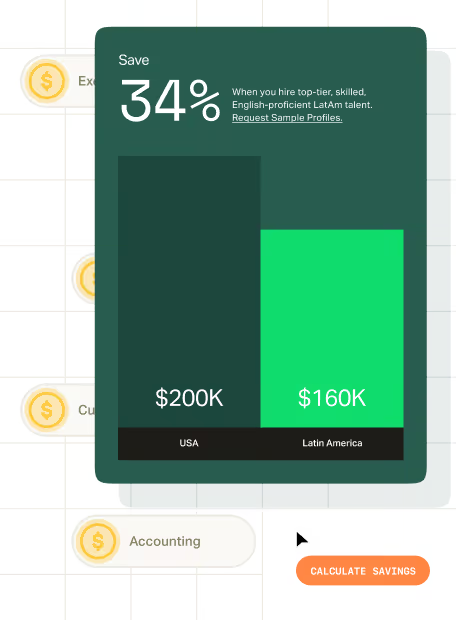
- Hiring a full-time developer costs roughly $36,000 to $108,000 a year, 49% to 68% less than hiring the equivalent US software engineer. Those are Hire With Near's Latin America-wide benchmarks, which is how we'd price a Dominican hire, because no reliable Dominican-specific salary survey exists.
- The country runs on Atlantic Standard Time (UTC-4) year-round with no daylight saving, matching US Eastern time exactly during Daylight Saving and sitting just one hour ahead the rest of the year, so a Dominican developer works your business day and joins stand-ups live.
- US companies have four ways to hire there: freelance platforms, hiring directly through your own entity or an employer of record, nearshore staff augmentation, or a staffing and recruiting firm.
If you're looking to hire developers in the Dominican Republic, you're tapping into a market with minimal time zone friction, workable English for engineering collaboration, and engineers who are used to working directly with US product teams. As the largest economy in the Caribbean, the country has built digital infrastructure and a business-friendly regulatory environment around exactly this kind of nearshore tech hiring.
The draw here is less about volume than about how Dominican engineers work. They tend to own a feature end to end, question a spec that doesn't make sense, and join a live stand-up instead of working heads-down from a ticket queue. That product-level thinking is what most US teams are actually hiring for.
This guide covers what you need to know before making your first hire: salary benchmarks, where the strongest technical skills concentrate, the four main ways to hire, and the compliance details worth knowing upfront, drawing on what Hire With Near's nearshore staffing and recruiting team sees when hiring developers across Latin America.
Why Should You Hire Developers in the Dominican Republic?
Three things make the Dominican Republic worth a serious look: a developer there works your business day, the country has a real multi-university engineering pipeline, and salaries run roughly half of US equivalents.
Together, they solve the specific problem most US companies are trying to solve when they look outside the country for engineering talent.
A developer there works your business day
The Dominican Republic sits in the Atlantic Standard Time (AST), UTC-4, and doesn't observe daylight saving. Your developer is at their desk while your team is at theirs: stand-ups happen live, a pull request gets reviewed the afternoon it lands, and a production question gets answered in minutes instead of tomorrow.
Here's how that overlap breaks down against each US time zone:
That gives near-total overlap for Central and Eastern teams, and a solid block of shared hours even on the West Coast.
In Hire With Near's analysis of more than 2,000 conversations with US companies exploring why US companies are hiring in Latin America, 30% were switching from offshore specifically to close that gap. It's rarely a complaint about the engineers.
Our guide to hiring remotely in Latin America covers how teams set core collaboration hours.
One of our recruiters answers the question most US teams actually have about the time-zone overlap:
A real, multi-university engineering pipeline
The Dominican Republic isn't relying on a thin, self-taught talent pool built around one school. More than 30 accredited higher education institutions, overseen by the Ministry of Higher Education, Science, and Technology (MESCyT), feed a real academic pipeline into software engineering.
The government has explicitly named software engineering, computer science, and cybersecurity as national strategic priorities, and it's backed that up with infrastructure: the Parque Cibernético de Santo Domingo technology park has been training and placing tech talent for over two decades, and the national Agenda Digital 2030 has made digital skills development a government-level priority.
The result is a pool of engineers who've come up through modern, enterprise-grade training rather than picking up skills piecemeal.
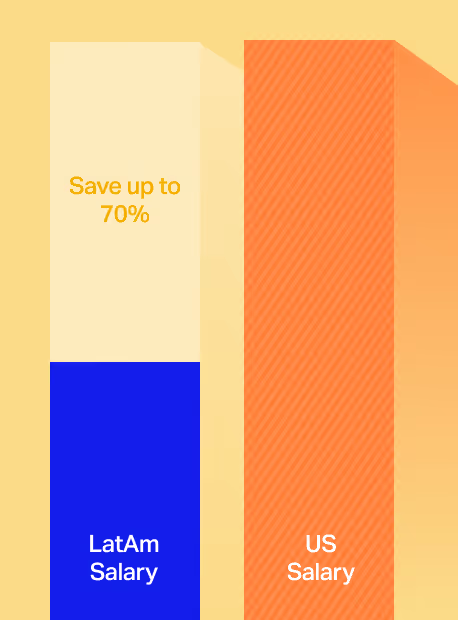
Salaries run up to 70% below US equivalents
Across Latin America and the Caribbean, US companies typically save 30–70% compared to hiring the same role domestically. For a software engineering lead, that efficiency translates directly into hiring power: the same budget yields a senior engineer with architectural experience instead of stretching a junior developer into a role they’re not ready for.
Instead of compromising on candidate seniority to meet budget targets, hiring in the Dominican Republic enables engineering leaders to secure experienced developers who can take full ownership of technical tickets from day one.
The full salary breakdown by role and seniority is covered later in this guide.

How Deep Is the Dominican Republic's Developer Talent Pool?
The Dominican Republic is a real nearshore market: roughly 11 million people, an established nearshore and business process outsourcing industry serving US companies, and a talent pool concentrated almost entirely in two cities, Santo Domingo and Santiago de los Caballeros.
But it's a smaller country compared to others in the region, like Brazil, Colombia, or Mexico. If you need fifteen engineers next quarter, the bigger markets give you more volume. If you need two to five remote developers who overlap your workday, the Dominican pool can usually cover that.
The more useful question is what kind of engineer the region produces. Across Latin America, 98% of the engineering roles Hire With Near placed last year went to mid-level or senior professionals, 51% senior and 47% mid-level, according to the 2026 State of LatAm Hiring Report. That's region-wide placement data rather than Dominican-specific, but it describes the profile US companies come here for: engineers who can own a service in week two, not ones who need months of ramp-up.
The pattern is sharpest in nearshore SaaS recruiting, where a small team can't absorb the training load a junior hire creates, and experienced engineers are the most expensive tier to hire at home. That's why US companies are hiring Latin American developers at that level, and it's exactly the kind of hire the Dominican Republic's two main hubs are built to supply.
Santo Domingo
The capital and dominant hub, where most of the country's developers are based. It also holds the largest concentration of established employers, so candidates have often already worked with US clients.
It's also home to two of the country's strongest technical universities:
- INTEC (Instituto Tecnológico de Santo Domingo), founded in 1972 and technology-focused from the start, offering degrees in software engineering, systems engineering, cybersecurity, and data science.
- UASD (Universidad Autónoma de Santo Domingo), founded in 1538 as the oldest university in the Americas, whose Faculty of Sciences covers software engineering, systems and computing, data science, cybersecurity, and AI.
Santiago de los Caballeros
The second hub, and it carries real weight. PUCMM (Pontificia Universidad Católica Madre y Maestra), one of the country's strongest engineering universities, has its main campus here. It offers computer science engineering, data science, and telematics engineering, so the city has its own graduate pipeline rather than depending on Santo Domingo.
Salary expectations run slightly below the capital's, and local competition for talent is lighter.
{{state-latam-hiring}}
What Technical Skills Do Dominican Developers Have?
Dominican developers work in the same modern stacks as the rest of Latin America, but the market carries a distinct structural specialization: a higher-than-average density of enterprise .NET and C# engineers.
Because the local tech sector historically grew alongside enterprise banking, telecommunications, and nearshore corporate IT infrastructure, Microsoft technologies are deeply embedded in the academic and professional pipelines.
Key tech stacks in the Dominican Republic
- The Microsoft Ecosystem (.NET Core, C#, Azure, SQL Server): The stack the Dominican Republic is best known for. If your architecture relies on enterprise .NET services, web APIs, or cloud systems built on Azure, the local candidate pool offers deep production experience in regulated environments.
- JavaScript/TypeScript (React, Node.js, Angular): React dominates front-end development across the Caribbean and wider region. Full-stack developers pairing Node.js with React or Angular are widely available for modern product development.
- Java & Spring Boot: Strongly anchored in legacy banking and large-scale enterprise services, making Dominican Java developers a good fit for complex backend architecture.
- Python (Django, FastAPI): Widely used for backend API development, integrations, and data engineering projects.
- PHP & Laravel: Common across web development agencies and mid-market commercial software applications.
What to screen for when hiring in the Dominican Republic
One caution our recruiters raise constantly in nearshore technical hiring: teams over-filter on minor framework versions. Demanding an exact match for a minor version throws out strong candidates who would be fully productive within a week. Experienced software engineers adapt quickly once they understand core architecture principles.
When evaluating remote talent, stack lists only tell half the story. The real signal comes from how a candidate approaches problem-solving, code quality, and technical communication.
Federico Bilello, Software Engineering Recruiter at Hire With Near, highlights the primary indicator he screens for when evaluating Latin American and Caribbean developers:
The main thing I look for is ownership. I always look for developers who have worked in startups or smaller companies, because those are the people who probably have ownership. If you bring them a problem, they won't ask how to solve it—they'll try their own ideas, they'll be creative.
— Federico Bilello, Software Engineering Recruiter, Hire With Near
Beyond ownership, look for candidates who write clean, testable code, understand the business outcome behind a ticket, and can explain technical trade-offs to non-technical stakeholders unprompted.
The clearest red flags remain consistent across seniorities: candidates who can’t articulate their specific role on past work, or who dodge questions when asked about past technical mistakes.
What Does It Cost to Hire Developers in the Dominican Republic?
Hiring a developer in Latin America costs 49% to 68% less than hiring the equivalent software engineer in the US. One honest caveat: no reliable Dominican-specific salary survey exists at the granularity an engineering budget needs, and the figures published online disagree by two to four times. The ranges below are our own Latin America-wide benchmarks, which is how we'd price a Dominican hire.
Here is what it costs to hire software developers in the Dominican Republic, from software engineers to specialist roles, compared to equivalent US hires, according to Hire With Near's salary benchmarks:
For the most up-to-date figures, see Hire With Near's US vs Latin America Salary Guide.
Our Latin America range for a senior engineer tops out at $108,000, which sits below the $115,000 floor for a mid-level US software engineer. That's the trade-off most engineering leaders are weighing. Pay at the top of the local range, though: according to our salary data, the spread within a role is wide, and companies paying at the floor lose people within a year.
That gap reflects the difference in cost of living between the two markets, not a difference in skill or output.
Here's how Santo Domingo compares to Tampa, Florida, a US city with a similar population and a comparable mix of industries, on everyday costs:
Source: Numbeo.com
How Can a US Company Hire Developers in the Dominican Republic?
US companies have four ways to hire developers in the Dominican Republic: freelance marketplaces, direct hiring, nearshore staff augmentation, or a staffing and recruiting firm. The right choice comes down to one question: do you need short-term help on a project, or a long-term, full-time developer on your team? Here they are, with the situation each one fits.
1. Freelance and marketplace platforms
Freelance platforms like Upwork and Toptal get you freelance developers in the Dominican Republic quickly, which can be the right call for a scoped two-week project. They're built for project work, so you carry quality control and continuity, and the developer is splitting attention across clients.
For a role someone will hold for years, specialist staffing gives you different results.
2. Hiring directly
Hiring directly means you find, screen, and hire the person yourself, and take on the employer relationship that comes with it. In the Dominican Republic, that means choosing between two paths for the employment side:
- Registering your own legal entity: It gives you complete control, since no third party touches payroll or the employment contract. But it's a real undertaking: incorporation, local tax registration, and ongoing accounting and HR support that doesn't end once the paperwork clears. Unless you're planning to build a team of dozens in-country, this route rarely makes sense for bringing on one or two developers.
- Working through an employer of record (EOR): An employer of record is a company that legally employs your hire on your behalf, running payroll, withholding taxes, administering benefits, and staying compliant with Dominican labor law, while you direct the day-to-day work. It's the faster, lower-commitment option once you've already found the person you want to hire, and there's no shortage of EOR companies operating in the region.
What an EOR won't do is find that person for you. Sourcing, screening, and vetting candidates is still entirely on you, whether that means posting on job boards for hiring in Latin America or running your own outreach. For most engineering teams, that search is the part that eats the budget and the calendar.
3. Nearshore staff augmentation
Nearshore staff augmentation places a pre-vetted engineer onto your team to work under your direction, with the firm handling payroll, benefits, and compliance for that person. It fits defined projects or capacity you aren't ready to make permanent.
In tech, it gets weighed against IT staff augmentation and software development outsourcing, where a vendor owns the deliverable instead of joining your team.
4. A staffing and recruiting firm
This is the simplest option for most US companies, since it's the only route where one relationship covers both finding the person and employing them.
You work with one of the specialist staffing firms for LatAm hiring: you describe the role, the firm sources and vets candidates against it, and you get a shortlist of people already screened for skill and English fluency.
Once you hire, the same firm takes on payroll, benefits, and compliance with Dominican labor law, so nothing about the employment side lands on your team.
That's the model Hire With Near runs on. We solve the sourcing burden that an EOR leaves on your plate, and the legal infrastructure that a DIY entity requires you to build yourself. The default we build for isn't just filling the role. It's a hire who's still on your team three years later.
{{prevetted-banner}}
What Do US Companies Need to Know Before Hiring in the Dominican Republic?
Three practical things shape a Dominican engineering hire: English proficiency, the mandatory 13th-month salary, and how you protect code and customer data.
English proficiency in the Dominican Republic
The Dominican Republic scores 503 on the 2025 EF English Proficiency Index, 63rd of 123 countries and regions worldwide, in EF's Moderate band.
Santo Domingo scores above the national average at 526, and several Latin American markets score higher, including Argentina and Uruguay.
English here is workable for engineering collaboration rather than exceptional, so we assess it on every placement.
This is one of the most common concerns hiring managers and tech leaders raise before their first search in the region, and it's worth reading how other companies think through it: the most common questions tech leaders ask about hiring in Latin America article covers it directly.
The 13th-month salary (regalía pascual)
Whether this applies depends on how you structure the hire. For a formal employment relationship, whether through your own entity or an employer of record, Dominican law requires a 13th-month salary, known as the regalía pascual or salario de Navidad.
It equals one-twelfth of the employee's ordinary earnings for the calendar year and it's due no later than December 20. An employee who hasn't worked the full year is entitled to a pro-rata share.
Overtime pay and profit-sharing are excluded from the calculation, and the payment is not subject to income tax. This is set out in Articles 219 to 222 of the Dominican Labor Code. For a formal employment arrangement, put it in your annual cost per engineer from the start.
IP, code, and customer data
Your developer will have repo access, infrastructure credentials, and often production data. Treat the paperwork as seriously as you would for a US hire: a written IP assignment covering work product, and confidentiality terms that survive the engagement.
Then, apply the same access controls you use for everyone else, from scoped permissions and SSO to offboarding that revokes access.
Most of the protection is operational, and it's standard ground for anyone hiring remote foreign employees.
How Does Hire With Near Help US Companies Hire Developers in the Dominican Republic?
Hire With Near sources, screens, and technically vets developers across Latin America. You get a candidate shortlist in three to five days, and payroll, benefits, and local compliance are handled as part of the placement.
The first question most engineering leaders have is whether the vetting actually holds up, because resumes have never been less reliable. Natasha Tarapow, Recruitment Consultant at Hire With Near, describes the core of it:
We always ask candidates to tell us about a project they've worked on, not just that they use this language and that one, but what their role was and what they actually did. It's important that they can explain their work to someone who isn't a developer. If they can do that, that tells me a lot.
— Natasha Tarapow, Recruitment Consultant, Hire With Near
Our recruiters work through four things:
- Project-level questioning: What the candidate built, what they owned, and what they'd do differently.
- A small real-world task: Debugging something, refactoring for scalability, or building a basic API with tests, reviewed together on a call so the judgment behind the code is visible.
- English assessed on every placement: It matters more here than in markets that score higher on the EF index.
- Reference checks: On the specific projects the candidate described.
Then, you interview the shortlist.
The second question is whether this scales past one hire. A US healthtech startup shows the pattern. Its two internal recruiters couldn't keep pace, and it refused to shorten an 8-step process of technical screens, coding assessments, and culture-fit interviews.
Hire With Near took over sourcing and screening, and the company hired 7 senior engineers across back-end, DevOps, QA, mobile, front-end, plus staff-level roles, at $323,000 in annual savings and a 14-day average time-to-hire.
That was a Latin America build rather than a Dominican one, but it's the shape of going from one hire to a nearshore team.
If you need a VP of Engineering or a CTO instead, that runs through executive search for engineering leadership.
Final Thoughts
The Dominican Republic won't give you the raw volume of Brazil or Colombia, and its English scores sit mid-table for the region. What it does give you is a genuine engineering pipeline, plus a market reputation for .NET and C# depth that's worth testing on your own shortlist. Add a working day that lines up with yours all year and salary ranges 49% to 68% below US equivalents.
For a team hiring two to five engineers, that's a strong combination.
Still comparing markets? The same guides exist for Costa Rica, Ecuador, Honduras, Guatemala, Panama, and Belize. You can also check our article about the best countries to hire software engineers.
To pressure-test the numbers against your own role, book a free consultation to talk through your requirements with our team. We'll give you salary benchmarks for the stack and seniority you need and explain how the process works.
{{latam-hiring-cta-v2}}
Frequently Asked Questions
How much does it cost to hire a developer in the Dominican Republic?
According to our Latin America-wide benchmarks, hiring a nearshore, full-time developer costs $36,000 to $108,000 a year depending on seniority and specialization, 49% to 68% less than hiring the equivalent US software engineer. No reliable Dominican-specific survey exists, so those regional benchmarks are how we'd price a Dominican hire.
Budget on top of that for the mandatory 13th-month payment and, if you use a partner, the recruiting or staffing fee. There's no entity cost when you hire through a staffing firm or EOR.
What is the average software developer salary in the Dominican Republic?
Our Latin America-wide benchmarks put software engineers at $36,000 to $108,000 a year, and specialist roles including nearshore back-end developer, remote front-end developer, .NET, and React at $30,000 to $108,000.
Treat any single average Dominican developer salary figure you find online with suspicion: published numbers disagree by two to four times, because no reliable country-specific survey exists.
For a full list of salaries, check Hire With Near's IT Roles Salary Guide.
Is the Dominican Republic in a compatible time zone with the US?
Yes. The Dominican Republic operates on Atlantic Standard Time year-round without daylight saving shifts, aligning directly with US Eastern time during the summer and staying just one hour ahead during the winter.
Whether your team runs on Eastern, Central, Mountain, or Pacific time, a developer there works during your core business hours. That keeps stand-ups, code reviews, and live pairing happening in real time rather than asynchronously overnight.
Do Dominican developers speak English well enough for daily stand-ups?
Yes, for day-to-day engineering collaboration, though this is a moderate-proficiency market on EF's scale. The Dominican Republic scores 503 on the 2025 EF English Proficiency Index, 63rd of 123 countries and regions worldwide, in EF's Moderate band, with Santo Domingo above the national average at 526.
Verify English per candidate rather than assuming it from a country average; we assess it on every placement.
Is a 13th-month salary required in the Dominican Republic?
For a formal employment relationship, yes. Dominican law requires a 13th-month salary, the regalía pascual, equal to one-twelfth of the employee's ordinary earnings for the calendar year and due no later than December 20.
Employees who haven't worked the full year receive a pro-rata share, overtime and profit-sharing are excluded, and the payment is not subject to income tax. See Articles 219 to 222 of the Dominican Labor Code.
The way you engage someone affects which local obligations apply, so confirm the structure with your EOR or counsel. Either way, candidates tend to factor the 13th-month payment into their expectations, since it's standard in the local market.
How long does it take to hire a developer in the Dominican Republic through Hire With Near?
You'll usually have a shortlist within three to five days, and most companies make a hire in under three weeks. In the Latin America healthtech build above, the average time-to-hire across 7 senior engineers was 14 days with the full 8-step interview process intact.
A comparable US senior engineering search often runs three to six months.
What other developer roles can I hire in Latin America?
Beyond generalist software developers, US companies regularly hire remote DevOps engineers, nearshore QA engineers, and mobile developers based in Latin America, plus specialized backend and frontend talent as teams grow. Most teams start with one role and expand once the overlap proves itself.




.webp)
.webp)



%203.svg)
.avif)





%20(1).avif)

%20(1).png)