.webp)


%203.svg)
Key Takeaways
- The 11 software development outsourcing companies worth shortlisting in 2026 are Hire With Near, Andela, AgileEngine, DECODE, BEON.tech, Innowise, Cheesecake Labs, Saigon Technology, Netguru, Onix, and STX Next. Each one carries at least a 4.5-star rating across 50 or more client reviews on an independent review platform, or has a verifiable track record with large enterprise clients.
- Choosing a software development outsourcing company means making two decisions: the model (staff augmentation, a managed team, or a project-based engagement) and the location (onshore, nearshore, or offshore). The model is the one that's harder to undo.
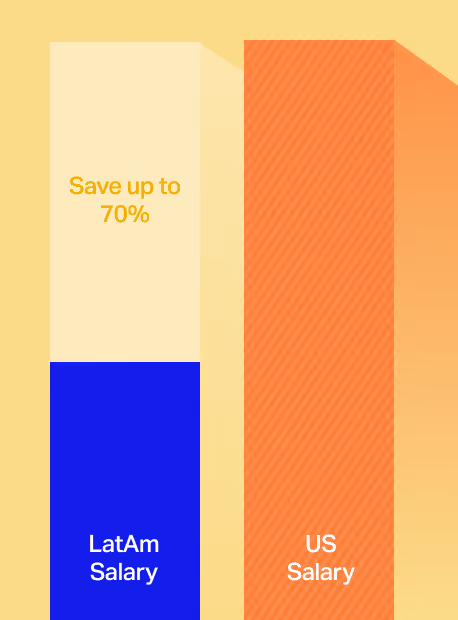
- The benefits of outsourcing software development include faster access to experienced engineers, team scaling you can reverse, and a shorter time to market. In Latin America, where engineers share most of the US workday, salaries also typically run 30 to 70% below comparable US salaries.
Two software development outsourcing companies can quote you the same rate for the same senior engineer and still be selling different things.
One might run your whole project with its own team and hand you finished software, while another might help you hire software engineering talent in Latin America who work only on your product, report to your own leads, and keep US business hours.
If a past vendor moved your engineers to another client right when they finally learned your codebase, the model you bought is usually the reason.
Below, I compare 11 software development outsourcing companies on how each one works with you, how much of your workday their engineers share, and what they publish about pricing, and then walk through how to choose one.
I'm a writer at Hire With Near, one of the 11 companies below, so I'm biased. I'll be clear about where we fit and where another firm on this list is the better call.
How Did We Choose The Software Development Outsourcing Companies?
Every company on this list clears at least one of two bars. Ten of the 11 carry at least a 4.5-star rating across 50 or more client reviews on an established review platform: G2, Clutch, Trustpilot, GoodFirms, or ClearlyRated. Client ratings only, no employee-review sites.
The eleventh, DECODE, has fewer reviews but a verifiable roster of enterprise clients, including Microsoft, AT&T, and Royal Caribbean.
To build the list, I looked at what each publishes about its services, delivery locations, engagement models, and technical focus, then wrote up who each is a fit for. I did not rank them, and no company paid for its spot.
What Are the Top 11 Software Development Outsourcing Companies?
The top 11 software development outsourcing companies in 2026 are Hire With Near, Andela, AgileEngine, DECODE, BEON.tech, Innowise, Cheesecake Labs, Saigon Technology, Netguru, Onix, and STX Next.
Treat this software development outsourcing companies list as a shortlist worth making calls about, not a ranking. I put Hire With Near first because we're built around engineers who join your own team and work your hours, and the other ten are in no particular order because the right fit depends on your roles, budget, and timeline.
All 11 can put experienced engineers on your product. You get:
- developers who have shipped production software for US companies
- English good enough for daily technical collaboration
- a defined process for screening, onboarding, and replacing people
What separates them is who employs the engineers, who manages them, where they sit relative to your working hours, and what happens when the engagement ends.
The table below shows which model each company offers and what it publishes about pricing.
However, the exact price comes from a quote, and it depends on the model. IT and tech recruiting firms in Latin America usually charge either a one-time placement fee or a monthly fee per hire, while project delivery firms bill by the hour or at a fixed price. Each listing below says which model the company offers.
I re-check these ratings regularly and update them when they change, so a platform may show a slightly different number by the time you read this.
If cost is what you're solving for, check what developer salaries look like in Latin America versus the US before you compare quotes. It shows you how much of each quote goes to the engineer.
1. Hire With Near

Website: hirewithnear.com
Headquarters: US
Rating: 4.9/5 on G2 (160+ reviews)
Services: Full-service nearshore staffing and recruiting, RPO, staff augmentation, executive search
Focus Regions: Latin America only
Hire With Near is a full-service staffing and recruiting agency that helps US companies hire top-performing remote talent in Latin America across all departments and industries. We handle sourcing, screening, payroll, and compliance, so the only part left on your side is the hiring decision.
Hire With Near ranked No. 118 on the 2026 Inc. 5000 list of the fastest-growing private companies in America.
The difference from most companies here is who the engineers work for: the developers we place work only for you, including senior software engineers, full-stack engineers, and DevOps specialists who sit in your stand-ups.
A healthtech company we worked with shows what that looks like. It was scaling fast with two internal recruiters and an 8-step technical evaluation it wouldn't shorten, so we took over sourcing, screening, and coordination through a shared tracker.
It kept all 8 steps, averaged 14 days to hire, and ended with 7 senior engineers across backend, DevOps, QA, mobile, frontend, and staff level, at $323,000 a year less than equivalent US salaries.
While researching this list, I read through our own G2 reviews as well. This one, from a client who's been hiring engineers with us for months, is the one I'd show anyone asking how the process works:
I've been working with Hire With Near for about six to eight months to hire engineering talent. [...] They really try to understand who we're hiring for, and every time I give feedback, they consistently find better people. It shows that they listen well.
Check more client reviews on our reviews page.
Key advantages:
- Specialist engineering recruiters: We place senior backend, frontend, mobile, QA, and data engineers every week, and our recruiters know why Python, JavaScript, Go, or a specific framework matters for your build.
- Quality-first screening: We fill 97% of the roles we take on and hold a client satisfaction score of 9.1 because we screen for drive, readiness, and cultural fit alongside the stack.
- One partner, one process: Hire for engineering and every other function through the same dedicated team. First candidates in 3 to 5 days with video introductions, most hires in under 3 weeks.
- 180-day replacement guarantee: Double the industry standard. If a hire doesn't work out in the first six months, we find a replacement at no additional cost.
Best for: US companies that want to build their own long-term engineering team in Latin America, in overlapping working hours, and keep control of the hiring bar.
Limitations: We're a recruiting and staffing partner, not a development shop, so there are four situations where we're the wrong call:
- You want a vendor to own delivery end to end: If you want a vendor to manage the engineers and hand you finished software, a full-service firm such as AgileEngine or Cheesecake Labs is the better choice.
- You need a fixed-scope, fixed-price project: Innowise, Saigon Technology, and Onix all sell work to a statement of work, and we don't.
- You need a bench for a few weeks: Our process is built for hires you keep, so it won't fit a team you spin up for two weeks and stand down.
- You need engineers outside Latin America: We place talent only in Latin America, so if your requirement is a team in Poland, Vietnam, or India, we're not an option.
Pricing: No upfront cost. Once you hire, you choose a one-time recruiting fee or a monthly fee that includes payroll and compliance. You set the salary, and we share benchmarks first.
2. Andela
Website: andela.com
Headquarters: US
Rating: 4.7/5 on G2 (1,535+ reviews)
Services: AI engineering talent placement, managed AI teams, model training and evaluation, engineering upskilling
Focus Regions: Global, with talent in Africa, Latin America, Europe, and India
Andela earned a spot here because it has repositioned around one problem: staffing the engineering work behind production AI systems. It certifies engineers for LLM, agentic, and MLOps work rather than general web development, and its client base leans enterprise: Goldman Sachs, GitHub, SoFi, Capital One.
Key features:
- AI-specific certification track: Engineers are credentialed against defined AI competencies such as retrieval systems, model alignment, and production deployment.
- Training as a service: Andela will upskill your in-house engineers on AI tooling, which is unusual among providers here.
Best for: Companies building or operating AI systems that need specialized engineers quickly, blended into an existing team or as a managed group.
Limitations: The engineers stay on Andela's side of the relationship, so this is capacity rather than a team you own. The heavy AI positioning may not suit a plain backend or frontend build, and overlapping hours depend on where your engineers sit.
3. AgileEngine
Website: agileengine.com
Headquarters: US
Rating: 5.0/5 on Clutch (65+ reviews)
Services: Custom software development, generative AI and machine learning, data and analytics, UX/UI design, QA and test automation
Focus Regions: Latin America (Mexico, Argentina, Colombia, Brazil, Guatemala), Europe, and India
AgileEngine made my shortlist for a perfect Clutch score across 65+ reviews, plus delivery hubs in Latin America that share most of the US workday. It runs more than 15 talent hubs, and its published client list includes Uber, Motorola, and Bloomberg Industry Group, so it is used to enterprise review cycles.
Key features:
- Studio structure: Design, data, AI, and QA sit in separate practices, so you can add a specialist discipline without hiring a second vendor.
- Two ways to buy: Integrate remote engineers into your team, or hand over a managed team that owns feature delivery.
Best for: Product teams that want a managed team for an AI or data-heavy build and value delivery hubs in overlapping working hours.
Limitations: Engineers remain AgileEngine's employees, so institutional knowledge sits with the vendor. The AI-first positioning may be more than a maintenance need requires, and with hubs on three continents, confirm where your team will sit.
4. DECODE
Website: decode.agency
Headquarters: Zagreb, Croatia (second office in Düsseldorf, Germany)
Rating: 5.0/5 on Clutch (16 reviews)
Services: Custom software development, AI development, dedicated teams, team extension, legacy system modernization, product discovery
Focus Regions: Western and Northern Europe, UK, US East Coast
DECODE is an EU-based software development company that has been building complex custom software since 2012, with 90+ engineers across Zagreb and Düsseldorf.
They usually work with two kinds of clients: tech companies whose product is the software itself, and mid-market businesses replacing or modernizing the aging systems their operations depend on. Their focus industries are transportation and logistics, telecom, healthcare, fintech, and IoT.
DECODE has built software for Microsoft, AT&T, Royal Caribbean, and Norfolk Southern, where a team of 20 built a capacity-planning platform handling 400,000+ daily reservations with millions in operational savings.
They engage either as a dedicated team that owns a product outright, or as senior engineers who join an existing in-house team. Clients stay an average of 4.5 years.
Key features:
- One team, one project policy: Engineers are assigned to a single client and don't context-switch between accounts, so the people building your product are working only on your product.
- Product-minded development: DECODE says its engineers think about the why behind a feature, bring their own ideas, and own the outcome of what they ship.
- Agentic engineering: Their teams build with AI agents supervised by senior engineers, which DECODE says cuts delivery timelines roughly in half.
Best for: European and UK companies that want a nearshore partner in the same or adjacent time zone, and US East Coast companies that can work with an overlap in their morning in exchange for EU data residency and ISO 27001-certified security.
Limitations: DECODE isn't a LatAm option, so West Coast US teams that need full-day overlap should look elsewhere. They also work in teams rather than placing individual contractors, so a company that just wants to hire one developer is a poor fit.
Pricing: Fixed price or time and materials. Clutch lists an hourly band of $50 to $99 and a $75,000 minimum project size.
5. BEON.tech
Website: beon.tech
Headquarters: Not publicly listed
Rating: 4.9/5 on Clutch (70+ reviews)
Services: Staff augmentation, contract-to-hire placement, IT recruitment, human data services for AI training
Focus Regions: Latin America
What stood out about BEON.tech is how narrow the focus is: Latin American software engineers placed with US companies, and not much else. Founded in 2018, it reports a 3-to-1 submit-to-hire ratio, with technical leads assessing candidates before profiles reach the client. Named clients include Superhuman, Evisort, AutoFi, and SimplePractice.
Key features:
- Contract-to-hire path: You can start with augmentation and convert to a direct relationship later, which is rare among the augmentation providers here.
- Candidate reports from technical reviewers: Each submission comes with a written assessment from a tech lead rather than a resume and a rating.
Best for: US software companies that need to add a small number of vetted Latin America engineers to an existing team fast.
Limitations: The Latin America focus means no coverage if your roadmap calls for a team in Europe or Asia, and headquarters are not publicly listed, so ask directly. The model is built around individual engineers joining your team, not a vendor owning delivery.
6. Innowise

Website: innowise.com
Headquarters: US, with offices across Europe and the Middle East
Rating: 4.9/5 on Clutch (70+ reviews)
Services: Custom software development, enterprise platform work, AI and data engineering, QA, DevOps, cloud migration, legacy modernization
Focus Regions: Global, with delivery concentrated in Europe
Innowise is here for its size and its certifications, which matter when your build touches regulated data. It reports more than 3,500 IT professionals and 1,600 completed projects, and holds ISO 9001, 27001, and 13485, the last of which covers medical devices. For a healthcare or fintech build that has to survive a security review, that paperwork does real work.
Key features:
- Enterprise platform specialists: Teams work in SAP, Dynamics 365, Salesforce, and Odoo, so an ERP or CRM project doesn't need a separate systems integrator.
- Three engagement models: Staff augmentation, a dedicated team with full project ownership, or a fixed-scope turnkey project.
Best for: Mid-market and enterprise companies with a platform-heavy or compliance-heavy build that want one vendor to own it.
Limitations: Delivery is concentrated in Europe, so a US team should plan for limited afternoon overlap and asynchronous review cycles. The scale that suits an enterprise program can feel heavy for a two-engineer need, and engineers stay with Innowise.
7. Cheesecake Labs
Website: cheesecakelabs.com
Headquarters: San Francisco, US, with a development office in Florianópolis, Brazil
Rating: 4.9/5 on Clutch (65+ reviews)
Services: Product strategy and UX/UI design, mobile and web development, backend engineering, AI and data work, DevOps and cloud
Focus Regions: Brazil and the US
The reason Cheesecake Labs made this list is design. Founded in 2013, it has worked on more than 350 digital products and pairs product strategy and interface design with engineering rather than selling design separately. Its teams sit in Brazil with US-facing management in San Francisco, which puts most of the working day in overlap.
Key features:
- Design and engineering in one team: Product discovery, UX, and interface design run alongside development instead of arriving as a separate statement of work.
- Mobile depth: Native and cross-platform mobile work is a core practice, not a side offering.
Best for: Companies building a new consumer or mobile product that need design and engineering from the same team, in overlapping working hours.
Limitations: The team is smaller than the enterprise firms here, so a large multi-track program may stretch capacity. Delivery is concentrated in Brazil, and engineers remain Cheesecake Labs employees.
8. Saigon Technology
Website: saigontechnology.com
Headquarters: Ho Chi Minh City, Vietnam, with offices in Virginia, Sydney, and Singapore
Rating: 4.9/5 on GoodFirms (50+ reviews)
Services: Custom software development, web and mobile apps, MVP builds, legacy modernization, QA testing, DevOps, offshore development centers
Focus Regions: Vietnam, serving the US, Australia, and Southeast Asia
Saigon Technology caught my attention for its engagement flexibility. Alongside dedicated team and fixed-price options, it runs offshore development centers and build-operate-transfer arrangements, where it stands up a team and eventually hands the operation to you.
Founded 14 years ago, it reports more than 500 developers across three Vietnamese delivery centers, 850 completed projects, and ISO 9001 and 27001 certification.
Key features:
- Build-operate-transfer option: Useful if your long-term plan is your own offshore entity rather than a permanent vendor relationship.
- Broad stack coverage: Python, Java, .NET, Node.js, React, Angular, and the major cloud platforms in one delivery organization.
Best for: Companies whose work can run asynchronously and that want a Southeast Asian delivery center, or a team they eventually take over.
Limitations: Vietnam and the US share almost no working day, so a question sent in your afternoon is generally answered the following morning. Plan for written handoffs and fewer live reviews. Engineers stay with Saigon Technology unless you use the transfer option.
9. Netguru
Website: netguru.com
Headquarters: Poznań, Poland
Rating: 4.8/5 on Clutch (70+ reviews)
Services: Product discovery, web and mobile engineering, product and experience design, AI and data services, cloud engineering, QA, commerce platforms
Focus Regions: Europe, serving clients globally
I chose Netguru for its track record with recognizable consumer brands and the depth of its design practice. It reports more than 400 employees, 2,500 delivered projects, and an NPS of 73, and works with IKEA, Volkswagen, OLX, Vinted, Delivery Hero, and UBS.
For commerce work, the team builds on VTEX, Saleor, Medusa, and commercetools rather than treating every platform as custom.
Key features:
- Commerce platform specialism: Headless CMS, marketplace, and omnichannel work on named commerce stacks.
- Design systems and accessibility: A dedicated design practice covering design systems and accessibility audits, not just interface work.
Best for: Companies that want a design-led partner for a consumer product or commerce platform and are comfortable with a European delivery team.
Limitations: Poland to the US leaves a short overlap window, usually your morning, so afternoon questions typically wait a day. The client roster skews toward large European brands, which can mean process weight a small startup doesn't need.
10. Onix
Website: onix-systems.com
Headquarters: Ukraine, with offices serving the US, UK, and other international clients
Rating: 4.8/5 on Clutch (55+ reviews)
Services: Custom web and mobile development, AI integration, UI/UX design, CRM and ERP development, AR/VR, project rescue, ongoing support
Focus Regions: Europe, serving the US, UK, Middle East, Asia, and Australia
Onix belongs on this list for longevity and for two unusual specialisms. Founded in 2000 and now with more than 370 people, it reports an 82% client return rate and average client relationships of three or more years. Its industry focus is distinctive: travel and hospitality software, plus fitness, EdTech, and booking platforms.
Key features:
- Travel and hospitality software depth: Booking, scheduling, and itinerary platforms are a named practice rather than a case study.
- Project rescue: A defined service for taking over and stabilizing an unfinished or failing build.
Best for: Companies in travel, hospitality, fitness, or EdTech that want a long-tenured vendor, or teams that need to rescue a stalled build.
Limitations: Delivery sits in Europe, so overlap with US hours is limited to your morning and real-time collaboration takes planning. A fintech or healthcare program may find deeper specialists elsewhere, and engineers stay with Onix.
11. STX Next
Website: stxnext.com
Headquarters: Poznań, Poland, with a delivery center in Mérida, Mexico
Rating: 4.7/5 on Clutch (100+ reviews)
Services: Python and web development, AI and machine learning, data engineering and lakehouse builds, cloud, product design, QA, enterprise automation
Focus Regions: Europe and Mexico, serving the US and UK
I added STX Next for the deepest single-language specialism on this list. It has built on Python for more than 20 years, employs over 500 specialists, and has delivered more than 1,000 projects. Data engineering and machine learning now sit alongside the core Python practice, and clients include Canon, Decathlon, Mastercard, and GSK.
Key features:
- Python and data engineering depth: Two decades of Python plus lakehouse and analytics work on Snowflake, Databricks, and Microsoft Fabric.
- Nearshore and offshore in one vendor: The Mérida delivery center offers overlapping working hours; Poland offers scale.
Best for: Companies with a Python, data, or machine learning roadmap that want proven specialists and the option of a Mexico-based team.
Limitations: The Python specialism is a strength and a constraint; a .NET or Java-heavy stack is a weaker match. If you need the nearshore option, confirm capacity in Mérida rather than assuming it.
What Is a Software Development Outsourcing Company?
Software development outsourcing is hiring an outside company to build, extend, or maintain software instead of doing all of it with in-house staff.
The provider you hire, a software development outsourcing company, supplies that engineering capability in one of three ways:
- Full-service development firms own delivery. You describe an outcome, and they staff the team, run the project, and hand back working software. Process, tooling, and institutional knowledge stay on the vendor's side.
- Staff augmentation providers place engineers who join your team and your stand-ups, while the provider handles their payroll and HR.
- Recruiting partners source and screen candidates who become your own team. This is the route for capability you keep, and it's where Hire With Near sits.
When I started at Hire With Near, I kept mixing up staff augmentation and recruiting partners. What sorted it out for me was asking one question: can the engineer be moved to another client's project? With a recruiting partner, they can't.
Ask which of the three you are buying before you ask about rates, because it decides who your engineers answer to and what you still have when the contract ends.
If you’re still weighing whether to buy engineering at all, read the case for an in-house developer versus outsourcing first.
What Are the Benefits of Partnering With a Software Development Outsourcing Company?
Six benefits come up most: faster access to engineers who have already done the work, lower costs (in Latin America, salaries typically run 30–70% below comparable US salaries), team scaling you can reverse, project management you don't have to run, a shorter path to shipping, and more time for your core team.
Access to the talent you need
Outsourcing has stopped being a purely cost-driven decision. Deloitte's 2024 Global Outsourcing Survey found that skilled talent and agility now join cost reduction as key drivers for outsourcing.
The assumption underneath a lot of hesitation about outsourcing is that outsourced engineers are junior. Our own placement data says otherwise. According to Hire With Near's 2026 State of LatAm Hiring Report, 98% of the engineering roles we placed in 2025 went to mid-level or senior engineers, split almost evenly between the two.
That mirrors the wider market. SignalFire's 2026 State of Talent Report found that companies of all sizes are prioritizing experienced engineers over new grads, with entry-level hiring at large tech companies down roughly 65% compared to 2019.
Most companies are competing for the same experienced engineers, and a provider's screening decides which of them reach your shortlist.
Cost efficiency
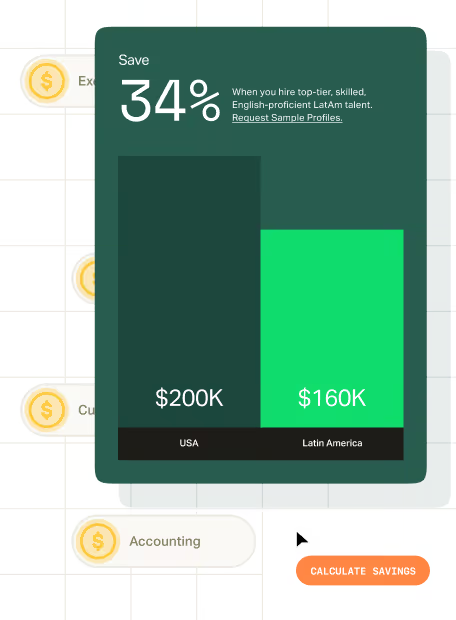
Engineering talent in Latin America typically costs 30 to 70% less than comparable US salaries, according to our own salary data. That gap is usually the largest single number in any outsourcing comparison you run.
Three variables move it far more than the vendor's logo does: the seniority you need, the region you hire from, and the engagement model you choose. A senior engineer through a full-service firm and the same engineer hired directly can land at very different total annual costs, so get a quote for the same role under each engagement model you're considering before you commit.
The savings come from differences in local cost of living, not from paying people below the market they live in. How much US companies save by hiring in Latin America breaks the math down by function, and our US vs Latin America Salary Guide carries the current ranges. If you hire Latin American developers, you're solving for both sides at once: a lower salary base and a working day that lines up with your own.
Team flexibility when you need it
Outsourcing lets you adjust team size without the complexity of hiring and laying off full-time employees, whether you're scaling up for a big project or down after launch. You maintain your core team while adding specialized skills as needed.
Focused project management
A good outsourcing company brings proven processes for managing remote development teams effectively, including clear documentation, established communication protocols, and regular check-ins, so you know where a feature stands without chasing it.
Faster time to market
Good outsourcing companies already have the processes, tools, and teams in place to start quickly. Instead of spending months building an in-house team, you plug into an established development workflow.
Focus on what you do best
Managing development teams eats calendar time your product roadmap needs. When you outsource, you hand off day-to-day technical management to people who do it for a living, which frees you and your core team to focus on product strategy, customers, and growth.
What Are the Most Common Software Development Outsourcing Models?
The three most common models are staff augmentation, a managed team, and a project-based engagement. A fourth route, a recruiting partner that helps you hire engineers of your own, fits when the roadmap is long-term.
Choose based on what you already have in-house. A fixed scope with no internal engineering leadership points to a project-based firm. An existing team that needs more hands points to staff augmentation. A long-term roadmap points to a recruiting partner.
Then ask how easily you can undo it. Staff augmentation and managed teams usually bill monthly, so they're easy to start and stop, and you keep paying for as long as the engineer is on your account. Hiring through a recruiting partner costs a one-time fee, and the engineer is on your team from then on.
A project-based engagement ends when the deliverable does. If you can't tell yet whether a role is permanent, a monthly arrangement lets you walk away. If you already know it is, paying once usually costs less over time. Either way, get the cost of exiting early in writing before you sign.
Staff augmentation model
Think of this as extending your existing team. You bring in developers who work directly with your in-house team, and you keep control of the project while the outsourcing company handles HR and administrative overhead.
Staff augmentation works best when your own leads already run the process and need more engineers working inside it.
Managed team model
You get a dedicated team that handles specific parts of your project, but they're managed by the outsourcing company. You set direction and priorities without worrying about day-to-day management, which is ideal if you want to delegate entire features or modules.
Project-based model
Here, you hand off a complete project and the outsourcing company takes full responsibility for delivery, from planning to implementation. This works best when you have clearly defined requirements and deliverables.
Whichever model you land on, the questions tech leaders ask about hiring developers in Latin America are worth putting to a full-service firm and a recruiting partner alike, because the answers are what separate them.
The full case for outsourcing software development goes deeper on each benefit.
Onshore, Nearshore, or Offshore: Which Outsourcing Location Should You Choose?
Location is the second decision, and the deciding factor is how much real-time overlap your work needs. Where your outsourced team sits drives cost, collaboration style, and how much of your working day you share.
In short, onshore means a US-based team and the easiest collaboration at the highest cost; offshore means a distant team at the lowest cost with little daily overlap; nearshore sits between them, a nearby team in Canada or Latin America that keeps most of your workday shared without US rates.
Onshore outsourcing
This means working with developers based in the US. You get the easiest communication and cultural alignment, but it's typically the most expensive option, and it's worth considering if you need frequent face-to-face meetings or have specific regulatory requirements. If the labels are confusing, nearshoring versus offshoring versus onshoring sorts out which is which.
Offshore outsourcing
This typically means working with teams in distant countries like India, the Philippines, or Eastern European countries. The costs can be very attractive, but you'll need to plan around a time difference of roughly 6 to 13 hours from the East Coast, depending on the country. This can work well for projects that don't need constant real-time collaboration.
Nearshore outsourcing
Nearshore outsourcing is a type of offshoring, but it specifically refers to working with teams in nearby countries. For US companies, that usually means Canada or Latin America.
The reason it matters is overlap. Microsoft’s 2025 Work Trend Index found that 30% of meetings now span multiple time zones and that after-hours meetings keep climbing as teams stretch to stay in sync. A north–south setup, where a US team and a Latin American team share most of the same clock, keeps that tax off your calendar.
With a nearshore team, your developers share most of your business hours, so code review happens the same day and a blocked engineer gets unblocked in a conversation instead of a thread.
A team in Colombia shares close to your whole working day. Argentina and Brazil run an hour or two ahead of the East Coast, so they cover a US morning in full and still overlap the second half of a West Coast team's day.
Our guide to hiring remotely in Latin America covers the practice, nearshore software development walks through the model, and nearshore software development companies narrows the field to providers built around the region.
Hybrid model: Keeping core team onshore
You can keep your core development team in-house and outsource specific functions around it, holding your lead developers and architects onshore while nearshore or offshore teams add capacity. To see which countries to consider, read our article on the top countries for outsourcing software development.
How Do You Choose a Software Development Outsourcing Company?
Decide first whether you want a vendor to deliver the project, extra engineers on your existing team, or engineers who become your own team.
Then, shortlist firms with strong verified reviews in your stack, test how they screen engineers, and get pricing and exit terms in writing before you sign.
1. Pick the model before you pick the vendor
The model is the hardest decision to reverse, and it narrows this list fast.
If you need a defined project delivered, firms like Saigon Technology and Onix sell fixed-price work.
If you're outsourcing developers to extend a team you already run, BEON.tech and Andela add engineers who join it.
If the product is long-term, Hire With Near helps you hire engineers of your own.
2. Decide how much of your workday the team needs to share
If your engineers need to join stand-ups and unblock each other the same day, shortlist providers whose teams sit in Latin America. If the work can run on written handoffs, teams in Europe and Asia widen the field.
I'm writing this from Argentina, an hour or two ahead of New York depending on the season, and almost all my calls with US teammates land in my morning or early afternoon, so a question gets answered the same day.
3. Check verified reviews for work like yours
Start with client reviews on Clutch, G2, or GoodFirms, and read past the star rating. Reading reviews for this list, I trusted the ones that named a stack, a team size, and a timeline far more than the five-star summaries.
4. Test how they screen engineers
Ask who screens candidates before their resumes reach you, and whether that person is technical. Ask how English is assessed, and be specific: can a candidate explain a broken deployment in a video architecture review? Then ask what happens after the shortlist: who runs the technical evaluation, and can the firm help you design it or administer it on your behalf?
I wanted to know what our engineering recruiters check beyond the keyword match, so I asked Natasha Tarapow, Recruitment Consultant at Hire With Near. Her answer surprised me:
A lot of developers also have two or three jobs in parallel — you'd think, wow, they must be amazing. But it's a red flag, because they're probably not performing well at all of them. Or if they are, it's because the expectations are very low. I always look for candidates who stay at least two or three years on average at each job.
— Natasha Tarapow, Recruitment Consultant, Hire With Near
5. Get pricing and exit terms in writing
Ask what you're paying for, and what reaches the engineer. I go through our sales-call notes a lot for my articles, and this one stayed with me. The owner of a small e-commerce holding company explained why they left their previous provider:
Our issue with the other company was they wouldn't tell us how much we were paying them. And one of the people that I interviewed said that the job was listed at like 50% less than what they told us we'd be paying. So that means that their fee was super high. And yeah, that's something that just really didn't sit right with me.
Before you sign, get the fee structure, the replacement terms, the cost of ending early, and who owns the code when the contract ends.
Final Thoughts
Whichever company you shortlist, ask the question from the top of this article before you talk rates: who will the engineers answer to day to day, and will they work only on your product?
Putting this list together, I noticed how many firms offer more than one model at once. AgileEngine, Innowise, and Cheesecake Labs each sell some mix of augmentation, dedicated teams, and delivery, so ask which model your quote covers.
If you already know you want engineers who stay, you're not alone. In Hire With Near's research into why US companies turn to Latin America, 12% came specifically to move off an outsourcing arrangement and build a dedicated team of their own. If that's your direction, our roundup of LatAm outsourcing companies shows how the field in the region compares.
Talk to a few companies on this list, including us. Whether you need one front-end developer in Latin America or a full engineering team, book a free consultation call and we'll walk through our process and share salary benchmarks for the roles you're hiring.
{{consultation}}
Frequently Asked Questions
What is software development outsourcing?
Software development outsourcing means hiring an outside company to build, extend, or maintain your software instead of doing all of it with your own staff.
That company can deliver a whole project, add engineers to a team you already run, or help you hire engineers who become your own team. Companies use it to add experienced engineers faster than a full in-house search allows.
Where can I find the best dedicated software development teams for outsourcing?
Dedicated software development teams come from three kinds of providers: full-service firms that run a team for you, staff augmentation providers that place engineers from their own bench, and recruiting partners that help you hire a team of your own. The 11 companies above cover all three.
Build a shortlist from client reviews on Clutch or G2, then judge each provider on two things: who screens the engineers before you meet them, and what happens when someone leaves. If you want the team to stay yours, a recruiting partner in Latin America helps you build a nearshore team of engineers who work only for you, during overlapping working hours.
Where can I hire an entire outsourced software development team for a tech project?
Hire a full-service development firm or a managed team. On this list, AgileEngine, Innowise, Cheesecake Labs, Saigon Technology, and Onix staff the whole team and take responsibility for delivery.
Agree on the scope, the team structure, and the pricing model (fixed price or time and materials) before work starts. Our step-by-step guide to outsourcing software development services covers that setup. If the project is the first stage of a product you'll keep building, consider hiring the core engineers yourself, because a vendor team takes what it learned about your codebase with it when the contract ends.
How much does it cost to outsource software development?
Outsourced software development is priced either as a rate per engineer (hourly or monthly) or as a fixed project fee. Most firms on this list show hourly bands between $22 and $99, mostly on Clutch, with project minimums from $10,000 to $75,000. The seniority you need, the region you hire from, and the engagement model move the number most.
Engineering talent in Latin America typically comes in 30 to 70% below comparable US salaries, according to Hire With Near’s US vs Latin America Salary Guide, while the US and Western Europe sit at the top of the range. Price the same role across two models before you compare vendors.
Our labor costs are too high and we need capacity fast. Which offshore software engineering companies offer dedicated remote teams with timezone overlap to the US and handle all the HR overhead?
Look at providers that hire in Latin America. Engineers there share most of your working day, wherever your US team is based, and salaries typically run 30 to 70% below comparable US salaries because of the lower cost of living.
On this list, Hire With Near, BEON.tech, and AgileEngine build dedicated teams in Latin America, and Cheesecake Labs and STX Next deliver from Brazil and Mexico. Depending on the model you choose, they handle payroll, contracts, and local compliance, so the HR work stays off your desk.
Speed depends on the model. A provider with an existing bench can often start an engineer within a couple of weeks. With Hire With Near, you get a shortlist of candidates in 3 to 5 days, and most of our clients make a hire in under three weeks.
How is a software development outsourcing company different from Upwork or Toptal?
The difference is who does the screening and who is accountable if a hire doesn't work out. On an open marketplace like Upwork, you write the post, run the filtering, and carry the risk if the contractor stops responding. Toptal screens its network up front, but you're still contracting with freelancers rather than getting a replacement guarantee.
An outsourcing company or recruiting partner sources candidates, screens them before you see a resume, and stands behind the placement, including replacement. That screening and accountability is what the fee pays for.
Our comparison of freelance developers versus offshore development companies walks through the trade-offs.
What software development roles can I hire in Latin America?
US companies hire the full range of software roles from Latin America, including software engineers, front-end developers, back-end developers, DevOps engineers, QA engineers, and mobile developers.
For example, the healthtech company above hired a QA engineer with more than 12 years in test automation and a DevOps engineer with more than 12 years in Kubernetes and CI/CD.







.webp)


%203.svg)
.avif)




%20(1).avif)

%20(1).png)