

%203.svg)
Key Takeaways
- Guatemala runs on Central Standard Time (UTC-6) year-round with no daylight saving. East Coast companies get six to seven hours of real-time overlap; West Coast companies get the same six to seven hours, depending on the time of the year.
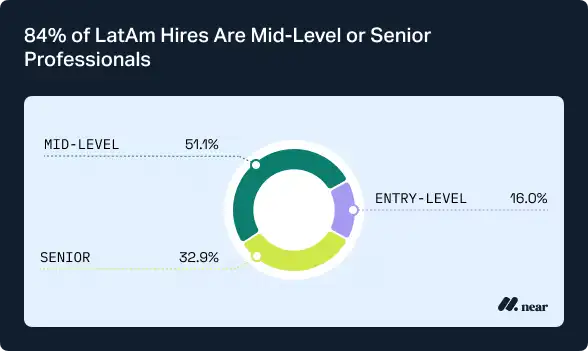
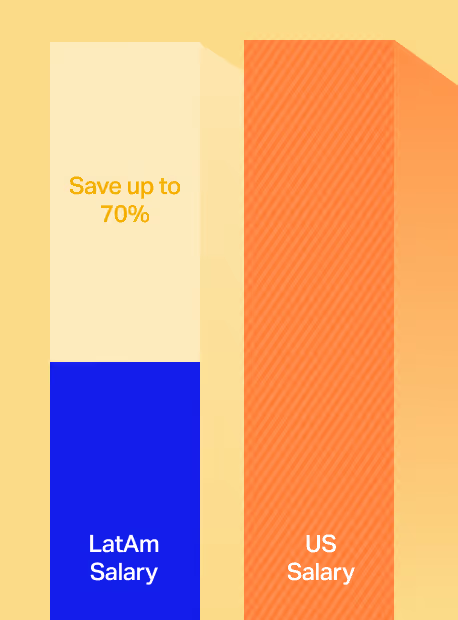
- Hiring in Guatemala typically costs 30–70% less than the US equivalent. Accountants, SDRs, operations coordinators, financial analysts, and executive assistants are the most commonly placed roles, and 84% of Hire With Near's LatAm placements are mid-level or senior professionals.
- Guatemala requires both a 13th-month salary (Aguinaldo, paid in December) and a 14th-month salary (Bono 14, paid by July). Together, they add roughly one additional month of pay to your annual budget, and both are easy to plan for once you know they're coming.
Guatemala City’s bilingual professional talent has been turning heads among US hiring managers, and from what I hear consistently from Hire With Near’s recruiters, that interest is well-founded.
Guatemala gives US companies access to experienced professionals in sales, customer success, and operations who work squarely within Central Time, at salaries that typically run 30–70% lower than US equivalents.
For companies that have already built teams in Colombia, Mexico, or Argentina and want to diversify or scale further, Guatemala is increasingly a natural next step.
This guide covers what US hiring managers need to know before making a hire in Guatemala: the talent profile, realistic salary benchmarks, the compliance items that catch companies off guard, and how Hire With Near makes the whole process work.
Why Are US Companies Hiring in Guatemala?
Guatemala gives US companies access to experienced bilingual professionals in sales, operations, and customer success who work Central Time hours, at salaries that typically run 30–70% lower than US equivalents.
It’s a market that’s been growing steadily, and for companies looking to hire people who work their exact time zone, Guatemala City’s talent pool is hard to ignore.
If you’ve been researching LatAm hiring, you’ve probably come across the broad case already: thousands of US companies are turning to Latin America because of time zone alignment, cultural familiarity, and real cost savings without giving up quality.
Guatemala’s case fits squarely within that picture, with a few country-specific strengths worth understanding.
Time zone alignment
Guatemala runs on Central Standard Time (CST, UTC-6) year-round with no daylight saving time.
The US does observe daylight saving, so the overlap shifts by an hour twice a year, but it stays within a range that works well for real-time collaboration regardless of the season
East Coast companies enjoy six to seven hours of real-time overlap, depending on the time of year.
West Coast companies achieve that same six-to-seven-hour overlap, with Guatemalan professionals anchoring the latter half of their day to sync with Pacific time.
Either way, there’s more than enough shared time for standups, client calls, and live collaboration.
English proficiency
Guatemala ranks #61 globally in the 2025 EF English Proficiency Index, placing it in the “moderate” band overall.
But the headline number understates what matters for US employers. Guatemala City’s professionals score 519, above the global average, and the EF breakdown by function shows Sales (590) and Operations (590) are both in the high-proficiency range.
Strategy and Project Management professionals score 623, putting them in the “very high” bracket.
For the roles US companies typically hire in Guatemala, the English picture is considerably stronger than the country-level number suggests.
And by the time a candidate reaches your interview, Hire With Near has already screened for spoken English, so you're only meeting people whose communication skills are aligned with what the role requires.
US professional culture
Guatemala City’s professional class has deep roots in the BPO and nearshore services sector.
Companies like TELUS Digital operate large facilities there, and a generation of professionals has built careers handling US clients, US business hours, and US-standard communication.
That practical bilingual experience is what makes the market particularly strong for customer-facing roles.
Cost savings
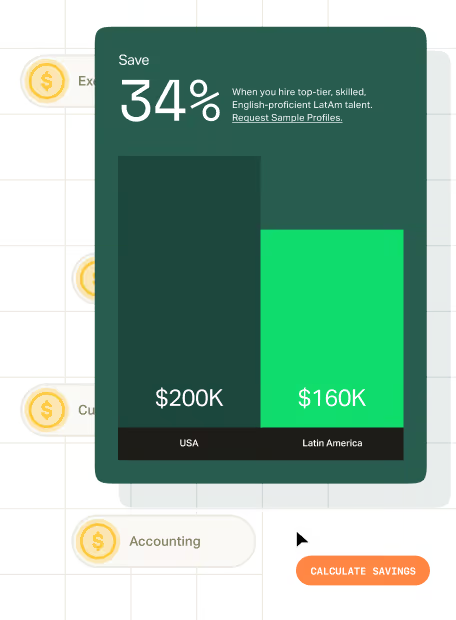
Companies hiring in Guatemala typically save 30–70% on salaries compared to US equivalents. According to Hire With Near’s 2026 State of LatAm Hiring Report, based on over 2,000 placements, the average annual savings per hire runs between $35,000 and $64,000.
Those savings aren’t coming from junior talent: 84% of placements across all LatAm markets were mid-level or senior professionals.
The cost difference reflects Guatemala’s lower cost of living, not the caliber of the people being hired.
How Can a US Company Hire in Guatemala?
US companies have three options for hiring in Guatemala: establish a legal entity, use an employer of record (EOR), or work with a specialist staffing and recruiting company.
For most, the third is the fastest path to a great hire. I’ll cover them in order from most to least complex.
Option 1: Establish a legal entity
Setting up a legal entity means registering your business in Guatemala so you can hire employees directly under your company’s name.
This involves establishing a subsidiary or branch office, navigating local business registration requirements, and setting up compliant payroll and benefits systems under the Guatemalan Labor Code (Código de Trabajo).
This gives you complete control over your international operations and makes sense if you’re planning to build a significant presence in Guatemala, with dozens of employees, not just one or two hires.
The reality? This option is typically only viable for larger companies with dedicated legal and HR resources. The upfront costs are substantial, the process can stretch three to six months, and you’ll need ongoing legal and accounting support to stay compliant as regulations change.
For most US companies looking to hire a handful of remote professionals in Latin America, this is overkill.

Option 2: Use an employer of record (EOR)
An employer of record is a third-party company that becomes the legal employer of your hire on paper, while you maintain day-to-day management and oversight.
The EOR handles everything on the back end: employment contracts, payroll processing, tax withholdings, benefits administration, and compliance with local labor laws. You pay the EOR, and they pay your employee according to local requirements.
In Guatemala, two statutory obligations in particular catch US employers off guard: the mandatory 13th-month salary paid in December and the mandatory 14th-month salary paid by July. Both are required by law and non-negotiable. An EOR manages these obligations automatically, so they don’t become a surprise budget item.
Popular EOR companies include Deel, Globalization Partners, Remote, and Oyster. For a full breakdown of how EOR arrangements work, this guide to hiring remote foreign employees covers the details.
The trade-off? You’ll still need to source and vet candidates yourself. The EOR handles the employment logistics, not the recruiting. That means you’re using LinkedIn or a job board for hiring in Latin America to find people, then bringing in the EOR to handle their employment.
Option 3: Work with a specialist staffing and recruiting company
This is the simplest option for most US companies.
You partner with one of the specialist staffing firms for LatAm hiring, like Hire With Near, that handles both talent acquisition and all employment logistics in one package.
Hire With Near doesn’t just find you qualified candidates. We also manage payroll, benefits, compliance, and local employment requirements through our nearshore staffing and recruiting services.
The process is simple: You describe the role you need to fill, we present pre-vetted candidates, and once you make a hire, we handle the rest. It feels as easy as hiring someone in the US.
This approach makes the most sense when you need both recruiting expertise and hands-off compliance management.
If you’ve been relying on freelance platforms like Upwork or Toptal, specialist staffing gives you fundamentally different results for full-time remote hires.
Related reading: How to Hire Developers in Guatemala: Salaries, Talent Pool, and Four Ways to Hire
What Can US Companies Expect from Guatemalan Professionals?
Guatemalan professionals are particularly strong in sales, finance, and operations roles, with working hours that overlap almost entirely with the US East Coast and Central time zones, making day-to-day collaboration straightforward.
For a broader overview of what the hiring process involves, the common questions US companies have about hiring remote talent offshore guide covers the practical details.

Sales and business development
Sales is Guatemala's top category in Hire With Near's placement data, and the reason connects directly to Guatemala City's BPO history.
Professionals who have spent years handling outbound sequences, managing objections, and running pipelines on US client accounts are well-positioned for SDR and sales development roles.
Guatemala City's corporate districts are home to large US-facing service operations, and a generation of professionals has built careers on exactly the skills that make a strong SDR: clear English communication, structured follow-through, and comfort working US hours.
Lucia Atensia, Sales Recruiter at Hire With Near, puts it this way:
LatAm sales professionals are highly adaptable and familiar with international business practices. A lot of our candidates have already been working with US clients — they know the business, they know European and US markets. That makes them much easier to integrate into global teams. They also tend to have a strong work ethic and resilience, which is crucial in fast-paced, target-driven environments.
If you need to hire an SDR in Latin America and want someone who can hit the ground running on US calls, Guatemala is worth a serious look.
Finance and accounting
Accountants across seniority levels are the most placed role by volume in Guatemala through Hire With Near, spanning staff accountants, senior accountants, and controllers.
That depth reflects both the quality of academic training coming out of Guatemala's top universities and the exposure many candidates have had to US clients through the corporate and BPO sectors.
If you're looking to hire an accountant in Latin America or need to hire a financial analyst who can work within your team's existing workflows, Guatemala has more depth here than most hiring managers expect.
Operations and administrative roles
Operations coordinators and executive assistants are consistently well-represented in Guatemala's placement data.
Professionals in these roles tend to bring strong organizational skills, clear written communication, and the kind of proactive ownership that makes remote operations work actually work.
Camila Banchero, Senior Recruiter for Operations at Hire With Near, puts it this way:
Operations professionals are expected to work with cross-functional teams — coordinating with different departments, sometimes IT. They need really strong communication skills and openness to feedback. Latin America has great communication skills, and that's something that makes LatAm operations professionals such a strong fit.
Hiring an executive assistant remotely from Guatemala is a natural fit given the time zone alignment and the professional polish candidates bring from Guatemala's corporate sector.
Top universities
When a resume from Guatemala lands on your desk, a few university names are worth looking out for:
- Universidad del Valle de Guatemala (UVG): Computer science, software engineering, data science, and tech project management. The premier private institution for technology and engineering talent in Central America. Graduates are the strongest candidates for software development roles.
- Universidad Francisco Marroquín (UFM): Global finance, fintech, corporate law, international relations, and product management. A highly elite private university focused on free-market economics and business leadership. Graduates tend to be polished, fully bilingual, and well-suited for account management, finance, and consultative roles.
- Universidad Rafael Landívar (URL): Business administration, digital marketing, human resources, and UX/UI design. A top-tier Jesuit institution with a strong emphasis on practical business skills and soft skills development. Graduates perform well in client-facing administrative roles and in the creative industry.
- Universidad de San Carlos de Guatemala (USAC): Civil engineering, hard STEM, corporate law, accounting, and healthcare. The only public university in the country and a major source of technically grounded professionals. Graduates bring rigorous foundational training and are well-represented in finance and accounting roles.
What Are the Salary Ranges for Guatemala Hires?
Hiring in Guatemala typically costs 30–70% less than hiring the same role in the US, and the numbers below show exactly what that looks like across the roles US companies hire most:
Source: Hire With Near 2026 compensation benchmarks
To put these numbers into context, we can compare the cost of consumer goods and real estate in Guatemala City directly against a US city like Miami, Florida:
For the full role-by-role breakdown, see our US vs. Latin America Salary Guide.
What Do US Companies Need to Know Before Hiring in Guatemala?
The thing that most consistently catches US companies off guard when hiring in Guatemala for the first time is the mandatory 14th-month salary that sits on top of the already-required 13th month.
Together, they add roughly one full additional month of pay to your annual cost. If you haven't budgeted for both, July is going to be a surprise.
These obligations apply under Guatemala's Labor Code to formal employment relationships. The arrangements most US companies use when hiring through Hire With Near work differently, but understanding the baseline helps you know what Guatemalan candidates factor into their expectations when evaluating an offer.
1. Paid time off and statutory leave
Professionals in Guatemala are legally entitled to a minimum of 15 consecutive business days of paid vacation after completing 12 months of continuous service.
Because the law specifies “working days,” weekends and public holidays that fall within the vacation window don’t count against the balance, so the real calendar impact is closer to three weeks per year.
Employees must have worked at least 150 days in the year to qualify.
Guatemalan labor law explicitly prohibits employers from substituting cash in place of vacation time while the employment relationship is active. Unused leave can only be paid out upon termination, covering a maximum of the last five years of accrued but untaken days.

2. Public holidays
Guatemala has 11 mandatory paid public holidays per year. Working on a public holiday requires paying a 100% surcharge over the regular daily rate, effectively doubling pay for that day. The list below is evergreen:
- January 1 — New Year’s Day
- March/April — Maundy Thursday and Good Friday (Holy Week - dates vary)
- May 1 — Labor Day
- May 10 — Mother’s Day (mandatory paid holiday for working mothers)
- June 30 — Army Day (subject to shifting rule; see note below)
- August 15 — Day of the Assumption (Guatemala City patron saint festival; treat as a mandatory operational pause for Guatemala City hires)
- September 15 — Independence Day
- October 20 — Revolution Day
- November 1 — All Saints’ Day
- December 24 from 12:00 PM — Christmas Eve
- December 25 — Christmas Day
- December 31 from 12:00 PM — New Year’s Eve
One holiday block worth planning around: Guatemala has some of the largest Holy Week celebrations in the world. The corporate and banking sectors treat Maundy Thursday and Good Friday as a mandatory full block of paid rest, effectively creating an extended nationwide shutdown each spring.
Under Guatemala’s Tourism Promotion Law, certain secular holidays (including Army Day on June 30) are shifted to create long weekends.
If the date falls on a Tuesday or Wednesday, it moves to the previous Monday. If it falls on a Thursday or Friday, it shifts to the following Monday. Plan your team’s schedule accordingly.
August 15 is worth flagging specifically. It’s the patron saint festival of Guatemala City, where the vast majority of the bilingual professional talent you’re hiring from is based. Expect it to function as a full operational pause.
3. 13th-month salary (Aguinaldo)
Guatemala requires a 13th-month salary by law, popularly called Aguinaldo.
It’s calculated based on average monthly earnings over the December 1–November 30 cycle, and must be paid in two halves: the first between December 1 and December 15, and the second by January 30 of the following year. Most corporate employers voluntarily pay the full amount upfront in early December.
For a hire who’s been with you less than a full year, the Aguinaldo is prorated.
The Aguinaldo is exempt from income tax and social security contributions up to an amount equal to one regular monthly salary, meaning the professional receives their full cash value.
4. 14th-month salary (Bono 14)
Guatemala is one of a handful of Latin American countries that requires a 14th-month salary on top of the 13th-month salary.
The Bono 14 must be paid in full by July 15 each year. It’s calculated over the July 1–June 30 cycle and is prorated for mid-cycle hires. Like the Aguinaldo, it’s tax-exempt up to one month’s regular salary.
In practice, this means your annual compensation budget for a Guatemala hire should include approximately 14 months of pay, not 12. That’s the full picture: two mandatory bonuses, paid on two separate schedules, roughly six months apart.
Whether the Aguinaldo and Bono 14 apply to a given engagement depends on how the working arrangement is structured. These obligations apply under formal employment relationships governed by Guatemalan labor law.
If the arrangement differs, the picture may change. When in doubt, get qualified local legal advice on how the structure affects your obligations.
{{salary-guide-cta}}
5. Private health insurance
Guatemala's public healthcare system covers baseline medical needs for formally employed workers.
But in practice, white-collar professionals in the country rely almost entirely on private coverage for their actual medical care. The public system faces chronic wait times and limited access to specialists, so professionals working in corporate environments simply don't use it for day-to-day healthcare needs.
For competitive offers, private health insurance is an expectation. But for the arrangements most US companies use when hiring through Hire With Near, it isn't a legal requirement.
How Does Hire With Near Help US Companies Hire in Guatemala?
Hire With Near helps US companies find and hire talent in Guatemala and across Latin America more broadly.
We have placed professionals across Guatemala’s primary hiring market in Guatemala City, in roles spanning sales, customer success, operations, finance, and marketing.
Our recruiters have direct experience with what candidates at different levels expect to earn, where the strongest bilingual talent concentrates, and what differentiates a strong hire from an average one in a market that’s newer to many US employers than Colombia or Mexico.
What sets our process apart is how much time our dedicated recruiter spends understanding exactly what you’re looking for before a single candidate is shortlisted.
They’ll get into the specifics of the role, the team, and what success looks like for your company. That groundwork is what produces candidates who match what you were looking for, and often exceed it.
We start with a kickoff call to get a comprehensive idea of the person your company needs. Within 3–5 days, the recruiter sends you a shortlist of pre-vetted candidates with video introductions.
From kickoff to accepted offer, the whole process usually takes about three weeks. Once your hire is in place, we handle payroll, benefits administration, and compliance on an ongoing basis.
What that looks like in practice
What our clients tell us they value most is how much time that frees up, not just on the admin side, but on sourcing and screening, which is where the real burden usually is.
Hiring outside the US through Hire With Near ends up feeling no different from making a domestic hire. Just usually faster, and at a fraction of the cost.
For a concrete example, when LifeSource Water Systems needed to support bilingual clients and expand coverage, they reached out to Hire With Near to test a new sales assistant framework.
They were so impressed by the pre-vetted talent that they instantly hired two professionals instead of one, saving $82,000 annually in corporate overhead while booking 8 sales meetings in their first 8 days.
As Bryan Harris, Director at LifeSource, put it:
Hire With Near was a great extension of our internal recruiting team—efficient, communicative, and delivered top-tier candidates quickly. The caliber of talent Hire With Near provided was as skilled as what we’d find in the US market, which was a pleasant surprise.
That’s the model: run a test with Hire With Near, hit your performance milestones ahead of schedule, and scale your team from there.
For companies filling director-level or leadership positions, Hire With Near also handles executive search in Latin America across all departments.
If you’re ready to explore hiring in Guatemala, book a free consultation to talk through your requirements with our team. They’ll walk you through salary benchmarks and what the process looks like, so you have what you need to decide if it’s right for you.
{{latam-hiring-cta-v2}}
Frequently Asked Questions
Is Guatemala in a compatible time zone with the US?
Yes. Guatemala runs on Central Standard Time (UTC-6) year-round and doesn’t observe daylight saving time.
Both East Coast and West Coast companies get six to seven hours of real-time overlap, depending on the time of the year.
Because Guatemala’s clock never moves, your exact alignment shifts by just one hour twice a year when the US changes clocks, keeping collaboration predictable year-round.
Are 13th and 14th-month salaries required in Guatemala?
Yes. Both are mandatory under Guatemalan labor law. The Aguinaldo (13th month) is paid in December and the Bono 14 (14th month) is paid by July 15.
Both are exempt from income tax and social security contributions up to the equivalent of one regular monthly salary.
What roles do US companies most commonly hire in Guatemala through Hire With Near?
Based on Hire With Near's placement data, the most common roles filled from Guatemala are accountants across seniority levels, sales development representatives, operations coordinators, financial analysts, and executive assistants.
Sales and finance together make up the bulk of placements, which tracks with Guatemala City's strong professional infrastructure in both functions.
What level of English can US companies expect from Guatemalan professionals?
It depends heavily on the candidate’s background. Professionals who have worked in Guatemala City’s BPO and nearshore services sector tend to be fully conversational with strong spoken English. Those coming from corporate multinationals are typically polished in both written and verbal communication.
The EF English Proficiency Index scores for sales and operations professionals in Guatemala put them in the high-proficiency bracket.
As with anywhere, English quality varies by candidate, and Hire With Near vets for it as part of the shortlisting process.
How long does it typically take to hire through Hire With Near in Guatemala?
From kickoff call to accepted offer, the process typically takes about three weeks. Your dedicated recruiter sends a shortlist of pre-vetted candidates with video introductions within three to five days of the kickoff call. Interview rounds and offer negotiations happen in the following two weeks. Onboarding and compliance setup run in parallel.
Does Guatemala have strong intellectual property protections?
Guatemala is a member of TRIPS (Trade-Related Aspects of Intellectual Property Rights) and has IP protections under its national legal framework. For companies placing professionals in tech, product, or creative roles, including clear IP assignment clauses in your working agreement is standard practice.
Hire With Near’s team can advise on how this is typically handled in the Guatemala market.
What industries hire the most from Guatemala through Hire With Near?
Guatemala's placement mix spans a range of industries, but demand is strongest where sales execution, financial precision, and operational support are central to the business.
Companies in financial services and in fintech nearshoring to Latin America regularly hire accountants and financial analysts. Technology and SaaS companies hiring nearshore talent in Latin America lean on Guatemala for SDRs and operations coordinators who can work directly within US business hours.
Professional services firms, including consulting, legal, and accounting practices, are also well-represented.
Beyond those, the model works across industries: if the role requires strong English communication and real-time availability, Guatemala's talent pool is worth considering regardless of sector.


.webp)



.webp)


%203.svg)
.avif)





%20(1).avif)

%20(1).png)