%203.svg)
Key Takeaways
- Offshore marketing works through outsourcing to agencies or freelancers who manage campaigns externally or hiring your own full-time remote marketers who integrate with your team.
- Outsourcing marketing services delivers cost savings and immediate specialized expertise, but hiring your own team provides full integration at similar costs.
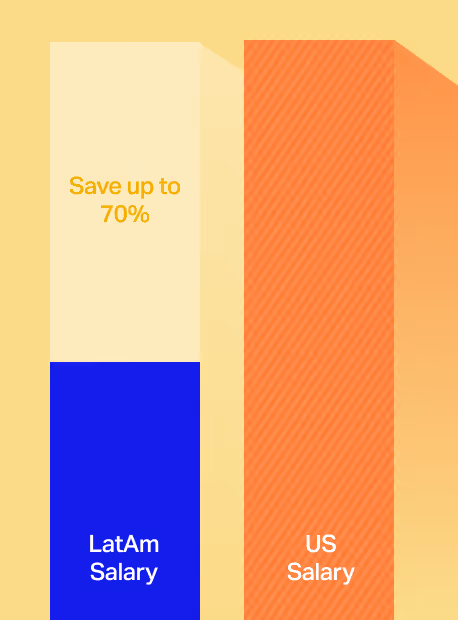
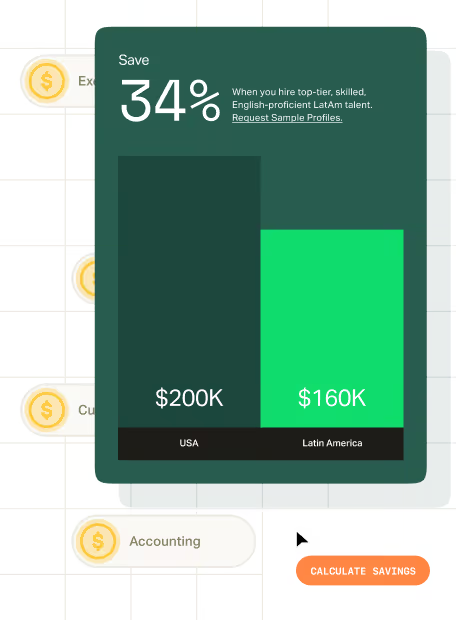
- Building your own offshore marketing team through nearshore hiring delivers up to 70% cost savings over hiring in the US, full team integration, and dedicated capacity that agencies and freelancers cannot match.
You’re probably here because you’re considering offshore marketing as an outsourcing option. You need more marketing output than your current team can produce, and you want to see if working with an agency or freelancers outside the US can help you move faster within your budget.
At the same time, you don’t want to trade one problem for another. If the work comes back off-brief, the quality is inconsistent, or communication is slow, outsourcing can turn into a cycle of rewrites, delays, and unclear results. The stakes are higher in marketing because a small miss in messaging or targeting can waste weeks of effort and ad spend.
This article will help you decide if offshore marketing is a fit. We’ll cover the pros and cons and what types of marketing tasks work well offshore. We’ll also cover an alternative to consider: hiring dedicated offshore marketers as part of your team instead of outsourcing project work.
What Is Offshore Marketing?
When most companies search for “offshore marketing,” they’re looking to outsource marketing functions to agencies or freelancers based in different countries—typically where labor costs are more affordable. This is what offshore marketing traditionally means: hiring external service providers to handle your marketing execution.
Offshore marketing agencies manage campaigns, content creation, and advertising from their own teams and infrastructure. Offshore freelancers work as independent contractors on specific projects or ongoing retainers. Both approaches give you access to marketing expertise without adding full-time employees to your payroll.
These offshore teams can work independently or in coordination with your domestic team to execute marketing strategies. They handle the day-to-day execution—writing content, managing ad campaigns, building websites, optimizing SEO—while you maintain strategic oversight.
However, there’s a third approach that many companies don’t initially consider: hiring your own offshore marketers as full-time team members. We’ll explore all three options in this article.
Why Do US Companies Turn to Offshore Marketing?
Cost is the primary driver. US companies need marketing capabilities—SEO, paid media management, content strategy, marketing automation—but domestic salary expectations make these positions financially impossible to fill at the level of seniority they actually need.
According to Semrush, 94% of businesses outsource some or all of their marketing activities.
Often, this is going to be to reduce costs when hiring in-house seems out of reach. And when companies are looking to outsource, they are often looking offshore—to places where salary expectations are lower—to maximize those cost savings.
What Are the Benefits of Offshore Marketing?
When you outsource marketing functions to offshore agencies or freelancers (and in this context, offshoring is essentially synonymous with outsourcing) the main benefits are cost savings, flexible capacity, and access to specialist expertise without committing to full-time headcount.
1. Significant cost savings from lower labor costs
Saving on salary costs and other overheads is often the primary reason businesses look to offshore marketing professionals. Labor costs in Latin America, India, the Philippines, and Eastern Europe, for instance, can be significantly lower than in the US due to lower living costs.
Beyond salary differences, outsourcing eliminates the overhead required to support an internal marketing team: office space, equipment, benefits administration, and employer taxes. When you outsource, those costs become the agency’s or freelancer’s responsibility, not yours.
2. On-demand capacity when you need it
Sometimes you don’t need to build long-term capacity—you just need marketing execution right now. Outsourcing gives you immediate access to professionals who can start within days, not weeks.
This matters when you’re launching a product, need to capitalize on a market opportunity, or have a gap created by turnover. An offshore marketing agency can deploy a team immediately. A freelance marketer can start on your project this week. You don’t wait through recruitment cycles, onboarding, or ramp-up time.
For businesses testing new markets or initiatives, outsourcing lets you move fast without committing to permanent headcount before you’ve validated the strategy.
3. Scalability for seasonal demands and campaign spikes
Scalability is different from on-demand capacity—it’s about flexing your marketing resources up and down based on predictable business rhythms.
B2C companies know they need extra creative production, ad management, and content support during Black Friday, holiday shopping, or summer promotions. B2B companies scale up when launching new products or running major campaigns. Outsourcing lets you bring in the exact capacity you need for these periods without maintaining that headcount year-round.
When the campaign ends or the season passes, you scale back down. You pay for what you need when you need it, without the financial burden or awkwardness of hiring and then laying off staff based on seasonal cycles.
Related reading: Everything You Need To Know About B2B SEO Outsourcing
4. Specialized expertise without full-time commitment
Some marketing functions require deep expertise but not full-time attention.
For example, running Google Ads effectively demands specific platform knowledge, optimization experience, and constant attention to performance metrics. But many businesses don’t need someone doing this 40 hours per week, 52 weeks per year.
The same applies to technical SEO, conversion rate optimization, marketing automation setup, or programmatic advertising. These are specialized skills that require expertise—but not necessarily full-time headcount for small and medium-sized businesses.
Outsourcing to specialists who do this work every day for multiple clients often delivers better results than trying to build that expertise in-house.
An offshore paid media agency managing $50M in annual ad spend across dozens of clients brings pattern recognition and optimization knowledge that a single in-house hire can’t match. They’ve seen what works across industries and budgets.
This is especially valuable at price points that make expertise accessible. You might not be able to afford a full-time senior Google Ads specialist at $100K+, but you can access that expertise through an offshore agency or freelancer for a fraction of the cost.
5. In-house teams can focus on core business activities
When you outsource marketing execution, your internal staff can concentrate on strategy, product development, customer relationships, and the work that directly drives your business forward.
Your product team isn’t stretched trying to manage SEO. Your sales team isn’t creating ad campaigns. Your founders aren’t writing blog posts at midnight. Marketing execution gets handled by professionals while your team does what they do best.
This matters particularly for small to mid-sized companies where everyone wears multiple hats. Outsourcing specific marketing functions creates breathing room for your team to focus on high-value work that can’t be delegated.
{{salary-guide-us-latam}}
What Are the Downsides of Offshore Marketing?
The main disadvantages of offshore marketing to agencies or freelancers are divided attention, limited brand knowledge, and inconsistent quality. In marketing, those gaps are more costly than in almost any other function.
Considering the possible disadvantages is essential before moving your marketing efforts offshore.
1. Divided attention and availability
With marketing agencies, your account is one among many. And you’re competing for their attention with clients who may have larger budgets or more urgent needs. With freelancers, they’re typically juggling multiple clients simultaneously to maintain a steady income.
Neither model provides the dedicated capacity of having your own team member. When you need quick turnarounds, immediate responses to performance issues, or someone available for an urgent strategy call, you’re dependent on their availability and priorities. Your campaign launch might coincide with their busiest period serving other clients.
They’re managing multiple brands, multiple strategies, and multiple sets of stakeholders. The depth of attention your marketing receives is inherently limited by their need to serve their full client roster.
2. Limited brand understanding and strategic context
External agencies and freelancers lack the institutional knowledge that comes from being embedded in your organization. They don’t sit in your customer calls, don’t hear the feedback from sales, don’t understand the nuances of why certain messaging resonates with your ideal customer profile while other approaches fall flat.
This context gap affects everything from messaging to creative direction. Your in-house team knows that Feature X matters to enterprise customers but Feature Y drives SMB conversions. They understand the specific pain points your customers articulate and the language they use. They know which competitors customers are evaluating you against and what objections come up repeatedly.
Agencies and freelancers work from briefs and kickoff calls. They can execute tactics well, but they’re always operating with incomplete information about your brand’s voice, customer psychology, and market positioning.
The subtle understanding of your brand that develops over months of being immersed in your business—that’s simply not available to external partners.
This becomes particularly problematic for content marketing, messaging strategy, and anything requiring deep customer understanding. You can provide brand guidelines and customer personas, but there’s a difference between reading about your customers and actually understanding them.
3. Cultural and language barriers
Beyond brand-specific knowledge, offshore teams may not have the same cultural understanding, communication styles, or language nuances as your domestic team. This may cause communication challenges that could lead to ineffective marketing messages or campaigns that do not resonate with your target market.
A marketing message that works perfectly in one cultural context may fall flat or even offend in another. Idioms, humor, urgency cues, and persuasion techniques all vary across cultures. An offshore team unfamiliar with your market’s cultural norms might miss these subtleties, creating campaigns that feel off-target even when they’re technically well-executed.
Language proficiency matters too. Even when offshore marketers speak English fluently, there can be differences in how marketing concepts are interpreted and expressed. The gap isn’t usually about grammar—it’s about the cultural understanding behind the words.
4. Time zone differences
Collaborating across time zones with teams in far offshore locations can be challenging. While asynchronous work is possible with today’s digital tools, it also means potential difficulties in scheduling meetings, coordinating tasks, and ensuring real-time communication.
When you need to discuss strategy revisions, review creative concepts, or troubleshoot campaign performance, time zone gaps can add 12-24 hours to decision cycles. A question you send at 9 am your time might not get answered until the next morning.
For time-sensitive marketing work—product launches, promotional campaigns, crisis response—these delays can be costly.
The coordination burden also falls on someone. Either your team adjusts their schedule for late-night calls, the offshore team works outside their normal hours, or you accept that synchronous collaboration will be limited to narrow windows.
5. Less direct control
Some business owners and managers may be less comfortable handing over marketing execution to an offshore team they can’t manage in person. The distance—both geographic and organizational—means you’re directing work rather than managing people.
You can’t walk over to someone’s desk to check progress, can’t read body language in meetings to gauge whether they truly understand your feedback, and can’t easily correct course mid-project. Everything goes through formal communication channels, which adds friction to what might otherwise be quick conversations.
That said, regular communication, clear processes, and structured feedback can help ensure offshore marketers stay aligned with your business goals. But it requires more intentional management than working with an in-house team.
6. Quality control
Maintaining high-quality standards can be more challenging when work is outsourced. There can be variance in how offshore teams interpret quality, which could affect branding and customer experience.
What they consider “done” might not meet your standards.
Their definition of thorough research, polished copy, or optimized campaigns may differ from yours.
Without the daily osmosis of working alongside your team, they’re calibrating quality based on their other clients and their internal benchmarks—not your specific expectations.
This isn’t necessarily about lower skill levels. It’s about different quality frameworks. Bringing work up to your standards often requires multiple revision rounds, detailed feedback, and explicit quality criteria that might be implicit with an internal team.
7. Short-term focus
Since offshore marketing teams will not be as familiar with your organization and its long-term objectives as your internal team, some may prioritize short-term tactics over building a long-term strategy, especially if their performance is measured by immediate results rather than sustainable growth.
Agencies often work on project-based or monthly retainer models. Their incentive is to deliver measurable results within their contract period.
That might mean focusing on quick wins—short-term traffic spikes, immediate conversions—rather than building sustainable marketing foundations that compound over time.
Similarly, freelancers contracted for specific deliverables are optimizing for project completion, not long-term brand building. They’re not thinking about how this campaign sets up next quarter’s initiatives or how this content builds toward your annual positioning goals.
The strategic continuity that comes from having someone invested in your long-term success is harder to achieve with external partners who engage with your marketing in defined increments.
Related reading: Top 12 Marketing Recruitment Agencies
How Do You Make Offshore Marketing Work?
Successful offshore marketing requires careful planning, clear communication, and management.
Here are five tips to make sure your offshore marketing efforts are effective:
1. Vet potential partners carefully
It’s crucial to exercise due diligence when choosing an offshore marketing partner. The selection process should involve in-depth research into various offshore marketing agencies or teams, examining case studies, and understanding each potential partner’s expertise in your industry.
Assessing the offshore team’s language proficiency and cultural understanding is also fundamental to ensure that they can represent your brand accurately and effectively. Select a partner that demonstrates flexibility, scalability, and a strong alignment with your business values and goals.
2. Communicate clearly
Efficient communication is the foundation of any successful offshore relationship. Establishing designated points of contact minimizes confusion and ensures that messages get through to the right people.
Set up regularly scheduled meetings, taking into account different time zones to foster real-time dialogue and timely updates. Implementing project management tools and platforms allows you to track progress transparently and facilitates collaboration.
Additionally, creating comprehensive briefs and guidelines keeps all team members on the same page regarding expectations and deliverables.
3. Set measurable goals
Your offshore marketing efforts should be goal driven and results oriented. Establish concrete, measurable objectives and key performance indicators (KPIs) to assess the performance of your offshore team.
This framework will help guide the marketing strategies and provide a clear basis for evaluating success. Goals should be realistic, aligned with overall business targets, and communicated clearly to your offshore team, allowing for course corrections and strategy adjustments.
4. Be transparent about your brand
To convey your brand’s voice, values, and message effectively, the offshore team needs an in-depth understanding of your brand identity.
Investing time in training and onboarding your offshore partners about your brand’s nuances, target audience, and market positioning is essential. This can involve sharing brand guidelines, conducting workshops, or implementing regular feedback sessions to align their work with your brand’s ethos.
5. Give regular feedback
Constructive feedback helps the team understand what works well and what areas require improvement or adjustment. This process should be:
- Consistent: Establish a routine for providing feedback—whether after each campaign or on a weekly, bi-weekly, or monthly basis—to create a predictable structure for continuous improvement.
- Specific: Offer clear, actionable insights. Vague comments can lead to confusion and ineffective changes.
- Balanced: Acknowledge successes and areas of strength just as much as areas needing work. This balanced approach encourages your offshore team and positively reinforces good practices.
- Forward-thinking: Feedback shouldn’t just critique past performance but also guide future projects. Discussing next steps, objectives, and how to implement the feedback into upcoming campaigns can lead to a constant cycle of refinement and development.
- Collaborative: Encourage a two-way dialogue, allowing the offshore team to ask questions and provide their input. This fosters a partnership environment where feedback leads to collective growth and learning.
Regular, detailed feedback enhances the quality of the team’s output and aligns them more closely with your company’s vision and goals.
An Alternative to Offshore Outsourcing: Building Your Own Offshore Marketing Team
Beyond outsourcing to offshore agencies or hiring freelancers, there’s another approach that many growing companies are discovering: hiring your own offshore marketers as full-time team members.
This isn’t outsourcing. It’s hiring. These are your employees. They attend your meetings, use your tools, follow your processes, and build institutional knowledge. They just happen to work from a different country.
Why US companies are building marketing teams in Latin America
According to Near’s recent report on why US companies hire in LatAm, which is based on discussions with over 2,000 companies in 2025, marketing is the second most common department companies are looking to fill with LatAm talent, representing 16% of all hiring inquiries.
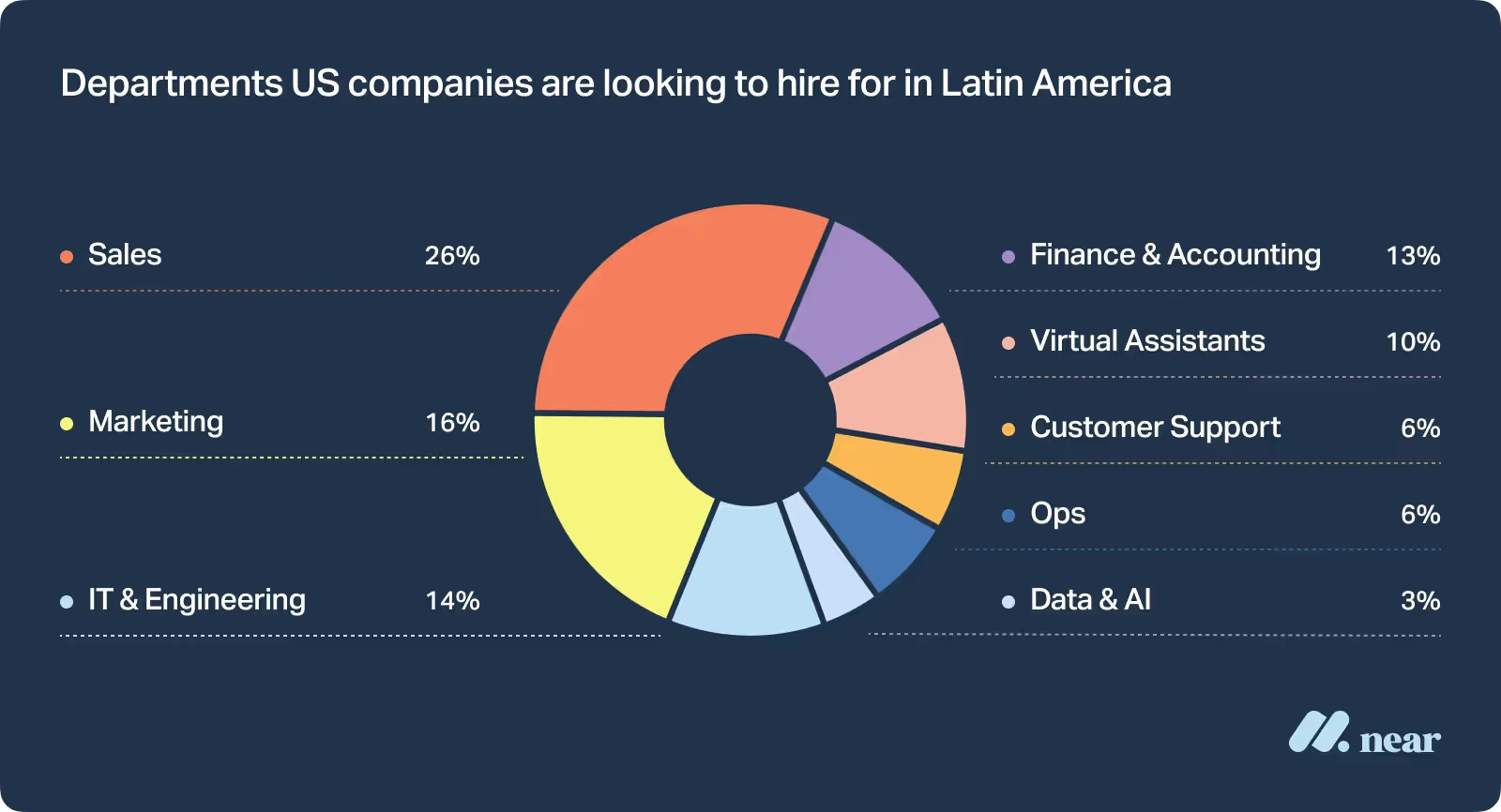
For companies facing talent scarcity specifically, marketing jumps to the #1 most common department they’re trying to staff, at 44% of businesses. The talent simply isn’t available in the US market at reasonable costs or timelines.
Cost savings: What hiring marketing talent in LatAm costs compared to the US
Here’s what building your own offshore marketing team actually costs compared to US hiring:
According to Near’s data, 84% of LatAm placements are for mid-level or senior positions. US companies aren’t hiring junior talent to save money—they’re accessing experienced professionals they couldn’t afford or find domestically.
Learn more: How to Build a High-Performing Marketing Team for 68% Less
Why hiring in Latin America works for marketing teams
Marketing requires cultural alignment in ways that technical roles don’t. Your marketers need to understand your target audience, recognize brand nuances, and communicate with the same cultural context as your US customers.
One of our recruiters explains why it’s so easy to find marketing talent in LatAm that is suited to the needs of US businesses:
Mainly because we are so similar culturally. We consume the same products, watch the same content, and engage with the same brands. When clients interview Latin American marketing candidates, they’re often surprised at just how aligned we are—it makes collaboration feel very natural.
Time zone alignment also matters critically for marketing. Your growth marketing manager needs to join morning standups. Your content manager needs to be available when stakeholders have feedback. Your paid media specialist needs to respond to campaign issues in real-time. Latin America operates in US time zones, making this seamless.
Also, English proficiency eliminates communication friction. Top Latin American marketing professionals typically speak fluent English, having often worked with US companies before.
Our State of LatAm Hiring Report shows that the top countries for talent in Latin America are Argentina, Brazil, and Colombia, with Brazil dominating marketing placements.
- Brazil dominates marketing placement volume per Near's LatAm Hiring Report. Brazilian marketing professionals bring strong digital and creative skills, and Brazil's large economy has produced a generation of marketers who have worked across consumer brands, agencies, and tech companies.
- Argentina leads for senior marketing roles and marketing leadership. Argentine professionals tend to bring a blend of strategic thinking and strong English proficiency that clients consistently flag as a differentiator. If you're hiring a Head of Marketing, Brand Manager, or a growth lead who will work closely with US executives, Argentina is a strong first choice.
- Colombia is Near's top overall placement country and a consistent source of strong marketing generalists: Digital marketers, content creators, and marketing automation specialists who work in closely overlapping US hours (Colombia runs on Eastern Time year-round).
By contrast, India and the Philippines, common offshore destinations for marketing work, present a harder fit for roles requiring real-time US collaboration. The 10–13 hour time zone gap means daily standups, live creative reviews, and same-day feedback cycles aren't practical.
Related reading: Top Countries to Hire Remote Marketing Talent
{{state-latam-hiring}}
How Do You Choose the Right Offshore Marketing Approach?
It comes down to three questions. Do you need dedicated capacity or project-based output? Does brand knowledge matter? Are you building for the long term or solving a short-term gap?
Cost Breakdown: US vs. Offshore vs. Nearshore Marketing
Before evaluating which offshore marketing approach is right for you, it helps to see the actual cost differences side by side. The table below compares the four main models to give you a realistic baseline:
The agency and freelancer columns deserve a note: Costs vary too widely to pin to a specific range, because they depend on project scope, platform, and specialization. But neither model gives you dedicated capacity. When you need someone available for a Tuesday morning strategy call, their availability depends on their other clients. You're paying for output, not a team member.
As Sofi Berardi, Near's Senior Recruiter for Marketing, puts it:
Some clients are simultaneously sourcing talent in the US and through us. When they compare, they're often surprised to find that the caliber of Latin American talent is just as good, if not better, at a much lower cost.
When outsourcing to an offshore marketing agency makes sense:
You should consider an offshore agency when:
- You need immediate marketing execution
- The project is short-term or seasonal
- You need highly specialized expertise for a specific initiative
- Your internal team has no bandwidth to manage additional people
- You’re testing a new marketing channel before building internal capacity
When outsourcing to offshore freelance marketers makes sense:
Offshore freelance marketers work well when:
- You have a specific, defined project (website redesign, one-time campaign)
- You need overflow support during peak periods
- You require niche expertise (e.g., conversion rate optimization consultant)
- Your budget is tight and you can’t commit to full-time hires yet
- The work doesn’t require deep integration with internal processes
When building your own offshore marketing team makes sense:
Hire your own offshore marketers when:
- You need dedicated marketing capacity, not split attention
- Building institutional knowledge matters for your business
- You want direct control and full integration with your team
- Cost efficiency matters, but quality can’t be compromised
- You’re building marketing capabilities for long-term growth
What Results Are Companies Seeing From Hiring Marketing Talent in LatAm?
Doubled lead generation in five months. Eleven roles filled in three weeks. $781,000 in annual savings. These are real companies. Here's what they did.
Propensity doubled lead generation in 5 months
Propensity hired a Head of Marketing and Product Marketing Manager in Latin America through Near. Within five months, they doubled lead generation and successfully transitioned from a development-focused to a growth-focused organization. They are saving 48% on salary costs compared to hiring in the US.
Rankings.io filled specialized marketing roles in 3 weeks
Rankings.io needed specialized roles: web designers, SEO specialists, PPC experts, and developers. Traditional hiring failed. Through Near, they filled 11 positions in three weeks on average, saving $463,000 annually.
Conversion Logix built entire marketing function
Conversion Logix filled 11 critical roles across client services, automation, marketing, and support, positions that were delaying client work and risking relationships. Their annual savings by hiring in Latin America over hiring in the US is $781,000.
Which Marketing Roles and Services Work Best Offshore?
Most marketing functions can be handled remotely. The ones that work best are execution-heavy roles that don't require in-person collaboration and can be managed through digital tools.
Some of the most common marketing services that businesses handle offshore include:
- Content creation: Writing of articles, blog posts, white papers, and video scripts can be managed by offshore content writers and copywriters.
- Graphic design: Logo and branding assets creation to web and social media content design can be handled by offshore graphic designers and logo designers.
- Social media management: Social media managers can handle social media posts, content creation, scheduling, engagement, and analytics remotely.
- Digital advertising: Media buyers can set up, manage, and optimize online advertising campaigns on platforms like Google Ads or Facebook Ads.
- SEO: SEO specialists can handle technical SEO, content optimization, link building, and performance tracking.
- Email marketing: Email marketing specialists can manage campaigns, automation, segmentation, and analytics.
- Website development and maintenance: The creation and maintenance of websites, including coding and updates, can be handled by remote website developers.
- Market research: Industry research, competitor analysis, and customer survey creation can be managed remotely by market research analysts.
- Creative direction: Creative directors can oversee brand strategy, campaign concepts, and creative execution from anywhere.
Related reading: How to Identify and Recruit Top Remote Marketing Talent
What Are the Most Common Concerns About Hiring Offshore Marketing Talent?
“Will they understand our brand voice?”
Yes, if you hire the right people and onboard them properly. This concern applies equally to US hires: anyone new to your company needs to learn your brand.
Latin American marketing professionals often have experience working with US companies and understand American business culture. The stronger concern is whether you have documented brand guidelines and clear onboarding processes. That problem exists regardless of geography.
“Can they work in our time zones?”
Latin American marketing professionals work in US time zones (Eastern, Central, Mountain, Pacific, depending on the country). This is the fundamental advantage of nearshore hiring over traditional offshore regions like Asia.
Your team can have real-time meetings, respond to urgent requests same-day, and collaborate without the 10-13 hour delays that come with Asian time zones.
“What about communication and language barriers?”
Marketing requires strong English fluency, and Latin American marketing professionals typically speak fluent English. They’ve often worked with US clients before and understand business communication norms.
During the hiring process, you’ll interview candidates and assess communication skills directly. Just like you would with US hiring. You don’t hire people you can’t communicate with effectively.
“How do we manage remote marketing staff?”
The same way you manage any remote team. If your company already has remote workers or distributed teams, you have the infrastructure. If not, you’ll need to think through async communication, documentation, and collaboration tools—but these are general remote work challenges, not offshore-specific problems.
Managing offshore marketers follows the same principles as managing remote US employees.
Final Thoughts
Deciding whether to offshore your marketing is about choosing the right structure for your business goals and constraints.
Agencies work when you need immediate execution without hiring overhead. Freelancers fill gaps for project-based work.
But if you’re building marketing capabilities for sustainable growth, hiring your own offshore marketers delivers dedicated capacity, institutional knowledge, and cost efficiency that neither agencies nor freelancers can match.
According to our data, US companies save an average of $35,000 to $64,000 annually per hire when building teams in Latin America. For a marketing department of even 3-4 people, that’s $150,000+ in annual savings that can be reinvested into campaigns, tools, or additional headcount.
At Near, we help companies build marketing teams in Latin America that integrate seamlessly with their existing operations. We handle sourcing, vetting, and placement, finding marketers with the exact skills and experience you need. Our average time-to-hire is under 21 days, and we back placements with a 180-day guarantee.
We know most companies don’t have a clear picture of what marketing talent actually looks like in LatAm.
That’s why we recommend starting with sample profiles.
We’ll send you profiles of 2–3 pre-vetted candidates. You’ll see their experience, education, skills, and English proficiency level. No meeting required. No commitment. Just real examples of the talent available.
This gives you a baseline. Most companies find that the talent exceeds their expectations, but seeing it firsthand makes the difference. If you then decide to hire with us, we’ll find out exactly what you are looking for and do a custom search.
To explore the caliber of talent we can find for you, get a list of pre-vetted candidates. See what the possibilities are. With Near, you can interview candidates for free and only pay once you make a hire.
{{prevetted-banner}}
Frequently Asked Questions
What’s the difference between offshore and nearshore marketing?
In contrast to “nearshore,” offshore typically refers to regions with significant time zone differences (8+ hours), like India or the Philippines.
Nearshore refers to nearby countries with aligned or overlapping time zones. For US companies, hiring or outsourcing in Latin America is “nearshoring”—same-day collaboration is possible.
This matters significantly for marketing roles that require frequent communication and real-time feedback.
Do offshore marketers need special equipment or software licenses?
If you are outsourcing to an offshore marketing agency, they are going to have their own equipment and software licenses. The same is generally going to hold true for freelancers.
If you are hiring offshore marketers, your marketing hires will need the same tools as your US-based marketers: access to your CMS, marketing automation platform, design tools, analytics, etc.
Software licenses work the same as they do for any remote employee. This is no different from hiring remote US staff.
What marketing roles should I consider hiring offshore or nearshore?
Beyond the common SEO, paid ads, and content roles, companies successfully hire offshore marketing talent for roles such as:
Can I start with one offshore marketing hire and scale later?
Yes. Many companies start with a single strategic marketing hire—often an offshore digital marketing specialist or SEO specialist—to test the waters.
Once they see results, they expand their offshore marketing team. This approach lets you validate the model before committing to building an entire department.
How do offshore marketing costs compare to hiring a US-based remote worker?
Hiring a remote US-based marketer costs the same as hiring locally—you’re still paying US salary expectations.
Offshore hiring (specifically nearshore in Latin America) delivers 52-73% cost savings because salary expectations reflect local cost of living, not US market rates. The work quality and output capacity remain the same, but the cost structure is fundamentally different.
What paid advertising platforms are best suited for offshore marketing management?
The two most commonly outsourced paid advertising platforms are Google Ads and Facebook Ads, and for good reason—both require specialized platform knowledge, constant optimization, and daily monitoring that offshore specialists can handle effectively.
Google Ads management is particularly well-suited for outsourcing because it demands technical expertise in keyword research, bid management, ad copy testing, and conversion tracking. An offshore specialist who manages Google Ads campaigns daily brings optimization experience across multiple accounts and industries.
Facebook Ads (and Meta advertising more broadly) similarly benefits from specialized management. The platform’s targeting capabilities, creative testing requirements, and audience segmentation complexity mean that dedicated specialists often deliver better results than generalists trying to manage it alongside other responsibilities.
Many companies find that outsourcing these paid media functions to offshore agencies or freelancers who specialize in performance marketing delivers stronger ROI than trying to build that expertise in-house—especially when you don’t need full-time headcount dedicated to a single platform.
However, if you do need to hire a dedicated full-time Google Ads expert for your team, read our comprehensive guide on how to hire Google Ads experts.
What industries use offshore marketing?
Offshore marketing is used across virtually every industry. The decision usually comes down to whether a business needs more marketing output than its in-house team can produce, or wants access to specialized expertise without the cost of a full-time US hire.
Customer service businesses offshore marketing to manage reputation, drive acquisition campaigns, and handle the volume of content and social media activity their brands require. AI and machine learning companies use offshore marketing talent to build awareness in fast-moving markets where in-house teams often lack the bandwidth to keep up with content, SEO, and paid campaigns simultaneously.
Administrative services firms, from outsourced HR providers to staffing companies, rely on offshore marketers to generate leads and maintain a consistent brand presence without the overhead of a large internal team.
Which companies can help me hire marketing talent in Latin America?
Several nearshore staffing firms specialize in helping US companies hire marketing talent in Latin America, connecting you with pre-vetted marketers who already work in your time zone.
If you're comparing providers, our roundup of the best companies to hire Latin American marketers breaks down how the leading options differ on vetting, pricing, and hiring model—so you can find the right fit before committing.







.webp)


%203.svg)
.avif)





%20(1).avif)

%20(1).png)