%203.svg)
Key Takeaways
- To hire an outsourced software developer, define the role and tech stack, choose an engagement model, vet candidates with a hands-on skills task, and hire in a region with real-time overlap like Latin America, where developers work during US business hours.
- The main decision is how to engage a developer: hand a project to an outsourcing company, add capacity through staff augmentation, hire offshore or nearshore developers directly, or use a specialist staffing and recruiting partner that finds and employs the developer for you.
- Latin America is the strongest region for most US teams because developers there work in your time zone, communicate in strong professional English, and align closely with US business culture.
Hiring an outsourced software developer starts with defining the role and tech stack, then choosing how you want to engage them, testing their skills with real work, and, for most US teams, hiring in Latin America so the developer works during your business hours.
Hire With Near does this for US companies every day, sourcing and placing developers as full-time members of your team when you hire software engineers through us.
This guide covers how to hire an outsourced software developer step by step: how to vet candidates, which engagement and hiring models exist and how to choose between them, what it costs, and why Latin America has become the strongest place to hire.
How to Hire an Outsourced Software Developer
Hiring an outsourced software developer comes down to seven steps: define the work, choose an engagement model, shortlist partners, test real skills, interview for problem-solving, agree on clear terms, and start with a trial.
Scaling a team stretches everyone thin, and being overworked is the most common cause of work-related stress, so the point of a good process is to add the right person fast without adding chaos.
1. Define your project requirements
Pin down scope first: the goals, timeline, and deliverables that define success, plus the stack and skills the work needs. A specific brief attracts the right candidates, and every hour spent here saves several in screening.
2. Choose an engagement model
Your engagement model shapes how you'll work with an outsourced developer. The common ones:
- Staff augmentation: A vendor places a pre-vetted developer onto your team to work under your direction, while the vendor stays the legal employer and handles payroll and compliance. It's for adding capacity without creating a permanent role, and it's never a do-it-yourself setup; a vendor does the employing.
- Project-based outsourcing: You hand a defined, standalone project to an external company that delivers it end to end.
- Dedicated team or developer: You bring on a developer or team that works only on your projects for the long run, integrated into your workflows like an in-house hire.
- Specialist staffing and recruiting partner: A partner finds, vets, and employs a full-time developer who joins your team directly. This is the model most US companies hiring long-term end up with.
Which one fits depends on commitment, flexibility, and control. We break the decision down in full below, in the section on choosing between an outsourcing company, staff augmentation, and hiring directly.
3. Research and shortlist potential partners
Finding the right people takes real research: use industry platforms, read reviews, and ask for referrals to build a shortlist of reputable options. Check each one's track record through past projects and client testimonials.
Partnering with a recruitment agency that specializes in software developers can speed this up, since they present pre-vetted candidates who already match your requirements.
Further reading: 15 Best IT Staffing Agencies to Find Top-Notch Tech Talent in 2026
4. Test real skills and cultural fit
Test skills with real work. The screen that works best is simple: ask a candidate to walk through a project they built, then explain it to a non-developer. If they can't, it usually means they're repeating terminology rather than describing work they did.
Follow that with a small, real-world task, like debugging a snippet, refactoring for scale, or building a basic API with tests, done live or as a short take-home and reviewed together on a call.
Watch for red flags: a candidate who can't explain their actual role on past projects, avoids talking about mistakes or challenges, or claims proficiency across an implausibly long list of tools and languages. And don't screen on a college degree; many of the strongest Latin American engineers started working before they graduated, and a degree requirement filters them out.
Cultural fit matters alongside the technical bar. A developer in a nearby time zone who communicates in real time and works the way your team does will outperform a stronger coder you can only reach overnight.
5. Interview for problem-solving
Use the interview to probe how a candidate thinks, not just what they've shipped. Ask how they approached previous clients' problems and how they handled setbacks; that shows whether they can work under pressure and points to the soft skills like communication, adaptability, and creativity that separate strong developers from merely competent ones.
The technical interview is where the real signal is. Federico Bilello, Recruiter, Software Engineering at Hire With Near, puts it plainly:
Even though I do everything I can to verify a candidate's skill set before they get to the client, there's always a small percentage who make it through to the technical interview. The only way to truly find out if someone is proficient is that technical interview. That's where the truth comes out.
6. Agree on clear terms
Put the important things in writing: timelines, deliverables, payment terms, and confidentiality. Most outsourcing disputes trace back to something that was never written down, such as a missed deadline definition, an unclear ownership clause, an assumed revision round. Write it down first.
7. Start with a trial period
Begin with a trial period to see how the developer performs and fits with your team before you commit long term. Two to four weeks of real tickets tells you more than any interview: how they scope, how they communicate blockers, and whether their code survives review.
Related reading: Comprehensive Guide to Hiring a Top Developer
Benefits of Outsourcing a Software Developer
Outsourcing software development gives you five concrete benefits: more capability per dollar, a wider talent pool, flexible scaling, faster delivery, and more time for your core business. You can hire from countries with a strong reputation for skilled developers and add the talent you need quickly, without building a full in-house team.
Here's what that gets you:
- More capability per dollar: The same budget that covers one US full-stack engineer covers close to a two-person team in Latin America, without cutting corners on quality.
- Access to a wider talent pool: You can work with professionals skilled in specific industries and at every level, which is especially useful for finding expertise in emerging tech that's hard to source locally.
- Scale up or down without a hiring freeze: Add developers for a busy quarter and release them when the project ends, instead of carrying a permanent headcount you don't need year-round.
- Faster project delivery: Developers who've shipped similar projects before bring workflows that already work, so you're not paying a team to figure out its process on your dime.
- More time for your core business: By handing off technical work, your internal team can concentrate on growth, strategy, and customers while external experts handle the build.
Outsourcing is a growth strategy as much as a budget one: the teams that treat it as added engineering capacity, not just cheaper hours, are the ones that ship faster.
What Types of Software Developers Can You Outsource Work To?
You can outsource almost any software role, but five types cover most of what US companies hire for. Here are the roles and what each one owns:
- Frontend developers: Build the user interface, making sure your website or app looks and feels intuitive.
- Backend developers: Handle databases, server-side logic, and APIs, keeping your systems running securely behind the scenes.
- Full-stack developers: Work across both front end and back end, a fit for projects that need integrated development.
- Mobile app developers: Build apps for iOS and Android to grow your mobile presence.
- DevOps engineers: Coordinate development and IT operations to ship reliable software consistently.
Whatever the gap, the point is the same: you hire the exact specialty you’re missing instead of stretching a generalist to cover it.
How Much Does It Cost to Hire an Outsourced Software Developer?
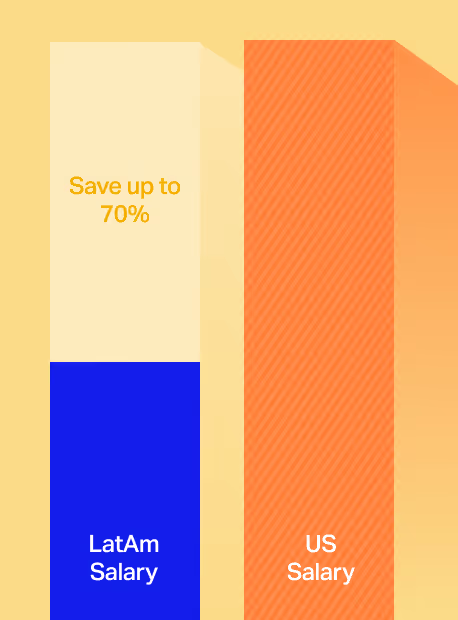
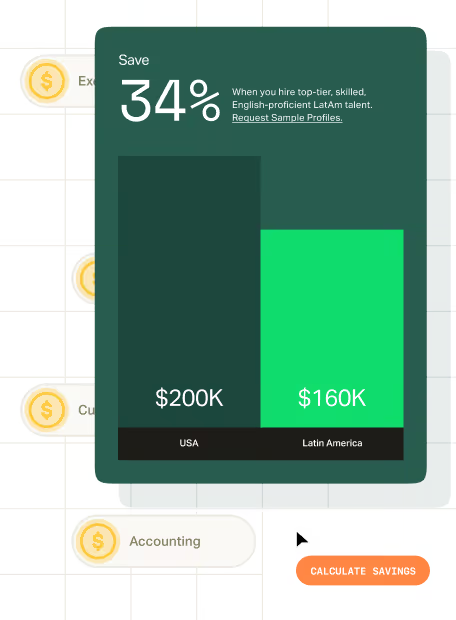
An outsourced software developer in Latin America usually costs 28% to 59% less than a comparable US engineer, so the same budget goes further: it can fund a more senior hire, or two developers where you planned for one. Three things drive the total: the developer's seniority, the engagement model you choose, and any fee your provider charges on top of the salary.
Seniority is the biggest lever, so pin down the level you need before you budget; a junior developer costs a fraction of a senior engineer. The engagement model matters next.
A project-based outsourcing company bills for the whole build, staff augmentation and direct hiring are priced closer to a salary, and a staffing or recruiting partner adds a fee for sourcing and, in some models, ongoing employment. Ask any provider to break down exactly what their fee covers, so you can compare like for like and avoid surprises.
According to Hire With Near's 2026 State of LatAm Hiring Report, a full-stack engineer averages around $69,000 in Latin America versus about $126,000 in the US, and across seniority levels software engineers run roughly $23,000 to $85,000 a year below US salaries, about 28% to 59% less. In practical terms, the budget for one US full-stack engineer covers close to a two-person team in Latin America.
{{state-latam-hiring}}
For detailed figures by role and seniority, see how IT salaries compare between the US and Latin America and our US vs Latin America salary guide. We keep the numbers on those pages so you can budget per engineer before you talk to anyone.
Should You Work With an Outsourcing Company, Staff Augmentation Company, or Hire Offshore Developers Directly?
For most US companies, the simplest path is a specialist staffing and recruiting partner that finds the developer and employs them for you, but the right choice depends on whether you need a finished project, flexible capacity, or a dedicated team member. There are four common ways US companies work with developers outside the US.
Across the guides I write with Hire With Near's engineering recruiters, one thing comes up again and again: these paths all get called outsourcing, when they are really four different commitments.
Here they are, from most complex to simplest.
Project-based outsourcing with a dev shop
Project-based outsourcing hands an entire, well-scoped build to an external company that delivers it start to finish. It fits a standalone project with clear requirements when you don't plan to keep the team afterward.
The trade-off is continuity: the team knows the code, and when the engagement ends, that knowledge can walk out the door. One small software team we spoke with had its early product built by an offshore group that later went dark:
The one that we're really talking about was developed by some people in Ukraine, and they've since kind of disappeared or fell off the map to us. So we were looking for either a direct hire or a team or an agency that we could work with to put more development into the application.
If this is your intent, start with our roundups of software development outsourcing companies: the best LatAm outsourcing companies and top offshore development companies.
Staff augmentation
Staff augmentation places a pre-vetted engineer onto your team to work under your direction, while the vendor stays the legal employer and handles payroll, benefits, and compliance.
It's the way to add engineering capacity for a project or a busy stretch without creating a permanent headcount, and it sits between a freelance marketplace and a direct hire: far more vetting and accountability than a marketplace, more flexibility than building a permanent team yourself. It is never a do-it-yourself option; a vendor does the employing.
Hire With Near offers this through our nearshore staff augmentation service, and if you want to see how the outsourcing and staff augmentation models compare side by side, our breakdown of staff augmentation versus outsourcing walks through it.
To compare firms, start with these top staff augmentation companies in Latin America.
Hiring offshore or nearshore developers directly
Hiring directly means you source and employ the developer yourself, usually through a job board or LinkedIn plus an Employer of Record for a cross-border hire.
It gives you the most control and the lowest ongoing fees, and it asks the most of you. The catch most teams miss: an Employer of Record handles only the employment logistics, so you still find and vet every candidate on your own.
If you have the internal recruiting muscle for that, our guide to hiring an offshore development team covers the models and costs; if you'd rather start from a shortlist, see the best companies to hire top developers in Latin America.
Working with a specialist staffing and recruiting partner
A specialist partner is the all-in-one, and where most companies hiring a full-time developer end up. Hire With Near finds and vets the engineer and employs them, handling sourcing, payroll, benefits, and compliance in one relationship through our nearshore staffing and recruiting services, so you can hire a software engineer in Latin America about as easily as hiring someone down the street.
This route is also the clearest way to see the two ways partners usually charge. Staff augmentation is an ongoing monthly model where the partner employs the person; direct-hire recruiting is a one-time placement fee for someone you then employ.
Choose based on how long you need the person and who you want on payroll.
The shift toward this model is already underway. In Hire With Near's analysis of 2,000+ conversations with US companies exploring Latin American hiring, 12% are moving away from outsourcing agencies toward hiring their own dedicated people, because they want people embedded in their team who grow with the business. An agency's people, by contrast, often get spread across several clients at once.
Bonfire is a good example. After its DIY search dragged on for months, Hire With Near handled sourcing and screening so its design leader only ran final interviews. The search closed in six weeks, saved about $53,000 a year versus a comparable US hire, and the UX engineer stayed more than two years. Bonfire's Director of Design and UX put it simply:
It was shocking to see the difference between the talent Near brought versus other firms I worked with.
See this PHP developer placement in action: a digital product consultancy hired a senior full-stack PHP developer at 45% below the US equivalent in 39 days.
Here's how the four options compare at a glance:
Why Outsource Software Developers From Latin America?
For most US companies, Latin America is now the strongest place to hire developers, because you get senior engineers who work during your business hours, communicate in strong professional English, and align with US business culture. Eastern Europe and Asia have long been outsourcing destinations, but the region's overlap with the US workday is what keeps moving teams toward hiring developers in Latin America.
Proximity and overlapping working hours
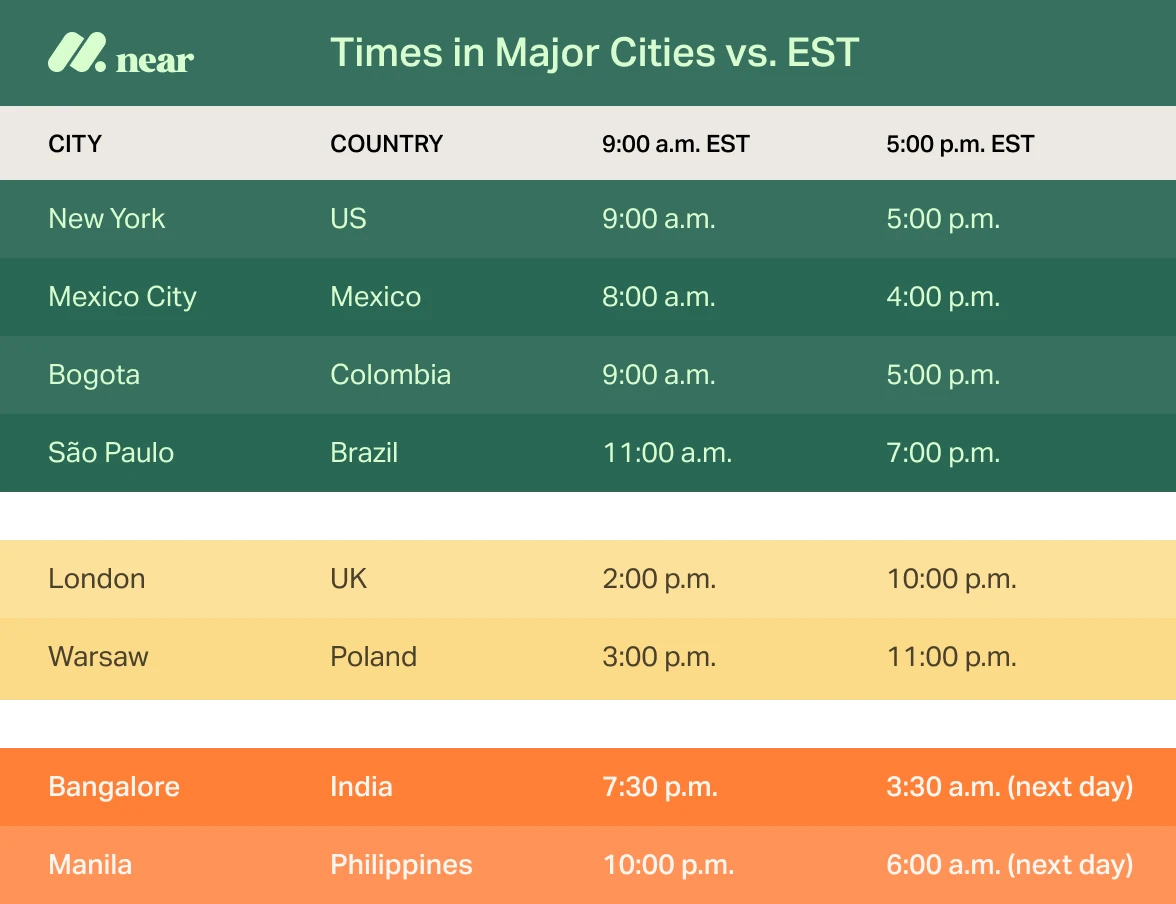
A developer in Latin America works during your business hours, whether your team runs on Pacific, Mountain, Central, or Eastern time, so you get real-time collaboration instead of overnight handoffs.
The research backs up why that matters: each additional hour of time-zone difference between teammates cuts real-time communication by about 11%. The study's authors recommend organizing distributed teams north to south, like the US and Latin America, rather than east to west.
Most Latin American countries also don't observe daylight saving time, so the exact offset shifts an hour or two with the season and with where you sit in the US; the constant is that your developer is online when you are.
In conversations with our development recruiting team, the contrast with far-offshore hiring is the thing US buyers raise most. One founder who had relied on an engineering team in India described it:
If I go to bed and wake up, your day’s done. You lose a day every single time, just from one message. I can’t do that anymore.
An offshore team half a day away answers your afternoon question the next morning; a developer in Latin America answers it the same hour. For more of what tech leaders weigh before they hire, see the questions tech leaders ask about hiring developers in Latin America.
Cultural affinity
Latin American developers tend to work the way US teams expect, and that shows up in communication and collaboration day to day. Natasha Tarapow, Recruitment Consultant, Development and DevOps at Hire With Near, sees the difference against offshore hiring every day:
The problem companies have with hiring in India isn't technical ability; it's cultural fit. They find people who are very strong technically, and they're cheap to hire compared to the US, but they're not a good cultural fit to typical US business practices. They take a long time to answer Slack messages, they don't notify their managers about what they're working on. In Latin America, we found that talent is not that way. We're very communicative. People really try to go above and beyond in their jobs.
Skilled workforce
Latin America has a deep, fast-growing developer talent pool. The Latin American software industry has grown on the back of strong technical education, government investment in tech, and a generation of engineers who already work with US companies. GitHub's Octoverse 2024 report counts more than 5.4 million developers in Brazil, 1.9 million in Mexico, 1.1 million in Argentina, and over 1 million in Colombia, each growing at double-digit rates year over year.
Agility and scalability
You can scale a Latin American team up or down as your roadmap changes. Because the talent pool is large and hiring timelines are short, adding a developer for a new project or a busy quarter doesn't mean a six-month search. If you're building a remote team, our guide to hiring remotely in Latin America walks through how to do it well.
{{hiring-remotely}}
Access to emerging technology
Latin American developers work across modern stacks and emerging fields like AI, machine learning, and cloud infrastructure. Governments and private accelerators across the region keep investing in tech hubs, so depth in newer specializations keeps growing alongside the core web and mobile skills most teams hire for.
Further reading: Why Forward-Thinking CTOs Are Turning to LatAm to Build Better Engineering Teams
Final Thoughts
Hiring the right outsourced software developer comes down to a clear process and the right model for your situation: define the work, test real skills over resumes, and pick the engagement that matches how long you need the person and who you want on payroll. Get those right and outsourcing stops being a pure cost play and becomes a way to ship faster with a stronger team.
For most US companies, that means hiring in Latin America, where developers work in your time zone and bring strong English and a close cultural fit. When you want help finding that person, Hire With Near can help you easily hire a developer in Latin America, so you skip the months of DIY sourcing and only run the final interviews.
Across roles, Latin America-based salaries run 30% to 70% below US rates; for software engineers specifically, costs run 28% to 59% less. Hire With Near has 3,500 placement roles for US companies.
If you want to explore hiring a developer in Latin America, book a free consultation to talk through your requirements with our team. They'll give you salary benchmarks and walk you through the process, so you have what you need to decide if it's the right move.
{{consultation}}
Frequently Asked Questions
What is outsourced software development?
Outsourced software development is hiring developers outside your own company to build or maintain software, either by handing a whole project to an external firm or by adding remote developers to your team.
The project-based version suits a defined, standalone build you don't plan to maintain in-house. Hiring a dedicated remote developer, on your team and under your direction, suits ongoing product work where continuity matters. Most US companies scaling a product choose the second, because the developer learns your codebase and stays with it.
We tried offshore hiring before and the time zones caused problems. Will developers in Latin America work our hours?
Yes. Developers in Latin America work during your business hours, whether your team is on Pacific, Mountain, Central, or Eastern time, so you avoid the 10-hour lag and the wait-until-tomorrow answers that come with far-offshore teams.
Daily standups happen live and urgent fixes get handled the same day. Because most of the region doesn't observe daylight saving time, the exact offset shifts an hour or two by season and by where you sit, but the working-day overlap holds all year. That real-time overlap is the main reason nearshore works where far-offshore didn't.
How good is an outsourced developer's English?
Strong professional English is common among Latin American developers who work with US teams, good enough to run architecture reviews, write clear documentation, and explain why a change broke production. Accents differ from person to person, and they rarely get in the way of being understood.
The way to check it is the same as checking skill: ask a candidate to walk you through a real project and explain the technical decisions in plain language. If they can do that clearly, they can communicate with your team and your clients.
How do you evaluate an outsourced developer before hiring?
Evaluate an outsourced developer with real work: ask them to walk through a project they built and explain it to a non-developer, then give them a small, real task like debugging a snippet or building a basic API with tests, and review it together on a call.
Watch for red flags such as being unable to explain their actual role, dodging questions about mistakes, or claiming every tool and language at once. Hire With Near's recruiters screen for this first, but the technical interview is where the truth comes out.
What happens if the developer doesn't work out?
Reputable staffing and recruiting partners back their placements with a replacement guarantee, so if a hire doesn't work out within a set window, they source a replacement at no additional fee. When you compare providers, ask two things: how long the guarantee lasts, and whether it covers a replacement search or only a refund.
A partner that stands behind its placements this way has real skin in getting the fit right the first time, which is exactly what you're paying for.
Which Latin American countries should I hire developers from, and how fast can someone start?
Strong developer talent spans several Latin American countries, with Brazil the largest engineering hub and Colombia, Argentina, and Mexico all deep in senior talent. Which one fits depends more on the specific skills and overlap you need than on the country itself.
On speed, a software engineer typically fills in about 21 days through a specialist partner, with many roles landing in the 7-to-28-day range, compared with the three to six months a US hire often takes. That gap is one of the main reasons teams hire in the region.
What other engineering roles can I hire in Latin America?
Beyond general software developers, US companies hire a wide range of engineering roles in Latin America, including front-end developers, back-end developers, full-stack developers, DevOps engineers, and mobile developers.
Latin American talent in these roles typically brings the same technical depth as US-based professionals, with better time-zone overlap than offshore alternatives, and salaries run 30% to 70% below US rates for comparable roles. That combination is why teams build entire engineering functions in the region, going well beyond single seats.







.webp)


%203.svg)
.avif)





%20(1).avif)

%20(1).png)