


%203.svg)
Key Takeaways
- Outsourcing QA offers quick setup and flexible coverage but limits product knowledge and ownership.
- Building QA in-house retains quality expertise and process control, but US QA engineer salaries and slow hiring timelines make this cost-prohibitive for most teams.
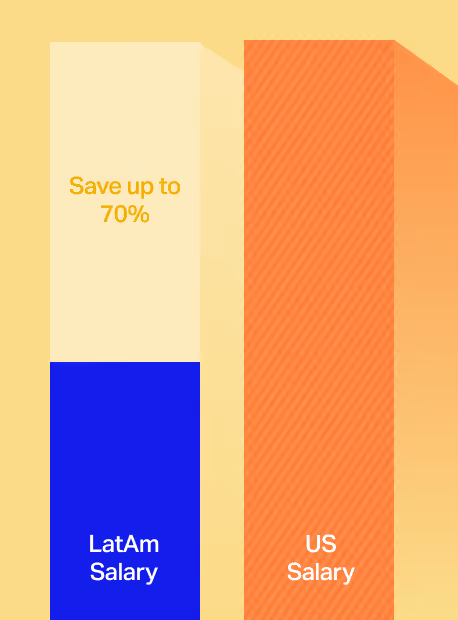
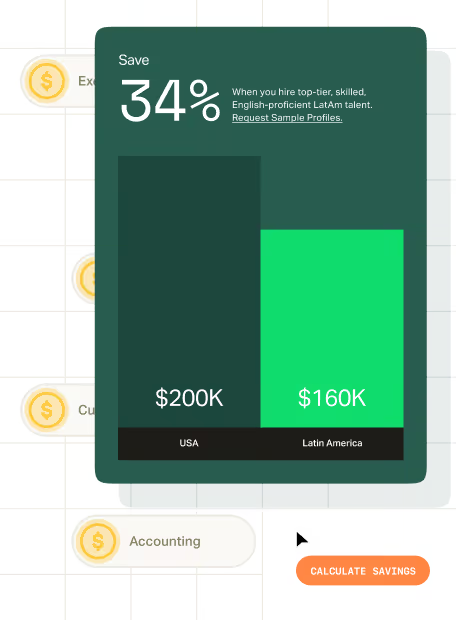
- Hiring QA testers full-time in Latin America costs 30–70% less than US hiring while providing dedicated product knowledge that outsourced agencies cannot match. You get affordable, full-time talent who work your hours and grow with your product.
If you’ve ever had a release derailed by a bug that should’ve been caught weeks earlier, you already know good QA isn’t a nice-to-have. It’s what keeps your team shipping confidently.
The question for most tech leaders isn’t whether to invest in QA. It’s how.
Do you outsource it to an agency that can start next week?
Or do you build in-house expertise that grows with your product?
Both paths can work. The key is understanding what you’re optimizing for: short-term capacity or long-term quality ownership.
Why Many Teams Outsource QA
Outsourcing QA is fast and flexible. When deadlines are tight, and you don’t have internal bandwidth, bringing in an external team—or a few testers through a staff-augmentation model—lets you keep shipping without pausing to recruit.
It’s especially appealing for companies that:
- Don’t need full-time QA yet. Early-stage teams might only need testing before major releases. An outsourcing company gives you access to talent without carrying the year-round cost.
- Need to scale up quickly. Agencies can stand up a team in days. You skip job postings, interviews, and onboarding.
- Are balancing budgets. QA outsourcing often costs far less than hiring a full-time US employee. For teams already stretching their engineering spend, it’s a practical way to add coverage.
And when you choose the right QA outsourcing partner—one that integrates well with your workflows and communication tools—it can be a solid bridge to stronger quality practices.
Still, it’s important to be realistic about what outsourcing gives you and what it doesn’t.
You’re effectively one of several clients. The testers you work with may rotate between projects. Knowledge about your product, your customers, and your codebase lives mostly outside your walls. That means you gain short-term efficiency, but not necessarily long-term ownership.
Why Others Choose to Build QA In-House
For companies with a growing codebase and a steady release cadence, building QA internally becomes less about cost and more about retaining knowledge.
An embedded QA engineer or tester becomes an extension of your development team—someone who knows your edge cases, your users, and your infrastructure. They don’t just execute test scripts; they spot risks early, join sprint planning, and help your developers ship with fewer rollbacks.
When QA sits inside your team, you also control the process. You decide what gets automated, what stays manual, and how testing fits into your CI/CD pipeline. There’s no waiting for an external team to pick up context or shift priorities. The collaboration is immediate.
And that internal context compounds. Over time, your QA function evolves from “checking for bugs” to improving how the whole team builds.
The trade-off, of course, is cost. US QA engineers and SDETs can easily run into six-figure salaries, and the hiring process is slow. For many companies, the need for dedicated QA is clear—but the budget just doesn’t stretch that far.
Why More Companies Are Hiring QA Testers and Engineers in Latin America
That’s where nearshore hiring changes the equation.
Hiring QA talent full-time in Latin America gives you the same cost advantages that make outsourcing attractive—but with the dedicated focus and continuity of an in-house hire.
You’re not sharing resources with other clients.
You’re building your own QA capability. You’re hiring QA testers, test automation engineers, and SDETs who learn your product deeply, join your standups, and grow with your team.
In Latin America, you can hire a QA engineer for up to 74% less than in the US.
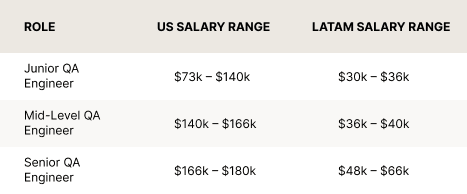
We’ve seen companies start with a manual QA tester to strengthen release confidence, then watch that same person evolve into an automation engineer who builds frameworks and integrates testing into CI/CD. When that growth happens inside your org, you retain the expertise. You’re not starting from zero every time a contract ends.
And because QA engineers across Latin America work in US time zones, collaboration happens in real time. Developers can hand off a fix at noon and have it verified before the end of the day. That immediate feedback loop protects velocity.
Just as importantly, it keeps quality ownership inside your company, not in a vendor’s Jira board.
The Bigger Picture: Catching Defects Early, Where It Counts
Whichever model you choose, one principle stays constant: the later you catch a defect, the more expensive it becomes to fix.
A defect caught during implementation is roughly six times costlier than if discovered during design, according to the IBM System Science Institute. Catch it after launch, and it can cost 15 to 30 times more, sometimes even 100x once it reaches production.
That’s why teams that view QA as a strategic function, not an afterthought, almost always come out ahead. They’re spending earlier, when quality is still cheap.
.avif)
Final Thoughts
There’s no universal right answer.
If your product is early and your release cadence unpredictable, outsourcing QA might be exactly what you need.
If you’re scaling fast and care about knowledge retention, building QA internally will pay dividends.
It’s how engineering leaders ship faster without lowering the bar because quality stops being a separate process and becomes part of every workday.
If you’re weighing whether to outsource or hire, start with what’s breaking your velocity: is it lack of capacity, or lack of collaboration?
If it’s both, you don’t need to compromise.
You can hire a QA engineer in Latin America who works in sync with your developers, strengthens your test coverage, and helps you catch defects before they cost 30x more to fix.
At Near, we pre-vet QA testers and engineers so you only interview candidates who match your technical requirements and communication standards. Most of our clients make a hire within 21 days.
Schedule a free, no-commitment consultation call. There's no fee to interview candidates, and you only pay when you find the right fit.
Frequently Asked Questions
What’s the difference between a QA tester and a QA engineer?
A QA tester (sometimes called a manual QA engineer) focuses on exploratory and manual testing: walking through user flows, reproducing bugs, and validating that new features behave as expected.
A QA engineer (sometimes called a QA automation engineer or SDET) builds and maintains automated test scripts, integrates them into CI/CD pipelines, and creates the frameworks that make testing faster and more reliable.
Most teams need both: manual QA for human judgment and exploratory work, and QA engineers for scalable, repeatable coverage.
Is a QA tester the same thing as a manual QA engineer?
They’re essentially the same role. “Manual QA engineer” just emphasizes that the person works within a structured engineering process—using tools like Jira or TestRail and collaborating closely with developers—while “QA tester” is the more general term. In both cases, the focus is on hands-on, human testing rather than writing automation code.
Why should I hire a QA tester or QA engineer in Latin America?
Because it lets you keep ownership of quality inside your company while achieving the cost efficiency of outsourcing.
You get full-time, dedicated talent who works in your time zone, participates in your standups, and develops deep knowledge of your product.






.webp)


%203.svg)
.avif)




%20(1).avif)

%20(1).png)