


%203.svg)
Key Takeaways
- The best QA outsourcing companies are QA Wolf, Testlio, Zoolatech, BetterQA, DeviQA, QA Madness, TestingXperts, QualityLogic, Applause, test IO (by EPAM), and Global App Testing. They bring different strengths across test automation, performance, security, crowdtesting, and embedded quality engineering. If you’d rather hire your own QA tester, Hire With Near stands out.
- Outsourcing QA fits tight deadlines, fluctuating workloads, and one-off specialized testing, while hiring a dedicated QA tester or engineer fits a growing codebase and a steady release cadence where you need someone who knows your product and stays.
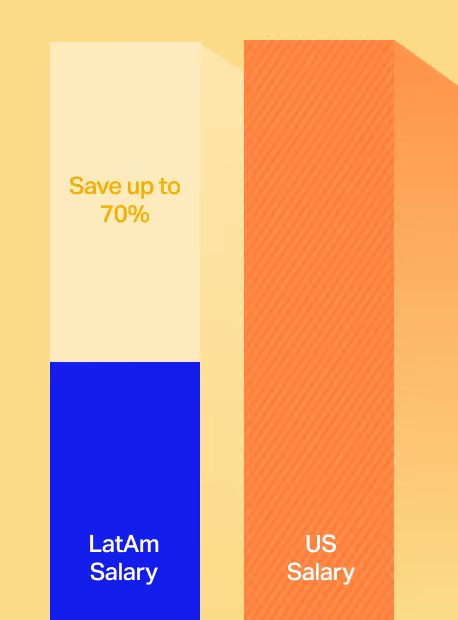
- Hiring your own QA testers and engineers in Latin America costs 30% to 70% less than hiring in the US and gives you dedicated product knowledge and continuity.
Shipping fast means your QA can’t be an afterthought: a missed edge case in production costs you customer trust, and every hour your team spends manually retesting the same flows is an hour not spent building.
QA outsourcing is how most companies solve this without slowing down, bringing in proven automation, security, and performance testing from a vendor that’s already built the process.
If you’re evaluating QA outsourcing companies or trying to figure out which one fits your stack and budget, I’ve put together a list of 11 worth considering. They all have a verified track record, client reviews to back it up, and specific testing expertise to match different kinds of software.
In this guide, I cover what each one does well so you can build your shortlist fast.
There is another path worth weighing: hiring your own dedicated QA testers in Latin America instead of outsourcing to a vendor. I explain how that works, and how Hire With Near helps with it, in a dedicated section later in this guide.
What Are the 11 Best Companies to Consider for Outsourcing QA Testing Services?
Ten of the 11 QA outsourcing companies below clear the same bar: at least 15 client reviews at a 4.0-or-higher rating on G2 or Clutch. The exception is TestingXperts, which doesn’t have a public review profile at that volume but has a verifiable track record with enterprise clients like KFC and Mercedes-Benz, which earned it a spot on this list.
The companies appear in no particular order.
To keep it up to date with our selection criteria, we regularly check ratings on third-party review sites and update as required.
The list mixes specialized QA providers, embedded QA teams, and crowdtesting platforms with different models, regions, and specializations, so the right fit depends on your product, budget, timeline, and how you like to work. The best way to know who’s the best fit for your business is to talk with a few of them.
For a wider view of outsourcing partners across functions, see our guide to the best LatAm outsourcing companies.
Note: Ratings and review counts are as of October 2026. We update them regularly to reflect current platform data.
1. QA Wolf
Website: qawolf.com
Headquarters: United States
Rating: 4.8/5 on G2 (195+ reviews) as of October 2026
Services: End-to-end test automation, managed QA (Coverage-as-a-Service), web and mobile testing
Focus Regions: Global (US-based)
QA Wolf made this list because of the way it removes the biggest reason in-house automation stalls: maintenance. The company builds and maintains your end-to-end test suite as a managed service, targeting broad automated coverage and fixing broken tests for you.
It also holds the largest verified review base of any company on this list. Teams that ship several times a day tend to rely on it most.
Key features:
- Builds and maintains automated tests on open-source Playwright and Appium, so you keep exportable code with no vendor lock-in.
- Runs suites on parallel infrastructure for fast, flake-free results on every pull request.
- Coverage-as-a-Service embeds dedicated QA engineers who own test creation and upkeep.
Best for: Fast-shipping software teams that want reliable end-to-end automation without staffing an internal automation function.
Limitations: Focused on automated end-to-end testing rather than broad manual or exploratory QA. It’s a better fit for teams with a defined web or mobile app than for very early prototypes.
2. Testlio
Website: testlio.com
Headquarters: Miami, Florida, United States
Rating: 4.7/5 on G2 (75+ reviews) as of October 2026
Services: QA strategy, manual and automated testing, mobile and web test automation, performance and security testing, CI/CD integration, QA team augmentation
Focus Regions: Global (150+ countries)
Testlio earned a spot on this best QA outsourcing companies list because it pairs a managed service with a vetted global testing community, so you get real-device coverage without recruiting testers yourself.
Its platform coordinates functional, payment, localization, and accessibility testing across 150-plus countries and hundreds of payment methods. That reach is why streaming, media, and fintech brands lean on it for release testing at scale.
Key features:
- Real-device testing across 150+ countries, 100+ languages, and 800+ payment methods.
- Managed through its LeoCore platform with AI-assisted tester matching and test-cycle orchestration.
- ISO/IEC 27001 certified, with named clients including Paramount+, BBC, SAP, and Roku.
Best for: Consumer, media, and fintech teams that need broad real-world device, payment, and localization coverage.
Limitations: The networked-crowd model fits release-cycle and on-demand testing more than a single embedded tester who lives inside your codebase day to day.
3. Zoolatech
Website: zoolatech.com
Headquarters: Miami, Florida, United States
Rating: 4.9/5 on Clutch (15+ reviews) as of October 2026
Services: QA strategy, manual and automated testing, mobile and web test automation, performance and security testing, CI/CD integration, QA team augmentation
Focus Regions: Global (US-based)
Zoolatech stands out for treating quality assurance as part of the engineering lifecycle rather than a separate testing stage at the end of development. Its quality assurance services combine manual and automated testing with performance and security testing, while integrating continuous testing directly into CI/CD pipelines.
That model is particularly relevant for enterprise products and software teams with frequent releases or complex mobile and web environments. Zoolatech has experience building scalable automation frameworks, improving existing QA processes, and embedding dedicated QA specialists into cross-functional engineering teams.
In one enterprise retail engagement, the company expanded testing to more than 3,000 automated and manual tests, achieved 75% automation coverage across iOS and Android, and substantially reduced regression and full-suite execution times.
Key features:
- End-to-end QA coverage spanning manual, automated, performance, security, usability, and cross-platform testing.
- Native mobile and web automation expertise, with testing integrated into CI/CD pipelines.
- Flexible delivery models ranging from QA process optimization and automation framework development to embedded QA engineers and scalable dedicated teams.
Best for: Enterprise and product companies that want QA engineers embedded closely with development teams and need to improve automation, release reliability, or testing maturity over the long term.
Limitations: Zoolatech is a broader software engineering company rather than a pure-play testing or crowdtesting platform, so organizations looking only for short-term, transactional testing capacity may prefer a specialized QA-only provider.
4. BetterQA

Website: betterqa.co
Headquarters: Cluj-Napoca, Romania
Rating: 4.9/5 on Clutch (70+ reviews) as of October 2026
Services: QA outsourcing, manual and automation testing, security testing, accessibility, dedicated QA teams
Focus Regions: Europe (global clients)
What stood out about BetterQA is its same-engineers-long-term model: rather than rotating testers, it embeds a dedicated team that builds up knowledge of your product. It works shift-left, reviewing requirements before code is written, and combines manual testing for edge cases with automation for repetitive flows.
A near-perfect Clutch rating across dozens of reviews reflects that continuity.
Key features:
- Embedded dedicated QA teams with a two-week proof of concept and no upfront payment.
- Five proprietary in-house tools for bug tracking, test flows, security, and accessibility, included with engagements.
- ISO 27001, 9001, and 13485 certified, with clients including McDonald’s, Nestlé, and ING Bank.
Best for: Product and SaaS teams that want a consistent, dedicated QA team rather than one-off project testing.
Limitations: European working hours overlap only part of the US workday, which matters if you need full real-time coverage.
5. DeviQA
%2010.25.31%E2%80%AFa.%E2%80%AFm..png)
Website: https://www.deviqa.com
Headquarters: United States (global delivery teams)
Rating: 5.0/5 on Clutch (35+ reviews) as of October 2026
Services: Managed QA, QA outsourcing, dedicated QA teams, test automation, performance and security testing
Focus Regions: Global
DeviQA is one of the QA outsourcing companies chosen for this list because of a perfect Clutch rating and the breadth of a 300-plus engineer bench that can own your entire testing function or slot into it.
The company offers managed QA, dedicated teams, and team augmentation across functional, performance, security, and compatibility testing.
Its investment in AI and self-healing automation is aimed squarely at cutting the maintenance that drags most test suites down.
Key features:
- Flexible engagement models, from fully managed QA to embedded dedicated teams and augmentation.
- The company reports that self-healing automation frameworks cut test maintenance by roughly 70%.
- Clients span fintech and healthcare industries, including Abbott, BP, and Tipalti.
Best for: Companies that want a scalable QA partner able to run the whole testing function or reinforce an existing one.
Limitations: DeviQA has a smaller published review base. Confirm fit for your specific stack during evaluation.
6. QA Madness
Website: https://www.qamadness.com
Headquarters: Warsaw, Poland
Rating: 4.8/5 on Clutch (35+ reviews) as of October 2026
Services: Manual and automation testing, security, performance, accessibility, API testing, QA consulting
Focus Regions: Europe (global clients)
The reason QA Madness made this list is its balance of AI-assisted speed and senior human sign-off, summed up in its own line: “AI does the work, QA owns the quality.”
The company runs manual and automated testing plus security, performance, and accessibility work, and offers standalone QA audits for teams that want an outside read on their process. Strong Clutch reviews back up its bug-reduction claims.
Key features:
- Automation across Playwright, Cypress, and Selenium, with AI acceleration for test-case creation.
- Specialized accessibility (WCAG), security, performance, and AI/LLM validation testing.
- ISTQB Silver Partner and ISO/IEC 27001 certified, with a proprietary test-management hub.
Best for: Teams wanting a QA partner that blends automation efficiency with certified senior oversight, or a one-off QA audit.
Limitations: Poland-based hours overlap only the earlier part of the US workday, so plan handoffs if real-time overlap is critical.
7. TestingXperts

Website: https://www.testingxperts.com
Headquarters: Harrisburg, Pennsylvania and London, UK
Rating: No public reviews on G2, Clutch, or Goodfirms as of October 2026. Client roster includes KFC and Mercedes-Benz.
Services: Enterprise-quality engineering, AI-led testing, test automation, digital assurance, accessibility, security
Focus Regions: Global (US, UK, Europe, Middle East, APAC)
TestingXperts caught my attention for its enterprise scale: it’s one of the largest pure-play quality engineering firms, with 13 global offices and multi-shore delivery.
The company leans hard into AI-led testing, from generative test design to self-healing automation, and reinvests a share of revenue into its TxLabs research hub. That depth suits large, compliance-heavy programs more than a single-app startup.
Key features:
- AI-led quality engineering with self-healing test automation and intelligent test orchestration.
- Multi-shore delivery across the US, UK, Europe, and APAC for follow-the-sun coverage.
- Broad enterprise services spanning functional, performance, security, and accessibility testing.
Best for: Enterprises and larger organizations that need a global, compliance-ready quality engineering partner.
Limitations: The enterprise focus can bring more process than a small team shipping a single product needs.
8. QualityLogic
Website: https://www.qualitylogic.com
Headquarters: Boise, Idaho
Rating: 4.9/5 on Clutch (30+ reviews) as of October 2026
Services: Functional and regression testing, test automation, load and performance testing, accessibility, usability
Focus Regions: United States (onshore, with hybrid options)
I chose QualityLogic for this list based on its onshore US model and its depth in digital accessibility, an area many QA firms treat as an afterthought.
Operating since 1986, it offers WCAG compliance testing and document remediation alongside functional, automation, and performance testing, plus a niche in smart-energy device testing.
Its onshore teams are the draw for companies that want US-hours collaboration and accessibility expertise in one place.
Key features:
- Onshore US delivery with optional hybrid onshore and offshore staffing.
- Dedicated digital accessibility practice, including WCAG audits and document remediation.
- Nearly four decades in business, with 200+ QA engineers and 6,000+ completed programs.
Best for: US companies that prioritize onshore collaboration or need serious accessibility testing.
Limitations: Onshore delivery typically carries higher rates than offshore-heavy providers, a trade-off for time-zone alignment.
9. Applause
Website: https://www.applause.com
Headquarters: United States
Rating: 4.4/5 on G2 (35+ reviews) as of October 2026
Services: Managed crowdtesting, functional, accessibility, UX, payment, localization, and AI application testing
Focus Regions: Global (200+ countries)
Applause belongs on this QA outsourcing companies list for the sheer scale of its testing community: more than 1.5 million testers across 200-plus countries, testing on millions of real devices.
That crowd powers functional, usability, accessibility, payment, and localization testing, and increasingly AI evaluation for teams shipping AI features.
Its roster of large-brand clients signals it’s built for demanding, high-volume programs.
Key features:
- Global crowd of 1.5M+ vetted testers with access to 5M+ real devices across 150+ languages.
- Specialized testing for payments, accessibility, localization, and AI-powered applications.
- Named clients including Google, PayPal, Microsoft, and Spotify.
Best for: Consumer-facing and enterprise teams that need real-world coverage across many devices, markets, and languages.
Limitations: The enterprise crowdtesting model is heavier than a small team needing a couple of embedded testers, and pricing skews toward larger budgets.
10. test IO (by EPAM)
.webp)
Website: https://test.io
Headquarters: Part of EPAM Systems (global tester crowd)
Rating: 4.3/5 on G2 (70+ reviews) as of October 2026
Services: On-demand crowdtesting, functional and exploratory testing, web and mobile testing
Focus Regions: Global (150+ countries)
I added test IO because it makes crowdtesting genuinely on-demand: setup takes minutes and the first bug reports arrive within about an hour.
Founded in 2011 and acquired by EPAM Systems in 2019, it draws on a crowd of 400,000-plus testers for real-device functional and exploratory testing, with reports that include screenshots and video.
The EPAM backing adds enterprise stability to a nimble model.
Key features:
- On-demand test cycles with rapid setup and results, run by a large global tester crowd.
- Real-device functional and exploratory testing that complements your automated suite.
- Pay-per-test pricing that scales with actual testing volume rather than a fixed monthly retainer.
Best for: Teams that want fast, flexible functional testing bursts layered on top of existing automation.
Limitations: Crowdtesting suits functional and exploratory coverage more than deep, embedded ownership of a test automation framework.
11. Global App Testing
Website: https://www.globalapptesting.com
Headquarters: London, United Kingdom
Rating: 4.3/5 on G2 (75+ reviews) as of October 2026
Services: Crowdtesting, functional and UX testing, localization, payment, accessibility, AI evaluation
Focus Regions: Global (190+ countries)
Global App Testing rounds out the list with real-user testing in the markets your customers live in: a crowd across 190-plus countries and 160-plus languages, running functional, localization, and payment tests on real devices and networks. This local-market reach is why global consumer brands use it to validate releases region by region.
Turnaround is fast, often within 48-hour cycles.
Key features:
- Crowdtesting network built for regional and localization validation, not just functional bugs.
- Accessibility testing included alongside standard functional and payment test coverage.
- ISO 27001 certified, with clients including Booking.com, Meta, and Eventbrite.
Best for: Companies launching or maintaining apps across many countries that need genuine local-market validation.
Limitations: A stated minimum investment (around $20,000) and a business-only model make it a fit for funded teams rather than very small projects.
What Is QA Outsourcing and How Does It Work?
QA outsourcing means engaging a third-party provider to handle some or all of your software testing instead of using your own employees. The provider’s testers run manual and automated tests, report defects, and verify releases while your developers keep building. Engagements can cover one project, an ongoing testing team, or individual QA engineers who join your team.
It typically starts with identifying the specific QA needs of a development project and selecting a partner who either carries out the testing directly or helps you hire QA professionals. The outsourced team then works with your developers to understand the requirements, set testing protocols, and make sure the software meets the quality standards you’ve defined.
Communication runs through regular updates, progress reports, and feedback sessions, which keep the testing process aligned with the project goals.
What Are the QA Outsourcing Models?
QA outsourcing models differ in two ways: where the testers are based (onshore, nearshore, or offshore) and how the work is structured (a managed project or a dedicated team). The right combination depends on how much real-time collaboration you need and how long the work will last.
Onshore, nearshore, or offshore?
- Onshore means testers in your own country. You get the same working hours and legal framework, which suits work where testers need to sit in daily standups. QualityLogic is an example from the list above, with an onshore US model. The trade-off is higher rates.
- Nearshore outsourcing means testers in nearby countries and time zones. For US companies, that’s Latin America, where most of the region sits zero to three hours from US time zones, so testers join live standups and verify bugs the same day.
- Offshore means testers in distant time zones, typically in Asia or Eastern Europe. Offshore teams can cover testing while your team is offline, but a question sent in the afternoon often waits until the next morning for an answer.
Managed project or dedicated team?
- Managed project: The vendor owns the testing outcome. You hand over a defined scope, such as a release’s regression suite, and the vendor decides who tests and how. QA Wolf and Testlio are examples from the list above. It works for defined, time-boxed testing, but the knowledge stays with the vendor when the project ends.
- Dedicated team: A group of testers works only on your product over the long term, usually following your priorities and joining your standups. BetterQA and DeviQA offer this model. It builds product knowledge over time, but it needs steadier work to justify.
A managed project is a service you buy, while a dedicated team is capacity you direct. If you’d rather own that capacity outright, hiring your own QA tester in Latin America is the third option, covered later in this guide.
What Are the Key Benefits of Outsourcing QA Testing Services?
Outsourcing QA offers four main benefits that can enhance your software development process: cost savings, access to a larger talent pool, easier scaling, and faster time to market. Together, they give you the expertise and flexibility to ship high-quality software.
Below, we look at how the QA outsourcing process delivers on each one.
Cost savings
One of the primary advantages of outsourcing software testing services is cost-effectiveness.
By partnering with an outsourcing company, you save on expenses related to hiring, training, and maintaining an in-house QA team. An outsourcing partner has already built that infrastructure, so you’re paying for output, not for the process of building a team from scratch.
This frees up budget you can put toward core activities like building and shipping product.
Access to a large talent pool
Outsourcing gives you access to a larger pool of skilled testers than you can access locally, and the depth matters more than the headcount. You can find outsourced QA specialists experienced in diverse testing environments and methodologies, providing comprehensive coverage across functional, performance, security, and usability testing.
A specialized QA provider maintains a pipeline of testers across manual, automation, and specialized disciplines like security and performance testing, so they can usually staff a role faster than a company sourcing on its own.
These providers use current tools and technologies to test faster and more thoroughly, and a strong provider will have testers who’ve already worked across the specific frameworks and CI/CD pipelines your team runs on.
Easy scaling
Outsourcing QA testing elevates the scalability of your projects. With the capability to scale teams up or down based on project requirements, you can manage varying workloads without the long-term commitments of permanent staff.
This matters most around release cycles. A product nearing a major launch might need a temporary surge in manual testers to cover regression testing across every user flow, then scale back down once the release stabilizes. An outsourcing partner absorbs that variability without you having to hire, then lay off, testers every quarter.
Faster time to market
By using a QA testing services company, businesses can achieve faster time to market. With dedicated teams focusing on QA, the software can be released with fewer bugs and higher reliability, allowing you to stay competitive and meet customer expectations.
The principle underneath this is simple: the later a defect is caught, the more expensive it is to fix. A dedicated QA function that runs in parallel with development catches issues while they’re still cheap to resolve, which is what drives the speed gain, not just having more testers on hand.
Focus on core business activities
When you outsource QA, your team redirects energy toward what drives your business forward: product development, marketing, and customer service. Your developers spend less time context-switching between building features and hunting for bugs.
This focused approach lets you maintain high software quality standards without diluting attention from strategic priorities. Your internal team handles what they do best while QA specialists ensure your releases meet quality benchmarks.
When Should You Outsource QA Testing Services?
Companies should consider outsourcing QA testing services when they’re up against tight deadlines, have fluctuating testing demand, need specialized skills their team doesn’t have, or lack the in-house QA capacity to keep up.
Understanding the right time to engage a QA testing services company can significantly improve the efficiency and quality of your software development process.
Here are key situations in which this approach is beneficial:
- Tight project deadlines: If you’re facing tight project deadlines and need to release software quickly, outsourcing QA can expedite the testing process. A dedicated external team can deliver thorough testing without compromising quality, helping you meet your launch date.
- Need for specialized expertise: For projects that require niche testing skills such as security, compatibility, or performance testing, outsourcing provides access to professionals with the needed expertise and experience.
- Limited budget for quality assurance: If you’re working with a limited budget but still need high-quality testing, outsourcing can be a cost-effective alternative to hiring and maintaining an in-house QA team. It allows you to achieve high-quality assurance standards without high overhead costs.
- Fluctuating QA needs: If you have fluctuating testing demands, outsourcing offers a flexible solution. You can easily scale the size of your QA team up or down based on your needs without the long-term commitment of permanent staff.
- Lack of in-house resources: If your company lacks the people or infrastructure for extensive testing, outsourcing fills the gap with the QA coverage you need.
- Need to focus on core development functions: If your internal team is stretched thin and you need to prioritize core development tasks, outsourcing QA frees up your developers to focus on building features and improving the product while quality standards are still met.
- Require access to advanced QA tools and technologies: When your project requires specialized testing tools that would be costly or impractical to buy and maintain in-house, outsourcing gives you access to those tools for thorough, efficient testing.
What Should You Consider When Choosing a QA Testing Services Provider?
When choosing a QA testing services provider, weigh nine factors: automation expertise, performance testing, security testing, compatibility testing, turnaround speed, communication, industry experience, certifications, and client reviews.
With so many companies offering QA outsourcing services, evaluating potential partners against your project needs is what separates a good fit from a costly mismatch.
Here are the key factors to consider when choosing a QA testing services company:
Expertise in automation testing
Automation testing is essential for enhancing efficiency and accuracy. Look for providers with a strong track record in automation testing, including expertise with leading automation testing tools like Selenium, QTP, or Appium.
Performance testing capabilities
A competent QA provider should demonstrate strong experience in performance QA through tools like JMeter or LoadRunner, helping keep your application stable and responsive under load.
Security testing specializations
With cyber threats rising, security expertise is vital. Choose a software testing company with strong capabilities here, including vulnerability assessments, penetration testing, and risk analysis.
Experience in compatibility testing
A provider with deep compatibility-testing experience helps your application behave consistently across different platforms and devices.
Look for one that tests across the specific combination of browsers, operating systems, and device types your actual users rely on, rather than a generic sweep of the most popular options.
A provider that can show you a real compatibility matrix from a past project, not just a list of tools they support, is a good sign they take this seriously.
Quick turnaround times
Opt for a provider whose turnaround times match your release schedule. Consider their ability to work within your working hours so you can have smoother coordination and faster resolution of issues found.
For example, you may want to consider working with a QA provider in Costa Rica or Mexico, where working hours overlap with US working hours, rather than a provider in Poland or the Philippines if real-time communication is essential to you.
Strong communication abilities
Effective communication is essential for a successful partnership. Evaluate the provider’s communication skills: do they give you clear, timely updates and respond quickly to questions?
A quick way to test this before signing anything is to watch how they handle your evaluation calls. A provider that answers technical questions directly, follows up with what they said they would, and flags concerns proactively during the sales process will likely behave the same way once you’re a client.
Relevant industry experience
A strong track record in your specific industry matters more than a broad one. Ask for case studies from projects similar to yours, not just a generic portfolio. How a provider has handled challenges specific to your industry tells you more about their problem-solving ability and adaptability than a general capabilities pitch does.
Certifications and credentials
Certifications are a quick way to gauge whether a provider's processes meet recognized standards, not just their own internal claims. Look for ISO 9001:2015 for quality management, ISO 20000 for service management, and ISO 27001 for information security management. These confirm the provider's practices are benchmarked against established industry norms, not just described that way in a sales deck.
Client reviews and feedback
Before signing anything, check what previous clients actually say. Reviews and references reveal how a provider performs once the contract is signed, not just how well they present during the sales process, and they're one of the more reliable ways to confirm reliability and skill from the outside.
What QA Services Can You Outsource?
Outsourcing services for software testing cover an extensive range of QA tasks to meet different needs:
Automated testing
Automation testing is a key part of modern QA processes—one survey found that 40% of companies automate software testing continuously throughout the software development cycle. Automation helps with repetitive testing tasks that would otherwise take a lot of time to complete manually.
Outsourcing automated testing saves time, boosts productivity, and ensures consistent, reliable testing, as external vendors often use tools like Selenium, JUnit, and Cucumber to streamline the testing process.
Manual testing
While automated testing handles repetitive validation efficiently, manual testing remains necessary for projects involving complex logic or requiring human judgment. Certain scenarios demand the nuanced evaluation that skilled testers provide.
Performance testing
Performance testing identifies potential bottlenecks in an application and verifies its capacity to handle anticipated user loads. It evaluates an application’s functionality under varying demand levels, focusing on maintaining stability and reliability.
To accurately gauge performance that mirrors actual user conditions, real-world tests are preferred over simulated environments.
Outsourcing performance testing provides access to specialized expertise and advanced tools designed to evaluate an application’s performance under various conditions, ensuring your application can handle real-world usage scenarios effectively.
Mobile app testing
Technical failure is one of the main reasons for user churn when it comes to mobile applications. Studies have shown that 79% of users will only try an app once or twice more if it fails initially, and 71% of uninstalls are the result of the app crashing.
Ensuring a uniform and satisfactory user experience across different platforms is essential, which makes mobile app testing indispensable. By conducting thorough mobile app testing early in the development process, QA professionals can detect any defects or usability problems.
Outsourcing performance and compatibility testing ensures that your application operates flawlessly across multiple devices and operating systems.
IoT testing
Outsourced IoT testing focuses on evaluating the functionality, security, and connectivity of internet-connected devices. This ensures reliable and secure device performance, offering a trustworthy user experience.
Outsourcing this aspect of testing mitigates risks and enhances device reliability, ultimately benefiting your business by helping you deliver high-quality, secure IoT products.
Security testing
Software vulnerabilities are being exploited all the time. Outsourcing security testing to experienced professionals helps find and fix vulnerabilities that could lead to cyberattacks. By hiring experts, you get access to advanced tools and specialized knowledge without needing to invest heavily in-house.
This approach strengthens your software’s defenses, ensuring data safety and building user trust. It also saves time and in-house resources, allowing your team to focus on core business activities while maintaining high security standards.
Hiring vs. Outsourcing: When Should You Choose Each?
An alternative worth weighing before you sign an outsourcing contract: hire your own QA tester or engineer full-time in Latin America, at 30 to 70% less than the equivalent US hire. Hire With Near’s research on why US companies hire in Latin America found that 12% are switching from outsourcing to building their own in-house teams, with IT and engineering among the top functions they bring in-house.
You get the cost advantage that makes outsourcing attractive in the first place, without giving up the thing outsourcing can’t offer: a tester who learns your product, your edge cases, and your users over time, and sticks around long enough for that knowledge to compound. You’re building your own capability, not renting time on a shared bench.
For teams with a growing codebase and a steady release cadence, the outsourcing trade-off starts to hurt. You need more than temporary capacity. You need someone who owns quality inside your team.
That is especially true for SaaS companies, where every release touches paying customers and a missed regression shows up in support tickets within hours.
When testing becomes a role, not a task
From the editorial work I do interviewing our recruiters, one pattern comes up again and again: the companies happiest with nearshore QA are the ones that stopped treating testing as a task to hand off and started treating it as a role to own.
Hiring QA talent full-time in Latin America gives you the cost advantage that makes outsourcing attractive, with the dedicated focus and continuity of an in-house hire.
The talent pool is deep enough to hire from directly. According to GitHub’s 2025 Octoverse report, Brazil alone now has 6.9 million developer accounts. Country-level figures for the rest of Latin America weren’t released in the 2025 edition, but the 2024 report counted Mexico at more than 1.9 million, Argentina at more than 1.1 million, and Colombia at over 1 million, all growing at double-digit rates year over year.
That depth spans manual testers through senior automation engineers and SDETs. You can hire someone for exploratory testing today and watch that same person grow into an automation engineer who builds frameworks and wires testing into your CI/CD pipeline. When that growth happens inside your org, you keep the expertise instead of starting from zero when a contract ends.
For a broader view of the market, our guide to hiring remotely in Latin America walks through how it works.
What Does It Cost To Hire a QA Engineer in Latin America?
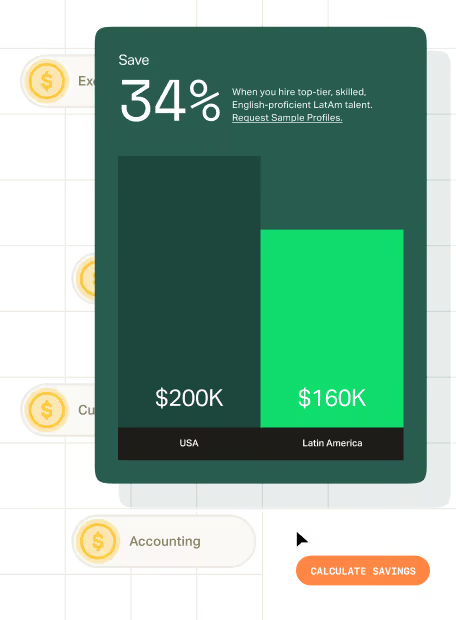
Hiring a QA engineer in Latin America runs from $30,000–$66,000 per year, compared with $67,000–$162,000 for the equivalent US hire.
To put that in concrete terms, here’s what hiring QA engineers costs in Latin America compared with equivalent US hires, according to Hire With Near’s salary benchmarks:
For the most up-to-date figures, see Hire With Near’s US vs Latin America Salary Guide.
According to our salary data, the savings hold across every seniority level. Hiring one mid-level QA engineer in the US often costs more than hiring two QA professionals in Latin America, so you can staff a dedicated QA function for what a single US hire would cost. You pay competitive local rates for full-time professionals who own quality on your team.
{{salary-guide-cta}}
Will they work your time zone and join your standups?
Yes, with some variation depending on the country and where your team sits. A QA hire in Latin America typically overlaps most or all of your business day, with only an hour or two of difference at the edges, as you can see in the table below:
That overlap is enough for live standups, same-day bug verification, and real-time handoffs instead of the overnight waits you get with far-offshore QA.
One founder we spoke with described the cost of getting this wrong. They had a senior QA engineer based in Asia-Pacific, and the time gap meant she was rarely online during their workday:
We currently have a senior QA that is focused on both manual testing and automation. She’s based in Sri Lanka, and I don’t get her enough during my day to actually allow to keep on that high quality and high throughput for my team. So we often release without her. So it’s not good, right?
Shipping releases without QA sign-off is exactly the failure a wrong-time-zone hire creates. A QA engineer in Latin America is at their desk when your developers are, so collaboration happens in real time: a developer can hand off a fix at midday and have it verified before the end of the day.
If you have any other concerns before you hire, our roundup of the questions tech leaders ask when hiring in Latin America covers what comes up most often, including standups, overlap, and onboarding.
Further reading: Outsource or Hire? Which Is Better When You Need QA Testers
How Does Hire With Near Help US Companies Hire QA Testers and Engineers?
Hire With Near is a nearshore staffing and recruiting partner that helps US companies build full-time teams in Latin America, from a single QA hire to a whole software engineering team. QA is one of the roles IT and tech companies ask us for most.
We source, screen, and present only QA testers and engineers who match your technical and communication requirements, so you hire from a short, vetted list instead of sorting through a pile of resumes yourself.
The process is simple. Hire With Near’s recruiters source candidates from a talent pool of 160,000+ pre-vetted professionals, screen them against your specific needs, and send you a shortlist in 3 to 5 days. Most companies make a hire in under three weeks.
How does Hire With Near vet QA testers and engineers before they reach you?
Hire With Near’s recruiters screen every candidate on three things before you ever see them:
- Technical skill
- The ability to explain their work clearly
- Fit with how your team operates
The technical interview is the filter that matters most, because a strong resume tells you what someone claims, not what they can do. Natasha Tarapow, Recruitment Consultant at Hire With Near, describes the core of that screen:
We always ask candidates to tell us about a project they’ve worked on — not just that they use this language and that one, but what their role was and what they actually did. It’s important that they can explain their work to someone who isn’t a developer. If they can do that, that tells me a lot.
— Natasha Tarapow, Recruitment Consultant, Hire With Near
That combination, technical depth plus the ability to communicate it, is exactly what separates a QA hire who owns quality from one who just runs test cases.
In the video below, Hayden Cohen, our co-founder, explains how that vetting process plays out in practice:
Communication and retention: what you're actually buying
Beyond the cost math, two things separate a direct hire from an outsourced contract. Latin American QA professionals typically bring strong English proficiency and cultural alignment with US work practices, so communication flows without the friction that often comes with far-offshore arrangements.
And because you're hiring someone directly rather than renting time on a shared bench, they build a career with your company instead of rotating to the next client. That continuity is what reduces ramp-up time and produces better testing outcomes over time, not just lower cost.
What hiring QA with Hire With Near looks like in practice
Hiring your own QA team gives you continuity that outsourcing’s revolving door doesn’t. According to Hire With Near’s 2026 State of LatAm Hiring Report, an analysis of 2,000+ placements, our Latin American hires stay 66% longer than comparable US hires, so the person who learns your test suite this quarter is still there next year.
Conversion Logix, an Inc. 5000 digital advertising and software agency in Austin, shows what that looks like. Local hiring was too expensive, and an earlier attempt to hire offshore in the Philippines hit communication hurdles: language barriers and nuanced US English made training difficult and slowed down their workflow.
They reached out to Hire With Near and built a 15-person Latin American team across engineering, marketing, finance, support, and admin, including a machine learning engineer and an automation specialist, cutting sourcing and interview time in half.
The result was $781,000 in annual savings, a 43% reduction versus US hires, at a 22-day average time-to-hire.
Their Client Services Manager, Tawnya Morse, put the experience simply:
I think the main benefit of LatAm talent is the ease of integration. It’s been so easy to work together without really noticing any kind of difference from somebody that’s in the States.
— Tawnya Morse, Client Services Manager, Conversion Logix
QA is a role Hire With Near places often, and you can see the caliber of QA professionals in Latin America available and the skills they bring.
If you’re still comparing your options, our roundup of the best companies to hire developers in Latin America and our guide to the top LatAm staffing firms show how the staffing model stacks up against outsourcing.
When you need to hire an engineering leader for your QA function, such as a QA manager or director of quality engineering, rather than an individual contributor, we also run executive search to find that person.
Final Thoughts
There’s no universal right answer between outsourcing QA and building your own team: the right call comes down to what is breaking your velocity.
If your product is early and your release cadence is unpredictable, a QA outsourcing partner from the list above may be exactly what you need: on-demand coverage, no long-term headcount, and specialized expertise you can turn on this week.
But if you’re scaling fast and quality keeps slipping through the cracks, the stronger move is usually to hire QA talent who learns your product and stays. That’s how Hire With Near helps you do it.
If it’s both, you don’t have to choose one forever. Plenty of teams outsource for surge capacity while they build a core QA function in parallel.
When you’re ready to explore hiring your own QA talent in Latin America, schedule a free, no-commitment consultation call with our team. There’s no fee to interview candidates, and you only pay when you find the right fit.
{{consultation}}
Frequently Asked Questions
What is the difference between QA outsourcing and hiring dedicated QA professionals?
QA outsourcing typically means working with a service company that manages testing as a project or provides shared resources across multiple clients.
Hiring dedicated QA professionals means building your own team of testers who work exclusively for you, integrate with your development process, and operate as full team members.
The dedicated model provides better long-term consistency and cultural fit, while traditional outsourcing works well for temporary project needs.
How do I know if I need manual QA testers or automation engineers?
Manual QA testers focus on executing test cases, exploratory testing, and logging bugs. They require little to no coding skills and are ideal for validating user experience and finding edge cases.
Automation engineers (also called SDETs) are programmers first who build test frameworks and automation scripts using tools like Selenium or Cypress. Most mature development teams need both.
What other engineering roles should I consider hiring in Latin America?
If you’re building out your engineering team in LatAm, consider these complementary roles: software engineers, full-stack developers, DevOps engineers, and back-end developers. These roles work well together with QA professionals to create strong, integrated development teams.
How fast can you hire a QA tester or engineer in Latin America?
Most companies hiring QA testers and engineers in Latin America see a shortlist of pre-vetted candidates within 3 to 5 days and make a hire in under three weeks. Because candidates are sourced and screened before they reach you, the slow part of hiring, sorting through unqualified applicants, is already handled.
Latin American professionals also tend to give shorter notice periods than the 30-, 60-, or 90-day waits common elsewhere, so your start date is closer than you might expect.
That speed is one reason teams with releases shipping next quarter choose to hire their own QA rather than wait on a vendor queue.
Which country should I hire or outsource a QA tester or engineer from?
It depends on your priorities. If you want the deepest talent pool, Brazil has the largest developer community in the region. If English fluency and cultural alignment with US teams matter most, Argentina is a strong choice. For the closest time zone overlap with the US East Coast, Colombia is worth prioritizing, and for Central and West Coast teams, Mexico offers the tightest alignment.
What is the best QA outsourcing company for financial services?
For financial services, the best fits on this list are DeviQA, BetterQA, TestingXperts, and Testlio, depending on what you test.
DeviQA’s clients span fintech and healthcare, including Tipalti. BetterQA holds ISO 27001 certification and counts ING Bank among its clients. TestingXperts is built for large, compliance-heavy programs, so it suits enterprise banks and insurers. Testlio, Applause, and Global App Testing cover payment testing across many payment methods and countries, which suits payment apps and checkout flows.
Whichever you shortlist, ask three questions:
- Which certifications do they hold? ISO 27001 for information security is a good baseline.
- How do they handle test data, so real customer data never reaches testers?
- Can they show completed testing for a regulated financial product?
If your systems are too sensitive for an external team to access, hiring your own QA tester keeps that access inside your company.
How much does QA outsourcing cost?
Most QA outsourcing vendors charge about $25–$49 an hour, and the average software testing project costs under $10,000, according to Clutch. Those are rates the listed vendors report themselves, so use them as a starting point and request quotes, because the price shifts with the type of testing, the region, and the engagement model.
If you hire a QA engineer directly in Latin America instead, you pay a salary rather than a vendor rate. According to our salary data, that runs $30,000–$66,000 per year, against $67,000–$162,000 in the US:
- Junior: $30,000–$36,000 in Latin America vs. $67,000–$112,000 in the US
- Mid-level: $36,000–$48,000 vs. $79,000–$132,000
- Senior: $48,000–$66,000 vs. $97,000–$162,000
That’s savings of up to 59% to 68% depending on seniority. For a mid-level QA engineer, it works out to about $17–$23 an hour at full time. That’s a salary equivalent, not what a vendor bills, so ask each provider for the all-in cost per tester.







.webp)


%203.svg)
.avif)





%20(1).avif)

%20(1).png)