%203.svg)
Key Takeaways
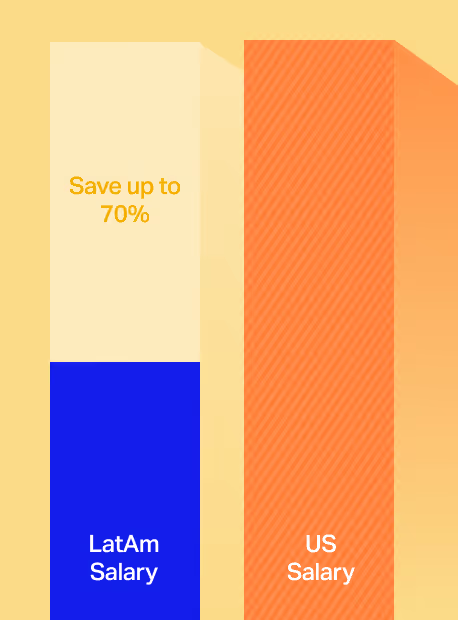
- For US companies, Latin America is the top region to hire remote accountants: Colombia, Argentina, and Brazil offer US GAAP familiarity, 0–3 hour time zone overlap, and annual savings of 49–71% compared to US-equivalent hires.
- When evaluating the best countries to hire remote accountants, three factors predict quality more reliably than cost alone: time zone alignment with US business hours, Big Four firm presence in the local market, and accounting programs that run five or more years.
- Latin America outperforms other regions for US accounting roles because overlapping working hours make same-day collaboration possible: research from Harvard Business School found that each additional hour of time zone difference reduces real-time communication by 11%.
Have you struggled to find a qualified accountant for your team? It’s not bad luck. It’s a structural problem that hundreds of US companies are running into right now: the US accounting talent pipeline reduction.
Hiring managers at CPA firms, SaaS companies, and growing businesses are feeling it: good candidates are slow to find, expensive to hire, and hard to retain.
Latin America is where 950+ US companies have solved this problem. If you’re looking to hire remote accountants in Latin America, countries like Colombia, Argentina, Brazil, and Mexico offer a combination of US GAAP familiarity, time zones that overlap with US business hours, and annual salaries that run 49–71% below US equivalents.
This article covers the best countries to hire remote accountants across 16 destinations, with the emphasis on the LatAm countries where Hire With Near places the most finance professionals.
Why Are US Companies Hiring Remote Accountants?
More and more US businesses are looking abroad to hire remote accountants. The reasons are straightforward: a shrinking domestic talent pool and costs that have become harder to justify.
According to Accounting Today, the number of candidates sitting for the CPA exam has fallen 27% over the past decade. The trend has continued: accounting graduates declined 6.6% in the 2023–24 academic year, following a 9.6% drop the year before, according to the AICPA’s 2025 Trends Report. Total accounting completions hit a 20-year low in 2023–24, with just 55,152 bachelor’s and master’s degrees awarded.
With the accounting staffing landscape having shifted, Latin America has emerged as the most practical answer to both problems. Hire With Near’s finance recruiting team places accountants as the second most common nearshore role, with most placements coming from Colombia and Argentina, according to the 2026 State of LatAm Hiring Report.
The candidates coming through that pipeline bring strong academic credentials, Big Four exposure, and direct familiarity with US business practices, at compensation levels 49% to 71% lower, reflecting the local cost of living rather than an inflated US market. For a team of three accountants, that difference funds another hire, upgraded tools, or additional finance capacity.
{{salary-guide-cta}}
What Makes a Country Good for Hiring Remote Accountants?
The best countries to hire remote accountants for US companies share a specific set of characteristics. When evaluating where to hire, look for:
- Strong educational systems: The best accounting talent comes from countries where the degree itself is rigorous. Accounting programs typically run four years in Brazil and five to six years in Argentina and cover international accounting standards from the ground up. That foundation means candidates arrive with genuine technical depth.
- Big Four firm presence: PwC, EY, Deloitte, and KPMG are the strongest quality signal in any candidate pool. Where these firms have established local offices, they train professionals in US GAAP, IFRS, and international audit and reporting standards as part of day-to-day work. A candidate with two to three years at a Big Four firm in Colombia or Mexico has had structured exposure to exactly the standards US clients need.
- US GAAP and IFRS familiarity: Countries with export-oriented professional services sectors develop talent that actively works to US and international standards, not just local equivalents. This is non-negotiable for any accounting role that touches financial reporting, investor materials, or tax compliance for a US entity.
- Time zone compatibility: For US companies evaluating the best countries to hire remote accountants, time zone alignment is the most underweighted factor. A 0–3 hour difference means your remote accountant works your hours. Month-end close doesn’t get delayed waiting for an overnight response. Client questions get answered the same day.
- English proficiency: For back-office roles with no direct client contact, functional English is usually sufficient. For senior roles, controller-level positions, or any work involving client calls or investor reporting, near-native fluency becomes a practical requirement. Country-level EF EPI rankings give a useful baseline, but role-specific screening during interviews is what truly matters.
Latin America checks every box for US companies. Other regions check some of them (India and the Philippines have strong talent and English proficiency, for example), but typically fall short on time zone alignment, which matters more than most hiring managers expect.
What Skills Should You Look for When Hiring Remote Accountants?
For remote accounting roles, the most important skills are those that hold up across borders: technical depth, software fluency, and the ability to communicate clearly in an async or video-first environment.
Here is a list of essential skills to prioritize during your remote hiring process:
Strong technical accounting skills
An in-depth knowledge of accounting principles and procedures is non-negotiable. Depending on your business needs, look for accountants with a firm grounding in topics like:
- Financial reporting
- Tax preparation
- Auditing
- Budgeting
They should also know the Generally Accepted Accounting Principles (GAAP) or International Financial Reporting Standards (IFRS).
Proficiency in accounting software
Remote accountants should be adept at using your company’s accounting software and tools, such as QuickBooks, Xero, Sage, or any industry-specific applications. Familiarity with cloud-based systems is also key, as these often facilitate remote accounting tasks.
US business context and client familiarity
Technical skills are important, but how a candidate applies them depends heavily on the context they’ve worked in. As Lucas Stepanenko, Sourcing Manager at Hire With Near, puts it:
My first questions are whether they have experience working with US-based clients and whether they can manage multiple clients simultaneously — those two things tell me a lot.
Analytical and problem-solving skills
Accountants must analyze financial data, recognize patterns, and identify potential issues. They should also be critical thinkers with a knack for solving complex problems and helping the business make informed strategic decisions.
Effective communication skills
The ability to communicate clearly and concisely is critical for remote workers. Look for candidates who can easily explain complex financial concepts to executives, managers, and clients at all levels, whether verbally or in writing.
Attention to detail
Accuracy is critical in the accounting field. Your remote accountant should pay meticulous attention to detail to ensure financial records are precise and error-free, as accurate information is foundational for reliable financial insights and compliance.
{{state-latam-hiring}}
The 16 Best Countries to Hire Remote Accountants
Based on our experience, Latin America is the clear first choice for US businesses. Lucas Stepanenko describes what he sees in practice:
LatAm finance professionals have strong academic training and a lot of exposure to Big Four firms. That gives them experience with international markets and makes them very well versed in key accounting standards like US GAAP and IFRS, which are among the most common requirements we see from our clients.
One of Hire With Near’s clients hired three accountants and an operations manager. According to Lucas, he was very surprised by their performance and responsiveness: they hit all their targets and received strong feedback from his own clients.
Our list of the 16 countries with strong talent pools for US companies hiring remote accountants leads with Latin America, followed by a summary of other regions worth knowing about.
For a full breakdown of compensation by role and seniority level, see Hire With Near’s US vs. LatAm salary guide.
1. Colombia
Colombia is Hire With Near’s top country by placement volume in 2026. Colombian universities have rigorous accounting programs, and many professionals pursue additional certifications to build their credibility with international clients. The country has a strategic time zone (Eastern Time or Central Time, depending on the season), which means full overlap with US business hours.
What our recruiting team consistently notes about Colombian accountants: strong proficiency in US GAAP, comfort with cloud-based accounting tools, and a work culture that aligns closely with US professional norms. If you need accountants comfortable with client-facing interactions, Colombia is the first country to look at.

2. Argentina
Argentina is Hire With Near’s second most common source country for finance placements, and there’s a structural reason for it: Argentine accounting programs run five to six years, considerably longer than most US and European programs, and the curriculum includes international accounting standards. PwC and EY both have significant presences in Buenos Aires, giving many candidates direct experience with international reporting requirements.
Argentina’s time zone puts the country one to two hours ahead of US Eastern Time, so same-day collaboration on month-end close, financial reviews, and client deliverables is standard. Many Argentine professionals are also multilingual: Spanish and English are common, with Italian as a third language for some, given the country’s European heritage.
Further reading: Nearshoring in Argentina: Costs, Talent, Top Locations, and How to Hire in 2026
3. Brazil
Brazil’s growing economy and strong emphasis on financial services education have produced a large pool of qualified accountants. Many professionals are fluent in both Portuguese and English, making them a strong fit for companies that work with multinational clients or have international operations.
Brazilian accountants increasingly hold international certifications and have experience with Big Four firms operating in the country’s financial centers.
The country spans four time zones, but São Paulo, Rio de Janeiro, and Brasília all operate on UTC-3, which puts them 1–2 hours ahead of US Eastern Time depending on the season. That’s close enough for full working-hour overlap with US East Coast teams.

4. Mexico
Outsourcing to Mexico is a particularly compelling nearshore option because of the minimal time zone difference: Mexico City operates on Central Time, meaning zero time zone friction with most US-based teams. The country has a solid education system in business and finance, and there are many bilingual professionals fluent in both Spanish and English.
Mexican accountants are known for their adaptability and understanding of both local and US accounting standards, which is especially relevant for companies operating in or expanding to the US-Mexico corridor.
As one example, a marketing agency needed to replace a departing accountant quickly and found their strongest candidate based in Mexico. She brought full-cycle accounting experience, GAAP-aligned reporting, and working hours that aligned closely with the agency's Eastern time zone. Hire With Near placed her in under three weeks, at 61% less than a comparable US hire.
5. Costa Rica
Costa Rica is strategically positioned for US-based companies due to its shared time zones and growing professional talent pool. The country strongly emphasizes education, producing accountants who are well versed in local regulations but also knowledgeable about US GAAP and IFRS.
Costa Rica’s stable economy and US-oriented business environment make it a reliable nearshore option, particularly for companies that value political and economic stability.

6. Peru
Peru is an emerging market with a solid education system that produces skilled accountants knowledgeable in both local and international accounting standards. Peruvian accountants typically earn 55–65% less than their US equivalents at comparable seniority levels, while maintaining professional standards.
The country’s growing number of technology-adept professionals also makes them a good match for businesses that need remote workers comfortable with modern accounting platforms and cloud-based tools.
7. Chile
Chile has a stable economic environment and has invested significantly in education, producing a workforce attuned to international business practices. The country’s strong economic ties with international markets mean that many Chilean accountants have experience with cross-border transactions and various financial systems. Chile’s time zone (generally UTC-3 to UTC-4) provides solid overlap with US East Coast hours.
Santiago in particular has developed into one of South America’s stronger financial services hubs, with a concentration of multinational firms that train accountants to international standards. English proficiency among finance professionals is solid, particularly at the mid and senior levels.
Other regions to consider
The following countries have real talent pools for remote accounting work. For most US companies prioritizing real-time collaboration on time-sensitive accounting tasks, the 8–12 hour time zone gap is a meaningful operational constraint. That said, companies with async-friendly workflows or those primarily looking for cost reduction may find strong candidates in these regions.
- Philippines: The Philippines has a strong tradition of accounting education and high English proficiency, shaped by the country’s US-influenced educational system. CPAs are plentiful, and communication with US clients is typically smooth. The time zone gap (8–12 hours from the US) is the primary challenge for accounting roles that require same-day responsiveness. Companies with time-sensitive accounting needs (month-end close, client queries, tax deadlines) often find that the lag creates compounding delays.
- India: India is a well-established destination, with professionals known for technical proficiency, understanding of various accounting principles, and adherence to quality control. English is widely used in professional settings. If you need real-time responsiveness on finance tasks, the 10–12 hour gap requires careful workflow design.
- Kenya: Kenya is a growing choice for accounting outsourcing due to its English-speaking professionals, with a strong educational focus on commerce and internationally recognized accounting qualifications.
- Romania: Romanian accountants offer a high standard of services and a good understanding of both local and international accounting practices. More commonly associated with IT services, the country also produces qualified finance professionals.
- Ukraine: Ukraine has a strong educational background in mathematics and finance, with many accountants who speak English and work comfortably with modern accounting software.
- Pakistan: Pakistani accountants provide cost-effective services and increasingly serve international clients, with a workforce experienced in working across borders.
- Vietnam: Vietnam has a growing skilled workforce offering accounting services to global clients. English proficiency has improved significantly, and the country’s work culture values diligence and precision.
- Poland: Poland has a highly educated workforce, with many financial professionals fluent in English and other European languages. Polish accountants are typically well trained in EU accounting standards and IFRS.
- South Africa. South Africa has a strong regulatory framework for accounting, auditing, and financial management, producing accountants with current knowledge of international practices. English is the primary professional language, which reduces communication overhead.
Why Time Zone Overlap Gives Latin America an Edge for US Accounting Teams
For most accounting roles, time zone overlap isn’t just a convenience: it’s an operational requirement. Month-end close, financial reviews, tax deadline crunches, and client-facing work all depend on the ability to ask a question and get an answer the same day.
Research from Harvard Business School and INFORMS puts a number on the cost: each additional hour of time zone difference reduces real-time communication by 11%. The researchers specifically recommend that companies distribute remote teams along a north-south axis, such as the US to Latin America, to maximize workday overlap.
Apply that finding to accounting: a 10-hour gap with an offshore provider doesn’t just mean slower responses. It means an entire overnight delay between a question and its answer, for every routine task.
Latin American accountants typically sit 0–3 hours from US time zones. That’s full overlap: your Colombia- or Argentina-based accountant is available for the same Zoom call, the same Slack thread, the same urgent close-of-quarter push as your US team.
Our analysis of 2,000+ hiring conversations found that 30% of companies switching to Latin America for hiring were specifically moving away from offshore regions, like India and the Philippines, because of time zone gaps affecting real-time collaboration.
How time zone misalignments affected real companies
One US accounting firm owner put it plainly when explaining why they needed a Latin America-based hire for a client-facing finance role:
For this role, we really would love to have somebody in Latin America just because the time zone is much closer to ours. And this role in particular requires a lot of client interfacing. It’s probably the most high touchpoint role with clients of any of the roles that we have. So almost all that time would be needed in a similar time zone because, well, you’d have to be able to answer.
Another accounting firm, Stull CPA, based in Fort Worth, Texas, had been relying on offshore hiring in Asia, where large time zone gaps meant slow turnarounds and quality issues that forced senior managers to step in and fix errors.
They turned to Hire With Near for Latin American candidates and filled three senior accountants and an operations manager in under 30 days, ahead of tax season. The result: $308,000 in annual savings, 68% less than equivalent US-based roles. Their Operations Manager Gisela Piñeiro described the difference directly:
With other outsourcing companies, we lost clients because of mistakes and delays. With [Hire With Near], we gained confidence.
{{prevetted-banner}}
Tips for Choosing the Best Country to Hire Remote Accountants
For most US companies, the right country checks three non-negotiable boxes: time zone alignment, US GAAP familiarity, and a strong accounting education system. Latin America covers all three. Here are six criteria to evaluate when choosing:
- Time zone differences: For roles that require daily collaboration, client-facing work, or time-sensitive close cycles, time zone alignment is the single most important variable. A 0–2 hour difference means your remote accountant works your hours, answers questions the same day, and participates in month-end close in real time. A 10–13 hour gap forces async-only workflows and creates friction that compounds over time.
- Travel proximity: If your engagement model includes periodic in-person visits, onboarding trips, or client-facing work that occasionally requires physical presence, proximity matters. Most of Latin America is 3–8 hours by flight from major US cities, making in-person meetings practical when needed. Asia-Pacific destinations can require 14–18 hours of travel each way.
- Cultural affinity: Cultural alignment affects day-to-day collaboration more than most hiring checklists account for. Look for professionals who communicate directly, take initiative, and are comfortable flagging issues without being asked. Latin American professionals are frequently described by US clients as proactive and engaged, more like team members than external vendors.
- Accounting standards: Your remote accountant should be fluent in the frameworks your business actually uses. US GAAP is the baseline for most US companies; IFRS matters if you have international operations or investors.
- Technical infrastructure: Reliable broadband, power stability, and access to standard business tools (Slack, Zoom, QuickBooks, NetSuite) are non-negotiable for remote accounting work.
- Economic and political stability: Instability in a candidate’s home country creates real operational risk: currency volatility affects salary expectations, political disruption can interrupt services, and high local inflation can drive turnover as candidates seek better compensation.
Hiring remote accountants from LatAm countries checks several boxes, providing high-quality accounting services without significant time difference challenges or high overhead costs.
Final Thoughts
Latin America gives US companies a practical solution to a real problem: qualified accounting professionals who work in your time zone, understand US accounting standards, and cost significantly less than US equivalents.
The countries covered here offer a range of options depending on your specific needs: Colombia and Argentina for depth of credentials and time zone alignment, Mexico for zero-offset nearshore convenience, and Brazil and Costa Rica for growing professional talent pools.
The cost savings are real: 49–71% annually versus US-based equivalents, depending on seniority. But the companies that get the most out of LatAm accounting hires aren’t just optimizing for cost. They’re building teams that operate with the same daily cadence as their US staff: available for the same calls, working the same deadlines, communicating with the same clarity.
If you want to explore what this looks like for your team, book a free consultation with Hire With Near. We’ll walk you through salary benchmarks, explain how the process works, and share sample profiles of the type of candidates you can expect.
You can also read our guide on remote accounting hiring for more detail on how to structure a remote accounting function and what to watch for when making your first hire.
{{latam-hiring-cta-v2}}
Frequently Asked Questions
How much does it cost to hire a remote accountant in Latin America?
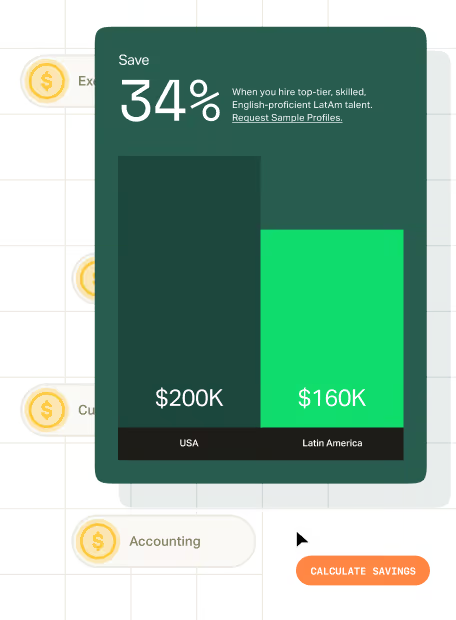
The average accountant salary in Latin America ranges from $24,000 to $60,000 per year, depending on seniority, compared to a US median of $81,680 (Bureau of Labor Statistics, May 2024). That works out to savings of roughly 49–71%, depending on the level of hire.
Senior-level roles show the widest gap: a senior accountant based in LatAm typically costs $42,000–$60,000 annually, versus $82,000–$139,000 for a US equivalent.
What is the best country to hire a remote accountant?
For US companies, Colombia and Argentina are the top choices, with Brazil and Mexico close behind. All four offer time zone alignment (0–2 hours from US Eastern time), strong accounting education, Big Four firm presence, and professionals with direct US GAAP experience. Colombia ranks first by placement volume and Argentina leads in depth of accounting credentials.
What qualifications should a remote accountant have?
Look for accountants with knowledge of GAAP or IFRS, proficiency in accounting software like QuickBooks or Xero, and international certifications such as ACCA or CIMA. Experience with Big Four firms and direct US GAAP work is the strongest quality signal for candidates based in Latin America.
For senior finance roles (Controller, CFO, VP Finance), Hire With Near’s executive search for finance roles handles placements at that level separately from standard staffing.
Do remote accountants in Latin America work during US business hours?
Yes. Most LatAm countries sit 0–2 hours from the US Eastern time zone, which means your accountant in Colombia, Argentina, or Mexico has full overlap with your standard working day. Month-end close, client calls, financial reviews, and quick turnaround questions all happen in real time, the same way they would with a US-based team member. This is the primary reason US companies choose LatAm over the Asia-Pacific regions for accounting roles.
Are remote accountants in Latin America familiar with US GAAP?
Yes, particularly those with Big Four experience or training at universities that include international accounting standards in their programs. Argentina’s five-to-six-year accounting degree programs incorporate IFRS and US GAAP as standard curriculum. Colombia, Brazil, and Mexico all have Big Four firm offices that produce alumni with hands-on international accounting experience.
What our recruiting team consistently finds is that Big Four exposure is the single strongest predictor of US GAAP competency in a LatAm candidate.
What is the difference between hiring a remote, nearshore, and offshore accountant?
“Remote” simply means the accountant works outside your office. “Nearshore” means they’re based in a country with close time zone alignment to your business: for US companies, that means Latin America (0–3 hour difference to US Eastern time). “Offshore” typically refers to hiring from a country with a large time zone gap, like India or the Philippines (8–12 hours from the US).
Hire With Near places nearshore remote accountants, not offshore ones. The distinction matters for accounting roles specifically because of how much same-day responsiveness affects the day-to-day work.
What types of US companies hire remote accountants from Latin America?
All types of US companies hire remote accountants from Latin America, but demand is especially concentrated in sectors with ongoing accounting needs and cost-conscious hiring.
Accounting firms are among the most active users of LatAm accounting talent, particularly for scaling during tax season. Finance companies and SaaS companies hire heavily for FP&A, revenue accounting, and financial operations roles. FinTech companies need accounting and compliance-aware finance professionals at all levels. Real estate firms and manufacturing companies round out the most active verticals.
The throughline: Any US business that needs reliable, time-zone-aligned finance support at a cost that makes sense for their budget.
What other finance and accounting roles can I hire from Latin America?
Beyond financial controllers, the most commonly hired finance and accounting roles from Latin America include:
- Financial analysts: FP&A, variance analysis, and reporting
- Staff accountants: Day-to-day bookkeeping and close support
- Accounts payable specialists: Vendor management and invoice processing
- CFOs: Fractional and full-time strategic finance leadership
- Bookkeepers: Transaction recording and reconciliation
All bring the same time zone alignment and US GAAP familiarity as the controller role.
How do I get started hiring a remote accountant from Latin America?
The fastest way to start is to book a free consultation with Hire With Near. The process typically takes 7–21 days from consultation to hire. During the initial call, we walk you through salary benchmarks for the role and seniority level you need and explain how the process works. From there, we run a custom search and deliver a shortlist of pre-vetted candidates matched to your specific requirements.







.webp)


%203.svg)
.avif)





%20(1).avif)

%20(1).png)