


%203.svg)
Key Takeaways
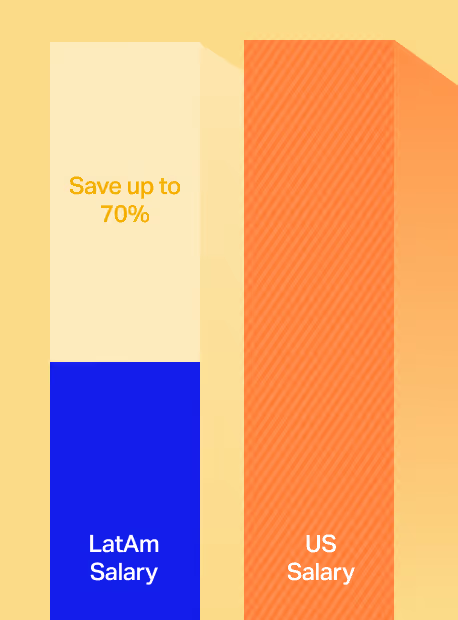
- When comparing offshoring accounting (India vs. Latin America), the decisive factor for most US accounting firms is time zone. LatAm sits 0–2 hours from US Eastern Time, meaning near-full working-hour overlap with US teams, compared to India's 10–13.5 hour gap. Add comparable talent quality and 35–69% cost savings vs. US-based hires, and LatAm is the stronger fit for client-facing accounting work.
- India's lower absolute labor costs make it a reasonable choice for batch-style, asynchronous accounting work, but the time zone gap creates compounding friction for client-facing roles, tax deadline crunches, and any work that requires same-day decisions.
- The number of candidates sitting for the CPA exam has fallen 27% over the past decade. You're increasingly hiring in Latin America not just to cut costs, but because qualified US accounting candidates are harder to find.
For most US accounting firms, Latin America is the stronger offshoring option. While India offers lower absolute labor costs, LatAm provides time zone alignment that India can’t: typically a 0–3 hour difference versus India's 10–13.5 hour gap. For client-facing accounting work and real-time collaboration, that difference is decisive.
Offshore accounting arrangements in India work well for structured, batch-processing tasks, but if you need someone who can cover client calls, respond to same-day requests during tax season, and work through problems with your team in real time, the time zone gap becomes a structural problem.
The urgency behind this decision is growing. According to Accounting Today, the number of candidates sitting for the CPA exam has fallen 27% over the past decade. For many US firms, offshoring isn't just a cost decision anymore — it's a talent access problem.
But time zone alignment isn't the only factor to consider. In this article, I compare offshoring accounting to India vs. Latin America across cost, talent quality, data security, and cultural fit in 2026.
Offshoring Accounting to India
India has long been a prominent player in global offshoring, earning its reputation through a combination of cost-effectiveness, solid business process outsourcing (BPO) infrastructure, and a vast pool of talent.
Here are a few factors that make India a competitive option for US accounting firms:
Cost savings
Labor costs in India are among the lowest of any offshore destination. According to PayScale, a mid-level accountant in India earns $4,800–$10,200 annually, a significant discount compared to the US equivalent of $65,000–$139,000.
For asynchronous accounting work, like outsourced bookkeeping, document processing, and tax preparation, that cost difference is real and the quality of structured work is strong. If your accounting function is primarily transactional and doesn't require daily US team interaction, India's cost profile is hard to argue with.
The same logic applies to the Philippines, where bookkeeping services are commonly used for high-volume, async work.
Related reading: Benefits of offshore bookkeepers
Skilled workforce
India produces more accounting graduates annually than almost any other country, with a strong pipeline through institutions like the Institute of Chartered Accountants of India (ICAI).
Over 80% of finance and accounting graduates are actively pursuing international credentials, like CFA, CPA, CMA, and ACCA, which means a large share of the available talent pool is already oriented toward US and global accounting standards.
For high-volume engagements where credential depth is a threshold requirement, India's talent supply is hard to match on scale alone.
Advanced infrastructure
India's BPO sector has decades of investment behind it. Major accounting platforms (QuickBooks, SAP, Oracle, and NetSuite) are standard in most established Indian service providers, and adoption of AI-driven analytics for audit and reporting workflows is ahead of most other offshore markets.
For US companies running structured, high-volume accounting operations, the infrastructure is already in place.
Offshoring Accounting to Latin America
Latin America has become the leading destination for US accounting firms looking beyond traditional offshore hiring. What makes it different is the model: Nearshore outsourcing means hiring professionals in adjacent time zones, so your accounting team works during your business hours rather than bridging a 10–13 hour gap.
Countries like Mexico, Brazil, and Colombia are at the forefront of this growth, each with deep talent pools, improving infrastructure, and direct overlapping working hours with US teams.
Time zone and cultural alignment
For roles that require client contact, same-day turnarounds, or real-time collaboration, LatAm's proximity to the US is its defining advantage. Most LatAm countries sit 0–2 hours from US Eastern Time, which means your accounting hire works during your business hours.
Hire With Near's analysis of 2,000+ hiring conversations found that 30% of companies turning to LatAm hiring were previously using offshore providers in Asia, with time zone misalignment cited as the primary driver for switching. Finance and accounting is the second most common department among companies making that switch.
One owner of a small tax and accounting firm described exactly why she shifted toward LatAm:
For this role, we really would love to have somebody in Latin America just because the time zone is much closer to ours. This role in particular requires a lot of client interfacing — it's probably the most high-touchpoint role with clients of any of the roles that we have. So almost all that time would be needed in a similar time zone because you'd have to be able to answer.
Cultural alignment reinforces the time zone advantage. LatAm professionals are often educated in US-style environments, familiar with North American business norms, and accustomed to direct communication and structured reporting expectations. In my experience placing finance professionals, clients consistently note that LatAm hires engage proactively: flagging issues before they're asked, pushing back when something doesn't add up, and taking ownership of outcomes rather than waiting for direction.
Franco Pereyra, Hire With Near's Co-Founder and COO, has a similar opinion:
What sets Latin American talent apart from other regions is that you'll find people who are proactive and creative, people who come up with ideas and new solutions. If you're looking for folks who can bring something to the table, who will push back if they think your idea doesn't make sense, that's what you find in LatAm.
Skilled workforce
LatAm's accounting talent pool is large, credentialed, and increasingly oriented toward US standards. In my five years sourcing finance and consulting talent at Hire With Near, the depth of the candidate pool consistently surprises clients.
The accounting professionals in Latin America that I place most often come from Colombia, Mexico, and Brazil, countries with strong university accounting programs, and Big Four exposure at PwC, Deloitte, EY, and KPMG is common among mid and senior candidates.
Many LatAm accountants hold CPA-equivalent credentials and arrive with strong familiarity with US GAAP and IFRS, two of the most common technical requirements we see from US accounting firms. QuickBooks, NetSuite, and SAP proficiency are also standard, which means the tool onboarding for US clients often isn't needed.
To illustrate the scale: The US has approximately 653,408 licensed CPAs (as of May 2026) according to NASBA data. Mexico alone has approximately 542,000 accountants, auditors, and finance specialists (per Q1 2025 data), according to Mexico's Secretariat of Economy, a ratio that makes LatAm one of the most talent-dense regions in the world for accounting professionals per capita.
Cost efficiency
Even with strong credentials, accounting professionals in Latin America offer significant cost advantages compared to their US-based counterparts. Compensation benchmarks show substantial savings across roles:
*Ranges reflect junior through senior levels. Compensation depends on seniority and specific role requirements.
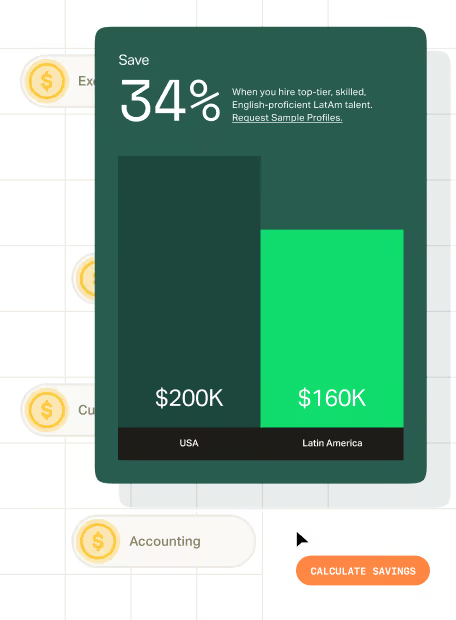
According to our 2026 State of LatAm Hiring Report, companies hiring accountants from LatAm save $33,000–$66,000 annually compared to US-based hires. That’s a 49–71% reduction depending on seniority.
Hire With Near's accounting recruitment services can connect you with pre-vetted candidates across all of these roles.
Further reading: Best staffing firms for hiring bookkeepers in LatAm
{{state-latam-hiring}}
Offshoring Accounting: India vs. LatAm Comparison
The right choice between India and Latin America comes down to what your accounting roles actually require day to day.
Here's a side-by-side breakdown of the key factors to consider when hiring remote talent in LatAm or India:
Cost
India offers the lowest absolute labor costs for accounting work: A mid-level accountant runs $4,800–$10,200 annually, compared to $36,000–$48,000 in Latin America. For purely transactional work, that gap is real.
But cost-per-hour isn't the same as cost-per-output. When a question sits unanswered overnight because your accountant is 12 hours ahead, or a client deliverable gets delayed waiting for a response window, those aren't line items in a salary comparison, but they show up in your results.
Workforce
Both regions produce credentialed, internationally trained accounting professionals familiar with US GAAP and IFRS. The talent pools are large. The difference shows up in how candidates engage, not whether they're qualified.
Across the accountants I've placed for US clients, LatAm professionals are often more qualified than the role title suggests. Many candidates applying for bookkeeper or staff accountant roles are technically CPAs with rigorous multi-year university training. That’s a credential depth that consistently surprises US clients who assumed those titles didn't require that level of education.
Big Four experience (PwC, EY, Deloitte, KPMG) is one of the strongest signals I look for in tax accountants and financial analysts. It means US GAAP and IFRS training was built into their careers from early on, not learned on the job for a US client.
Time zone
An accountant in Bogotá works the same hours as your Chicago team. An accountant in São Paulo is one to two hours ahead of New York. Either way, your 3 p.m. question gets answered before the end of the business day. India operates 10–13.5 hours ahead of US Eastern Time. Your 3 p.m. deadline is their 1:30 a.m.
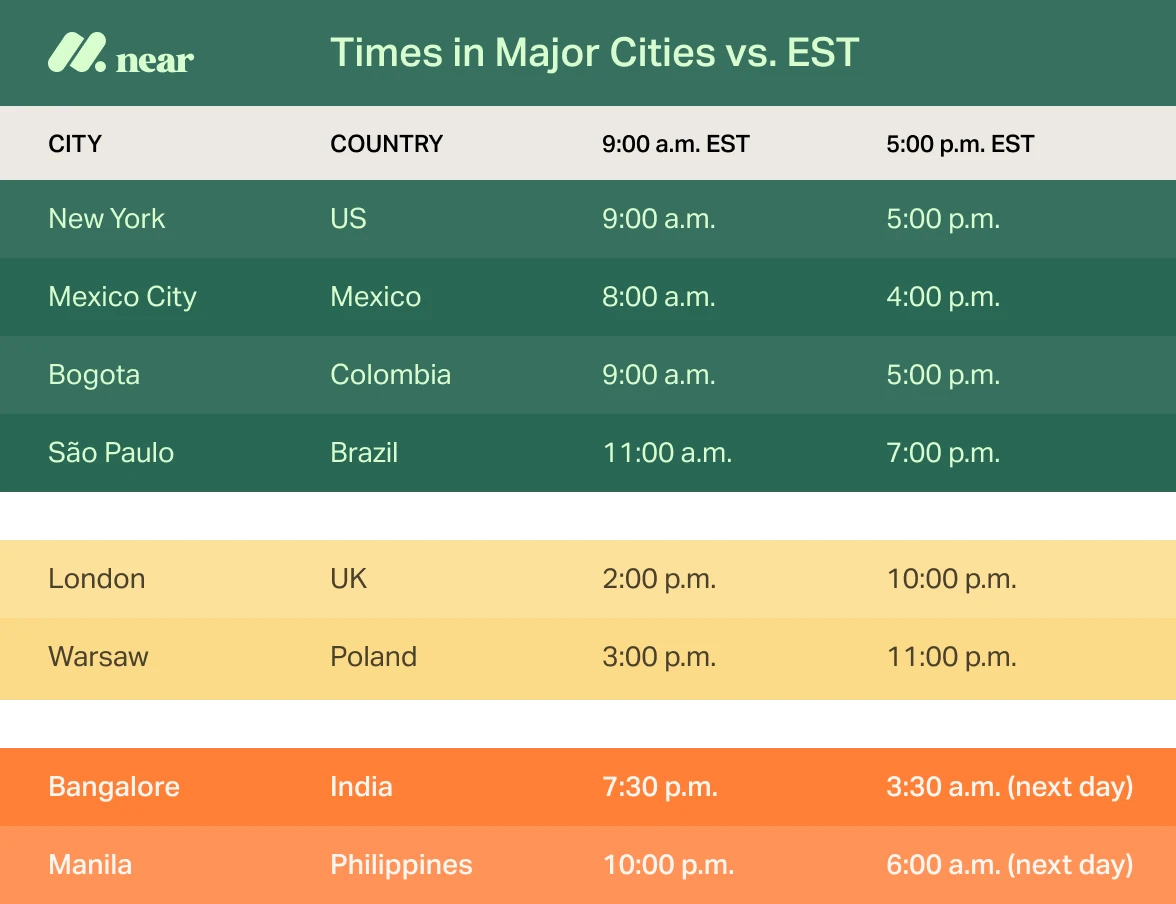
A study from Harvard Business School and INFORMS found that each additional hour of time zone difference reduces real-time communication by 11%.
The friction shows up in predictable ways. One founder in the technology and payments space described what happened with their India-based team:
Right now, a lot of our engineering is based in India... it just becomes too late for them to be productive, especially in the later part of the time here. Right now, they're like 4 a.m., 5 a.m. for them, and I think they're kind of complaining that it's not doable.
The same dynamic plays out in accounting. Tax season deadlines don't wait for overnight handoffs. Client questions don't schedule themselves around a 12-hour lag.
The practical rule: If your accounting work is primarily batch-style and asynchronous, India's time zone can work. If your work requires same-day responsiveness, client calls during US business hours, or real-time reconciliation, LatAm is the better fit.
Culture
India has developed genuine familiarity with US business practices through decades of BPO work. But familiarity isn't the same as alignment. LatAm professionals tend to communicate more directly, take more initiative, and engage with problems rather than wait for instructions, traits that show up consistently in how US clients describe the difference after making the switch.
That cultural proximity produces working relationships that feel less like vendor management and more like having a team member in another city.
Infrastructure
India's BPO infrastructure is mature and deeply established, built over decades of offshore services investment, with redundant connectivity, large provider networks, and well-documented security practices. For companies running structured, high-volume accounting operations, that institutional infrastructure is a real asset.
LatAm has closed the gap significantly. Colombia, Mexico, and Brazil now offer reliable broadband, established co-working ecosystems, and stable power infrastructure in major professional services hubs. For direct hires working remotely, the infrastructure question is largely resolved in any major LatAm city.
Language
In both regions, professionals working with US clients typically have strong written and spoken English. For most accounting roles, that's sufficient.
Where LatAm pulls ahead is bilingual capability. Spanish-English proficiency is common across the region, and recent Census Bureau data shows roughly 42 million people in the US speak Spanish at home.
For accounting firms with Hispanic clients, or any client-facing role where Spanish fluency adds value, that's a practical differentiator.
Quality of service
India's long presence in the accounting outsourcing market brings deep institutional knowledge and well-established quality control processes, particularly for high-volume transactional work.
LatAm has developed rapidly, driven by a credentialed talent pool and growing investment in professional services. But the quality difference that US clients notice most is responsiveness.
When your accountant works your hours, questions get answered the same day, deliverables don't wait for overnight turnarounds, and month-end close doesn't run long because someone wasn't available during your working hours. Real-time availability changes what collaboration looks like in practice.
Which Region Is Right for Your Accounting Function?
Choosing between offshoring accounting to India vs. Latin America comes down to one question: What do your accounting roles truly require day to day? Here's how to think through it:
When to choose India
India is the stronger option when cost is the primary driver and real-time collaboration isn't a requirement. Consider India if:
- Your accounting work is primarily transactional and batch-style, like AP processing, payroll runs, reconciliations, and document preparation
- Deliverables can be handed off overnight and reviewed the next morning without business impact
- You have an existing management layer in the US that can handle all client communication and oversight
- You're running high-volume operations where the scale of India's talent pool and lower cost profile outweigh the time zone tradeoff
- Your accounting function has no direct client contact requirements
When to choose Latin America
Latin America is the stronger option when your accounting roles require active participation in the US business day. Consider LatAm if:
- Your accountant needs to join team calls, respond to client questions same-day, or collaborate in real time during close cycles
- You're hiring for client-facing roles (controller, financial analyst, or senior accountant) where responsiveness is part of the job
- You want a professional who works your hours, in your tools, as a full team member rather than a vendor
- English proficiency and cultural alignment are important for direct client interaction
- You're replacing a US-based hire and need the same level of integration at a lower cost
For most US accounting firms, the deciding factor is the last one: If you'd expect a US hire to be available during your business day, you need a LatAm hire. India works when the work can wait.
{{latam-hiring-calculator}}
Legal and Regulatory Environment
Data security and regulatory compliance don't get enough attention in offshore accounting decisions. Most conversations start with cost and time zones, and compliance gets treated as a checklist item at the end. It deserves more than that.
The way client financial data is handled, stored, and transferred across borders has real legal and reputational consequences for your firm. Both regions have regulatory frameworks worth understanding: They're different in structure, but both are workable for US firms that do their due diligence.
Data protection in India
India enacted its Digital Personal Data Protection Act (DPDPA) in 2023, bringing a formal data protection law to a market that previously operated without one. Large BPO providers commonly hold ISO 27001 certification, which provides a recognized framework for information security management.
One thing to flag: Cross-border data transfer requirements under the DPDPA are still being finalized. Before transferring any client financial data to an India-based accounting partner, clarify their data handling policies and how they plan to comply as the regulations develop.
Data protection in Latin America
Several LatAm countries have data protection laws modeled on or aligned with GDPR, which many US firms find easier to evaluate against their existing compliance processes:
- Argentina: The Personal Data Protection Act (PDPA) is one of the region's oldest and most comprehensive frameworks. Argentina is one of the few non-EU countries formally recognized by the European Commission as providing adequate data protection.
- Brazil: The Lei Geral de Proteção de Dados (LGPD), enacted in 2020, is modeled closely on GDPR and applies to any organization processing data of Brazilian residents.
- Mexico: The Federal Law on Protection of Personal Data Held by Private Parties (LFPDPPP) governs how personal and financial data must be handled by private entities.
For US accounting firms handling sensitive client financial data, these GDPR-aligned frameworks often provide a more familiar compliance baseline than India's newer and still-developing DPDPA regime.
HIPAA and SOC 2 considerations
If your firm handles healthcare-adjacent financial data, HIPAA compliance is relevant regardless of region. Look for partners in either India or LatAm who can demonstrate SOC 2 Type II certification or who operate under a Business Associate Agreement (BAA) framework for sensitive data.
This is a partner-specific requirement, not a regional one. A SOC 2-compliant LatAm firm is more trustworthy than a non-compliant India firm, and vice versa. Don't assume regional reputation substitutes for documented compliance and vet the specific partner.
How to Choose the Right Accounting Offshoring Partner for Your Business
Once you've decided which region fits your accounting function, the next step is finding the right partner to make the hire.
Whether you're evaluating top finance and accounting outsourcing providers, reviewing bookkeeping outsourcing services, or considering a direct hire through a recruiting partner, here's what to look for.
Expertise and specialization
Make sure the partner has the right specialized skills and understands your industry's regulatory environment and accounting requirements. Look for a transparent track record: case studies, client references, and demonstrated experience with US-based clients in your industry. For accounting roles specifically, ask whether candidates have direct experience with US GAAP and whether they've worked with US-based companies before.
Technology and infrastructure
A potential offshoring partner should have access to modern accounting software and tools. Verify that their technical setup can support your work, including the ERP systems or accounting platforms your firm uses (QuickBooks, NetSuite, Xero, etc.).
Security and compliance
Data security is non-negotiable when handling financial information. Confirm that the partner adheres to the relevant data protection frameworks for their region and ask specifically about SOC 2, HIPAA compliance if relevant, and their data transfer policies. Reputable partners should be able to provide documentation.
Communication and collaboration model
Assess whether the partner's working model matches your collaboration needs. If you need daily check-ins, real-time question resolution, and client-facing availability, verify that the team can operate during your business hours.
This is where the India vs. LatAm decision becomes most tangible. Nearshore staffing gives you overlapping working hours by design: offshore arrangements in Asia require someone to adjust their schedule to make that happen.
Cost transparency
While cost savings are a primary reason for offshoring, make sure you understand the full cost structure. Ask for a breakdown that includes any placement fees, management fees, or technology costs beyond the base salary.
Cultural compatibility
Evaluate the cultural alignment between your business and the offshoring partner. Look for compatibility in work ethic, communication style, and business practices.
For accounting roles specifically, ask whether candidates have experience working directly with US clients. It's one of the strongest predictors of success.
Training and development
A reliable partner invests in the continuous training and development of their team. Ask about how they approach upskilling, how they handle knowledge transfer when someone leaves, and what their retention rates look like. High turnover in an accounting arrangement creates significant operational risk.
Performance metrics
Establish clear performance metrics and KPIs with your offshoring partner from day one. For accounting roles, this might include accuracy rates, turnaround times on deliverables, and client satisfaction scores.
Further reading: Key considerations for effective offshore bookkeeping
{{prevetted-banner}}
Final Thoughts
For most US accounting firms, the decision between India and LatAm comes down to what the work requires. India works for asynchronous, batch-style accounting tasks where overnight turnaround is acceptable. But for client-facing roles, real-time collaboration, and any work tied to US deadlines, Latin America is the better fit, and the 35–69% cost savings vs. US-based hires make it a financially strong decision.
The pattern plays out in the firms that have made the switch to LatAm. FinanceWithin, a fractional finance services firm based in Austin, had previously tried offshore recruitment in India. The results were consistent problems: high turnover and inconsistent quality that eroded any cost advantage.
When client demand accelerated, they turned to Hire With Near and built a multi-role LatAm finance team of senior bookkeepers, accounting managers, and financial analysts. The result was $535,000 in annual savings (64% reduction vs. US-based hires), with time-to-hire dropping from three weeks to seven days.
Sheena Malson, Director of Accounting at FinanceWithin, described the candidate quality this way:
When we saw candidate quality, it became clear these were truly top-tier professionals, better than what we found independently.
That's the outcome most accounting firms are looking for: lower costs, faster hiring, and professionals who show up ready to work.
Before you commit to anything, see what LatAm accounting talent actually looks like. We'll send you profiles of 2–3 pre-vetted candidates with their experience, education, skills, and English proficiency level. No meeting required. No commitment.
Most companies find the caliber exceeds their expectations, but seeing it firsthand is what makes the difference. If you decide to move forward, we'll do a custom search based on exactly what you need.
Get a list of pre-vetted candidates and see what's possible or book a free, no-commitment call to talk through what you need.
Frequently Asked Questions
What is the difference between offshoring and nearshoring for accounting?
Offshoring means hiring accounting talent in a geographically distant country, typically in a very different time zone, like India or the Philippines.
Nearshoring means hiring in a geographically close country with overlapping time zones, like the Latin American countries near the US.
India is an offshore destination (10-13.5 hours from US Eastern Time), while LatAm is a nearshore destination (0-2 hours from US Eastern Time).
For your firm, the distinction matters most for roles requiring real-time communication, client-facing work, or same-day responsiveness.
Is offshoring accounting to India still a good option?
Offshoring accounting to India is a reasonable option when your work is primarily asynchronous: batch bookkeeping, overnight document processing, or structured data entry that doesn't require same-day interaction. India offers the lowest absolute labor costs globally, and its talent pool for accounting certifications is large.
But for US firms comparing India vs. Latin America, the answer shifts quickly once client-facing roles are involved. India's 10-13.5 hour time zone gap makes it difficult to schedule live calls, respond to same-day client questions, or work through tax deadline issues in the moment.
Further reading: In-house vs. outsourced bookkeeping: what is better?
Which country has the best accounting talent for US companies?
When offshoring accounting, India vs. Latin America comes down to what your roles require. For real-time collaboration, countries like Colombia, Mexico, and Brazil offer the strongest combination of US GAAP training, English proficiency, and time zone alignment.
Argentina, in particular, has a rigorous 5-6 year university accounting degree and a strong pipeline of Big Four-trained professionals. Colombia and Mexico offer slightly less time zone difference from US Pacific Time and have growing pools of internationally certified accountants.
India has a larger overall talent pool, but for roles requiring live collaboration with US clients, LatAm professionals are consistently the better fit.
How much can I save by offshoring accounting to Latin America vs. hiring in the US
Savings vary by role and seniority level. Compensation benchmarks show that a mid-level accountant in Latin America typically earns $30,000-$42,000 per year, compared to $70,000-$114,000 for a comparable US hire. Controllers range from $42,000-$90,000 in LatAm vs. $110,000-$230,000 in the US. Across roles, typical savings run 35–69% vs. US-based hires.
For a more detailed view, the accounting salary benchmarks for Latin America cover junior through senior levels.
What are the data security risks of offshoring accounting, and how do I evaluate them?
The data security risk in offshoring is real but manageable with the right partner. In India, the DPDPA (2023) is the governing data protection framework, and large BPOs typically hold ISO 27001 certification. In LatAm, Argentina, Brazil, and Mexico all have GDPR-equivalent data protection laws that many US firms find easier to evaluate.
Regardless of region, ask any potential partner for SOC 2 Type II certification documentation, confirm their data transfer policies, and, for healthcare-adjacent financial work, verify HIPAA compliance.
The region is less important than the specific partner's compliance posture.
What other finance and accounting roles can I hire based in Latin America?
Hire With Near helps companies hire the full range of finance and accounting professionals from Latin America. You can find accountants, bookkeepers, financial analysts, controllers, CFOs, payroll specialists, accounts payable specialists, accounts receivable specialists, staff accountants, revenue accountants, finance managers, and treasury analysts. Each role comes with the same rigorous vetting process and cultural fit assessment that Hire With Near provides.
Can Latin American accounting professionals handle US tax law and GAAP requirements?
Yes. Latin American accountants, particularly those based in Argentina, Colombia, and Mexico, are routinely trained in US GAAP and IFRS, especially those who have worked at or for Big Four firms (PwC, EY, Deloitte, KPMG).
In Argentina, accounting is a 5-6 year university program, and graduates often pursue international certifications like CPA and ACCA.
What we typically see at Hire With Near is that US clients are consistently surprised by the credential depth of LatAm candidates, especially for tax accountant and financial analyst roles, where US regulatory knowledge is non-negotiable.







.webp)


%203.svg)
.avif)





%20(1).avif)

%20(1).png)