


%203.svg)
Key Takeaways
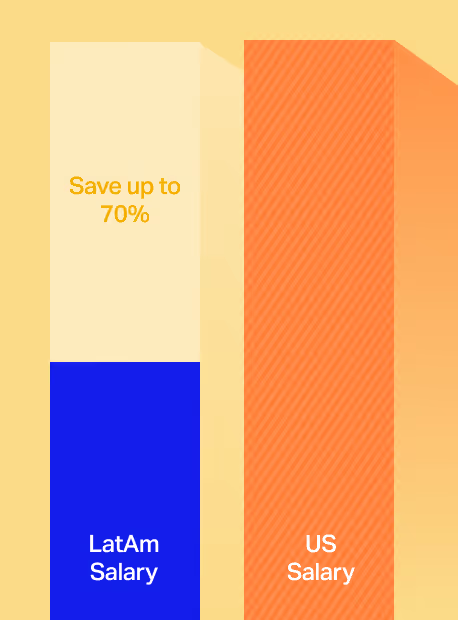
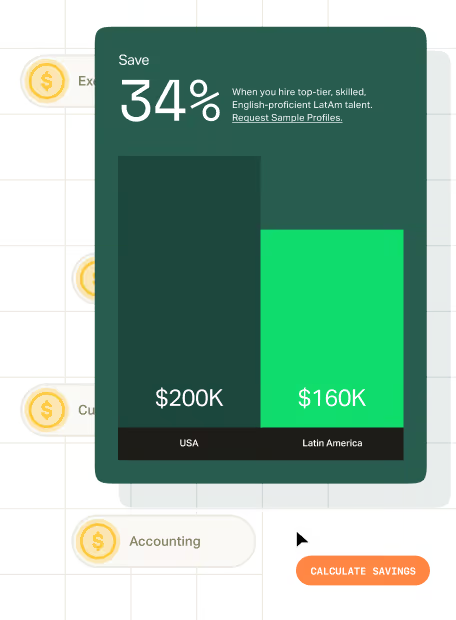
- The benefits of offshore accounting let your budget go further: Latin American accounting professionals typically cost 35–69% less than US equivalents, so the same hiring budget builds a larger, more capable finance team without the overhead of US-based hiring.
- Nearshore accounting in Latin America delivers those same cost savings while eliminating the biggest drawbacks of traditional offshore arrangements: time zone gaps, communication barriers, and compliance friction.
- Hiring dedicated, full-time Latin American accountants combines offshore cost advantages with the real-time collaboration and retention rates that outsourced accounting firms can't match.
Your Q3 close took five days longer than projected because three people were out. Your controller is handling work meant for two roles while screening candidates who ghost after the second interview. The delays are now affecting investor reporting, and you're burning budget on emergency contractor fees that never seem to stop.
Offshore accounting gives you a direct path out of this cycle. The benefits of offshore accounting include lower labor costs (typically 35–69% vs. US-based hires, as of 2026), access to experienced accounting professionals in deep talent markets, time zone-aligned collaboration when hiring in Latin America, and the ability to scale your team without adding US-equivalent overhead.
In this guide, I explain what offshore accounting involves, its real benefits, the challenges worth knowing about, how to build a working offshore accounting function, and why hiring finance and accounting professionals in Latin America has become the leading choice for US companies making this shift.
What Is Offshore Accounting?
Offshore accounting is the practice of delegating a company's accounting and financial functions to professionals located in another country. In practice, this works in one of two ways: You either contract a third-party firm that assigns their staff to your work, or you hire dedicated full-time professionals who work exclusively for your company but are based abroad.
In the firm model, you're buying a service. The provider manages their own staff, which gives you less visibility and control but can work for high-volume transactional tasks.
In the direct hire model, your offshore accountant works in your systems, follows your processes, and reports to your team. They work the same way a domestic hire would, just from a different country.
The accounting functions you choose to offshore can range from day-to-day bookkeeping and accounts payable to month-end close, financial reporting, tax preparation, and controller-level oversight. Essentially, any accounting work that doesn't require physical presence in your US office.
Offshoring vs. nearshoring accounting
Offshoring isn’t the only model. Nearshoring and offshoring are related strategies that US companies use to build out their finance functions without hiring domestically.
Traditional offshoring (India, the Philippines, Southeast Asia) puts your accounting team 10–13 hours away from your US office. That works for batch-processing tasks, but it creates friction for anything requiring same-day responses, client calls, or close-cycle collaboration.
Nearshoring solves that: By hiring in Latin America, US companies get the cost savings of offshore hiring with 0–3 hours of time zone difference, meaning your accountant works your hours.
The talent shortage makes both models more relevant than ever. According to Accounting Today, the number of candidates sitting for the CPA exam has fallen 27% over the past decade, and accounting graduates declined 17% between 2016 and 2022. For many US firms, offshoring and nearshoring are becoming the primary way to find qualified accounting talent.
Further reading: What Smart Companies in America Are Doing to Overcome the Accounting Talent Shortage
What Are the Benefits of Offshore Accounting?
Offshore accounting can reduce labor costs, provide access to specialized expertise, and enable companies to scale their accounting function without the delays and overhead of domestic hiring.
Here are the core benefits of offshore accounting:
Cost savings
The most direct benefit of offshore accounting is that the same hiring budget goes significantly further: You can build a more capable finance team without increasing headcount costs.
According to Near's 2026 State of LatAm Hiring Report, companies hiring accounting talent from Latin America typically save 35–69% compared to US-based equivalents.
At the role level, that translates to a mid-level accountant in Latin America typically earning $30,000–$42,000 per year, compared to $70,000–$114,000 for a US-based equivalent. A financial analyst generates savings ranging from $53,000 to $115,000 per year.
For more information on salaries in Latin America, visit our Latin America's Salary Guide.
Beyond salary, you reduce costs associated with office space, benefits overhead, and the extended timelines that domestic hiring creates. Every month a role sits open, your existing team carries the load.
Specialized expertise
Offshore accounting gives you access to professionals trained in US accounting standards, even when your local hiring market can't produce them fast enough. With only 124,000 new accounting and auditing job openings projected annually through 2032, according to the US Bureau of Labor Statistics, many replacing experienced professionals who are retiring, the domestic shortage isn’t temporary.
A finance manager at a PE-backed mid-market company described the pressure plainly: “I'm just finding that I need more skill sets than I'm being given the budget to fill.” Offshore accounting is the direct answer to that gap.
Across the financial analysts and accountants I've placed for US clients, the caliber of talent coming out of Latin America consistently surprises hiring managers who expected to make trade-offs on quality.
Latin American finance professionals have strong academic foundations, often from five- to six-year university programs, and many have Big Four experience with PwC, EY, or similar firms. That background gives them direct exposure to US GAAP and IFRS, which are among the most common requirements we see from clients.
Scalability
Offshore accounting lets you match your accounting capacity to your actual workload, without the 60-to-90-day hiring cycles that domestic recruiting typically requires.
FinanceWithin, a fractional finance services firm based in Austin, Texas, had tried scaling through offshore hiring in India before coming to Hire With Near and hit a wall: High turnover and inconsistent quality made it impossible to take on new client engagements with confidence.
After switching to Latin American talent, they were able to hire multiple bookkeepers within days to support 10 new client engagements simultaneously, saving $535,000 annually, a 64% reduction compared to US-based hires.
Their Director of Accounting, Sheena Malson, put it this way:
When we saw candidate quality, it became clear these were truly top-tier professionals, better than what we found independently.
That kind of scaling speed isn’t possible with domestic recruiting. Offshore hiring, done right, turns your accounting function into something elastic rather than a permanent bottleneck.
Enhanced efficiency
Offshore accounting teams typically work with modern accounting tools: QuickBooks, NetSuite, Xero, Sage, and the reporting layers built on top of them. This means you're not starting from zero on tool adoption.
One practical note from my experience sourcing these roles: QuickBooks-proficient talent is widely available across Latin America's accounting candidate pool, but NetSuite is harder to find because the certified talent pool is smaller. If your ERP is NetSuite, budget for a slightly longer search or plan to provide internal training. Either way, the professionals exist.
The efficiency gain goes beyond tools. Since Latin American professionals work in US time zones with just a 1–3 hour difference, month-end questions get answered the same day. Deadlines don't slip because of overnight handoffs. Your team can run real-time financial analysis and move from close to reporting without the lag that offshore arrangements in Asia typically introduce.
Financial insights and strategic analysis
Offshore accounting teams don't just maintain books and file compliance reports. Senior offshore accountants and financial analysts can deliver the same strategic analysis your US-based finance team would: variance analysis, cash flow modeling, budget-vs-actual reviews, and KPI reporting.
This is particularly valuable for companies that are growing into more sophisticated finance operations but aren't ready to justify a full US-based finance team. Offshore and nearshore models let you access analytical depth at a cost that makes sense for your stage.
Reduced administrative overhead
When you hire offshore accounting talent through a staffing partner, much of the administrative burden shifts off your plate: payroll processing, compliance with local labor laws, benefits administration, and international contracts are handled for you. That's a meaningful operational benefit for lean finance or HR teams.
Further reading: Top Countries to Hire Remote Offshore Accountants
{{state-latam-hiring}}
Potential Drawbacks of Offshore Accounting
Offshore accounting's five most common challenges are time zone gaps, communication barriers, data security exposure, onboarding complexity, and accounting standards alignment.
The good news: Most of these risks are substantially reduced when you hire nearshore talent from Latin America rather than traditional offshore providers in Asia.
Time zone differences
The biggest operational drawback of offshore accounting in Asia or Eastern Europe is the time zone gap. When your accounting team is 10–12 hours away, urgent month-end questions don't get answered until the next morning.
The owner of a US tax and accounting firm, who had previously used offshore staff in Asia, described this challenge directly when evaluating what role to hire next:
For this role, we really would love to have somebody in Latin America just because the time zone is much closer to ours. There's a lot of client interfacing. It's probably the most high-touch role with clients of any of the roles that we have. So, almost all that time would be needed in a similar time zone because, well, you'd have to be able to answer.
The fix is straightforward: hire from Latin America. With a 1–3 hour difference from most US time zones, your offshore accountant works your hours. No schedule adjustments, no overnight handoffs, no waiting until tomorrow for an answer.
Communication and language barriers
Language barriers affect the quality of accounting work in concrete ways: reports formatted to the wrong expectations, financial summaries that miss nuance, and rework cycles that erode the efficiency gains you were looking for.
Latin American accounting professionals generally have strong English fluency and are familiar with US business communication norms. Argentina, for example, ranks #26 globally on the 2025 EF English Proficiency Index and accounting and finance professionals in the country score above the global average.
They understand US professional expectations around deadlines, status updates, and client interactions, which is as important as technical skill for any role with an external-facing component.
Data security and compliance
Offshore accounting requires sharing sensitive financial data with external parties: general ledgers, payroll records, banking information, and, sometimes, shareholder or investor data. Worrying about data security is a legitimate concern, and it deserves specific mitigations, not just vague reassurances.
When vetting an offshore provider or staffing partner, ask specifically about:
- SOC 2 compliance or equivalent security certifications
- NDA requirements for all staff handling your data
- Data handling protocols: where data is stored, who has access, and how access is revoked when an engagement ends
- Breach notification procedures
If you're hiring a dedicated full-time professional rather than working with an outsourced firm, the data handling policies are largely determined by the tools you use (cloud accounting platforms with two-factor authentication, role-based access controls in your ERP) rather than the provider's infrastructure. The same security practices you'd apply to a remote US employee apply here.
Onboarding and knowledge transfer
Offshore accountants need time to learn how your company operates: your chart of accounts, your close process, your industry-specific revenue recognition policies, and the quirks in your current bookkeeping that your outgoing accountant has been managing by institutional memory.
This isn’t unique to offshore hiring. Any new accounting hire requires onboarding. But it's worth flagging because some companies wrongly assume offshore hires can be productive on day one with minimal orientation.
The mitigation is documentation. Before your offshore accountant's first day, have process maps ready for your monthly close, written explanations of any non-standard accounting treatments, and a clear 30-60-90 day plan that defines what “up to speed” looks like.
Companies that build this documentation for an offshore hire often end up with better internal processes as a side effect, because they've had to write down things that were previously tribal knowledge.
Further reading: Key considerations for effective offshore bookkeeping
Managing across different accounting standards
For tax-specific roles, US tax law fluency is another challenge. US individual and business tax codes are specific, regularly updated, and not something accountants from non-US markets automatically know.
The mitigation for this challenge is Latin American hiring specifically, rather than offshore hiring generally. Across the accounting candidates I've sourced in my five years placing finance talent at Hire With Near, Argentina stands out: Approximately 80% of the candidates I place are based there, partly because of the country's five- to six-year university degree programs and strong public university system.
Many Argentine accounting graduates have worked with US clients through international firms and have direct familiarity with US GAAP. Big Four exposure on a resume (PwC, EY, Deloitte, KPMG) is one of the strongest signals for tax accountants and financial analysts, because it means they've been trained on the standards clients are looking for.
This doesn't mean every offshore hire will arrive with complete US tax law knowledge. It means the talent pool you're drawing from in Latin America skews meaningfully toward professionals who understand how to work to US standards, which reduces the ramp-up time significantly.
How to Build and Manage an Offshore Accounting Team
You've decided offshore accounting is the right move. Now the question is how to structure it.
The most important structural decision is choosing between a dedicated full-time hire and an outsourced accounting firm. For most growing companies, the dedicated hire delivers better quality, faster response times, and lower long-term costs. Here’s how to build it:
Dedicated hire or outsourced firm?
The first choice is structural: Do you want a dedicated full-time professional who works exclusively for your company, or do you want an outsourced accounting firm that pools staff across multiple clients?
Outsourced accounting firms offer convenience: You pay a monthly fee and someone else manages the staff. But that initial practicality comes with slower response times, less control over which staff member handles your books, and institutional knowledge that resets every time the firm rotates staff.
Several clients who came to Hire With Near after trying outsourced models described the same experience: The firm would put a lot of burden back on them, asking for information and context that the client expected the firm to already know.
On the other hand, a dedicated hire works for you exclusively. They learn your business, your ERP, your close schedule, and your reporting expectations, and they're available when you need them.
If you have more than 20–30 accounting transactions per month or investor reporting requirements, a dedicated professional is more cost-effective than the per-hour billing of an outsourced arrangement, and typically produces better work.
How to structure your offshore accounting function
The right starting point depends on where you are operationally:
- If you need accurate books and haven't yet systematized your close process: Start with a bookkeeper. A strong offshore bookkeeper based in Latin America can handle daily transaction recording, bank reconciliations, and basic financial statement preparation for $22,000–$40,000 per year, compared to $46,000–$74,000 for a US equivalent.
- If you have a bookkeeper and need more analytical capacity: The next hire is typically a staff accountant or general accountant who can own your close process end-to-end, prepare management reports, and handle more complex reconciliations. When you decide to hire an accountant in Latin America for this role, look for candidates with ERP experience that matches your stack and at least two years of close-cycle ownership.
See our guide on how to hire offshore bookkeeping talent for a full sourcing and vetting walkthrough.
- If you're preparing for an audit, raising capital, or managing multi-entity structures: You need a controller. Latin American controllers with US GAAP experience typically earn $42,000–$90,000 per year, compared to $110,000–$230,000 for a US-based equivalent. For senior finance and accounting leadership at the director or C-suite level, executive search for finance and accounting leaders is available through Hire With Near as well.
{{salary-guide-cta}}
Onboarding an offshore accountant: the first 90 days
The first 30 days are about access and orientation: ERP logins, accounting software access, introduction to your close calendar, and a walkthrough of any non-standard accounting treatments or historical cleanup issues. Schedule at least two live video calls in the first week. Don't make onboarding async.
Days 30–60 are about supervised close cycles. Let your new hire run the first close with your oversight. You'll catch anything that needs adjustment before it becomes a pattern, and they'll ask the right questions once they've worked through the process once.
By day 60–90, a strong offshore accountant should be running the close independently and flagging issues proactively. If you built your process documentation in step one, this transition happens faster.
One client who hired three accountants and an operations manager through Hire With Near was initially skeptical about whether LatAm professionals could match the responsiveness and quality of his previous US hires.
In my experience, that skepticism usually dissolves after the first close cycle. He described being surprised by their performance, their responsiveness, and that they were hitting all their targets and receiving great feedback from his clients. Now he's expanding the team.
Tools and tech stack
For bookkeeping and accounting, QuickBooks Online is the most common US accounting platform, and talent proficient in QuickBooks is abundant in Latin America. Xero is also widely known. If your company runs on NetSuite, know that the certified talent pool is smaller, so plan accordingly.
For communication: Slack, Google Meet, or Microsoft Teams. Set core collaboration hours explicitly so your offshore team knows when you expect same-day responses. Asynchronous handoffs work well for routine tasks, but reserve real-time communication for close cycles, urgent issues, and weekly syncs.
For project management and close coordination: Tools like Asana, Monday.com, or even a shared Google Sheet close checklist work well for tracking deliverables and flagging blockers before they become delays.
Integrating offshore accountants into your team
Treat your offshore accountant the same way you'd treat any remote member of your US team: Include them in the Monday kickoff, loop them into the Slack channels where finance topics surface, and introduce them to the department heads who submit expenses or request reports.
The companies that get the most out of offshore accounting are the ones that treat their offshore hire as an embedded team member, not a service vendor. That distinction affects how information flows, how proactively your accountant flags issues, and how much institutional knowledge they build over time.
Hire With Near's nearshore staffing model is specifically designed to produce this kind of integration: dedicated, full-time professionals who work your hours, report to your management, and operate as a genuine extension of your team rather than an external contractor.
Why Latin America Beats Asia for Offshore Accounting
Latin America outperforms Asia for offshore accounting because of real-time time zone overlap (0–3 hours difference vs. 10–13.5 hours), strong English proficiency, and deep US GAAP familiarity, delivering 35–69% cost savings without the scheduling friction and communication delays that offshore teams in Asia create.
For example, the cost of hiring a full-time accountant in Latin America ranges from $24,000 to $60,000 annually, compared to $65,000 to $139,000 for a US-based accountant. That's cost savings that rival Asian markets, without the operational drawbacks.
Here's why Latin America outperforms traditional offshore locations:
- Real-time collaboration instead of delays: Latin America operates in US time zones (0–3 hour difference maximum), while Asia requires overnight handoffs. Some US firms do use bookkeeping services in the Philippines successfully for batch-style, async work, but for roles that require same-day responses and client interaction, the time zone gap becomes a structural problem. Stull CPA switched from Asian offshore hires to Latin American accountants specifically to eliminate time zone delays that were causing costly errors and slow turnaround times during tax season. Their Operations Manager, Gisela Piñeiro, described the difference: “With other outsourcing companies, we lost clients because of mistakes and delays. With Hire With Near, we gained confidence.”
- Cultural alignment with US business practices: Latin American professionals understand US business culture, communication styles, and work expectations. Offshore teams in Asia often require extensive training on US business norms and may approach deadlines, feedback, and problem-solving differently.
- Strong English proficiency for client-facing roles: Latin American professionals typically have stronger conversational English and understand US professional communication norms, reducing miscommunication in financial reporting and client interactions.
- US GAAP familiarity from the ground up: In my experience sourcing finance talent across Latin America, where roughly 80% of the candidates I place are based in Argentina, the accounting education system produces graduates who are deeply trained in international standards. Latin American finance professionals have strong academic foundations and significant exposure to Big Four firms. That gives them direct experience with international markets and fluency in key accounting standards like US GAAP and IFRS. Asian accountants more commonly specialize in their local frameworks, requiring additional training.
- Direct team integration with no scheduling workarounds: With overlapping work hours, Latin American accountants can join your daily standups, respond to urgent month-end questions in real time, and participate fully as team members. CyberFortress built an entire accounting team in Latin America and reduced their month-end close timeline by 33%, a result that depends entirely on real-time communication capacity. That's not achievable with Asian offshore teams.
- Easier travel and in-person meetings: Much of Latin America is 3–10 hours by flight from major US cities, making in-person training, team meetings, or relationship-building far more practical than traveling to Asia.
The bottom line: If you're exploring offshore accounting to reduce costs, Latin America delivers the same financial benefits as Asia with operational advantages that make your accounting function work better.
For a detailed breakdown, see our comparison of offshoring accounting to India vs. Latin America.
Hire With Near's research on why US companies hire in Latin America found that 30% of companies that come to us are specifically switching from offshore providers in India or the Philippines, with time zone misalignment cited as the primary reason.
An accounting recruitment partner that specializes in Latin America, like Hire With Near, handles the complexities of international hiring: sourcing, vetting, payroll, compliance, and benefits administration, so you get access to this talent without taking on the administrative burden yourself.
Examples of Offshore Accounting Services
Offshore accounting services cover the full range of financial operations: bookkeeping, accounts receivable and payable, payroll processing, tax compliance, and financial reporting, all of which can be staffed by dedicated Latin American professionals at 35–69% less than US market rates.
Bookkeeping services
Bookkeeping is the foundation of a solid financial management system. When you hire an offshore bookkeeper, they typically handle:
- Maintaining accurate records of daily financial transactions
- Managing ledgers
- Reconciling bank accounts
- Preparing initial financial statements
Offshoring these tasks keeps your recordkeeping consistent and accurate, which is important for informed decision-making and compliance.
Further reading: Comprehensive Guide to Hiring a Great Bookkeeper
Accounts receivable and payable services
Managing accounts receivable and payable is vital for maintaining healthy cash flow. Offshore services in this area help businesses manage income and expenditures by handling:
- Invoicing
- Tracking payments owed by customers
- Processing incoming payments
- Handling vendor bills
- Making timely payments
- Managing cash
Hiring a top accounts receivable specialist or accounts payable specialist helps you keep cash flow from stalling and maintain good relationships with suppliers and customers.
Further reading: Where to Hire Offshore Accounts Receivable Talent?
Payroll services
Payroll processing is complex and time-consuming, involving calculating pay, deductions, and complying with local tax laws. Offshore payroll services handle this process so employees are paid accurately and on time while filings and financial records stay compliant.
Further reading: Where To Hire Offshore Payroll Managers: The 7 Best Countries
Tax planning and compliance services
With constantly evolving tax regulations, compliance is difficult for lean in-house teams to maintain. Offshore tax planning and compliance services involve:
- Strategic planning to minimize tax liabilities
- Compliance with local and international tax laws
- Preparing and filing tax returns
Offshoring these tasks gives you access to tax accountant expertise in navigating tax codes and protects your company against liabilities and penalties.
Financial reporting and analysis
An experienced offshore financial analyst can perform in-depth analysis and surface insights into financial trends, performance metrics, and opportunities for cost reduction and growth. This level of financial intelligence supports strategic planning and helps leadership make informed decisions.
For companies that want finance recruitment services at the analyst and FP&A level specifically, Hire With Near's finance industry practice covers this.
Further reading: Time to Hire a Financial Analyst? Here's What You Need to Know
Where Can You Find Offshore Accounting Services?
Finding the right offshore accounting partner means evaluating specialized platforms, general freelance marketplaces, and staffing agencies based on whether you need ongoing dedicated support or project-based work.
Online outsourcing platforms
Freelance marketplaces are a common starting point for companies exploring offshore accounting. They offer quick access to a wide range of profiles and flexible engagement terms, which works well for one-off projects or short-term needs.
The tradeoff is consistency: You're often working with a different person each time, and institutional knowledge doesn't carry over between engagements.
Specialized accounting platforms
Specialized platforms focus exclusively on accounting and finance talent, which means deeper vetting for role-specific credentials like US GAAP familiarity, CPA qualifications, and experience with common accounting software. They're a better fit if you need someone who can own a function, not just complete a task.
For a detailed comparison of third-party outsourcing providers across all three categories, see our guide to finance and accounting outsourcing providers.
Staffing and recruitment agencies
Staffing and recruitment agencies give you access to pre-vetted candidates and handle much of the sourcing and screening work. Agencies that specialize in Latin American talent, like Hire With Near, also manage payroll, compliance, and benefits administration, so you're not navigating international employment law on your own.
For bookkeeper-specific options, see the best bookkeeping outsourcing services and our list of the best staffing firms for hiring bookkeepers in Latin America.
{{prevetted-banner}}
Final Thoughts
If you've read this far, you're probably past the “should I do this?” question and closer to “how do I do this right?” The short answer: choose Latin America, choose a direct hire model, and choose a recruiting partner who specializes in the region.
The cost savings are real: 35–69% less than US-based hires across finance and accounting roles. The benefits of offshore accounting go beyond the salary gap. Companies build accounting functions that really work with professionals who show up during US business hours, own their scope, and integrate into the team like any other hire.
Stull CPA eliminated the turnaround delays and communication errors they experienced with Asian offshore hires after switching to LatAm accountants. CyberFortress saved over $1.2 million annually and cut their month-end close by 33%. FinanceWithin reduced time-to-hire from three weeks to seven days and saved $535,000 annually.
Schedule a free, no-commitment consultation call today to understand how Hire With Near can help you hire top finance and accounting professionals. We'll give you salary benchmarks for the roles you need to fill and explain our process and fees.
Frequently Asked Questions
What is offshore accounting?
Offshore accounting is the practice of managing a company's financial functions through professionals or firms located in another country, typically to reduce costs, access specialized expertise, and scale accounting capacity without adding US-equivalent overhead. Companies can hire dedicated full-time offshore professionals or work with outsourced accounting firms.
What are the biggest challenges of offshore accounting?
The most common challenges are time zone gaps that slow down real-time decision-making, communication and language barriers that affect report quality, and data security concerns when sharing sensitive financial information with external parties.
Additional challenges include onboarding new hires to your specific processes, making sure candidates have US GAAP and tax law familiarity, and managing knowledge transfer.
Most of these risks are substantially reduced by hiring nearshore talent in Latin America rather than traditional offshore providers in Asia.
How is nearshore accounting different from offshore accounting?
Nearshore accounting refers specifically to hiring accounting professionals in geographically close, time-zone-aligned markets. For US companies, that means Latin America.
Offshore accounting is a broader term that includes any cross-border accounting arrangement, including providers in Asia, Eastern Europe, and elsewhere.
The practical difference in the offshore vs. nearshore accounting debate: Nearshore professionals in Latin America work overlapping US business hours (0–3 hour difference), while offshore teams in India or the Philippines are typically 10–13.5 hours away.
That time zone gap creates delays in communication, slower turnaround on urgent questions, and coordination overhead that compounds on time-sensitive functions like month-end close and tax season. Nearshoring removes those friction points while delivering comparable cost savings.
What other finance and accounting roles can I hire in Latin America?
Beyond general accountants and bookkeepers, US companies hire a wide range of finance and accounting roles in Latin America. The most common: controllers to manage close cycles and multi-entity reporting, financial analysts for FP&A and modeling, tax accountants for US tax compliance, payroll specialists for processing and compliance, and CFOs or finance managers for strategic leadership.
All of these roles have deep talent pools in Latin America with US GAAP exposure and competitive compensation compared to US equivalents.
Can offshore accountants handle US-specific tax work and GAAP reporting?
Yes, Latin American accountants with Big Four experience or formal training in international accounting standards can handle US GAAP reporting and, for many roles, US tax work.
The talent pool varies by specialization: general accounting and FP&A candidates are widely available with strong US GAAP familiarity. Tax-specific work (individual tax returns, complex business tax strategies) requires more targeted sourcing for candidates with direct US tax experience.
In our experience working with US accounting firms, the candidates who perform best on US tax work tend to have prior experience with US clients or firms, which we specifically screen for.
What is the typical time to hire an offshore accountant?
Through Hire With Near, most accounting roles are filled in under three weeks from job description to accepted offer. FinanceWithin reduced their time-to-hire from three weeks to seven days by switching from internal LinkedIn recruiting to Hire With Near's pre-vetted candidate pipeline.
The timeline depends on how specific your technical requirements are: QuickBooks roles fill fastest, while NetSuite-specific roles may take longer due to a smaller certified talent pool.
How much does it cost to hire an offshore accountant?
Hiring an offshore accountant in Latin America typically costs $24,000–$60,000 per year, depending on seniority, compared to $65,000–$139,000 for a US-based equivalent, a savings of 49–71%. A mid-level accountant runs $30,000–$42,000 annually. Controllers range from $42,000–$90,000 in LatAm vs. $110,000–$230,000 in the US. Costs vary by role, seniority level, and country.
How much does outsourced bookkeeping cost?
Outsourced bookkeeping in Latin America typically runs $22,000–$40,000 per year for a dedicated full-time bookkeeper, compared to $46,000–$74,000 for a US-based equivalent, savings of 19–57% depending on seniority.
For a full breakdown of outsourced bookkeeping costs across engagement models, see our outsourced bookkeeping cost guide.







.webp)


%203.svg)
.avif)





%20(1).avif)

%20(1).png)