


%203.svg)
Key Takeaways
- Hiring an offshore bookkeeper in Latin America saves up to 69% vs. a US-based equivalent.
- Latin American bookkeepers typically earn $2,500–$3,000/month at the mid level.
- Latin America offers near-full US time zone overlap, making it the top offshore region for client-facing accounting roles that require real-time responsiveness.
- Many Latin American bookkeepers hold five- or six-year accounting degrees and work with US GAAP and QuickBooks daily. The credential gap most US hiring managers expect simply isn't there.
If you're spending more time managing your books than running your business, or paying a US bookkeeper $60,000+ a year for work that doesn't require a US-based hire, offshore bookkeeping is worth a serious look.
The benefits of offshore bookkeeping go beyond cost, but the economic argument alone is compelling. Typically, you can hire a qualified full-time bookkeeper in Latin America for what you'd pay for a part-time in-house hire in the US.
This guide covers the pros and cons, as well as a decision framework for whether it makes sense for you. You’ll also learn why hiring a bookkeeper in Latin America specifically outperforms other offshore regions, the average salary data, and where to find the right candidate.
What Is an Offshore Bookkeeper?
An offshore bookkeeper is a remote professional who handles a company's bookkeeping tasks while being based in a different country. They can perform the same responsibilities as an internal bookkeeper, including recording transactions, preparing financial statements, and managing accounts payable and receivable. But they don’t require the overhead of an in-house worker.
It's important not to confuse offshore bookkeeping with the more general practice of bookkeeping outsourcing. While both involve delegating bookkeeping to a third party outside your organization, offshore bookkeeping specifically refers to hiring a bookkeeper based outside your country.
Advantages of Hiring Offshore Bookkeepers
Offshore bookkeeping offers three core benefits:
- Lower cost
- Easier scaling
- Access to a larger talent pool
Here's how each plays out in practice.
Cost-effectiveness
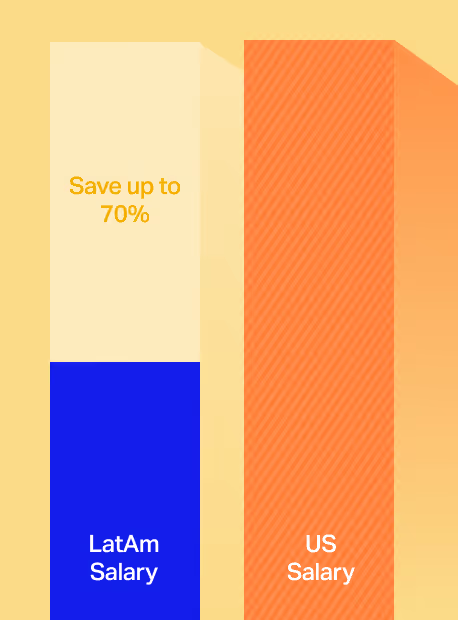
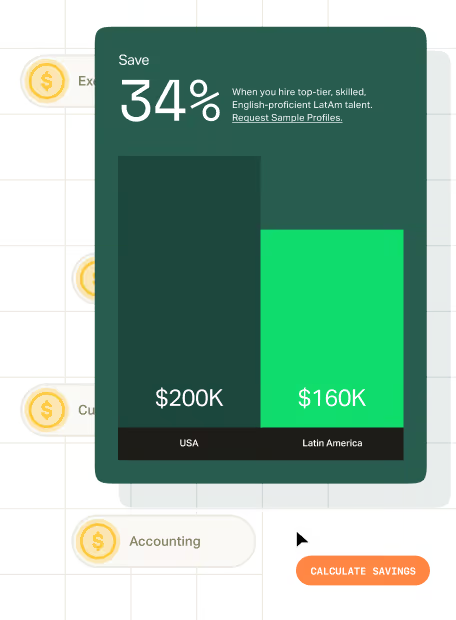
Hiring offshore bookkeeping talent lets your budget go significantly further than US-based hiring, and the gap is wider than most business owners expect. According to compensation benchmarks, the average annual salary of a bookkeeper based in Latin America is roughly $28,800/year, compared to $66,500/year for a US equivalent.
Depending on seniority, you can save anywhere from 55% to 69% versus a US hire, and most companies see a 57% average reduction.
In addition to the salary, you can avoid overhead costs like office space, equipment, and bookkeeping software licenses that typically come with an in-house employee.
Scaling opportunities
Offshore bookkeeping is more flexible than internal positions, especially when your workload fluctuates. You can start with one bookkeeper to handle daily transactions and AP/AR, then add capacity as your client base or transaction volume grows.
This is especially valuable for accounting firms, fractional CFO practices, and e-commerce businesses with seasonal spikes or categories where demand can double or triple at certain points in the year.
Access to specialized talent
Hiring offshore gives you access to a larger talent pool, including professionals with specific software expertise (QuickBooks, Xero, NetSuite) or industry-specific knowledge like real estate accounting or e-commerce inventory reconciliation. In regions like Latin America, you'll often find bookkeepers with credentials well above what the role title suggests. (We’ll share more on that below.)
Disadvantages of Hiring Offshore Bookkeepers
Offshore bookkeeping has real tradeoffs, but understanding them helps you set the right expectations before hiring. Here are some of the more common challenges that come with the practice.
Communication barriers
Differences in culture and language can sometimes lead to misunderstandings or delays. However, this risk varies significantly by region.
Latin American professionals generally have strong English proficiency and share closer cultural norms with US businesses than bookkeepers in more distant offshore markets. The bigger communication variable happens to be the lack of time zone overlap, which we cover in more detail later.
Less direct control over finances
Remote bookkeepers are harder to monitor and manage closely compared to in-house staff. This is manageable with the right systems, which often require more intentional setup than an in-house hire.
Today, it’s common to use shared access to cloud accounting software, defined deliverable schedules, and regular check-ins to maintain expectations.
Information security
Offshore bookkeeping means sharing sensitive financial data with someone outside your organization. Because accounting information has a higher privacy standard than some other types of data, you should work only with professionals who understand data security protocols and use encrypted file transfers. Always operate under a clear confidentiality agreement.
When hiring through a recruiting partner, vet their screening process for security awareness as part of your selection criteria.
Once you understand the tradeoffs, the next step is deciding when offshore bookkeeping actually makes sense for your business.
When Should You Hire an Offshore Bookkeeper?
Offshore bookkeeping makes financial sense in four specific situations. Here is a decision framework for evaluating why you should hire an offshore bookkeeper and whether your business is ready.
- Your in-house team is understaffed
When transaction volume grows faster than your team's capacity, bookkeeping backlogs build up quickly. Payroll preparation, accounts payable, and reconciliations don’t wait. Hiring an offshore bookkeeper to absorb this routine workload gives your in-house staff room to focus on higher-value work.
One co-founder at a fractional CFO and bookkeeping firm described the pressure this creates and how the company is considering offshoring to ease it: "We've got advanced finance graduates who want to do more finance work. The bookkeeping work is less exciting for our team, and so we're trying to find the right mix, the right fit to see if there's a group or a team overseas that will be able to help us execute on that."
- US accounting talent is hard to find
The talent gap isn’t anecdotal. According to Accounting Today, the number of candidates sitting for the CPA exam has fallen 27% over the past decade, and between 2016 and 2022, accounting graduates declined by 17%. As a result, hiring a bookkeeper in the US is taking longer and costing more, even for junior roles.
Offshore bookkeeping gives you access to a talent pool that isn't constrained by the same structural shortage.
- You’re overusing senior talent on basic tasks
This trigger is common in accounting and fractional finance firms. If your CPAs or senior finance staff are spending time on transactional bookkeeping that doesn't require their credentials, you're wasting capacity and paying for it.
Offshore bookkeepers can take on the day-to-day work so your senior team can stay focused on advisory work, tax strategy, or client relationships.
- You need support for a specific period or project
Offshore bookkeepers work well for project-based engagements. They can do a cleanup of historical records, year-end reconciliation, migration to a new accounting platform, or coverage for a leave vacancy. You can then pay for what you need without the long-term overhead of an in-house hire.
How Much Does an Offshore Bookkeeper Cost?
Hiring a bookkeeper in Latin America costs up to 57% less than a US equivalent, depending on seniority. According to Hire With Near's 2026 State of LatAm Hiring Report, companies hiring bookkeepers in Latin America save an average of $27,000 to $66,400 per year compared to US-based hires.
Below is a breakdown by seniority level:
*Compensation benchmarks for bookkeeper roles in Latin America. Figures in USD. Savings vary by seniority level and specific market.*
For more benchmarks across accounting and finance roles, see the full Latin America salary guide and the accounting roles salary guide.
What Industries Benefit Most from Offshore Bookkeeping?
Most industries that rely on accurate, ongoing financial record-keeping can benefit from offshore bookkeeping, but a few sectors see especially high returns.
Accounting and CPA firms are among the heaviest users of offshore bookkeeping talent. Firms dealing with client volume, especially during tax season, use LatAm bookkeepers to handle data entry, reconciliations, and client account management. This frees senior CPAs for higher-value advisory work.
E-commerce companies often have high transaction volumes, multi-channel inventory reconciliation, and month-end close processes that require dedicated bookkeeping capacity. A Nevada-based health and beauty supplement company hired a QuickBooks-experienced bookkeeper in Latin America through Hire With Near, saving $26,000 per year and hiring 5x faster than through traditional recruitment channels.
Real estate businesses manage recurring transactions across multiple properties or funds, including rent collections, maintenance expense tracking, and investor reporting. These day-to-day duties are well-suited for a dedicated offshore bookkeeper.
Fractional CFO and bookkeeping firms often scale their client portfolio faster than they can hire locally. FinanceWithin, a fractional finance services firm in Austin, Texas, needed to onboard 10 new client engagements simultaneously. After previous offshore hiring in India produced turnover and inconsistent quality, they switched to nearshore bookkeepers and accounting managers in Latin America through Hire With Near.
The change resulted in $535,000 in annual savings (a 64% reduction vs. US-based hires), and they cut time-to-hire from three weeks to seven days.
As Sheena Malson, their Director of Accounting, put it: "When we saw candidate quality, it became clear these were truly top-tier professionals — better than what we were finding on our own."
Professional services and SaaS companies with lean finance teams often delay proper bookkeeping until it becomes a problem. An offshore bookkeeper can establish a reliable monthly close process without the overhead of a full-time US hire.
If any of these profiles match your situation, find a pre-vetted bookkeeper in Latin America and see available candidates.
Why Latin America Stands Out for Hiring Offshore Bookkeepers
Not all offshore markets are equal for bookkeeping, and Latin America has a set of advantages that other regions don't offer. Here's what consistently comes up when working with US accounting firms and finance leaders.
Time zone alignment
Time zone alignment is often the deciding factor for bookkeeping work. Bookkeepers who handle accounts payable, payroll, and client-facing financial questions need to be reachable during your business hours, not working overnight on the other side of the world.
An owner of a remote accounting and bookkeeping firm serving 80+ US clients explained it this way:
I think for the long term, I’d rather have somebody in our time zone. That’s the biggest issue is just the time, because they’re working right now… it’s midnight. So they’re going to work till five, six in the morning. And I think long term, it’s hard for somebody to do that.
Latin America solves this problem. Argentina typically runs one to two hours ahead of the US East Coast, depending on daylight saving time, while many parts of Mexico align closely with US Central Time, and Colombia matches US Eastern Standard Time and stays within one hour of the East Coast year-round. For a small tax and accounting firm with hundreds of clients who may call during filing deadlines, that near-full overlap with US business hours is a practical requirement for excellent service delivery.
Education and credentials
This is where most US clients are genuinely surprised. In my five years sourcing finance and consulting talent at Hire With Near, the credential level of Latin American bookkeepers consistently exceeds what clients expect at this price point.
For example, across the Latin American finance market, roughly 80% of the candidates I place are based in Argentina. To earn a university degree in accounting in Argentina, candidates study for five or six years, a more rigorous credential than the US equivalent at the bookkeeper level. That educational depth shows up in how they handle complex reconciliations, multi-entity accounts, and client interactions.
Many LatAm bookkeepers are also CPAs, a higher credential than many clients expect at this level. Hire With Near's 2026 State of LatAm Hiring Report found that 84% of LatAm placements through Hire With Near were mid-level or senior, which directly counters the assumption that offshore bookkeeping means junior-level talent.
GAAP and US software familiarity
Latin American finance professionals have strong academic training and a lot of exposure to Big Four firms. That gives them experience with international markets and makes them very well versed in key accounting standards like US GAAP and IFRS. These two standards, specifically, are among the most common requirements we see from clients looking to hire bookkeepers and accountants.
Most also have hands-on experience with QuickBooks, Xero, and other US-standard accounting platforms from working with US-based clients or employers prior to joining Hire With Near's network.
English proficiency
English fluency is standard among the Latin American finance professionals in Hire With Near's candidate pool, particularly in Argentina, Colombia, and Mexico. For client-facing bookkeeping roles, where the professional is communicating directly with your clients or your clients' vendors, this matters.
How To Select the Right Offshore Bookkeeper
Five criteria consistently separate strong offshore bookkeeper hires from poor ones. Here is what to evaluate.
Screen for US-company experience first
When I'm reviewing candidates for bookkeeper roles, the first thing I ask is whether they have experience working with US-based companies. That context tells you a lot about their familiarity with US accounting practices, client communication norms, and software tools.
Candidates with this background shorten ramp-up time significantly.
Prioritize multi-client experience
Multi-client experience is the single clearest differentiator I look for when screening bookkeepers. Candidates who've managed multiple client relationships simultaneously know how to communicate clearly with different stakeholders, handle volume complexity, and work independently without needing constant direction.
This is especially relevant for accounting firms and fractional CFO practices where one bookkeeper will be managing several client accounts.
Verify tool and platform fluency
The bookkeeper should demonstrate hands-on experience with the specific platforms you use: QuickBooks, Xero, NetSuite, FreshBooks, or others. Ask for specifics when seeking talent, such as “I've managed month-end close for 12 QuickBooks clients, including full AR/AP reconciliation”, instead of just "I know QuickBooks".
Vague answers here are a red flag.
Check references and prior client communication samples
Ask for references you can actually contact, and specifically ask about reliability and communication quality. For client-facing roles, request a sample of written communication to clients or stakeholders. This tells you far more than a skills test.
Assess data security awareness
Your bookkeeper will have access to sensitive financial data. In your screening process, ask how they handle confidential information, what tools they use for secure file transfer, and whether they've signed NDA agreements with prior clients. The right candidate won't hesitate to answer in detail.
Where Can You Find Offshore Bookkeepers?
Three sourcing channels work for offshore bookkeeping: open freelance platforms, professional referrals, and nearshore recruiting partners. Each has a different risk profile. Here is what to know before choosing.
Online platforms
Platforms like Upwork, Freelancer, and Fiverr give you access to a large pool of bookkeepers at various price points. The tradeoff here is that you're responsible for all screening, and the quality bar varies widely.
Inflated resumes and candidates who are working part-time for multiple employers are common problems on open platforms.
You can also source candidates directly through LinkedIn, though this requires time and a clear screening process.
Referrals from your personal network
Recommendations from trusted peers who have used offshore bookkeeping services remain one of the highest-quality sourcing methods. A referred candidate comes with a track record you can verify and a real performance reference, not just a self-reported resume.
A nearshore recruiting partner
Working with a firm that specializes in sourcing and vetting LatAm finance talent removes most of the risk from the search. For example, Hire With Near provides access to a pool of over 160,000 pre-screened professionals in LatAm, with candidates screened for English proficiency, accounting credentials, US software experience, and communication quality.
Final Thoughts
Offshore bookkeeping delivers real, measurable advantages, such as lower costs, a broader talent pool, and, in Latin America specifically, the time zone alignment that makes collaboration with US clients and teams practical.
The key is knowing what to look for and where to find it.
Whether you run an accounting firm or a growing business that needs dedicated bookkeeping support, LatAm has the talent to match what you need at a fraction of US rates.
Hire With Near serves accounting firms and finance teams across the US, with a typical time-to-hire of under three weeks.
To hire a pre-vetted bookkeeper in Latin America, you can start with a free consultation to describe what you need and get matched with pre-screened candidates within days.
Book a free consultation call to get started.
Frequently Asked Questions
What are the pros and cons of offshore bookkeeping?
Offshore bookkeeping’s biggest advantage is cost: you can often hire a qualified bookkeeper in Latin America for a little more than half of what a comparable US-based professional would cost, while still getting strong credentials and relevant experience.
The tradeoffs include potential communication or cultural gaps and the need to manage data security carefully, but these are manageable when you hire in regions with good English proficiency and set clear processes from the start.
How much does an offshore bookkeeper cost?
A mid-level bookkeeper based in Latin America typically earns $2,500–$3,000/month, compared to $3,900–$6,000/month for a US equivalent at the same level. Industry compensation data shows savings of 55% or more, depending on seniority.
Are offshore bookkeepers GAAP-trained?
Latin American bookkeepers are commonly trained in US GAAP and IFRS, particularly those who have worked with US-based clients or multinationals. Finance professionals in the region have strong academic training and exposure to Big Four firms, which makes US accounting standards part of their standard preparation.
In Argentina, accounting degrees require five or six years of study, and many bookkeepers at this level have credentials equivalent to or exceeding the US CPA designation.
Which countries have the best offshore bookkeeping talent?
Latin America, particularly Argentina, Colombia, and Mexico, consistently produces strong bookkeeping and accounting talent for US companies.
Argentina stands out for academic rigor: the country's accounting degree programs require five or six years, and the talent pool includes many professionals with Big Four exposure. Colombia and Mexico offer strong English proficiency and near-full US time zone overlap.
Can an offshore bookkeeper work in my time zone?
Yes. Bookkeepers based in Latin America can work standard US business hours without needing overnight shifts. That makes it easier to collaborate in real time, get same-day responses to urgent questions, and keep critical processes like month-end close or tax season filings on track.
How do I protect sensitive financial data when working with an offshore bookkeeper?
Data security with an offshore bookkeeper requires the same protections you'd use with any remote finance hire.
Recommendations include a signed NDA and confidentiality agreement, encrypted file sharing (not email attachments for sensitive documents), and role-based access permissions in your accounting software so the bookkeeper only sees what they need.
Schedule a regular access audit as part of your onboarding process.
What software should an offshore bookkeeper know?
QuickBooks, whether online or through the desktop version, is the most common requirement. You should also look for experience with Xero, NetSuite, or FreshBooks, depending on which platform you use.
For e-commerce clients, familiarity with integrations like A2X, Shopify, or Amazon Seller Central is valuable.
What other finance and accounting roles can I hire from Latin America?
Beyond accountants, Latin America offers strong talent across the entire finance and accounting function. Companies commonly hire bookkeepers to handle day-to-day transaction recording and reconciliations, controllers to oversee accounting operations and financial reporting, staff accountants for month-end close and general ledger maintenance, and tax accountants who understand both local and US tax regulations.
Many professionals in these roles have experience with US companies and are already familiar with tools like QuickBooks, NetSuite, and other accounting software systems.
What types of businesses benefit most from hiring an offshore bookkeeper?
Businesses with ongoing, dedicated bookkeeping needs get the most value from an offshore hire. Accounting and CPA firms use LatAm bookkeepers to scale client capacity without adding US overhead. Finance teams at growing companies use them to maintain accurate books as transaction volume grows.
Real estate firms rely on bookkeepers for property-level accounting and investor reporting. Fintech companies and SaaS businesses with lean finance teams use them to establish reliable monthly close processes without the cost of a full-time US hire.
Anywhere you have a volume of recurring financial transactions, a dedicated bookkeeper in LatAm is a cost-effective solution.






.webp)
.webp)


%203.svg)
.avif)





%20(1).avif)

%20(1).png)