


%203.svg)
Key Takeaways
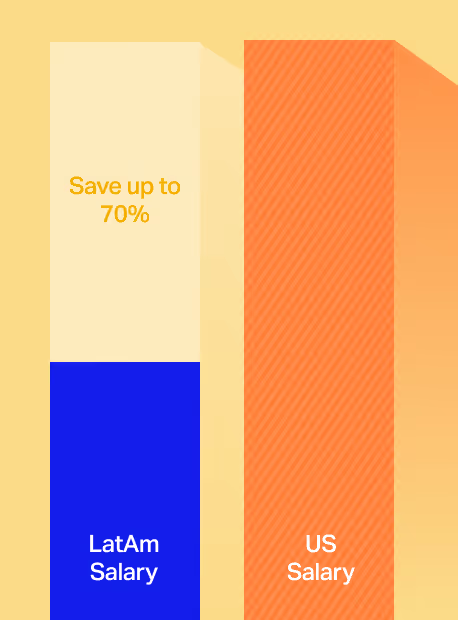
- For US companies, time zone is the single most important variable in offshore bookkeeping. The 11–14 hour gap to Asia creates real operational friction in month-end close, client communication, and error resolution. Latin America's 0–3 hour difference eliminates that friction while delivering 30–70% cost savings versus US equivalents.
- A successful offshore bookkeeping hire comes down to three screening criteria: confirmation they work US business hours, strong spoken English, and direct experience with US-based companies.
- Working with a specialized hiring partner removes the trial-and-error from offshore bookkeeping. The vetting criteria for this role aren't obvious until you've seen enough failed hires to know what to look for. A partner who screens for those signals daily shortens your path to a hire that works.
You found a bookkeeper offshore, the price looked right, and the first few weeks went smoothly. Then, the month-end close arrived. Your bookkeeper was 12 hours behind, unavailable during your core hours, and questions that should have taken 10 minutes to resolve were queuing overnight. By the time you got answers, the window for catching errors had closed.
Time zone is the most common reason offshore bookkeeping fails. Not cost, not qualifications. But that doesn't mean offshore bookkeeping doesn't work. Businesses that get it right consistently do three things: they hire in the right region, they screen for the right skills, and they structure the engagement so their bookkeeper works as a team member, not a vendor at a distance.
In this article, I cover what actually makes offshore bookkeeping succeed: the offshore vs. nearshore tradeoff, how to evaluate a provider or hire your own finance and accounting professional, and why the right recruiting partner makes a significant difference from day one.
How Does Offshore Bookkeeping Work?
Offshore bookkeeping means hiring a bookkeeper based in another country to handle your financial operations, either through a third-party firm that assigns shared staff to your account, or by hiring a dedicated full-time professional who works exclusively for your business. The two models are meaningfully different.
With a firm, you're buying a service and the provider manages their own staff. You get convenience but less control, less visibility into who handles your books, and institutional knowledge that resets every time the firm rotates staff.
With a dedicated hire, your bookkeeper works in your systems, follows your processes, and reports to your team. The engagement functions like any other remote employee, just based in another country.
Most US companies hiring offshore bookkeepers are looking for one or more of the following: lower labor costs, access to credentialed professionals in markets where accounting talent is more available than domestically, and time zone alignment that allows real-time collaboration during US business hours.
Offshore bookkeepers handle a wide range of financial tasks, including:
- General bookkeeping and transaction recording
- Financial reporting and month-end close
- Accounts payable and accounts receivable management
- Payroll processing
- Tax preparation and compliance support
- Audit support
- Budgeting and forecasting
The scope depends on the seniority and credentials of the person you hire. A junior bookkeeper handles transaction-level work. A senior bookkeeper or staff accountant can own the full close cycle, prepare management reports, and flag financial issues proactively before they compound.
For a detailed walkthrough of the outsourcing vs. in-house decision, our in-house vs. outsourced bookkeeping guide covers all the key variables.
Why US Companies Are Choosing Offshore Bookkeeping
For many US companies, offshore bookkeeping isn't just about cutting costs. It's about stretching the same finance budget to cover a more experienced hire than the domestic market makes affordable.
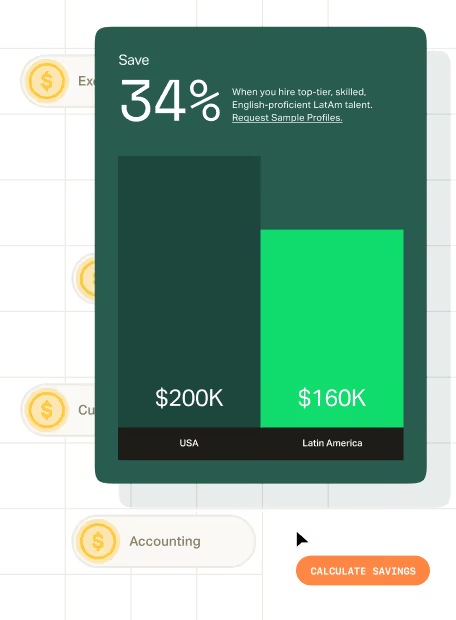
A mid-level bookkeeper in Latin America, for example, typically earns $2,500–$3,000 per month, compared to $47,000–$72,000 per year for a US equivalent, savings of 36–50% at the mid-level alone.
Source: Hire With Near 2026 Salary Guide and State of LatAm Hiring Report
For a full breakdown, see our outsourced bookkeeping cost guide and the accounting roles salary guide.
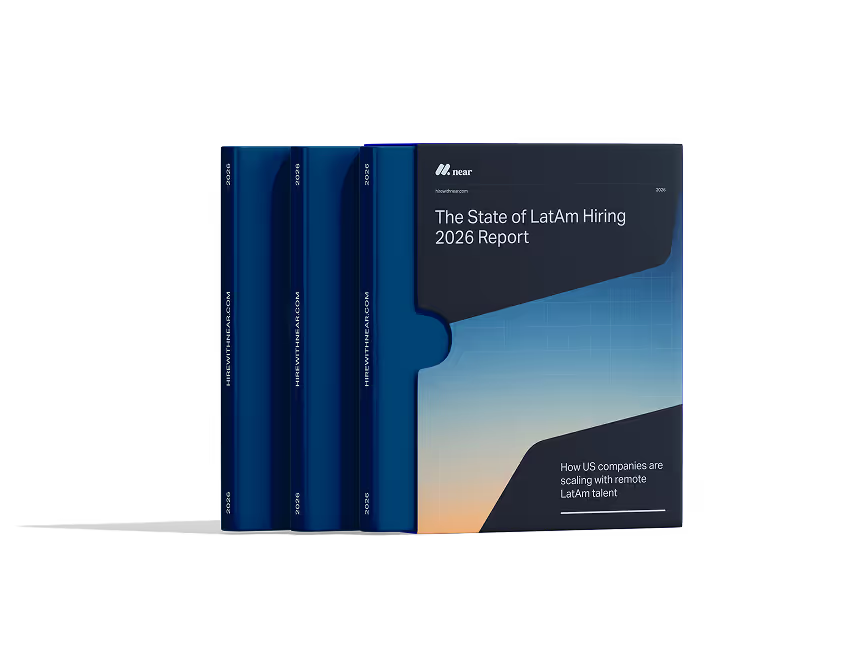
According to Hire With Near's 2026 State of LatAm Hiring Report, companies hiring bookkeepers in Latin America, across all seniority levels, consistently save 30–70% on salaries compared to US equivalents.
But cost savings alone don't explain why offshore bookkeeping has accelerated. Another part of the equation is the shrinking domestic pipeline. According to Accounting Today, CPA exam candidates have fallen 27% over the past decade and accounting graduates declined 17% between 2016 and 2022.
For many US firms, offshore hiring is no longer just a cost optimization. It's how they fill roles the domestic market can no longer supply.
For a deeper look at the full case for this model, see our guide to the benefits of offshore bookkeepers.
Offshore vs. Nearshore Bookkeeping: Why Time Zone Is the Deciding Factor
For companies considering offshore bookkeeping, time zone is the single most important variable to evaluate, more than cost, more than platform, more than agency reputation. And it's precisely the time zone that separates offshore from nearshore.
For US companies, offshore typically means providers in Asia: the Philippines, India, and similar markets, with a time difference of 11–14 hours from most US locations. Nearshore means Latin America: Colombia, Argentina, Mexico, Brazil, with a 0–3 hour difference.
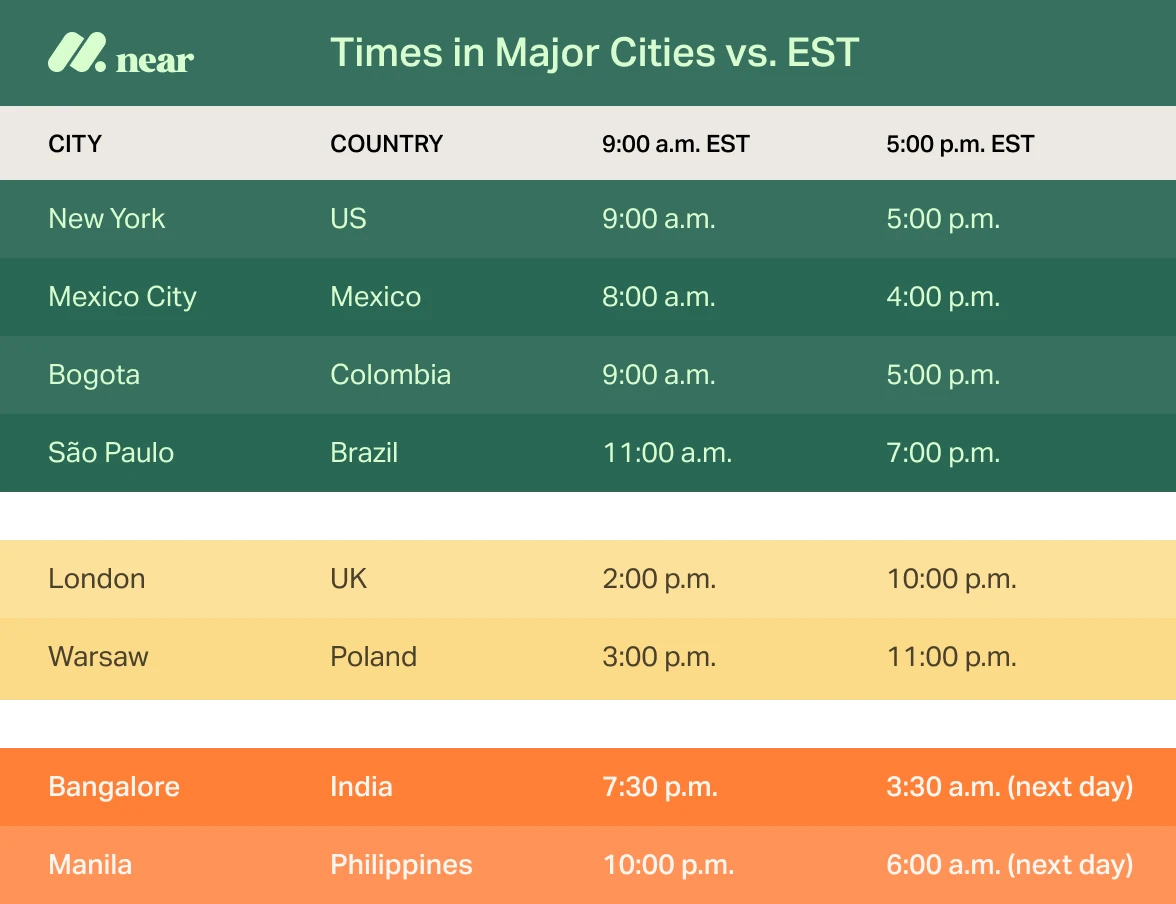
That gap has concrete consequences in bookkeeping. When a bookkeeper's working day ends while your team's day is just beginning, errors don't get caught until the next morning. Questions that arise during the month-end close get batched into email chains instead of being resolved in real time.
A Harvard Business School and INFORMS study found that each hour of time zone difference reduces synchronous communication by 11%. The study recommends organizing distributed teams along a north-south axis, such as US-LatAm, rather than east-west to maximize workday overlap.
What companies find after trying offshore bookkeeping in Asia
The pattern is consistent. One niche real estate tax consulting firm we work with tried a Philippines-based agency and found that candidates weren't willing to work US hours. When the time zone gap becomes a negotiation about schedules rather than a given, the collaboration model breaks down before the work even starts.
An SMB accounting firm owner with a prior offshore team in Asia put the business case plainly:
For this role, we really would love to have somebody in Latin America just because the time zone is much closer to ours. This role in particular requires a lot of client interfacing. It's probably the most high-touch role with clients of any of the roles that we have. So almost all that time would be needed in a similar time zone because you'd have to be able to answer.
According to Hire With Near's research on why US companies turn to LatAm hiring, 30% are switching from offshore to nearshore specifically because time zone gaps with Asia were making real-time collaboration almost impossible.
But it’s important to say that bookkeeping services in the Philippines and other Asian countries remain widely used and work well for tasks that don't require real-time back-and-forth.
{{state-latam-hiring}}
What to Look for When Choosing an Offshore Bookkeeping Provider
If you've decided offshore bookkeeping is right for your business, the next step is choosing the right provider or hire. Most companies underweight two criteria that end up being decisive: English proficiency and, as I already mentioned, time zone alignment.
Here are the factors that matter most:
US business hours coverage
This is the first question to ask, regardless of where the provider is located. Some Philippines-based providers offer US-hours coverage; some LatAm providers don't explicitly require it. Confirm whether your bookkeeper will be available during your core working hours before evaluating anything else.
English proficiency
Don't assume English quality based on geography. If you're evaluating an individual hire, schedule a video call before making a decision. Strong spoken English matters more than most US clients expect, especially for roles involving client communication, reporting, or monthly review calls.
Familiarity with US accounting standards
Your offshore bookkeeper should know QuickBooks, understand GAAP basics, and be comfortable with your business's accounting practices. This is more common in LatAm than most US clients expect. The region's accounting programs are rigorous, and a significant share of senior LatAm finance professionals have Big Four experience with direct US GAAP and IFRS exposure.
In my experience screening bookkeeper candidates, the first thing I look for is whether they've worked with US-based companies before. That context tells you a lot about their familiarity with US clients, accounting practices, and communication expectations. It's the fastest signal for whether a candidate will integrate smoothly or require a long ramp period.
Experience and reputation
Look for a partner or an individual hire with a strong track record in bookkeeping for your type of business. Ask for references, check testimonials, and consider a short trial period to evaluate responsiveness and output quality before committing to a longer engagement.
Service model and pricing
Whether you're working with a firm or hiring directly, understand what you're paying for. Flat-rate packages, hourly rates, and subscription models all have different implications for how you budget and manage the relationship. A dedicated full-time hire typically costs less over time than per-hour or per-task arrangements once volume reaches a consistent level.
For a step-by-step walkthrough of the full hiring process, see our guide on how to hire a bookkeeper.
If you're focused specifically on the offshore side, our “How to hire offshore bookkeeping talent” guide is the more targeted resource.
A specialized recruiting partner makes every one of these criteria easier to evaluate. That's covered in the next section.
Why Working With a Hiring Partner Sets You Up for Success
If you decide to hire a dedicated bookkeeper rather than work with a firm, a specialized recruiting partner gives you a significant advantage over sourcing independently. The difference isn't just speed: it's the quality of filtering that happens before you ever see a candidate.
You skip the sourcing and screening burden
Finding qualified offshore bookkeepers independently means building your own vetting process from scratch: sourcing across markets you don't know well, assessing English proficiency without a benchmark, verifying US accounting familiarity without a standard test, and checking references across international hiring contexts.
A specialized partner has already built that infrastructure. As a dedicated accounting recruitment services provider, Hire With Near runs English assessment, multi-client experience screening, US company history verification, tool proficiency checks (QuickBooks, Xero, NetSuite), and red-flag reviews as a standard part of every search.
By the time you see candidates, the filters have already been applied.
You get faster placements with less risk
Hire With Near places bookkeepers within 21 days on average, with no upfront payment required. If a hire doesn't work out, we replace them at no additional cost.
ORBA Cloud CFO switched from an offshore Asia team to a nearshore LatAm approach after time zone misalignment meant work was happening while their US team slept. Working with Hire With Near, they saved $159,000 annually across two roles. The solution wasn't just going nearshore. It was having a partner who knew exactly what to screen for.
You get the logistics handled
Our nearshore staffing model handles compliance, payroll, and international employment logistics, so you focus on the work rather than the paperwork. For senior finance and CFO-level searches, we also offer executive search in Latin America for companies building out leadership-level finance functions.
{{prevetted-banner}}
How To Integrate Offshore Bookkeepers Into Your Business Operations Successfully
Choosing the right bookkeeper is half the work. How you onboard and integrate them determines whether that hire delivers or underperforms.
Here's what really moves the needle:
Onboard them like a full team member
The most common integration mistake is treating offshore hires as external contractors rather than embedded team members. Your offshore bookkeeper should get the same first-week setup as any new hire: system access, a walkthrough of your close calendar, an introduction to the people they'll work with, and clarity on how your team communicates.
A short session covering your Slack norms, meeting cadence, and reporting format removes more friction than any generic cultural training program.
For a detailed walkthrough, see our guide on effective onboarding for remote hires.
Set up real-time communication from day one
Offshore bookkeeping works best when your bookkeeper is reachable during your core hours, not just available by email. Set explicit expectations about response times, establish which channel handles urgent questions (Slack vs. email vs. a standing call), and schedule at least one live touchpoint per week in the first 30 days.
For nearshore LatAm hires, this is straightforward. For offshore Asia arrangements, you'll need to agree on a communication window upfront and build your workflows around it.
Build a feedback loop, not just a review cycle
Don't wait for a quarterly review to flag issues. The most effective offshore bookkeeping relationships run on short feedback loops: a quick debrief after the first close, a check-in at 30 days, and a structured review at 90 days. Catching small misalignments early prevents them from becoming recurring problems.
Standardize how you track deliverables, like a shared close checklist, a task board, or even a Google Sheet, so both sides have visibility into what's due and what's been completed.
How To Handle Data Security and Compliance in Offshore Bookkeeping
Two operational risks require clear standards before any offshore bookkeeping engagement starts: data security and regulatory compliance. Neither can be treated as an afterthought.
Data security: what to require from any offshore partner
In 2024, the US recorded 3,158 data compromises, a near-record pace that shows no sign of slowing. In any finance operation, that context makes data security non-negotiable.
Before engaging an offshore bookkeeper or firm, confirm the following:
- Role-based access controls in your accounting platform (QuickBooks, NetSuite, and Xero all support this natively)
- A signed NDA before any financial data is shared
- Clear data handling protocols: where data is stored, who has access, and how access is revoked when the engagement ends
- SOC 2 Type II certification or equivalent, if your business has compliance requirements
For direct hires, your data security posture is largely determined by the tools you use and the access controls you set. Apply the same practices you'd use for any remote US employee.
Regulatory compliance: know what applies to your business
Compliance requirements vary by industry, entity structure, and jurisdiction.
Offshore bookkeepers with US client experience are typically familiar with US GAAP, standard tax filing requirements, and common reporting frameworks. For more complex situations, like multi-entity structures, industry-specific compliance like HIPAA, or CPA firm requirements, verify that your bookkeeper or firm has direct experience with those requirements before hiring.
If your business operates across multiple jurisdictions or has specific regulatory exposure, consider getting legal counsel to confirm your offshore arrangement is structured correctly before the engagement begins.
Final Thoughts
If you're weighing your offshore bookkeeping options, Latin America stands out for a specific reason: You can build the finance function your business needs at 30–70% lower cost than US hiring, without the time zone friction that makes offshore Asia unsustainable for most roles requiring real-time collaboration.
The companies that get offshore bookkeeping right make three good decisions upfront. They prioritize time zone alignment, they vet specifically for English proficiency and US accounting standards familiarity, and they work with a hiring partner who already knows how to find and filter for those signals.
Hire With Near helps US companies hire a dedicated bookkeeper in Latin America, typically within 21 days.
Book a free consultation call with us to learn more about how we find and vet the right finance and accounting talent for your business.
Frequently Asked Questions
What is the difference between offshore and nearshore bookkeeping?
Offshore bookkeeping refers to hiring in geographically distant countries, often with 10-to-15-hour time zone gaps, such as the Philippines or India. Nearshore bookkeeping means hiring in countries with the same or adjacent time zones: for US companies, that's Latin America.
For finance roles that require real-time collaboration during month-end close or daily communication, nearshore Latin America is the more practical model.
How can I ensure the confidentiality and security of my financial data with an offshore bookkeeping provider?
Making sure your financial data is protected starts with selecting an outsourcing provider that adheres to international data protection regulations and has cybersecurity measures in place before any work starts.
Discuss and agree on specific security protocols, including encryption standards, secure file transfer methods, and non-disclosure agreements, before beginning the partnership. Ask potential providers to document their access control practices.
How do time zone differences affect offshore bookkeeping, and how can they be managed?
Time zone misalignment is the most common reason offshore bookkeeping arrangements fail, not cost or quality. When your bookkeeper's workday ends while yours is starting, errors sit uncaught, questions queue up overnight, and month-end close becomes a communications bottleneck.
The most effective fix is hiring in Latin America, where bookkeepers work hours that closely overlap with the US.
If you're committed to a provider in Asia, set clear core-hours expectations, use asynchronous-first workflows for routine tasks, and accept that real-time collaboration will be limited.
How do I assess an offshore bookkeeper's English skills before hiring?
The most reliable method is a live video interview. Schedule a call and listen to how clearly the candidate communicates, how directly they answer questions, and whether they can discuss specific accounting scenarios with precision. Strong bookkeeping candidates speak in organized, specific terms, not vague generalities. You can supplement this with a short test task that requires a written explanation of their approach.
If you're working with a specialized hiring partner, English assessment is part of their standard screening process, so you see only candidates who have already passed that filter.
What accounting software should an offshore bookkeeper know?
QuickBooks is the most common US requirement and it's widely available in Latin America. If QuickBooks proficiency is a must-have, LatAm is a strong sourcing market for it. Xero and FreshBooks are also broadly available. NetSuite is the most difficult to find across any market, including LatAm, so if your company runs on NetSuite, expect a smaller candidate pool and a longer search.
Offshore bookkeepers based in Latin America also tend to have strong general Excel skills, which matters for reporting and reconciliation work that falls outside the accounting software.
What are the best bookkeeping outsourcing services?
The top bookkeeping outsourcing services for small businesses in 2026 include Bench, Pilot, Bookkeeper360, and several nearshore staffing firms for companies that want a dedicated hire rather than a managed service.
Your best option depends on whether you need a full-service firm handling your books on their schedule, or a dedicated full-time bookkeeper who works in your systems and on your team. For a curated comparison of the leading options, see the best bookkeeping outsourcing services, which covers the top providers across both categories.
Should I hire directly or use a staffing firm for offshore bookkeeping?
Hiring directly through a job board is faster in the short run but puts all screening and vetting responsibility on you: English assessment, tool proficiency, US accounting standards familiarity, and reference checks.
A staffing firm that specializes in finance roles has already built the filters and the candidate pipeline for those exact variables.
The vetting criteria for offshore bookkeeping aren't obvious. Most companies only learn what to screen for after a failed first hire. A specialized partner already knows.
What other finance and accounting roles can I hire from Latin America?
Beyond financial controllers, the most commonly hired finance and accounting roles from Latin America include:
- Financial analysts: FP&A, variance analysis, and reporting
- Staff accountants: Day-to-day bookkeeping and close support
- Accounts payable specialists: Vendor management and invoice processing
- CFOs: Fractional and full-time strategic finance leadership
- Bookkeepers: Transaction recording and reconciliation
All bring the same time zone alignment and US GAAP familiarity as the controller role.
What are the best staffing firms for hiring bookkeepers in Latin America?
Several staffing firms place bookkeepers in Latin America, but results vary significantly based on their finance specialization and how they screen for the US-specific requirements that matter in this role (English quality, QuickBooks proficiency, US GAAP familiarity).
Our review of the best staffing firms for hiring bookkeepers in LatAm covers the firms with a demonstrated track record specifically in finance and accounting placement.
Are there outsourced bookkeeping options specifically for CPA firms?
Yes. Several providers specialize in bookkeeping support for CPA firms and accounting practices. These arrangements are structured differently from standard business-to-bookkeeper hires: They typically involve higher volume, multi-client management, and familiarity with CPA workflow tools.
Our guide to outsourced bookkeeping providers for CPA firms covers the providers and hiring approaches best suited to that model. Hire With Near also places bookkeepers for CPA firms, and the multi-client experience screening we run is directly relevant to that use case.
How do I find and hire offshore bookkeeping talent?
The fastest path to find and hire offshore bookkeeping talent is working with a specialized recruiting partner who already has a vetted pipeline of finance and accounting candidates in Latin America.
If you prefer to hire directly, the most important steps are: writing a clear job description that specifies software requirements and US-hours availability, screening for English proficiency via video interview, running a test task on a real accounting scenario, and checking references from prior US-based clients.







.webp)


%203.svg)
.avif)





%20(1).avif)

%20(1).png)