%20(1).webp)


%203.svg)
Key Takeaways
- This roundup covers three kinds of providers: accounting and BPO firms that run your AR as a managed service (Deloitte, PwC, EY, KPMG, Capgemini, BDO, BPM, and Auxis), a freelance marketplace (Toptal), and a dedicated-hire model (Hire With Near). Building a dedicated AR team in Latin America instead of outsourcing typically saves around 55% versus a US hire for the same seniority.
- Which model fits comes down to control: a BPO firm is fast to stand up but assigns a shared, rotating team, while a dedicated specialist works only for you and learns your customers and your books.
- Outsourcing costs are usually priced per invoice, as a percentage of collections, on a flat monthly retainer, or as a dedicated full-time hire, so total cost depends on your invoice volume, complexity, and whether you need collections only or full-cycle AR.
The strongest accounts receivable outsourcing firms for US companies in 2026 fall into two camps: established global accounting firms that run your AR as a managed service, and providers that help you build your own dedicated AR team in Latin America.
If you're reading this, your AR backlog has probably outgrown the setup that used to work. Invoices are going out late, collections calls are slipping, and cash you've already earned is sitting in someone else's account. Maybe your current firm charges top-of-market rates and still treats you like one account among dozens.
That's the real question behind this search: keep paying premium rates for a shared outsourcing team, or put a dedicated specialist on your side who knows which customers pay late and why.
This article compares the top accounts receivable outsourcing companies serving US businesses, breaks down what outsourcing costs, and helps you decide between handing AR to a firm and building your own team.
Full disclosure: Hire With Near is one of the options here, and we'll be clear about where we fit and where another provider might be the better call. If you want to skip ahead, you can hire finance and accounting talent in Latin America directly.
10 Top Accounts Receivable Outsourcing Companies
The 10 top accounts receivable outsourcing companies for US businesses in 2026 are Deloitte, PwC, Hire With Near, BPM LLP, Toptal, EY, KPMG, Capgemini, BDO, and Auxis. They range from the Big Four and global managed-services firms to a nearshore specialist and a build-your-own-team model, so the list covers both traditional outsourcing and its alternatives.
In putting this list together, we looked at companies that meet at least one of two criteria. They either have at least 50 client reviews on an established review platform (G2, Clutch, Trustpilot, GoodFirms, or ClearlyRated, client ratings only) with an overall rating of 4.5 or above, or they have a verifiable track record with large, recognizable enterprise clients.
The second criterion applies to firms whose client rosters speak to a level of delivery quality that enterprise procurement processes validate in ways review platforms often don't capture. When a provider runs finance operations for household name brands, that accountability carries weight; large enterprises don't re-engage vendors that underdeliver.
From the providers that qualified, we compared accounts receivable and finance capabilities, delivery model, pricing signals, and US client experience on their official websites, and we leaned on what Hire With Near's finance and accounting recruiters consistently tell us about what US buyers need from an AR function.
The companies are presented in no specific order, and include outsourcing firms that can handle your accounts receivable processes as well as recruiters for accounting roles who can help you hire accounts receivable specialists.
Our goal is to help you build a solid shortlist, not to tell you who's objectively best. There is no single best provider for every company. Your invoice volume, your control preferences, and your budget are unique. The fastest way to know who fits is to talk to a few of them.
All these companies can help you get invoices out, payments collected, and cash flowing more predictably.
You get:
- proven accounts receivable and collections processes
- technology that reduces manual work and errors
- experience handling US billing and compliance requirements
This is the baseline for any top accounts receivable provider.
What matters are the differences in how they operate, whether you get a shared team or a dedicated one, and how they structure their partnership with you. Here's what sets each apart.
1. Deloitte
%2012.34.52%E2%80%AFp.%E2%80%AFm..webp)
Deloitte earned a spot on this list because of its scale and the depth of its finance transformation practice, which lets large enterprises fold AR into a much broader operating model. It is one of the Big Four and one of the most recognized finance and accounting firms in the world.
Rather than selling AR as a standalone service, Deloitte treats receivables as one piece of a redesigned finance function, alongside payables, close, and reporting. Its analytics practice builds reporting around your receivables data, so aging, disputes, and collection performance are visible in one place instead of buried in spreadsheets.
Key features:
- Finance transformation scope: AR improvements land inside a broader operating-model redesign covering payables, close, and reporting, not as a bolt-on service.
- Analytics-led reporting: Receivables dashboards give finance leaders visibility into aging, disputes, and collection performance.
- Global delivery: Big Four scale for multi-entity, multi-country AR operations, with industry-specific teams.
Best for: Large enterprises that want AR handled as part of a wider finance transformation program.
Client perspective: Deloitte qualified on enterprise track record rather than review volume: along with the rest of the Big Four, it audits the substantial majority of Fortune 500 companies, and that level of enterprise procurement scrutiny validates delivery quality in ways review platforms don't capture.
Limitations: Aimed at enterprise engagements; pricing isn’t publicly listed and is likely a poor fit for small and mid-sized companies. AR is delivered by a shared managed-services team rather than a dedicated hire.
2. PwC
%2012.39.16%E2%80%AFp.%E2%80%AFm..webp)
PwC is here because of its rigorous, compliance-first approach to accounts receivable management, backed by the resources of a Big Four firm. Its solutions include automated invoicing, payment processing, and dispute resolution.
Data security and regulatory compliance sit at the center of the offering, which is why regulated businesses tend to shortlist PwC first. Its controllership and managed-services teams take on invoicing and collections with the explicit goal of reducing bad-debt risk.
Key features:
- Compliance-first design: Controls, data security, and regulatory compliance are built into the AR workflow, not added afterward.
- Automated invoicing and dispute resolution: Invoicing, payment processing, and dispute workflows run through PwC’s managed-services model.
- Controllership integration: AR can sit inside a broader controllership engagement, so collections connect directly to your close and reporting.
Best for: Companies in regulated industries that prioritize compliance and data security in their AR function.
Client perspective: PwC qualified the same way as its Big Four peers: on enterprise track record rather than review-platform volume. It's part of the group that collectively audits the substantial majority of Fortune 500 companies, and that scale of client vetting is its own form of validation
Limitations: Enterprise-oriented; pricing isn’t publicly listed. Like other global firms, PwC assigns a managed-services team rather than a dedicated specialist who works only for you.
3. Hire With Near
%2012.23.42%E2%80%AFp.%E2%80%AFm..webp)
Hire With Near is a full-service staffing and recruiting agency that helps US companies of all sizes hire top-performing remote talent in Latin America across finance, accounting, sales, software engineering, AI, data, design, marketing, operations, and virtual assistance. We handle the full process end to end: sourcing, vetting, payroll, compliance, and onboarding.
When you're evaluating accounts receivable outsourcing, consider this: most firms assign your account to a shared team that juggles many clients at once. That means split attention, rotating staff, and people who never really learn your customers or your books.
We know you're not surprised to see us on this list, and of course we're biased. But we offer something different. Instead of handing your AR to an external team, we help you hire dedicated accounts receivable specialists in Latin America who work exclusively for your company, learn your processes, and grow with your business.
Key features:
- Finance specialists, placed weekly: We place accounts receivable specialists, credit analysts, staff accountants, and controllers every week, with specialist finance recruiters screening beyond certifications for real-world impact. Many candidates bring Big Four experience and understand US GAAP and complex collections. You get skilled accounts receivable specialists in Latin America who deliver the same rigor as your best US hires.
- Quality-first approach: Our 97% placement rate and 9.1+ client satisfaction come from obsessing over fit: not just skills but the drive, readiness, and cultural match to contribute from day one. That focus on fit is also why 80% of our hires stay two or more years. We screen for technical accounting proficiency, compliance rigor, and the communication skills a client-facing collections role demands.
- One partner, one process: Scale across functions, not just AR, with one dedicated team and a repeatable hiring cadence. First candidates in 3 to 5 days with video introductions, most hires in under 3 weeks. We remember what worked last time and adapt based on your feedback, so hiring gets easier over time.
- 180-day replacement guarantee: Double the industry standard. If a hire doesn't work out in the first six months, we find a replacement at no additional cost to you.
Best for: Companies that want a dedicated AR specialist on their own team, in a US-aligned time zone, instead of a shared outsourcing team.
Client perspective: It holds a 4.8/5 rating on G2 across 140 client reviews. CyberFortress saved over $1.2M annually by building their entire accounting team through Hire With Near, including specialists who helped cut their month-end closing timeline from 15 days to 10 days.
Limitations: We're a staffing and recruiting partner, not a done-for-you BPO; you manage the specialist day to day, the way you would any team member. We place talent only in Latin America, not other offshore regions.
Pricing: No upfront costs. Pay only after you hire, with flexible options: a one-time placement fee, or a monthly staffing fee if you want us handling payroll and compliance. You set the salary.
4. BPM LLP
%2012.54.13%E2%80%AFp.%E2%80%AFm..webp)
We included BPM LLP because it pairs the credibility of a top US accounting firm with a dedicated outsourced-accounting practice, and it holds a 4.7/5 rating on ClearlyRated across 459 client reviews as of July 2026. Founded in California's Bay Area, BPM now spans more than 1,300 professionals across US and international locations plus a virtual region.
Its outsourced accounts payable and accounts receivable services are built to strengthen cash flow while protecting the customer relationships that matter to your business.
BPM positions AR outsourcing inside a broader managed-services offering, so companies can add controllership, reporting, and advisory support as they grow.
Key features:
- Full-cycle AR management: Invoice generation, payment tracking, collections, and customer communication handled by a CPA-firm team.
- Managed-services breadth: AR sits alongside outsourced accounting, controllership, and advisory, so the same firm can scale with your finance needs.
- US accounting depth: A top US accounting firm with more than 1,300 professionals and deep US GAAP and compliance experience.
Best for: US mid-market companies that want their AR run by an established CPA firm with room to add more finance services.
Client perspective: Rated 4.7/5 on ClearlyRated (459 reviews) as of July 2026.
Limitations: As a full-service accounting firm, BPM may be more than a company needs if it only wants AR support. Pricing isn’t publicly listed.
5. Toptal
Toptal stands out for its selectivity and its strength in interim and project-based finance work, and it holds a 4.7/5 rating on G2 across 265 client reviews as of July 2026. The platform accepts only the top 3% of applicants through skills assessments, live problem-solving, and test projects.
Its finance network covers CPAs, bookkeepers, interim controllers, and US GAAP experts, which makes it a fit for companies that need senior AR or finance coverage for a defined period rather than a permanent hire.
Toptal matches most clients in under 24 hours and offers a trial period of up to two weeks before you commit.
Key features:
- Rigorous vetting: Only the top 3% of applicants pass Toptal's screening, so you connect with pre-screened finance professionals.
- Interim and project coverage: Strong fit for interim controller or CFO coverage, AR cleanup projects, or US GAAP reporting on a defined timeline.
- Fast matching with a trial: Average match time under 24 hours, with a trial period of up to two weeks before billing begins.
Best for: Companies needing senior, short-term or project-based AR and finance help rather than a full-time team member.
Client perspective: Rated 4.7/5 on G2 (265 reviews) as of July 2026.
Limitations: A freelance marketplace model suits interim and project work more than a long-term, embedded AR function. Premium rates; you engage independent professionals rather than build a dedicated in-house team.
6. EY
%2012.58.53%E2%80%AFp.%E2%80%AFm..webp)
EY is on this list because of the breadth of its financial outsourcing services, from tax planning to managed services and consulting, all under a Big Four umbrella.
Where EY stands out is in fitting AR to your sector: reporting and analytics are configured to industry-specific billing patterns, so a healthcare provider and a distributor don’t get the same template. Its accounts receivable services aim to improve cash flow and reduce bad debt through a mix of technology and specialist teams.
Key features:
- Industry-tailored AR: Reporting and analytics configured to sector-specific billing and collection patterns rather than one standard template.
- Breadth under one umbrella: AR sits alongside tax, managed services, and consulting, so scope can grow without adding vendors.
- Decision-grade reporting: Detailed financial reporting and analytics turn receivables data into something finance leaders can act on.
Best for: Businesses that want AR paired with industry-specific reporting and analytics.
Client perspective: Like the other Big Four firms on this list, EY qualified on enterprise track record rather than review-platform ratings. The Big Four collectively audit the substantial majority of Fortune 500 companies, a level of enterprise scrutiny most review platforms don't capture.
Limitations: Enterprise-focused, with pricing available only on request. Delivery runs through a shared services team, so no single specialist is dedicated to your account.
7. KPMG
%201.02.12%E2%80%AFp.%E2%80%AFm..webp)
KPMG made this list for its focus on operational efficiency and financial accuracy across the AR function. Its solutions include automated billing, payment processing, asset management, and comprehensive reporting.
KPMG frames AR work in operational terms: billing accuracy, cycle time, and process efficiency, backed by the data-security and compliance controls you’d expect from a Big Four firm.
Key features:
- Efficiency metrics: AR improvements are tied to measurable process outcomes like billing accuracy and cycle time, not treated as back-office admin.
- Automated billing and reporting: Billing, payment processing, and comprehensive reporting run through KPMG’s managed-services platform.
- Security and compliance controls: Data protection is a core part of the offering, which matters when a third party touches your customer payment data.
Best for: Companies that want AR improvements tied to broader operational efficiency and strong data-security controls.
Client perspective: KPMG's qualification here rests on enterprise track record, not review counts. As one of the Big Four auditing the substantial majority of Fortune 500 companies, its client relationships go through a level of procurement vetting that review platforms don't measure.
Limitations: Geared toward larger organizations, and pricing is available only on request. The work is delivered by a shared services team, not a specialist you manage directly.
8. Capgemini
%201.06.32%E2%80%AFp.%E2%80%AFm..webp)
Capgemini earned a spot on this list because of its scalable, technology-driven approach to accounts receivable at high volume. The firm’s services include full order-to-cash accounts receivable management, from invoice generation to payment collection.
Its bet is automation: AI handles the repetitive processing work, which improves accuracy and lowers the per-invoice cost for clients pushing serious volume through the system.
Key features:
- Full order-to-cash coverage: Invoice generation through payment collection under one delivery model.
- AI-enabled processing: Automation improves accuracy and lowers per-invoice processing costs at high volume.
- Built for scale: A global delivery model designed for large, complex AR operations that smaller providers can’t absorb.
Best for: Larger companies with high invoice volumes that want AI-enabled, full-cycle AR at scale.
Client perspective: Capgemini qualified on its enterprise delivery record; its BPO engagements run through the procurement standards of the global companies it serves.
Limitations: Built for volume and enterprise engagements; pricing isn’t publicly listed. You get a delivery team shared across accounts, not a specialist of your own.
9. BDO
%201.12.30%E2%80%AFp.%E2%80%AFm..png)
What stood out about BDO is its emphasis on personalized support alongside accounting outsourcing that improves financial performance. The company’s services include detailed financial analytics and reporting, helping businesses gain insights into their transaction lifecycles, accounts receivable processes, and revenue recognition.
Compared with the Big Four entries above, BDO positions itself closer to the mid-market: an advisory-led relationship where growing companies get direct attention rather than a slot in an enterprise delivery queue.
Key features:
- Advisory-led AR: Receivables support comes with analytics on transaction lifecycles and revenue recognition, not just transaction processing.
- Mid-market positioning: A service model built for growing businesses that want direct attention, not enterprise-only engagement structures.
- Global network: Access to broader accounting and advisory support as your finance needs expand.
Best for: Growing businesses that want AR support with a more personalized, advisory-led touch.
Client perspective: BDO qualified on its established track record as one of the largest global accounting networks serving mid-market and enterprise clients.
Limitations: As a full-service firm, it may offer more than a company that only needs AR help. Pricing isn’t publicly listed.
10. Auxis
%201.15.02%E2%80%AFp.%E2%80%AFm..webp)
Auxis earned a spot on this list because it is a nearshore finance and accounting outsourcing pioneer whose enterprise client roster speaks for itself: it runs finance operations for brands including Condé Nast, Equifax, and Subway. With more than 25 years of finance transformation experience, Auxis delivers AR outsourcing from delivery centers in Costa Rica (opened 2010) and Colombia (added 2021), giving US companies real-time time-zone overlap.
Its accounts receivable services cover the full order-to-cash cycle: customer credit administration, billing, cash application, collections management, and dispute management, with teams trained on US GAAP and IFRS.
For companies that want the speed and time-zone alignment of nearshore delivery but prefer a managed BPO over building their own team, Auxis sits between the two models.
Key features:
- Full order-to-cash coverage: Credit administration, billing, cash application, collections, and dispute management under one roof.
- Nearshore time-zone overlap: Delivery centers in Costa Rica and Colombia provide real-time overlap with US business hours.
- US GAAP and IFRS-trained teams: Delivery staff are trained on both standards, covering US reporting requirements as well as multinational subsidiaries.
Best for: Companies that want nearshore AR outsourcing with US-hours overlap delivered as a managed service.
Client perspective: Enterprise clients include Condé Nast, Equifax, and Subway.
Limitations: A managed BPO model means a shared team rather than a dedicated hire you control directly. Pricing isn’t publicly listed.
How Much Does Accounts Receivable Outsourcing Cost?
Accounts receivable outsourcing is usually priced one of four ways: per invoice or transaction, as a percentage of the receivables collected, on a flat monthly retainer, or as a dedicated full-time hire you pay a salary for. What you pay depends on your invoice volume, how complex your billing is, and whether you need collections only or the full order-to-cash cycle.
Here's how the four models tend to work in practice.
Per-invoice or per-transaction pricing
You pay a set rate for each invoice processed or transaction handled. This suits companies with predictable, moderate volume, but the bill climbs directly with the number of invoices, so a busy month costs more. It's the model most exposed to volume spikes.
Percentage of collections
The provider takes a cut of what they collect, often on the harder past-due accounts. It aligns their incentive with getting you paid, but on high-value invoices the fee can add up fast, and you're sharing a slice of revenue you earned.
Flat monthly retainer
You pay a fixed monthly fee for a defined scope of AR work. Costs are predictable, which finance teams like, but you'll want the scope spelled out so a growing invoice count doesn't push you into a higher tier or out-of-scope charges you didn't see coming.
Dedicated full-time hire
Instead of paying a firm per invoice, you employ your own AR specialist full time and pay a salary. This is the model that tends to cost the least for companies with steady, ongoing AR volume: the cost is fixed and known, the person works only for you, and you're not paying a premium on every transaction.
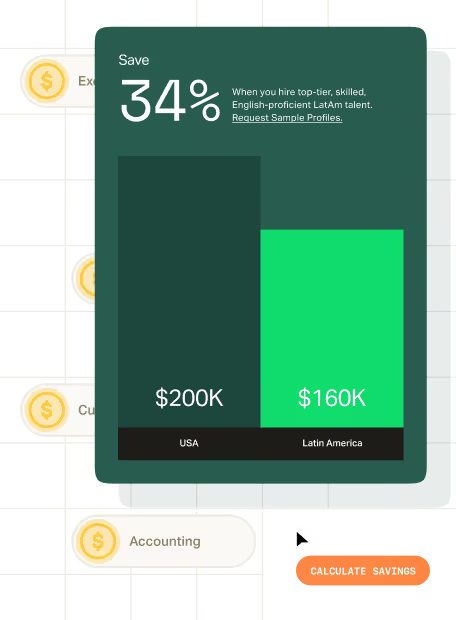
That last model is where hiring in Latin America changes the numbers. According to Hire With Near's 2026 State of LatAm Hiring Report, companies hiring accountants in Latin America save around 55% versus US hires (roughly $33,000 to $66,000 per year per role), and 84% of our placements are mid-level or senior rather than junior.
So a dedicated AR specialist in Latin America isn't a cheaper, lesser option; it's an experienced hire at a fraction of the US salary. For a fuller picture of the numbers, see our accountant salaries in Latin America guide and the broader US vs. Latin America salary data.
The pain that sends companies looking in the first place is usually cost that doesn't scale. One US real estate investor with multiple property entities, using a top regional accounting firm, put the frustration plainly:
It's costing us an arm and a leg to get it done by our current accountants here in the United States. They are a top, like, regional accounting firm. So they're charging top of market rates. We don't get any discount for them, like, for having multiple entities.
For a direct comparison of the pricing models against building in-house, our breakdown of outsourcing vs. in-house accounts receivable and our guide to the costs and savings of outsourcing your accounts receivable walk through the trade-offs in more detail.
Is Outsourcing AR Better Than Hiring a Dedicated AR Specialist?
It depends on your invoice volume and how much control you want, but for companies with steady AR work, a dedicated specialist usually wins on both cost and continuity. A BPO firm is faster to stand up and takes hiring off your plate, while a dedicated hire gives you one person who learns your customers, works your hours, and answers only to you. Here's how to decide.
Outsourcing to a BPO firm makes sense when your volume is unpredictable, you need coverage tomorrow, or you don't want to manage anyone. The trade-off is that you get a shared, rotating team billed per transaction, so your costs rise with volume and no single person ever really owns your account. A dedicated specialist is the opposite: a full-time hire who integrates with your team, learns your billing quirks, and gives you direct control, at a fixed, predictable cost that doesn't spike when invoices do.
For a lot of finance leaders, the deciding factor is ownership. As one real estate tax consulting firm owner put it:
I want to own the employee. I want them to work for me.
In conversations with Hire With Near's finance and accounting recruiting team, the pattern that comes up is consistent: the companies happiest with their AR setup are the ones who stopped renting a slice of a shared team and put a dedicated person in the seat, especially when collections means getting on the phone with their customers.
One legal-tech startup hiring an AR and collections specialist described exactly why the model and the location matter:
One of the things that is attractive about South America, provided that the English speaking, because this would be a role where there would be the potential to get on calls. So we need somebody that's fluent in English, is the fact that the time zones are effective because we do need East Coast and West Coast U.S. time zone support.
That time-zone point is the real payoff of nearshore over offshore. A dedicated AR specialist in Latin America is at their desk during your business hours, wherever your team sits in the US, so collections calls, disputes, and month-end questions get handled the same day instead of waiting overnight.
This is a big part of why companies switch. In a Hire With Near analysis of more than 2,000 hiring conversations, 30% of US companies were moving from offshore outsourcing to nearshore hiring to get real-time overlap, with finance and accounting among the top functions making the switch.
The move to a single dedicated hire does raise one fair objection: what happens if that person leaves? A firm has a bench; a solo hire is one person. The same multi-entity real estate investor named the worry directly:
With our current bookkeeper, if somebody quits, like, there's no hiccup. They have 25 other people [who] are going to step into that person's shoes and finish our books for us.
It's a legitimate concern, and the answer is twofold. A good staffing partner backs the placement with a replacement guarantee (ours runs 180 days, double the industry standard), and a dedicated person who knows your books is more resilient day to day than a rotating cast who each learn a fraction of them. Continuity isn't only about how many people are available; it's about how well the person in the seat understands your business.
Qualification is the other question finance leaders raise, and it's where the Latin American talent pool tends to surprise people. Lucas Stepanenko, Sourcing Manager, Finance & Accounting at Hire With Near, explains what the region’s finance professionals bring:
LatAm finance professionals have strong academic training and a lot of exposure to Big Four firms. That gives them experience with international markets and makes them very well versed in key accounting standards like US GAAP and IFRS, which are among the most common requirements we see from our clients.
The structural backdrop makes the case for either model. The US is projected to have more than 124,000 new accounting and auditing job openings each year through 2032, many of them replacement roles as experienced professionals retire, according to the US Bureau of Labor Statistics. That shortage is exactly why outsourcing and nearshore hiring exist, and why building a dedicated finance team abroad has become a mainstream move rather than a workaround.
The clearest proof is what it does in practice. When CyberFortress, a San Antonio cybersecurity company, doubled headcount in a year and couldn't fill senior finance roles at US rates, they built a 20-person finance and accounting team in Latin America through Hire With Near instead of handing the work to a BPO firm.
The result was over $1.2M in annual savings and a month-end close cut from 15 days to 10.
What Are the Benefits of Outsourced Accounts Receivable Services?
Outsourcing your accounts receivable frees up cash, cuts overhead, and hands the invoicing-and-collections grind to people who do it all day. These are the advantages that show up once you outsource accounts receivable that make it a compelling option for US businesses.
Improved cash flow
Outsourcing accounts receivable services means timely invoicing and payment collection, which is crucial for maintaining a healthy cash flow. Late payments are the norm, not the exception: Intuit QuickBooks’ 2025 Small Business Late Payments Report found that 56% of US small businesses are owed money from unpaid invoices, averaging $17,500 per business, and 47% have invoices more than 30 days overdue.
Outsourcing providers use technology to speed up invoicing and collections, cutting the delays and write-offs that keep cash you’ve already earned out of reach.
Reduced operating costs
An in-house AR team means salaries, benefits, training, software licenses, and the management time to run all of it, whether this month's invoice volume is high or not. Outsourcing swaps that fixed overhead for a cost that flexes with what you actually need.
Enhanced accuracy
Outsourcing providers run invoicing and payment posting through software that catches duplicate invoices, misapplied payments, and data-entry errors before they hit your books. Fewer discrepancies mean fewer disputes with customers and less time reconciling at month-end.
Access to expertise
An AR team that does nothing but AR has seen your problems before: the customer who always pays at 60 days, the dispute that stalls a five-figure invoice, the reconciliation that never quite ties out. You’re buying pattern recognition your in-house generalist doesn’t have.
Faster payment cycles
Outsourced teams work late invoices on a schedule: reminder emails at set intervals, phone calls when reminders stall, and escalation before an invoice ages into bad-debt territory. That routine is what shortens your average collection period. Most in-house teams only chase payment when someone finds the time.
Better customer service
A team that isn't buried in day-to-day operations can afford to stay pleasant on the fifth reminder about the same invoice, not just the first. That consistency is what keeps a slow-paying customer from also becoming an ex-customer, and automated, on-schedule reminders mean it happens the same way every time, not just when someone remembers.
Scalability
If your invoice volume swings with the season, a provider can add or drop capacity without you hiring or laying anyone off. That flexibility is the main reason companies with lumpy billing cycles choose outsourcing over a fixed headcount.
Focus on core business activities
Handing off AR gives your team its time back. Chasing payment is a real drain: 44% of B2B invoiced sales in North America were paid late in 2025, with bad debts averaging 6% of receivables, according to the Atradius Payment Practices Barometer.
Every hour your controller or office manager spends on reminder emails is an hour not spent on pricing, forecasting, or customers. Outsourcing the follow-up work puts that time back where it earns money.
How Do You Choose an Accounts Receivable Outsourcing Company?
Choose an accounts receivable outsourcing company on five things: relevant AR and industry experience, a real vetting process for the people who touch your invoices, data-security controls you can verify, transparent pricing with no hidden fees, and client references that check out.
The difference between a strong provider and a weak one shows up in the specifics you ask for, so here's what to verify.
1. Relevant AR and industry experience
Confirm the provider has run AR for US companies in your industry, not just accounting in general. Ask for the number of years they've handled US billing and collections, examples of companies like yours they support, and how they handle the billing quirks specific to your sector (recurring invoices, insurance reimbursements, retailer chargebacks, multi-entity structures).
A provider with a track record in your industry can tailor collections to your customers and stay on top of the compliance requirements that apply to you.
2. How they source and vet the people handling your AR
Ask exactly how a provider screens the people who will touch your invoices, because for a role tied to your cash flow and customer relationships, a weak hire creates real risk. Any provider can claim great talent, so make them show the filter.
The specific checks to demand of any provider: verified US-AR and collections experience, an English-proficiency assessment for client-facing collections calls, and confirmed familiarity with US GAAP and the accounting standards your work requires.
Ask to see example profiles and how they test for accounting accuracy before a candidate reaches you. When our finance and accounting recruiters screen for AR and collections roles, they weight exactly these markers: US GAAP and IFRS exposure, real collections experience, and clear spoken English. Those are what predict whether someone can own the function rather than just process transactions.
For more on the concerns finance leaders raise before making this move, see the most common questions finance leaders ask about hiring accountants in Latin America.
3. Data-security and confidentiality controls
Verify the provider has strong security protocols to protect sensitive financial data, and get the specifics rather than a reassurance.
Ask about encryption standards for data in transit and at rest, role-based access controls, regular security audits, and documented compliance with regulations like GDPR and CCPA. Ask who is liable if data is compromised and what their incident-response process looks like. Strong security minimizes the risk of a breach and protects your reputation, and it matters no matter where the provider's team is based.
4. Pricing structure and contract terms
Pin down how the provider prices AR and read the contract for anything that can inflate the bill. Ask which model they use (per invoice, percentage of collections, flat retainer, or dedicated hire), what counts as out-of-scope, and whether costs jump as your invoice volume grows.
Check for hidden fees, minimum commitments, and the terms for ending the engagement. Transparent pricing you can model against your real volume is the point; a quote you can't tie to your numbers is a red flag.
5. Client testimonials and references
Research the provider's reputation through client reviews and direct references to gauge reliability and service quality. Look at ratings on established review platforms, and ask to speak with a current client in a situation like yours.
References tell you about responsiveness, accuracy, and what happens when something goes wrong, which is exactly what you want to know before you hand over your receivables.
{{state-latam-hiring}}
Final Thoughts
Here's what we've learned from helping 950+ companies solve their accounts receivable challenges: the best solution isn't always traditional outsourcing.
Sure, you could hand over your AR processes to a third-party provider. But your accounts receivable function is too critical to your cash flow to trust to someone else’s shared team and rotating staff.
Companies like CyberFortress have found a better approach: dedicated accounting teams built with Latin American professionals who work exclusively for them. The results speak for themselves: over $1.2M in annual savings, faster month-end closes, and team members who understand their business.
The choice is yours: keep grinding through internal hiring, pay premium rates for traditional outsourcing, or build your own dedicated AR team. According to our salary data, companies hiring accounting talent in Latin America save around 55% versus US hires while getting the same quality work.
We also handle senior finance roles through executive search in Latin America when you're ready to build out the leadership layer.
The talent is there, the savings are real, and the process is faster than you think.
If you want to explore building a dedicated AR team in Latin America, the best thing to do is book a free consultation to talk through your specific requirements with our team. They'll give you salary benchmarks and explain how the process works, so you have the info you need to decide if it's right for you. Book a no-commitment call with us.
{{consultation}}
Frequently Asked Questions
What are the challenges associated with transitioning to an outsourced accounts receivable model?
Transitioning to an outsourced accounts receivable model can present several challenges, including internal resistance, software integration complications, potential time zone and cultural differences, and maintaining consistent quality.
Many of these issues can be addressed by partnering with a reputable accounts receivable outsourcing firm that has experience with US clients in your industry. Alternatively, working with a nearshore hiring partner like Hire With Near lets you hire talent located in a similar time zone that shares cultural common ground with US teams. This removes the two friction points that derail most transitions.
How long does it take to transition AR to an outsourcing provider or stand up a dedicated hire?
Most AR transitions take a few weeks to a couple of months, depending on the model you choose. A BPO firm typically needs several weeks to map your process, integrate with your billing software, and onboard its team before it fully takes over.
Standing up a dedicated hire can be faster on the sourcing side: at Hire With Near, we usually present first candidates for finance roles within 3 to 5 days and complete most placements in under 3 weeks, after which the specialist ramps on your specific processes.
Either way, plan the transition around your month-end close and collections cycles so cash flow never stalls mid-switch.
Are accounts receivable specialists in Latin America qualified for US accounting work and familiar with US GAAP?
Yes, many finance professionals in Latin America work exclusively with US clients and bring direct US GAAP and IFRS experience, often from Big Four firms. The region has deep academic training in accounting and strong exposure to international standards, which is why US companies routinely hire AR specialists, controllers, and accountants there for work that touches US books.
When you evaluate any provider, ask for candidates with verified US-AR or collections experience, confirmed US GAAP familiarity, and strong English for client-facing collections calls. Those three markers are the reliable signal that someone can handle US accounting work without a learning curve on the fundamentals.
How do outsourced accounts receivable services handle disputes with clients?
Most outsourced AR teams work disputes through the same basic sequence: pull the original invoice and any delivery or service records, get the customer on the phone or email to understand exactly what they're disputing, then resolve it with a credit, a payment plan, or a documented rejection.
The better providers log every dispute in a system so nothing sits untouched for weeks, and give you a report showing how many disputes are open, how old they are, and where each one is stuck.
What measures do outsourcing providers take to ensure data security?
Reputable providers protect financial data with encryption in transit and at rest, role-based access so only the people who need to see an invoice or bank detail can see it, and regular third-party security audits. Ask whether the provider holds a certification like SOC 2; that's a faster way to verify their controls than taking their word for it.
They should also build their process around regulations like GDPR and CCPA, and be able to tell you exactly what happens if there's a breach: who gets notified, on what timeline, and who's liable. For the full list of questions to ask before you sign, see the data-security section above.
What finance and accounting roles can I hire from Latin America beyond accounts receivable specialists?
Finance teams can be built out well beyond accounts receivable using Latin American talent. The region has strong depth across the full accounting function, and companies routinely staff entire teams there rather than a single role. For the full picture of how to approach it, see our guide to hiring finance and accounting talent in Latin America.
Companies commonly hire credit analysts to manage creditworthiness assessments and reduce bad debt exposure, staff accountants for day-to-day financial reporting, bookkeepers for transaction recording and reconciliation, controllers to own the reporting function, and accounts payable specialists to round out a complete finance team.







.webp)


%203.svg)

.avif)






%20(1).avif)

%20(1).png)