.avif)


%203.svg)
Key Takeaways
- Outsourced bookkeeping costs vary based on transaction volume, account complexity, frequency of service, and the pricing model you choose. The three most common models are hourly rates ($30–$50/hr for US providers), fixed monthly fees ($500–$1,500/month for small businesses), and value-based pricing.
- Hiring a dedicated bookkeeper from Latin America delivers comparable cost savings to a third-party outsourcing firm (55–69% less than US-based equivalents) while giving you a single person who works exclusively for your business, builds institutional knowledge over time, and is available during your business hours.
- CPA exam candidates have fallen 27% over the past decade. For many US businesses, the shift to a dedicated LatAm bookkeeper isn't just about cost. It's how they fill a role the domestic market can no longer supply reliably.
You've been spending $1,500 a month on an outsourced bookkeeping firm. Your financials get done, mostly on time, but every question takes a day or two to get answered. You're not sure who's really working on your books, and when something goes wrong, you're back to explaining your business from scratch.
That's the experience most US companies have with third-party bookkeeping firms: the price looks manageable, but the control and continuity you give up are harder to quantify. For a growing number of businesses, that tradeoff no longer makes sense.
There's an alternative that's becoming increasingly common: hiring a dedicated bookkeeper directly from Latin America. The cost savings are comparable to a third-party firm, but the difference is that you get someone who works exclusively for your business, knows your books inside out, and is available during your business hours.
This guide covers both options: what they cost, where the real differences are, and how to decide which model fits your business. Whether you're comparing bookkeeping outsourcing services or considering a dedicated outsourced bookkeeper for the first time, the numbers below give you a clear baseline.
What Factors Affect Outsourced Bookkeeping Costs?
Outsourced bookkeeping costs vary significantly based on a handful of well-defined factors. Understanding them upfront helps you avoid paying for capacity you don't need.
The main factors include:
Volume of transactions
One of the primary factors affecting outsourced bookkeeping costs is the volume of transactions that need to be processed. The more transactions your business has, the more time and resources it will take for a bookkeeper to manage them.
Businesses with high transaction volumes can expect to pay more for outsourcing their bookkeeping tasks.
Complexity of accounts
The complexity of a business's accounts can also impact the cost of bookkeeping services.
If your company has multiple departments, projects, or revenue streams, a bookkeeper may need more time and effort to manage your accounts effectively. This can result in higher costs for outsourcing bookkeeping services.
Frequency of service
How often you need bookkeeping work done directly affects what you pay. A business with daily transaction volume needs ongoing support; one with lighter activity might only need weekly or monthly reconciliations.
Most outsourced bookkeeping firms price by frequency tier. Daily service costs more than monthly, not just because of time, but because the bookkeeper needs to stay continuously familiar with your accounts rather than picking things up once a month and catching up.
Level of expertise required
The level of expertise required for bookkeeping tasks usually impacts the cost. The more complex and specialized the tasks, the higher the cost of outsourcing bookkeeping is likely to be.
Some businesses may only need basic bookkeeping services, such as data entry and bank reconciliation, while others may require more specialized professional services, like tax preparation or financial analysis.
Software and technology
Some outsourced bookkeeping firms charge more because they use advanced accounting platforms or proprietary reporting tools. Whether that premium is worth paying depends on whether those tools improve the output you receive.
What matters more than the software itself is compatibility with your existing setup. A firm running a platform you can't access or review independently creates visibility problems.
Before committing, confirm which tools they use, whether you'll have direct access, and whether your current accounting software is supported.
Additional services
Most outsourced bookkeeping firms offer tiered packages, and the price difference between tiers is often driven by add-ons: financial reporting, budgeting support, payroll processing, or tax preparation. These can be genuinely useful, but they're also where the bill quietly grows beyond what you originally budgeted.
Before signing, map out exactly what your business needs today and what you might need in six months. Pay for what you'll really use, and confirm whether additional services can be added later rather than locking into a higher tier upfront.
Pricing Models for Outsourced Bookkeeping Services
Outsourced bookkeeping providers typically price their services in one of three ways: hourly rates, fixed monthly fees, or value-based pricing.
Each model works differently depending on your transaction volume, how predictable your needs are, and how much you want to budget in advance.
Hourly rates
Hourly billing is the most common starting point for outsourced bookkeeping, particularly for one-off projects, cleanup work, or businesses with irregular transaction volume. You pay only for the time spent, which can work in your favor when needs are light and predictable.
The main drawback of hourly billing is unpredictability. If your books are disorganized or transaction volume spikes, the hours add up quickly. Most businesses with ongoing bookkeeping needs find fixed monthly pricing more manageable once volume reaches a consistent level.
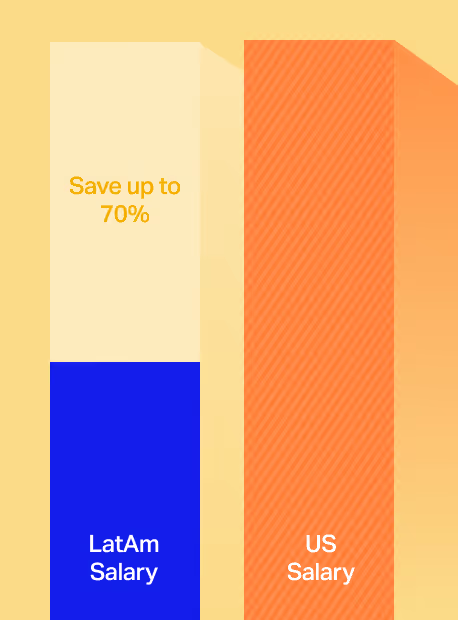
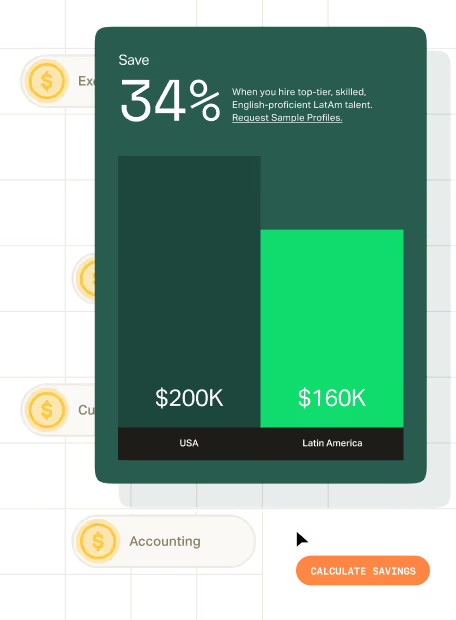
LatAm-based bookkeepers directly hired usually earn $22,000–$36,000 per year, which works out to $10–$17 per hour, representing 55–69% savings compared with hiring an in-house US bookkeeper, or $27,000–$66,400 per year depending on seniority.
{{salary-guide-cta}}
Fixed monthly rates
Fixed monthly pricing is the most common model for ongoing bookkeeping relationships. You pay a set fee each month for a defined scope of work, which makes budgeting predictable and removes the anxiety of watching hours accumulate.
Packages are typically tiered by transaction volume and complexity: basic reconciliation and reporting at the low end, with payroll processing, accounts payable management, and financial reporting added at higher tiers.
The main risk with fixed pricing is paying for capacity you don't use during slow months, or hitting the ceiling of your package during busy ones. Before signing, confirm exactly what's included and what triggers an overage charge.
Value-based pricing
The value-based model is a more personalized approach to outsourcing bookkeeping services. Instead of charging based on hours, service providers will assess the specific needs and requirements of your business and price their services accordingly.
This model is often beneficial for businesses with complex financial needs or those looking for more strategic financial guidance.
The cost for value-based pricing can vary greatly depending on the level of service required, but it usually ends up in a similar range to the fixed monthly rate pricing structure, depending on your needs and requirements.
Cost Comparison Between Outsourced and In-House Bookkeeping
Outsourced bookkeeping typically costs less than in-house hiring on a total-cost basis, even when the hourly rate looks higher on paper. The difference is what you're not paying for: benefits, payroll taxes, office space, equipment, and recruiting.
Here's how the numbers compare across models and regions:
In-house bookkeeping costs
According to the US Bureau of Labor Statistics, the median annual wage for bookkeepers in the US was $49,210, or $23.66 per hour, as of May 2024. State-level rates vary significantly: higher-cost states like California, New York, and Massachusetts average $27–$29 per hour, while lower-cost states like Alabama and Mississippi run closer to $20–$22 per hour.
That's just the base wage. Add benefits, office space, equipment, payroll taxes, and training, and the total cost of an in-house bookkeeper commonly runs 20–30% above salary. For businesses with high transaction volume or specialized requirements, the number climbs further.
Outsourced bookkeeping costs
Freelance and outsourced bookkeeping providers typically charge more than in-house wages, often $30–$50 per hour, to cover their overhead and profit margin. On a fixed monthly basis, US-based outsourced firms generally run $500–$1,500 per month for small businesses.
Outsourcing to lower-cost regions reduces that figure substantially. India and the Philippines are two of the most common destinations, with providers typically charging $8–$15 per hour for standard bookkeeping work.
Eastern Europe (Poland, Romania, Ukraine) is a less common but growing option for US companies, particularly those with EU operations or GDPR compliance requirements, with rates generally falling between $15–$25 per hour.
These regions offer real cost savings, but for roles requiring real-time US collaboration, the 8–13 hour time zone gap creates operational friction that the hourly rate doesn't capture. Questions queue overnight, month-end close can't be course-corrected in real time, and the coordination overhead adds up.
That's where Latin America comes in.
Further reading: Outsourcing vs. In-House Bookkeeping: Key Differences Every Business Owner Should Know
The Alternative to Outsourcing: Hiring Your Own Dedicated Bookkeeper From Latin America
Outsourcing your bookkeeping to a third-party firm solves the capacity problem, but it creates a different one: the work gets done by someone you didn't hire, who doesn't know your business, and who is probably managing ten other clients at the same time.
In the conversations our recruiting team has with US business owners, the pattern is consistent. One US-based media entrepreneur with two small businesses described it directly:
When you use these accounting firms that you work with, they're good, but they put a lot of burden back on you, and it's not your team that's aware of it. So it ends up falling back on the principles of the company.
That preference reflects a real and growing shift. Hire With Near's analysis of 2,000+ hiring conversations found that 12% of US companies turned to LatAm hiring specifically to move away from outsourcing models, citing a preference for workers who feel like part of the team rather than agency-assigned staff.
.webp)
What the dedicated-hire model means
Hiring your own dedicated bookkeeper based in Latin America is what's known as nearshoring: bringing on a full-time remote professional in a geographically close, time-zone-aligned market. For US companies, Latin America sits 0–3 hours from most US cities, which means your bookkeeper works during your business hours, not on a schedule adjusted to bridge a 12-hour gap.
This isn't a shared hire across an agency's client roster or someone on rotating assignments. It's one person who learns your chart of accounts, your software, your vendors, and your reporting cadence, and stays.
The cost picture is comparable to what third-party outsourcing firms charge for a monthly retainer, but you're getting more for it: no agency markup, no revolving-door candidates, and a bookkeeper who builds institutional knowledge over time.
What it costs
According to Hire With Near's 2026 State of LatAm Hiring Report, companies hiring bookkeepers in Latin America save between $27,000 and $66,400 annually compared to equivalent US hires, a 55–69% reduction depending on seniority.
Here's how the salary ranges look by seniority level, based on 2026 compensation data:
For a full breakdown by role and seniority, see the accounting roles salary guide.
For most small businesses, a mid-level bookkeeper with strong QuickBooks proficiency covers everything they need at $2,500–$3,000 per month. That's comparable to what many outsourced bookkeeping firms charge for a monthly retainer, but with a dedicated hire instead of a shared one.
What this looks like in practice
The dedicated-hire model solves something outsourcing firms structurally can't: one person, fully committed to your business, who builds real knowledge of your accounts over time.
Lucas Stepanenko, Sourcing Manager for Finance & Accounting at Hire With Near, puts it plainly:
LatAm finance professionals have strong academic training and a lot of exposure to Big Four firms. That gives them experience with international markets and makes them very familiar with key accounting standards like US GAAP and IFRS.
In his experience placing bookkeepers for US clients, roughly 80% of placements come from Argentina and Brazil, countries where accounting degree programs typically run four to six years and Big Four presence is strong.
On salary expectations, he notes that clients often want to pay a very low salary while expecting a senior-level hire. In his experience, it's more cost-effective to bring on a junior profile, pay them slightly more, and invest in training them.
That talent is genuinely available. A health and beauty supplement e-commerce company in Nevada had tried Upwork and Philippines-based firms without success: Candidates juggled multiple clients and never fully committed to a single role. Working with Hire With Near, they found a dedicated bookkeeper with two years of QuickBooks experience within one month. Their operations manager said:
Once a candidate comes from Hire With Near, we know they're definitely worth looking at.
The result: $26,000 in annual savings and a hire that happened five times faster than traditional recruitment.
For many US companies, this model isn't just a cost play. With CPA exam candidates falling 27% over the past decade, it's becoming a structural alternative to a domestic pipeline that keeps shrinking.
The trade-offs to know
The dedicated-hire model gives you more control, but also more responsibility. When you hire through a staffing firm like Hire With Near, the placement is handled for you: candidate sourcing, screening, and vetting. Once placed, the bookkeeper is your direct report. You're responsible for onboarding, performance management, and day-to-day direction.
That's a reasonable trade-off for most businesses that have the capacity to manage one person. If you don't have a manager who can provide oversight, a fully managed outsourcing firm may still be the right starting point.
How Can You Select the Right Outsourcing Partner or Dedicated Hire?
Whether you're evaluating a third-party bookkeeping firm or considering a dedicated LatAm hire, five criteria consistently separate reliable options from ones that create more work than they solve. The questions differ slightly depending on the model.
Experience and expertise
For outsourcing firms: Ask how many clients they serve in your industry and request references from businesses of similar size and complexity. A firm that specializes in e-commerce accounting will understand your revenue recognition and inventory needs better than a generalist.
For a dedicated hire: Look for candidates with direct experience supporting US-based businesses. That context tells you more about fit than industry credentials alone.
Technology and security
For outsourcing firms: Ask specifically about data encryption, access controls, and whether they've completed a security audit in the past 12 months. SOC 2 Type II certification is the strongest signal.
For a dedicated hire: The security posture is largely in your hands. Use role-based access controls in your accounting platform, require a direct NDA before work begins, and apply the same data handling standards you'd use for any remote US employee.
Communication and responsiveness
For outsourcing firms: Ask for specific SLAs, not just assurances that they communicate well. How quickly do they respond to questions? What happens during the month-end close if something needs immediate attention?
For a dedicated hire: This is where the LatAm model has a structural advantage. A bookkeeper in your time zone can answer a question on the same business day. That's not a feature that firms offering offshore Asia arrangements can match without someone working outside normal hours.
Customizable services
For outsourcing firms: Avoid packages that include services you don't use. Understand exactly what's in scope and what triggers an overage charge before signing.
For a dedicated hire: Scope is defined by you. The bookkeeper does what your business needs, not what a tiered package covers.
Cultural fit
For both models, look for professionals who communicate directly, take initiative, and are comfortable flagging issues without being asked.
In our experience placing finance professionals, this shows up in the interview: Candidates who give specific, organized answers to process questions tend to work the same way on the job.
Our guide on how to hire an offshore bookkeeper walks through what to evaluate at each stage of the process.
{{prevetted-banner}}
Outsourced Bookkeeping vs. a Dedicated LatAm Hire: Which Is Right for Your Business?
If you want to hand off your bookkeeping function entirely and don't need daily visibility into who's doing the work, a third-party outsourcing firm is a workable option. But if you want the same cost savings with a person who knows your business, works your hours, and is accountable only to you, a dedicated bookkeeper from Latin America is the stronger model.
The costs are comparable. The difference is ownership. A third-party firm rotates staff and manages the relationship on their terms. A dedicated hire works exclusively for you, builds institutional knowledge over time, and stays.
Most businesses that have tried both land on the same conclusion: the dedicated model costs about the same and delivers more. The only real upfront investment is finding the right person.
If you're not sure where to start, our guide on how to hire a bookkeeper walks through the full process.
If you want to explore hiring a bookkeeper in Latin America, book a free consultation call to talk through your specific situation.
Frequently Asked Questions
What is the difference between outsourcing bookkeeping to a firm and hiring a dedicated remote bookkeeper?
The key difference is ownership: an outsourced firm assigns your work to rotating staff shared across multiple clients, while a dedicated hire works exclusively for your business.
Both models can offer comparable cost savings compared to US-based talent, but a dedicated hire builds institutional knowledge over time, communicates directly with you, and stays with your business rather than cycling through engagements. If control and continuity matter, the dedicated model is typically the stronger long-term choice.
For a full breakdown of what drives those advantages, see our guide to the
How much does it cost to hire a bookkeeper in Latin America?
Hiring a dedicated bookkeeper based in Latin America typically costs $1,800–$5,000 per month, depending on seniority. Junior bookkeepers run $1,800–$2,500 per month ($22K–$30K annually), mid-level bookkeepers $2,500–$3,000 per month ($30K–$36K annually), and senior bookkeepers $2,800–$5,000 per month ($34K–$60K annually).
These rates compare favorably to both US salaries and third-party outsourcing monthly retainers, and the hire works exclusively for your business.
How quickly can I hire a dedicated bookkeeper from Latin America?
Hire With Near typically delivers a shortlist of pre-vetted candidates within days and completes placements in under three weeks. Traditional hiring processes for accounting roles typically take five to eight weeks, so the speed difference is significant.
The key is working with a firm that maintains an active, pre-screened talent pool rather than starting searches from scratch.
What industries commonly hire outsourced or remote bookkeepers?
Virtually every industry outsources bookkeeping, but some sectors do it consistently.
Real estate businesses use outsourced bookkeepers to manage recurring rent payments, vendor invoices, and multi-entity reporting without growing back-office headcount. CPG brands need bookkeepers for high-volume retailer invoices and trade spend tracking.
Administrative services firms rely on accurate financials to stay focused on client work. SaaS companies and manufacturing businesses are also active users of LatAm bookkeeping talent, given the combination of cost savings and overlapping working hours.
How does hiring a bookkeeper in Latin America compare to hiring in the Philippines?
Hiring bookkeepers in Latin America outperforms the Philippines on two factors that matter most to US businesses: overlapping working hours and communication.
LatAm professionals have overlapping working hours with US teams, so real-time questions get answered the same day rather than the next morning. English fluency and familiarity with US accounting standards are also consistently strong among LatAm candidates.
The e-commerce company profiled in this article switched from Philippines-based providers to a Hire With Near placement specifically because previous candidates juggled multiple clients and submitted inflated resumes.
What are the best staffing firms for hiring a bookkeeper in Latin America?
Hire With Near is one of the top staffing firms for hiring bookkeepers in LatAm, with a network of 160,000+ pre-vetted Latin American professionals with finance and accounting recruiters who specifically screen for bookkeeping, QuickBooks, US GAAP, and IFRS proficiency.
Other firms vary by geographic focus and specialization.
What to look for: firms that pre-screen candidates rather than forwarding generic resumes, have a defined process for matching on software skills (QuickBooks, Xero), and can speak to placement success rates in the accounting function specifically.
Are there specialized outsourced bookkeeping options for CPA firms?
Yes. CPA firms have specific needs that differ from general small business outsourcing: white-label capacity, multi-client workflows, and staff who understand public accounting processes.
Our guide to outsourced bookkeeping providers for CPA firms covers the options available, including firms that specialize in CPA firm support and the difference between outsourcing capacity versus hiring dedicated staff.
Latin America is an increasingly common source for CPA firm bookkeeping staff because of strong academic credentials and familiarity with US accounting standards.
What should I consider before hiring a remote bookkeeper in Latin America?
Before hiring a remote bookkeeper in Latin America, the main considerations are overlapping working hours, English proficiency, familiarity with US accounting standards (US GAAP, QuickBooks, Xero), and how you'll manage the day-to-day work relationship. Latin America scores well on all four for US companies.
The biggest failure mode is treating the hire as a set-it-and-forget-it arrangement. The most successful engagements involve regular check-ins and clear expectations from day one.
Our guide on how to make offshore bookkeeping work covers the practical setup steps, including onboarding, communication cadence, and software access.
What other finance and accounting roles can I hire from Latin America?
Beyond the roles featured in these case studies, Hire With Near helps companies hire a comprehensive range of finance and accounting professionals from Latin America. You can find accountants, bookkeepers, financial analysts, controllers, CFOs, payroll specialists, accounts payable specialists, accounts receivable specialists, staff accountants, revenue accountants, finance managers, and treasury analysts. Each role comes with the same rigorous vetting process and cultural fit assessment that Hire With Near provides.










%203.svg)
.avif)





%20(1).avif)

%20(1).png)