%203.svg)
Key Takeaways
- To outsource bookkeeping, identify which tasks to hand off, decide between a managed service and a dedicated full-time hire, set your budget, and vet your provider.
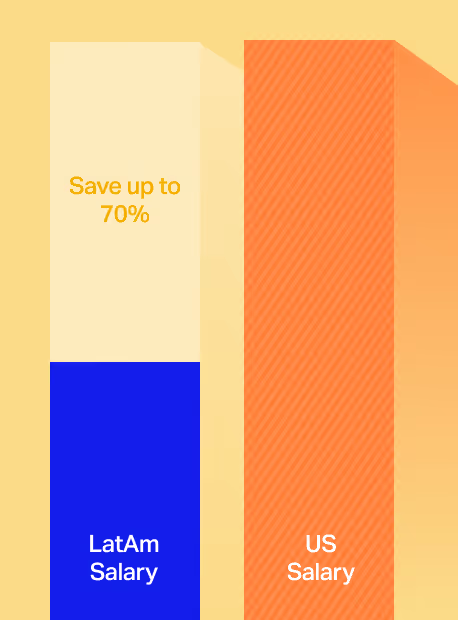
- A dedicated bookkeeper based in Latin America at the mid-level typically earns $2,500-$3,000 per month, which is 36-50% less than a US-based equivalent and comes without the administrative burden that managed outsourcing services put back on you.
- If you hire a bookkeeper based in Latin America through Hire With Near, the typical time to hire is under three weeks.
You're running a business, but bookkeeping keeps pulling you back to the desk. Transactions need categorizing, reconciliations are overdue, and tax season is a month away. Your options are to keep doing it yourself, hire a managed bookkeeping service, or bring on a dedicated bookkeeper who works for you full-time.
Each path works, but they have different processes, costs, and demands on your time. This step-by-step guide walks through how to outsource bookkeeping, what each service model involves in practice, and what it costs to hire a bookkeeper based in Latin America.
What Is Outsourced Bookkeeping?
Outsourced bookkeeping means hiring a third-party company or individual to handle all or part of your business's financial recordkeeping.
Instead of having an in-house bookkeeper, you'll have an external bookkeeping team or individual working remotely on your books.
Outsourced bookkeeping providers are usually equipped with the tools and expertise to manage your financial records accurately and efficiently.
How to Outsource Bookkeeping: A Step-by-Step Process
Outsourcing your bookkeeping is a practical, manageable process, but it goes more smoothly when you approach it in the right order. Here are the six steps.
Step 1: Identify which bookkeeping tasks to hand off
Start by listing what you currently do and what's taking the most time. Common tasks to outsource include:
- Bank reconciliation
- Accounts payable and receivable management
- Payroll processing
- Expense tracking
- Financial reporting
- Tax preparation
Not everything needs to be handed off at once. Many businesses start with the most time-consuming tasks (reconciliation, payroll) and keep higher-level decisions in-house until they trust their bookkeeper.
Step 2: Decide between a managed service and a dedicated hire
This is the most important decision in the process because each outsourcing model uses a completely different approach.
A managed bookkeeping service assigns your account to a shared team. You get the deliverables, but you don't own the relationship with the person doing the work. On the other hand, a dedicated hire is a full-time professional who works exclusively for your business, learns your processes, and becomes a real part of your team.
How can you know which is best?
For businesses with simple, low-volume books, a managed service can be enough.
For businesses with ongoing complexity, including multiple cost centers, regular payroll, and growing transaction volume, a dedicated hire typically delivers more continuity and less administrative back-and-forth.
See the section below on hiring your own bookkeeper in Latin America for a deeper comparison of these two models. Additionally, the in-house vs. outsourcing comparison guide covers the tradeoffs in detail.
Step 3: Evaluate your software stack
Make sure your bookkeeper will be able to work with the tools you already use. QuickBooks and Xero are the most common platforms in the US market. If you're using a more specialized system, confirm compatibility before committing to a provider or candidate.
Latin American bookkeepers are widely proficient in QuickBooks. If that's your platform, you'll have a large candidate pool to choose from. If you need a specialist, you can also hire a QuickBooks Expert with dedicated platform expertise.
Step 4: Set your budget and seniority requirements
Know what you can spend before you start vetting providers, as each level of expertise and experience can cost more. For reference, a junior bookkeeper handles data entry and reconciliation well, while a senior bookkeeper can take on financial reporting, tax prep, and higher-stakes decision support.
The cost section below has the full salary breakdown for US-based vs. Latin America-based bookkeepers at each level. Refer to it to see what you may spend on talent in your unique situation.
Step 5: Vet and select a provider or recruiter
For managed services, evaluate the provider's coverage, turnaround time, and how they handle errors. For a dedicated hire, work with a staffing firm that specializes in the role and the region.
Ask these key questions to help you narrow down the options:
- How many candidates can you present?
- What's your typical time to hire?
- How do you handle replacements if the fit isn't right?
For more details on these questions, see the guide on how to do offshore bookkeeping well, which gives you more advice on evaluating talent and choosing between offshore and nearshore models.
Step 6: Onboard your bookkeeper and establish reporting cadence
Onboarding a bookkeeper, whether through a managed service or as a dedicated hire, requires giving them access to your accounts, walking them through your categories and chart of accounts, and agreeing on a reporting cadence.
Set expectations up front: how often will you review financials together? Who do they contact for expense receipts? What's the turnaround time for ad-hoc requests?
Good onboarding takes a few hours of your time, but it’s well worth the investment. Skipping it costs you weeks of back-and-forth later and may cause your hire to make unnecessary mistakes in the first few weeks.
{{salary-guide-cta}}
What Are the Benefits of Outsourcing Bookkeeping?
Outsourcing bookkeeping gives growing businesses a few clear wins: lower total cost than a US hire, real-time help closing the books each month, and fewer compliance headaches for the leadership team.
1. Cost savings
Outsourcing your bookkeeping can save your business money in several ways. You won't have to bear the expense of hiring and training an in-house bookkeeping team. Many outsourced providers offer competitive rates because they specialize in bookkeeping at volume and operate in lower-cost markets.
I cover the cost of outsourced bookkeeping in more detail below.
2. Time efficiency
Bookkeeping can easily eat several hours a week. When you hand it to a specialist, you get that time back to sell, serve customers, and manage your team instead of chasing receipts.
Some businesses also use automation tools to extract data from bank statements, cutting down the time spent on manual data entry.
3. Access to specialized expertise
Outsourced bookkeeping providers have in-depth knowledge of accounting principles and practices. They can offer valuable insights and advice to help improve your business's financial management.
4. Scalability
As your business grows, so does the volume of financial transactions that need to be recorded and managed. Outsourced bookkeeping providers have the resources and flexibility to accommodate business growth without disruptions.
5. Reduced risk of errors
Bookkeeping mistakes can have severe consequences for a business, including penalties from tax authorities or inaccurate financial reporting. By outsourcing this task to financial experts, you can reduce the risk of errors in your financial records.
6. Data security
Outsourced bookkeeping providers have systems and protocols in place to help keep your financial data secure. It can give you peace of mind knowing that your sensitive information is in safe hands.
7. Access to the latest technology
Outsourced bookkeeping providers use advanced accounting technology and software to manage financial records efficiently. Outsourcing allows you to benefit from access to these tools without having to invest in them yourself.
8. Focus on core business functions
As a founder, you’re already juggling sales, hiring, and operations. Outsourcing your books removes one of the most tedious tasks from that list, so you can spend more of the week on work that actually grows the business.
9. Better financial management
With the help of outsourced bookkeeping, you can have a clearer and more accurate view of your business's financial health. This can help you make informed decisions and set strategic goals for the future.
10. Compliance with regulations
Outsourced bookkeeping providers are often well-versed in accounting regulations and can help keep your business compliant with financial reporting requirements as laws and best practices change.
{{state-latam-hiring}}
When to Consider Outsourcing Bookkeeping
It’s not always obvious when it’s time to get help with your bookkeeping. These five signs can alert you to the opportunity to simplify and save through outsourcing.
Limited time or resources
As a business owner, your plate is already full with managing day-to-day operations and making strategic decisions. If you find yourself struggling to keep up with bookkeeping tasks, it may be time to outsource.
Lack of expertise
Bookkeeping requires specialized knowledge and skills, as well as a close following of recent rule changes and regulations. Any mistakes can have serious consequences for your business's financial health.
If you or your team lack the necessary expertise in this area, outsourcing can provide access to bookkeeping professionals with the right qualifications and experience.
Cost savings
If you don't have the resources to hire a full-time bookkeeper in-house or want to avoid additional overhead costs such as employee benefits, training, and software expenses, outsourcing can be the cost-effective solution you're looking for.
Scalability
Do your bookkeeping needs fluctuate as your business goes through different seasons? With outsourced bookkeeping, you can easily scale up or down depending on your business's requirements without having to worry about hiring or letting go of staff.
Compliance concerns
If you're finding it overwhelming to follow complex regulations and tax laws in your industry, it may be a good time to outsource bookkeeping to professionals. This helps keep your records compliant with all relevant laws and regulations.
Pro tip: If you want to further simplify your financial processes, explore our QuickBooks Expert hiring page. It can connect you with professionals specifically proficient in QuickBooks for all your bookkeeping tasks.
What Services Do Outsourced Bookkeeping Providers Offer?
Outsourced bookkeeping services can range from basic data entry and bank reconciliation to more complex tasks, such as financial reporting and tax preparation. Some common services offered by outsourced bookkeeping providers include:
Accounts payable management
This involves managing your business's outgoing payments, such as bills and invoices. Outsourced bookkeeping providers can help you make sure all payments are made on time and accurately recorded in your books.
Accounts receivable management
Accounts receivable management involves tracking and collecting payments from your customers. Outsourced bookkeeping providers can help you simplify this process, keeping your cash flow healthy.
Payroll processing
Managing payroll can be time-consuming and complex, especially for small businesses. Outsourced bookkeeping providers can handle all aspects of your payroll, from calculating payroll taxes to issuing paychecks.
Bank reconciliation
Bank reconciliation compares your business's bank statements with its internal financial records to verify everything is accurate. Outsourced bookkeeping providers can help you reconcile your accounts regularly and identify any discrepancies so you can stay ahead of issues and remain compliant.
Financial reporting
Financial reporting is the process of compiling, reviewing, and interpreting your financial statements so you can clearly understand how your business is performing and where it may need adjustment.
General ledger maintenance
A general ledger is a record of all your business's financial transactions. Outsourced bookkeeping providers can maintain and update your general ledger, making sure all transactions are accurately recorded.
Tax preparation and filing
Preparing and filing taxes can be a time-consuming and complex process, and getting it wrong can result in costly fines or penalties. Outsourced bookkeeping providers have the knowledge and expertise to handle your business's tax needs, keeping you compliant with all relevant laws and regulations.
Expense tracking and management
Keeping track of expenses is important for maintaining your business's financial health. Outsourced bookkeeping providers can help you monitor and manage your expenses, as well as provide valuable insights into areas where you can cut.
Where to Outsource Bookkeeping: Why Latin America Stands Out for US Businesses
If you're considering outsourcing bookkeeping overseas, the country you choose matters more than most buyers realize, especially when it comes to day-to-day collaboration.
Mexico
Mexico is an increasingly popular destination for outsourcing in Latin America, including bookkeeping operations. The country has a well-educated and skilled workforce, and for businesses in the US, the working hour overlap is hard to beat — Central and Mountain time for most of the country, with no adjustment needed during core work hours.
Brazil
Brazil has a large pool of certified accountants and accounting graduates, making it an attractive option for businesses looking to outsource financial tasks. The country's accounting programs are rigorous and produce professionals experienced with international standards.
Argentina
Argentina is one of the most popular destinations for outsourced bookkeeping in Latin America, and for good reason. Accounting programs at Argentine public universities run five to six years and produce graduates who typically hold the equivalent of both a US accounting degree and postgraduate training.
The country also has a lower cost of living than the US, which contributes to the meaningful salary difference between US-based and Argentina-based bookkeepers. Also, Argentina's time zone puts it one to two hours ahead of the US East Coast. Because of this, real-time collaboration with US teams is practical and consistent.
The Philippines
The Philippines has a well-established accounting sector with many graduates and certified professionals. If you're currently using bookkeeping services in the Philippines or considering it, it's worth comparing the time zone trade-off.
Manila is 12-15 hours ahead of US time zones, which means same-day collaboration on urgent issues requires scheduling. Some businesses find this manageable; others find it adds friction they'd rather avoid.
Why Latin America specifically wins for US-based businesses
The consistent advantage Latin America holds over Asia-Pacific outsourcing destinations comes down to three things: overlapping working hours with US time zones, strong English proficiency across the professional workforce, and close cultural alignment with US business norms. You're not giving up collaboration speed for cost savings. You're getting both.
An Alternative to Outsourced Bookkeeping: Hiring Your Own Bookkeeper in Latin America
Managed bookkeeping services and dedicated hires both get your books done. The difference is in who owns the relationship with the person doing the work, and how much of the coordination load stays with you.
What managed outsourcing actually looks like day to day
With a managed bookkeeping service, you’re one client on a shared team’s roster. You don’t pick the person doing the work, and you can’t really coach them the way you would your own employee.
One founder who had been using an external accounting firm put it plainly: "When you use these accounting firms that you work with, they're good, but they put a lot of burden back on you, and it's not your team that's aware of it. So it ends up falling back on the principles of the company."
The same founder described the concrete reality of that burden: "At the end of the month, the accounting firm sends me a list of like 30 expenses, and I have to go and hunt those down and find the receipts."
This is the structural nature of a managed service. The firm does what they agreed to do; you handle the gaps.
What a dedicated hire looks like instead
A dedicated bookkeeper based in Latin America works for you, full-time, in your systems, on your schedule. They learn your chart of accounts. They know which vendors are recurring and which are one-offs. They flag unusual expenses before you have to ask.
Over time, they become part of the operational fabric of your business in a way a shared-team service never can.
One hiring manager who had tried offshore agencies summarized the preference this way:
"I want to own the employee. I want them to work for me."
That ownership model is exactly what hiring through a nearshore staffing firm like Hire With Near provides. You get a full-time professional based in Latin America who is your employee, not a contractor shared across clients.
Why the switch from offshore and managed services is accelerating
The data backs up this pattern. Hire With Near's research on 2,000+ hiring conversations found that 30% of companies switch to Latin America specifically after frustration with offshore providers. Finance & Accounting is the second most common department driving that switch, according to Hire With Near's Why US Companies Hire in LatAm Report.
Part of the structural story is the US talent supply. According to Accounting Today, the number of candidates sitting for the CPA exam has fallen 27% over the past decade, and accounting graduates declined by nearly 17% between 2016 and 2020. Hiring a dedicated bookkeeper at US rates is getting harder and more expensive. Latin America fills that gap at a fraction of the cost.
Latin American finance talent is trained to the same standards
FinanceWithin, a fractional finance firm based in Austin, Texas, had tried offshore hiring in India before coming to Hire With Near, and faced high turnover and inconsistent quality. After switching, they hired senior bookkeepers and accounting managers based in Latin America, filling multiple roles within days to support 10 new client engagements at once. The result: $535,000 in annual savings and a time-to-hire that dropped from three weeks to seven days.
Miles Eggart, COO of FinanceWithin, summed it up: "Partnering with Near has been a major win. The speed, talent pool, and quality have raised our expectations."
Sheena Malson, FinanceWithin's Director of Accounting, added: "The talent pool from Near has been outstanding. Far beyond what I could find on LinkedIn."
The quality holds up because the underlying academic training is strong. Argentina, where about 80% of placed finance candidates are based, produces graduates from five- to six-year university accounting programs. Many have exposure to Big Four firms and international standards, including US GAAP and IFRS. QuickBooks proficiency is also widely available across the region.
To understand the full picture of what dedicated offshore bookkeepers bring to US businesses, see the overview of the benefits of offshore bookkeepers.
How Much Does Hiring a Bookkeeper in Latin America Cost?
Latin America is consistently one of the most cost-effective options for US businesses, with the added benefit of real-time time zone overlap.
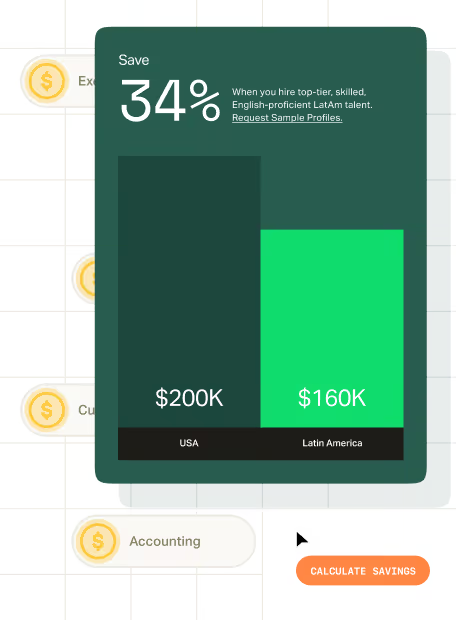
According to Hire With Near's 2026 State of LatAm Hiring Report, companies hiring bookkeepers based in Latin America save 55-69% annually compared to US-based equivalents.
In my five years sourcing finance talent at Hire With Near, I've seen that figure hold across seniority levels and industries.
The savings are real, but the smarter framing is that you're getting a professional with equivalent training at a salary that reflects Latin American market rates. It’s not a cheaper version of a US hire.
The table below shows current compensation benchmarks for bookkeepers at each level:
In practice, this means the budget you'd spend on a single mid-level US bookkeeper ($47,000-$72,000/year) covers a mid-level Latin American bookkeeper for two full years, or a mid-level and a junior simultaneously. It’s not a cost cut as much as it's a different level of coverage for the same spend.
For more on how these rates compare across the full range of accounting and finance roles, see the accounting roles salary guide and the Latin America salary guide.
One practical note on seniority: sometimes clients want to pay a junior rate and expect a senior-level candidate. Latin American finance professionals have real exposure to international markets and Big Four firms, so their expectations reflect that.
A more useful approach is often to hire a high-potential mid-level candidate, pay them competitively for the market, and invest a bit in onboarding. That combination tends to produce better long-term outcomes than pushing for the most senior profile at the lowest possible rate.
For companies specifically looking to hire bookkeepers through a Latin American staffing firm, the guide to the best staffing firms for hiring bookkeepers in LatAm covers the key players and how to evaluate them.
For companies that need a Controller, CFO, or Director of Finance in addition to bookkeeping support, Hire With Near's executive search in Latin America service handles senior finance hiring at that level as well.
Hire With Near is also recognized as one of the leading accounting recruiting services for US companies that want a dedicated, long-term hire rather than a managed service contract.
If you'd like to hire a bookkeeper in Latin America through Hire With Near, the typical time to hire is under three weeks.
For a full breakdown of what outsourced bookkeeping costs depending on service type and provider, see outsourced bookkeeping cost.
Final Thoughts
Outsourcing your bookkeeping comes down to a decision between two models: a managed service that handles your books as one account among many, or a dedicated full-time bookkeeper who works exclusively for your business.
Both options remove the work from your plate. The difference is in how much coordination stays with you and how integrated that person becomes with your team.
For many small and mid-sized businesses, the dedicated hire model, particularly when the bookkeeper is based in Latin America, delivers more continuity, lower long-term cost, and less administrative friction than a managed service.
If you're ready to move forward and consider hiring a bookkeeper in Latin America, schedule a free, no-commitment consultation call.
{{latam-hiring-cta-v2}}
Frequently Asked Questions
How much does it cost to outsource bookkeeping?
A full-time bookkeeper based in Latin America typically costs $1,800–$5,000 per month, depending on seniority. That’s usually 36–57% less than a comparable US hire, with similar training and experience.
For a full breakdown of pricing by service type and provider, see the outsourced bookkeeping cost guide.
When should I outsource my bookkeeping?
Outsourcing makes sense when bookkeeping is taking more time than you can afford, when errors are creating compliance risk, or when you're scaling faster than your current setup can handle. Most small business owners reach the outsourcing threshold when monthly transactions exceed what they can reasonably manage themselves, or when they find themselves delaying financial decisions because the data isn't current.
Can I use software like QuickBooks to do my business bookkeeping?
Yes, you can use software tools like QuickBooks to handle basic bookkeeping needs. However, knowledge and experience are required to use it effectively. While bookkeeping software alone may be enough for small businesses with simple bookkeeping requirements, working with a bookkeeping provider that has advanced bookkeeping knowledge makes sense once your functions become more complex.
Outsourced bookkeeping providers usually know various accounting tools, including QuickBooks.
How do bookkeepers work remotely?
Bookkeepers can work remotely by using cloud-based accounting software. This allows them to access your financial records securely from anywhere with an internet connection while enabling you to save on overhead costs associated with hiring on-site bookkeepers.
Is AI replacing bookkeepers?
No, AI is not replacing bookkeepers, but it is changing what they spend their time on. AI tools now handle transaction categorization, duplicate flagging, and routine report generation.
What they don't replace is the judgment, context, and client-facing communication that make a bookkeeper valuable. Most businesses using AI accounting tools still need a human bookkeeper to review outputs, handle exceptions, and translate the numbers into decisions. AI is more accurately described as a productivity tool for bookkeepers than a replacement for them.
What are the best bookkeeping outsourcing services?
The top bookkeeping outsourcing services for small businesses in 2026 include Bench, Pilot, Bookkeeper360, and several nearshore staffing firms for companies that want a dedicated hire rather than a managed service.
Your best option depends on whether you need a full-service firm handling your books on their schedule, or a dedicated full-time bookkeeper who works in your systems and on your team. For a curated comparison of the leading options, see the best bookkeeping outsourcing services, which covers the top providers across both categories.
What staffing firms help you hire a bookkeeper in Latin America?
Several staffing firms specialize in placing bookkeepers based in Latin America for US companies, with Hire With Near among the most active. For a full comparison of options, the best staffing firms for hiring bookkeepers in LatAm guide covers placement speed, pricing models, and what to look for in a recruiting partner.
What outsourced bookkeeping providers do CPA firms use?
CPA firms commonly use specialized bookkeeping outsourcing providers that understand accounting firm workflows and can handle client-facing tasks like reconciliation, month-end close, and financial statement preparation.
For a breakdown of the top options specifically for accounting and CPA firms, see outsourced bookkeeping providers for CPA firms.
What industries commonly outsource their bookkeeping to Latin America?
Almost any US industry can benefit from LatAm bookkeepers, but demand is highest where financial accuracy and real-time collaboration matter most. If you're in fintech, LatAm bookkeepers handle transaction volume and compliance requirements at scale. Real estate companies use them for property-level accounting and rent roll management. SaaS businesses hire them for subscription revenue recognition and monthly close. Manufacturing and healthcare are also among the most active categories. Time zone overlap with US teams and strong English proficiency make LatAm bookkeepers practical across all of these verticals. For companies in financial services specifically, Hire With Near also serves finance industry clients looking for dedicated accounting talent.
How do I hire offshore bookkeeping talent?
Hiring offshore bookkeeping talent involves choosing your target region, setting seniority and software requirements, and working with a recruiter or staffing firm that specializes in that market. For a step-by-step breakdown of the process, including how to evaluate candidates and what to look for in a nearshore vs. offshore model, see how to hire offshore bookkeeping talent.
What other Finance & Accounting roles can I hire for with professionals based in Latin America?
Beyond bookkeepers, US companies hire a wide range of finance and accounting professionals based in Latin America, including accountants, accounts payable specialists, controllers, financial analysts, and payroll specialists. Latin American finance professionals typically bring the same technical depth as their US counterparts, with better time zone alignment than offshore alternatives and meaningful cost savings across all seniority levels.






.webp)
.webp)


%203.svg)
.avif)





%20(1).avif)

%20(1).png)