


%203.svg)
Key Takeaways
- Nearshore customer support outsourcing offers a balanced solution, combining cost savings with high-quality, culturally aligned customer service from nearby countries.
- Nearshore contact center companies provide technical support, order management, complaint resolution, and multilingual assistance, enabling businesses to focus on core activities.
- Ideal scenarios for outsourcing to a nearshore provider include when you are experiencing rapid business growth, have limited in-house resources, need a cost-efficient option, deal with seasonal fluctuations, or require multilingual support.
Your support tickets are piling up, but hiring qualified customer service reps is getting harder and more expensive to hire locally.
Outsourcing makes sense for many companies. But as soon as you start looking at your options, you’re faced with a sea of companies with different services, pricing models, and promises. Which one will actually deliver what your business needs?
This guide breaks down the top customer service outsourcing companies, what to look for when choosing a partner, and how to set your partnership up for success
What Is Nearshore Customer Support Outsourcing?
Nearshore customer support outsourcing refers to the business practice of transferring a portion or all of your customer service operations to a neighboring or nearby country, often within a very similar time zone.
In many ways, nearshoring is a middle ground between onshore outsourcing, where services remain within your home country, and offshore outsourcing, which typically involves partners in distant locations, often with significant time zone differences.

What Do Nearshore Customer Care Companies Do?
A nearshore customer care company can provide a wide range of support services. It serves as an extension of your customer service team, offering seamless integration and ensuring that customer interactions maintain high quality and satisfaction standards.
Here are some of the functions they typically perform:
- Customer inquiries: Addressing customer questions, resolving issues, and providing product or service information
- Technical support: Troubleshooting assistance and instructions for customers navigating complex issues with technical products or software
- Order processing: Placement, tracking, and management of incoming orders
- Complaint resolution: Managing customer complaints and ensuring satisfaction
- Billing support: Assisting customers with billing inquiries, payment processing, and any related issues
- Customer retention: Initiatives designed to keep customers engaged, like follow-up calls, surveys, loyalty programs, and special promotions
- Sales support: Helping with upselling and cross-selling opportunities by identifying customer needs
- Multilingual support: Providing support in multiple languages for a diverse customer base
- Data collection: Gathering customer feedback, tracking performance metrics, and analyzing data to provide valuable insights
- Knowledge base management: Maintaining and updating a comprehensive knowledge base or FAQ section for self-service options using modern knowledge base software
By handling these different functions, nearshore customer care companies enable you to concentrate on your core activities, innovate, and grow.
Benefits of Nearshore Customer Support Companies
Partnering with a nearshore customer support company can offer numerous benefits. Here are a few of them:
Closer proximity
One of the most significant advantages of outsourcing customer support to a nearshore location is geographical proximity. Operating within the same or similar time zones allows for real-time communication and faster response times, enhancing collaboration and overall efficiency.
Time zone alignment can be especially important in customer service if your customers are located close to your business geographically.
This closer proximity also enables more frequent and convenient face-to-face meetings if necessary, fostering better relationships and quicker problem resolution.
Cultural understanding
Nearshore call center outsourcing companies often share cultural similarities with businesses in the United States. This cultural compatibility leads to a deeper understanding of customer attitudes, preferences, and expectations. These similarities are crucial in delivering personalized, empathetic support.
A culturally attuned support team can provide a more intuitive and satisfying customer experience, as they are better equipped to handle nuances and subtleties specific to your market.
Lower costs
Onshore services can be prohibitively expensive, and offshore services may come with hidden costs related to quality and communication barriers. Nearshore outsourcing balances substantial cost savings and a high quality of service.
Lower operational and labor costs in Mexico and other Latin American countries translate into more affordable support services without sacrificing competency.
Bilingual workers
In many nearshore countries, there is a high availability of bilingual and multilingual workers. Argentina, for instance, ranks 28th in the world in English language proficiency, even ahead of countries like Switzerland, Spain, and France.
Bilingual support teams can provide more effective communication and an improved customer experience for a wider audience.
Scalability
A nearshore contact center company offers the flexibility to scale operations up or down based on your changing needs. Whether you’re experiencing seasonal surges in customer inquiries or planning to expand your service offerings, remote customer service providers can quickly adjust their resources to meet demand.
This scalability ensures that your customer service operations remain agile, capable of adapting to market changes, and supportive of your business growth.

When Should You Outsource Customer Service to a Nearshore Customer Support Company?
Is partnering with a nearshore customer support company the right choice for your business? Here are some common scenarios where outsourcing makes strategic sense:
You’re undergoing rapid growth
If your business is experiencing a period of fast growth, it’s challenging to scale internal customer service teams quickly enough to keep up.
A nearshore customer support team can provide the additional resources and skilled workforce needed to handle higher volumes of customer inquiries without compromising the quality of service provided.
You have limited in-house resources
Many businesses—from startups to larger enterprises—face extremely limited resources, with customer care employees leaving their organizations more quickly than they did before the pandemic.
If your company faces constraints in manpower, budget, or infrastructure, maintaining an in-house team can be difficult.
Nearshore outsourced contact center services provide access to a larger talent pool of skilled contact center agents and technical resources.
You need to keep costs low
If you’re looking to reduce operational expenses while maintaining (or improving) service quality, you should consider nearshore outsourcing for your customer service. The savings realized from workers’ lower salary expectations can significantly impact your bottom line.
Your customer experience needs work
Improving customer experience has been found to bring a suite of advantages, including cost savings, higher revenue, and increased customer loyalty.
If your current customer service operations are struggling to meet expectations, partnering with a nearshore vendor can bring fresh expertise and innovative practices. Enhanced training, better tools, and new perspectives can greatly enhance customer satisfaction.
Your technology is outdated
If your company lacks the infrastructure or technical expertise to support evolving customer service tools, nearshore outsourcing can bridge the gap. Many nearshore support companies invest in and use state-of-the-art tech, ensuring your customers and clients benefit without you needing to make an internal investment.
Why You Should Consider an Alternative to Outsourcing Customer Support: Hiring Your Own Customer Support Reps in Latin America
Traditional customer service outsourcing means handing off your support operations to a third-party provider who manages shared teams across multiple clients.
Building your own remote customer support team means hiring dedicated professionals who work exclusively for you (usually with the help of customer service recruiters). These hires are your employees, fully integrated into your company culture and systems, just based in another country.
Here's what changes when you build your own team instead of outsourcing:
- Complete control over quality and processes. Your team follows your standards, uses your systems, and represents your brand directly. There's no middleman interpreting your requirements or splitting attention across other clients.
- Dedicated team members who grow with your business. These aren't shared resources—they're your employees who learn your products deeply, understand your customers' needs, and build institutional knowledge over time.
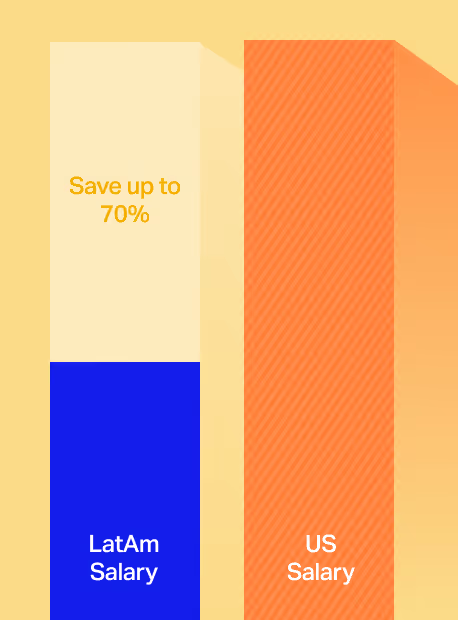
- Similar cost savings without the outsourcing markup. You get the same 30–70% cost reduction compared to US salaries, but without paying a premium to an outsourcing company. You set the salaries directly based on market rates in Latin America.
- Cultural integration and alignment. Your Latin American team members participate in company meetings, collaborate with other departments, and feel like part of the organization—because they are. This cultural cohesion translates into better customer experiences.
- Time zone alignment that enables real-time collaboration. Most Latin American countries operate within 0-3 hours of US time zones, making it easy to coordinate with your team, provide training, and handle escalations during overlapping business hours.
The tradeoff is that you need to handle team management directly rather than delegating it to an outsourcing provider. But for companies that want ownership over their customer experience and value building long-term team assets, hiring your own remote support professionals in Latin America offers a compelling alternative to traditional outsourcing.
Near’s report on the top reasons US companies hire in Latin America gives more insight into the growing trend of hiring in this region.
Final Thoughts
Outsourcing customer service to a nearshore company offers a practical way to scale support operations, reduce costs, and access bilingual talent pools. For many businesses, traditional outsourcing providers deliver exactly what they need—quick capacity, professional management, and predictable monthly costs.
But outsourcing isn't your only option for accessing Latin American talent.
If you want complete control over your customer experience, prefer dedicated team members who work exclusively for your company, and value building institutional knowledge over time, consider hiring your own customer support professionals in Latin America.
You get the same cost savings and time zone advantages as outsourcing, but with team members who are fully integrated into your culture and committed to your success.
If traditional outsourcing fits your needs, check out our list of the 15 best customer service outsourcing companies in 2026 to find providers that specialize in nearshore support operations.
If you want to build your own dedicated support team, Near can help you hire pre-vetted bilingual customer service professionals in Latin America who work exclusively for your company. We handle recruitment, vetting, compliance, and payroll while you maintain direct management of your team.
Get a list of pre-vetted candidates to see the caliber of talent we can find you. There’s no commitment, and with Near, there is nothing to pay until you hire.
Frequently Asked Questions
What's the difference between outsourcing customer service and hiring my own remote team?
Outsourcing means contracting with a third-party provider who manages shared support teams across multiple clients. Hiring your own remote team means recruiting dedicated customer service professionals who work exclusively for your company as your employees.
With outsourcing, the provider handles management and quality control. With direct hiring, you maintain complete oversight while a partner like Hire With Near handles recruitment, compliance, and payroll. Both approaches offer access to Latin American talent and similar cost savings—the choice depends on whether you prioritize hands-off convenience or direct control over your customer experience.
How do I find qualified customer service professionals in Latin America?
If you're considering building your own team rather than outsourcing, working with specialized staffing and recruiting companies can dramatically reduce your hiring timeline.
These firms maintain pre-vetted talent pools, handle initial screening for technical skills and English proficiency, and present candidates who match your specific requirements.
Companies typically receive candidate profiles within days rather than spending weeks or months sourcing independently. Look for recruiters with deep networks in customer service talent and experience placing professionals with US companies.
Do Latin American customer service reps have strong English skills
This is one of the most common concerns companies have when considering Latin American talent for customer-facing roles.
The short answer is yes—but you need to screen carefully. Countries like Argentina rank 28th globally in English proficiency, ahead of Spain, France, and Switzerland. However, English skill levels vary significantly by individual, so thorough language assessment during hiring is critical.
Many Latin American professionals have worked with US companies, understand American business culture, and can communicate clearly with minimal accent. For detailed answers to this and other common questions, check out our guide: “Will They Have Good Internet?” and Other Questions Customer Service Managers Ask About Hiring Customer Support Reps in Latin America
How much can I realistically save by hiring remote customer service talent?
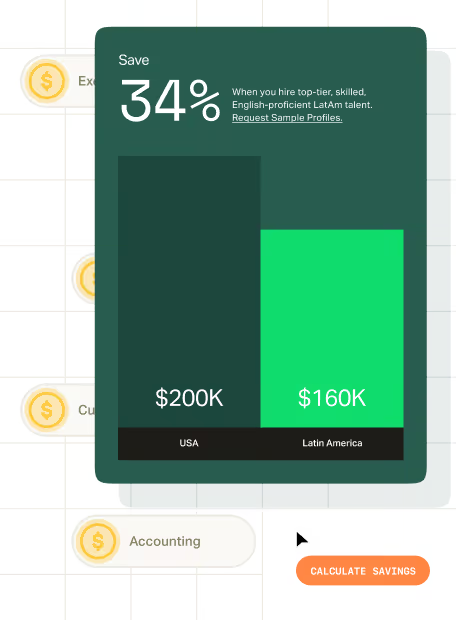
Cost savings vary by role and location, but US companies typically save 30–70% compared to equivalent US salaries when hiring in Latin America.
A customer service representative earning $51,000-58,000 in the US might cost $18,000-24,000 in Argentina or Colombia. According to Hire With Near's State of LatAm Hiring Report, customer success professionals are among the most commonly hired positions in the region, with proven retention rates.










%203.svg)
.avif)





%20(1).avif)

%20(1).png)