%203.svg)
Key Takeaways
- Hiring offshore .NET developers in Latin America means salary expectations between $48K and $108K a year at the mid and senior levels for experienced C# and ASP.NET Core engineers, against $87K to $189K for the same experience in the US.
- Screen for professional C# and ASP.NET Core experience specifically, verified with one small real-world coding task, plus the ability to explain a technical decision to a non-developer.
- Latin America is the strongest offshore destination for a .NET hire when you need real-time collaboration, because your developer is online during your business day rather than handing work off overnight.
Companies hire offshore .NET developers when a senior C# engineer who can own a Microsoft-stack system is too hard to find at a US budget, and Latin America is where most of that search lands. These are the developers behind the back-end systems, internal tools, and enterprise software a company runs on, work that is expensive to staff and more expensive to get wrong.
In most US markets right now, qualified and affordable rarely show up in the same candidate. Hiring offshore widens the search to developers who have spent years maintaining production .NET systems for US teams, at a salary that closes the gap a local search couldn't, and you can do it in weeks instead of carrying a two-month vacancy.
This guide covers what the role costs, which offshore destinations fit which teams, what to screen for, and how to work with a staffing and recruiting partner to get the right hire onto your team.
What Does an Offshore Dot Net Developer Do?
An offshore .NET developer builds and maintains applications on Microsoft’s .NET platform from another country, usually writing C# with ASP.NET Core on the back end, storing data in SQL Server, and deploying to Azure.
Dot net developer, .NET developer, and NET developer all describe the same role.
The work falls into four buckets:
- Internal line-of-business applications, the tools your operations, finance, or support teams run on.
- The APIs behind a web or mobile front-end.
- ASP.NET Core services behind SaaS products, which is why nearshore SaaS recruiting so often comes down to C# depth.
- Modernizing legacy .NET Framework applications onto .NET 8 or later, one of the most common reasons a US company starts this search.
One distinction decides whether your job description attracts the right people: do you need a back-end .NET specialist or a full-stack developer who also owns the front end?
Back-end developers who live in C# and Entity Framework are a different candidate pool from full-stack generalists. Decide which before you write the posting.
Most .NET teams also deploy to Azure, so settle early whether you need dedicated Azure developers or a .NET developer with solid DevOps habits.
What Are the Benefits of Hiring Offshore .NET Developers?
The biggest benefit is plain: hiring a senior .NET developer offshore often costs less than hiring a mid-level one in the US, and you can do it without a six-month search. Offshore here means a full-time developer based in another country who works as part of your team, not a vendor you hand a spec to.
1. Cost efficiency
The savings you get by hiring a professional from Latin America or Southeast Asia instead of the US aren’t a discount on quality. A developer’s salary tracks the cost of living where they work, not the value of the work itself.
It’s the same reason hiring a software engineer in Austin costs less than placing one based in San Francisco despite doing comparable work.
2. Access to global talent
A local search is capped at whoever’s actively job-hunting in your city right now. Offshoring opens up developers who’ve spent years maintaining production .NET systems for US companies, people who aren’t visible to a local search because they were never looking locally to begin with, and who often bring more hands-on experience with your specific stack than a candidate from a smaller domestic pool would.
3. Faster time to market
Filling a role takes time. SHRM’s 2026 recruiting benchmarking, drawn from more than 4,600 organizations, puts the median time to fill a nonexecutive role at 39 calendar days, down from 44 a year earlier. US hiring is getting faster overall, but a search for a senior .NET engineer still runs long, because the qualified shortlist is thin.
Hiring from an existing pipeline is what shortens it: at Hire With Near, most companies see a candidate shortlist in three to five days and hire in under three weeks.
4. Scalability and team focus
As the roadmap grows, you can add dedicated .NET capacity without constantly rebuilding your recruiting pipeline, while your in-house team stays focused on their core responsibilities instead of taking on additional development work.
5. Diverse perspectives
A developer who’s spent their career solving problems in a different market brings approaches your local hires haven’t been exposed to, shaped by different constraints, different-scale systems, and different company stages along the way.
Offshore hiring is often the fastest way to add that range to your team, since it opens up experience your local hiring pool simply doesn’t have.
6. Reduced project risk
A senior offshore hire brings the same habits any experienced developer would: code review, test coverage, and release discipline that keep small mistakes from becoming outages.
The difference is where you can find that experience for the price. A domestic search at your budget often means settling for someone still building those habits. With offshore hiring, the same budget reaches someone who’s already had years to build them.
7. Access to modern tooling and cloud platforms
Strong .NET developers work in current versions: .NET 8 or later, Entity Framework Core, containerized deployments, and Azure pipelines. That keeps your application out of a framework nobody wants to maintain.
Offshore hiring widens the pool of developers who’ve worked in that current stack day to day, since a local search can leave you choosing between paying up for someone current or settling for someone who’s fallen a version or two behind.
8. Real-time collaboration during your workday
Pick your destination well and your .NET developer is online while your team is working, whether your office runs on Pacific, Mountain, Central, or Eastern time.

A developer in Latin America overlaps most or all of a US workday, so stand-ups happen live, a blocked pull request gets an answer within the hour, and handoffs happen while everyone’s actually at their desk.
Eastern Europe buys you a few overlapping hours in the morning, workable but tighter. Southeast Asia puts your developer’s workday on the opposite side of the clock from yours entirely, so most communication becomes next-morning, not same-hour.
That last option isn’t automatically wrong. Around-the-clock coverage is a real trade-off, useful for teams that want asynchronous handoff, someone picking up where your team left off overnight. Most product teams don’t want that; they want a developer in the same conversation as everyone else, not a relay.
How Much Does It Cost to Hire an Offshore .NET Developer?
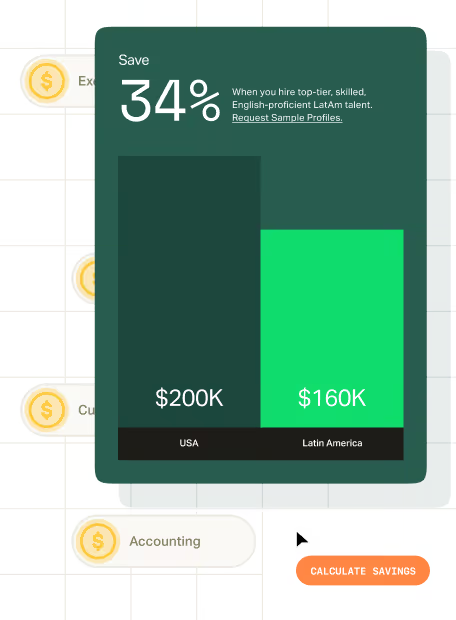
Hiring an offshore .NET developer in Latin America costs $48K to $72K a year at mid-level and $72K to $108K at senior level, against $87K to $157K and $106K to $189K for the same experience in the US. That’s a 43% to 54% reduction on the experienced end of the range.
These Latin America bands come from Hire With Near's own placements, not published averages or a vendor's asking rate, which is why we lead with them.
Other regions follow a predictable pattern: South and Southeast Asia sit lowest on cost, while Eastern Europe and Latin America run in a similar range above them. The destinations section below covers where each one lands, and why the workday overlap is usually worth the difference.
To put that in concrete terms, here’s what hiring a .NET developer costs compared to equivalent US hires, according to Hire With Near’s salary benchmarks:
For the most up-to-date figures, see Hire With Near’s US vs Latin America Salary Guide.
Across the placements in Hire With Near’s 2026 State of LatAm Hiring Report, 98% of engineering hires were mid-level or senior, split 51% senior and 47% mid-level. Offshore does not mean junior.
Besides geography, three things move the number: seniority, whether the role needs Azure and DevOps depth on top of C#, and whether the brief is back-end only or full-stack. Be honest about which you need.
Rate is also not the same as cost. A developer you hire at the bottom of the band and replace in month four is the expensive hire: you pay the salary, the second search, and three months of roadmap that didn’t move.
For the wider view, our IT Roles Salary Guide: US vs Latin America covers the rest of the engineering stack.
{{latam-hiring-calculator}}
What Are the Skills To Look for in an Offshore .NET Developer?
Three things decide this hire: real professional depth in C# and ASP.NET Core, database skills that go past writing queries, and the ability to explain a technical decision to someone who isn’t a developer.
Technical depth is half the brief. Let’s start with this side:
- Proficiency in .NET languages: A strong .NET developer should be fluent in C# or VB.NET, the primary languages for the framework. These skills allow them to write efficient, clean, and maintainable code for a variety of applications. Most teams hiring for a .NET role are really hiring C# developers, since that’s where nearly all new .NET work happens.
- Experience with ASP.NET framework: ASP.NET Core expertise is the core of the job: it’s what your web applications and APIs are built on. A developer who has run it in production has already solved authentication, caching, and load handling once, so your team isn’t learning that on your roadmap.
- Client-side technologies: A professional .NET developer should also understand front-end technologies like HTML, CSS, and JavaScript, enough to build and debug the interface their API feeds.
- Database management skills: Knowledge of database management systems like SQL Server or Oracle is a must. Your offshore .NET developer should be able to design, query, and optimize databases so your applications stay fast and reliable under load. On data-heavy products, some teams hire dedicated SQL developers alongside their .NET engineers.
- Understanding of object-oriented programming: Object-oriented programming (OOP) is fundamental to .NET development. A developer with a solid grasp of OOP principles can create reusable, modular code that simplifies maintenance and future upgrades.
- Familiarity with development tools and frameworks: Proficiency in tools like Visual Studio and frameworks like Entity Framework improves a developer’s efficiency. The debugger and profiler are how a developer finds a slow query instead of guessing, and Entity Framework migrations are how schema changes ship without hand-written SQL.
- Knowledge of system architecture and design patterns: Your .NET developer should also understand various design patterns and architectural principles like model-view-controller or microservices. That way, your application can stay structured, scalable, and future-ready.
- Testing and debugging skills: Every professional developer should have a knack for testing and debugging their own work. Familiarity with tools like NUnit or MSTest is what keeps critical bugs from reaching release.
- Agile methodologies experience: Experience working within agile frameworks, such as Scrum or Kanban, helps developers adapt to project changes. It also means they can work inside your sprint from week one and raise a blocker in the standup rather than at the end of it.
The other half is whether the developer can work inside your team.
- Strong problem-solving abilities: .NET work is mostly diagnosis, so ask for a specific problem the candidate chased down and what the cause turned out to be.
- Excellent communication skills: In a remote team, most of a developer’s decisions get explained in writing before anyone sees the code. Listen for whether a candidate can describe a tradeoff in plain language; someone who can will hold their own in a code review and with the people who use what they build.
- Willingness to learn: Technology evolves quickly, which is why the right .NET developer keeps learning: ask what they picked up in the last .NET release and where they used it.
In the conversations I have with Hire With Near’s developer recruiters, two signals come up before anyone talks about frameworks. Our Recruitment Consultant, Natasha Tarapow, describes the first:
We always ask candidates to tell us about a project they’ve worked on, not just that they use this language and that one, but what their role was and what they actually did. It’s important that they can explain their work to someone who isn’t a developer. If they can do that, that tells me a lot.
— Natasha Tarapow, Recruitment Consultant, Hire With Near
The second is a resume pattern. Our recruiters read two or three concurrent jobs as a red flag instead of a badge, and treat a claimed proficiency spread across an implausible number of frameworks the same way. A candidate who can name what they owned, and what they got wrong, beats one whose skills list covers everything.
A specialist software developer recruitment agency screens for all of this before a resume reaches you, but if you want to familiarize yourself with the process, read our How to Hire .NET Developers guide.
What Are the Interview Questions to Ask .NET Developer Candidates?
Four questions separate a real senior .NET developer from a resume:
- How do you handle dependency injection and service lifetimes in ASP.NET Core? A good answer names singleton, scoped, and transient, then gives an example of picking the wrong one and what broke.
- How would you diagnose a memory leak or garbage collection pressure in a long-running .NET service? Listen for a method: measure first, capture a dump or profile it, then find what’s holding references.
- When do you use Entity Framework Core, and when do you drop to raw SQL? Strong candidates describe a hot path where they moved to SQL and why.
- How would you approach migrating a .NET Framework app to .NET 8 or later? The answer should be incremental: inventory dependencies, move shared libraries first, run both side by side. A big-bang rewrite is the wrong answer.
Then, verify the answers with one small real-world coding task reviewed together on a call. Aside from technical interview questions, include ones that uncover their problem-solving abilities, approach to teamwork, and ability to adapt to challenges.
A technical product lead at a small B2B SaaS company told us why the technical half can’t be skipped:
We've found that we need to go through and do a deep technical interview to make sure, when they say that they have done these C# projects, that they really know C#. So when I say interview, what I’m really looking for is: is the person a good communicator? Will they fit in on the team?
Start with the questions any developer hire needs:
- Can you explain your experience with .NET frameworks? Look for detailed answers about the frameworks they’ve worked with.
- How do you handle tight deadlines or unexpected challenges? The best candidates will share examples of staying calm under pressure and delivering results.
- Can you walk us through your debugging process? Their response should show structured thinking and attention to detail.
- What tools and technologies do you use regularly? Answers should reflect familiarity with the essential tools and testing frameworks.
- How do you stay updated with new technologies? Candidates who engage in continuous learning demonstrate long-term value.
What do tech leaders ask before the technical questions start?
Whether the developer will be online when their team is. In the conversations our recruiters have with US engineering leaders, that question comes before anything technical, because it decides whether the hire fits how the team already works.
The honest answer depends on destination: a developer in Latin America is at their desk during your business day, wherever your team sits in the US, while a developer on the other side of the world is finishing as you start.
Test it rather than taking a promise. Ask the candidate how they personally handled stand-ups and code review across time zones on their last remote team, and listen for a working pattern rather than an offer to be flexible.
For more on what technical leaders raise, see the questions tech leaders ask about hiring developers in Latin America.
Where Are the Best Offshore Destinations To Hire .NET Developers?
US companies realistically compare four destinations when they hire offshore .NET developers: India, the Philippines, Eastern Europe, and Latin America.
The choice gets decided by workday overlap far more often than by rate. In Hire With Near’s analysis of more than 2,000 hiring conversations with US companies, 30% cited time zones as the reason for switching from offshore to nearshore.
India
India has the deepest .NET talent pool of any offshore market and the lowest rate band, with Microsoft-stack experience that runs long and enterprise-scale.
The constraint is the working day: India sits 9.5 to 10.5 hours ahead of US Eastern time, depending on US daylight saving shifts. Because of that offset, live schedule overlap is reduced to a thin window at either end of the day, causing code reviews and handoffs to run on an overnight cycle.
A founder running engineering through a team in India described what that costs:
They did a pretty decent job refactoring a lot of code, to be honest. It’s just, you lose a day. You lose a day every single time just from a message. I can’t do that anymore, at least for the engineer.
The code was good, the problem was the clock.
Eastern Europe
Poland, Ukraine, and Romania have strong .NET communities and a long history of Microsoft-stack work for US and Western European clients, with mid-range rates and consistently good technical English.
Overlap is the trade-off again, though better than Asia: a Central European workday is largely done by the time a US West Coast team logs on, and an East Coast team gets a morning window at best.
The Philippines
The Philippines is strongest on English fluency and familiarity with US business norms, with competitive rates and a large IT services sector. That sector is weighted toward support and business process work rather than Microsoft-stack engineering, so senior .NET supply is thinner here.
The Philippines is 12 to 13 hours ahead of US Eastern Time, depending on US daylight saving time shifts. Because the working day sits directly opposite a US schedule, code reviews and handoffs run on an overnight cycle.
Latin America
If real-time collaboration matters to you, this is the region that solves it. Brazil, Mexico, Colombia, and Argentina each have a substantial developer population with .NET depth, built on years of enterprise and financial-services work that leaned heavily on the Microsoft stack.
Cost lands above India and roughly in line with Eastern Europe, so this isn’t the cheapest option on the list. What you’re paying for is the difference between a developer who’s in the same conversation as your team all day and one who hands off work at the end of their shift and picks up questions the next morning.
Demand is heavy enough that IT and tech recruiting in Latin America is now its own specialty.
Here’s how the four compare:
We go deeper on the closest calls in hiring remote talent in Latin America vs India, Latin America vs Eastern Europe, and Latin America vs the Philippines.
For most teams hiring one full-time .NET developer to work inside an existing sprint, the shortlist narrows to Latin America.
Why Hire Offshore .NET Developers in Latin America?
Latin America wins a .NET hire on one thing above all: your developer is working while you are. The regional tech industry is growing fast, driven by strong education systems and heavy US demand, so it isn’t hard to hire Latin American developers with the .NET skills you need.
Overlapping working hours
Most pairings share nearly the whole workday, and the widest one, a West Coast team and a developer in Argentina or Brazil, still shares a solid morning-to-midday block. Exact gaps shift with where you sit and the time of year, since most of Latin America no longer observes daylight saving.
The practical difference: a question asked at 2 p.m. gets answered at 2 p.m., not tomorrow.
Our guide to hiring remotely in Latin America covers core collaboration hours.
Cultural alignment
Latin American .NET professionals often share similar cultural values and work styles with businesses in the US. In practice, that shows up in small things: direct feedback lands the way it was meant, meetings start on time, and turnaround expectations don’t need spelling out.
In the video below, our CEO and Co-founder Hayden Cohen explains how to spot cultural fit during a job interview:
Strong technical skills
The talent pool here has numbers behind it. GitHub’s Octoverse 2025 report counts 6.89 million developer accounts in Brazil, the fourth-largest developer population in the world, plus 3.2 million net new accounts across Latin America in a single year, with Brazil, Mexico, and Colombia driving the growth.
GitHub’s 2024 edition, the last time it broke the region out country by country, counted more than 1.9 million accounts in Mexico (up 21% year over year), more than 1.1 million in Argentina (up 22%), and more than 1 million in Colombia (up 25%).
Read those as the size of the developer community rather than a headcount of employed engineers, since GitHub counts anyone with an account as a developer.
The education pipeline holds up too: Georgetown's CSET data shows Mexico now graduates a higher share of STEM students than the US (26% vs 20%), with Brazil and Mexico each producing well over 200,000 a year.
We cover hiring remote talent in Brazil, the region’s largest pool, on its own.
English proficiency
Most Latin American developers working with US companies are fluent in English, technically as well as conversationally, and many have already spent years on US teams. When screening a professional, pay more attention to whether they can walk you through an architecture decision live and in writing than to the accent.
Save on hiring and overhead costs
Choosing to hire LatAm .NET developers costs less than hiring the same experience locally, because salaries there track a lower cost of living, not a lower bar on experience.
You also skip overhead a local hire carries: no desk, and no local benefits administration when a partner or an employer of record handles payroll and compliance.
Our analysis of savings from hiring in Latin America breaks down what companies keep in practice.
Proximity and ease of travel
Flights between the US and most of Latin America are short and direct, which makes an occasional onsite realistic: a project kickoff, an architecture week, or an offsite without losing two days to travel each way.
How Do You Hire an Offshore .NET Developer?
You have four realistic routes to a full-time offshore .NET developer: source and employ the person yourself, use a freelance platform, use a staff augmentation company or offshore development partner, or work with a specialist staffing and recruiting partner that handles both finding the person and employing them, in one relationship.
They run from most work on your side to least:
Option 1: Source and hire the developer yourself
You post the role, source candidates on a job board for hiring in Latin America or LinkedIn, run every screen yourself, then become the employer. For a cross-border hire, that second part usually means an employer of record, which handles contracts, payroll, tax withholding, local benefits, and compliance while the developer works as part of your team under your day-to-day management.
The gap to plan for is recruiting. Most EOR companies handle employment logistics, not sourcing or vetting, so you still find, screen, and technically verify every candidate yourself. On a single .NET hire, that’s where the calendar goes.
Option 2: Freelance and contractor platforms
Platforms like Upwork, Toptal, and Fiverr get you contractors quickly, and they’re built for project work rather than a full-time engineer inside your sprint.
Quality and retention stay with you: the developer is often splitting attention across clients, and the technical claims on a profile are yours to verify. That last point is what the product lead quoted earlier ran into with platform-sourced C# candidates.
For full-time remote hires, specialist staffing gives fundamentally different results.
Option 3: Staff augmentation and offshore development partners
A staff augmentation firm places pre-vetted engineers onto your team to work under your direction, while the firm remains the employer of record for payroll, benefits, and compliance. It sits between a marketplace and a direct hire: more flexible than permanent headcount, with far more vetting than a platform.
It fits teams scaling capacity up or down, or staffing a defined project. If you’d rather understand how this model compares to others before picking one, our overview of nearshore staff augmentation breaks down how it works, and for project-shaped work specifically, there are dedicated offshore .NET development services built around the stack.
Option 4: Work with a specialist staffing and recruiting partner
This is the simplest route for most companies, because one relationship covers both jobs: finding the person and employing them. The sequence is concrete:
- You describe the role and the actual stack rather than a job title.
- Sourcing runs against that stack.
- Candidates get screened for English and communication, then technically verified.
- You receive a short shortlist instead of a pile of resumes.
That candidate shortlist is why a partner speeds up hiring without lowering your bar.
Hire With Near does this through nearshore staffing and recruiting services, and across the wider function when you hire remote software engineers.
Whichever route you pick, look at shortlist quality before rate. Our roundups of the best nearshore staffing companies and the best companies to hire developers in Latin America are reasonable places to start comparing.
How to hire an offshore .NET developer in five steps
The process itself isn’t complicated, but skipping a step is usually what turns a hire into a redo six months later. Here’s the order that truly works:
- Define the stack rather than the title: C# and ASP.NET Core version, database, cloud, and whether the role is back-end only or full-stack.
- Pick your destination on workday overlap first and rate second.
- Choose your route: source and employ the person yourself, a platform, staff augmentation, or a staffing and recruiting partner.
- Screen for years of professional C# and .NET experience specifically, plus the ability to explain a technical decision to someone who isn’t a developer.
- Verify with one small real-world task reviewed together on a call, then move to an offer inside four interview stages.
Final Thoughts
Hiring offshore .NET developers works when you get two things right: verify the C# and ASP.NET depth yourself instead of trusting a resume, and pick a destination where the developer is working during your day.
A fast-growing US healthtech startup did both. With two internal recruiters and an 8-step interview process it refused to shorten, the company reached out to Hire With Near and hired 7 senior engineers in 14 days on average and saved $323,000 a year against US salaries. The coding assessments stayed in place; the speed didn’t come from lowering the bar.
If you’re weighing whether to hire a .NET developer in Latin America, the most useful next step is to book a free consultation and talk through your requirements with our team. We’ll give you salary benchmarks and walk you through the process, including executive-level technical hiring if the gap is a CTO or VP of Engineering rather than an individual contributor.
{{latam-hiring-cta-v2}}
Frequently Asked Questions
Is a dot net developer the same as a .NET developer?
Yes, they’re the same role: dot net developer, .NET developer, and NET developer are three spellings of one job title, describing an engineer who builds software on Microsoft’s .NET platform, most often in C# with ASP.NET Core.
The dot net spelling exists because the period is awkward to type and search for, so job boards and resumes use it. Skills and salary bands don’t change with the spelling.
What is the average hourly rate for an offshore .NET developer?
An offshore NET developer in Latin America works out to roughly $23 to $52 an hour at the mid and senior levels, based on the annual ranges in our salary data.
Rates run lower in India and the Philippines and land in a similar band in Eastern Europe. Companies hiring full-time professionals usually compare annual salary instead, since a full-time engineer isn’t billed hourly.
Our breakdown of offshore developer rates covers the spread by region.
How good is the English of .NET developers in Latin America?
Most Latin American .NET developers working with US companies are fluent in English, conversationally and technically, and many have spent years on US teams already.
Fluency isn’t the same as accent; test whether they can explain a technical decision clearly, in writing and live. Require two things in the screen: a live architecture walkthrough of something they built, and a short written explanation of a past decision.
How long does it take to hire an offshore .NET developer?
Most companies hiring through Hire With Near see a shortlist in three to five days and hire in under three weeks, then add whatever notice the candidate owes their current employer.
Three things stretch that out: an interview loop with more than four stages, an undefined stack, and a job description written around a title instead of the work. Ask about start dates in the first conversation, not at offer stage.
Will I get a senior .NET developer, or someone who calls themselves senior?
You verify seniority instead of trusting the title, and three checks do most of the work. Ask for years of professional experience with C# and .NET specifically, not total years in software.
Read a claimed proficiency spread across an implausible number of frameworks as a warning rather than a strength. Then, let one small real-world exercise, reviewed together on a call, settle it.
How long do offshore .NET developers typically stay?
Expect two to three years per role, which is what healthy engineering tenure looks like in Latin America and anywhere else. What holds a strong .NET developer that long is compensation that’s strong in their local market, ownership of a system rather than ticket work, and a growth path they can see.
Screen for the pattern in the resume: consistent multi-year stints rather than a string of short, overlapping ones.
What other engineering roles can I hire offshore in Latin America?
Beyond .NET developers, US companies commonly hire nearshore C# developers, back-end engineers based in Latin America, and DevOps engineers who work your hours in Latin America.
They get hired alongside a .NET hire because a Microsoft-stack team rarely needs only application code: someone owns the database, someone owns the cloud deployment and CI/CD pipeline, and the back-end, SQL, and .NET briefs all overlap.






.webp)
.webp)


%203.svg)

.avif)






%20(1).avif)

%20(1).png)