.webp)


%203.svg)
Key Takeaways
- Hiring a .NET developer in Latin America costs $30K to $108K a year depending on seniority, against $80K to $189K for the equivalent US hire, according to our salary data.
- Argentina, Brazil, Ukraine, Poland, India, Costa Rica, and Mexico are the top countries to hire offshore .NET developers, each with a different mix of cost, workday overlap, and technical depth.
- Offshore .NET development services cover almost any part of the Microsoft stack, from end-to-end product builds to ASP.NET and legacy .NET Framework maintenance, delivered either as a managed agency service or by dedicated engineers who work inside your team.
Offshore .NET development usually starts with cost: a senior C# engineer who can own a legacy .NET codebase costs more at home than most budgets allow.
The catch is that the offshore teams companies turn to for those savings often create a new problem: Hire With Near's research into why US companies hire in Latin America, drawn from more than 2,000 hiring conversations, found that 30% came looking specifically because their existing offshore arrangement left them without meaningful overlap with their own workday.
The choice underneath all of it is how you want that work structured. You can buy it as a managed service from an agency that owns the delivery and staffs the project its own way, or you can hire your own offshore .NET developer who joins your team directly, works your hours, and stays on the codebase long after the original project ends.
This guide covers both routes: what you can offshore, what hiring a .NET developer costs by seniority, how to vet a partner before you sign anything, and how to run the hire once you've decided which model fits.
Why Offshore .NET Development Services?
Offshoring .NET development gives you access to experienced engineers at a cost you can sustain, which matters because the experience level most teams need is the level that's hardest to hire at home.
According to SignalFire's State of Talent Report 2025, hiring bounced back for mid- and senior-level engineering roles after 2023 while entry-level hiring kept shrinking: new graduates now make up about 7% of Big Tech hires, down 25% from 2023. The engineers you want are the ones everyone else is competing for.
But cost savings isn't the only goal. Many other reasons make offshoring .NET development services attractive to US companies:
Cost-efficiency
.NET is mainstream tooling, not a niche: 29.9% of professional developers report using C# in the Stack Overflow Developer Survey 2025, with ASP.NET Core at 21.3%. The talent pool is deep, and so is the competition for it.
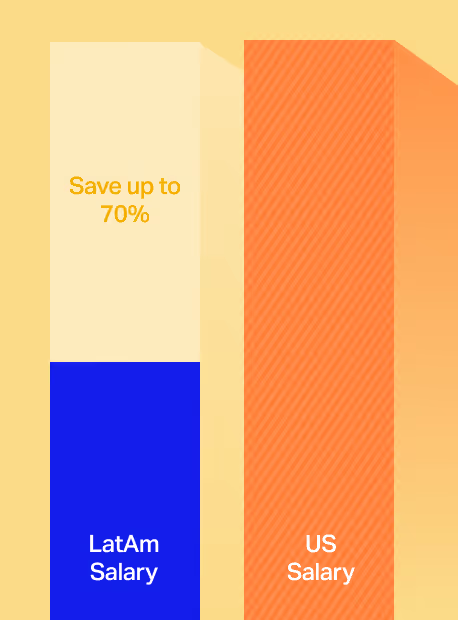
Hiring an experienced .NET engineer in a region where the cost of living is lower often costs 30–70% less than hiring the equivalent US engineer.
That gap comes from where the person lives, not what they're worth, the same reason a developer in Austin costs less than one in San Francisco. In practice, you can often hire a senior offshore engineer for what it costs to hire a mid-level engineer in the US.
We cover the hiring costs, split by seniority, in a later section.
Access to global talent
Offshoring means your talent pool stops being a commute radius. .NET has been a mainstream enterprise choice in many markets for years, which means there's a deep bench of developers who cut their teeth on it rather than picking it up recently. Developers who have integrated microservices at scale or tuned a decade-old enterprise system are far easier to find once you stop searching locally.
Scalability and flexibility
Offshore .NET services let you scale up for a major launch or run lean through a quieter quarter, without the commitments and overhead of full-time local hires. A platform migration might need six engineers for two months and one for the year after; an offshore partner can flex to that shape in a way a permanent local team structurally can't, since adding or releasing US employees carries its own cost, timeline, and legal weight every time.
Focus on core business functions
Offshoring the build work means your in-house team spends less time on day-to-day implementation and more on the things only they can do: setting direction, making product decisions, and talking to the customers who use what gets shipped.
The offshore team owns getting the .NET application built; your team owns deciding what gets built and why.
Time zone advantages
Whether an offshore .NET developer can join your stand-up depends entirely on which offshore region you choose, so choose deliberately.
A team ten or more hours away can genuinely run overnight, so batch jobs and self-contained work land on your desk in the morning. Anything that needs a stand-up, a code review, or a same-day answer works far better when the developer is online during your business hours, wherever your team sits in the US.
The cost of the gap is measurable. Research from Harvard Business School and INFORMS, based on 12,038 employees at a Fortune 100 multinational, found that the larger the time zone gap between two colleagues, the more of their work gets pushed outside normal business hours for one side of the pair. Where work depends on synchronous collaboration, the researchers conclude, companies benefit from aligning teams north to south rather than east to west.
Choosing to offshore to a nearby time zone (that's called nearshoring) gives you overlapping working hours. For US teams, the best option is Latin America. Our free guide to hiring remotely in Latin America covers how that works in practice.
The technical co-founder of a healthcare AI startup explained to us why he was adding Latin America while keeping his existing engineering team exactly where it was:
My goal is to continue to keep my team in Romania. No challenges with that at all. They're doing an awesome job. They're really good engineers. It's just that in order to have good coverage for our U.S. customers, I'm looking for options in the same time zone. So with that thought in mind, I thought maybe I should look at Latin America.
The cost isn't always hypothetical. An engineering lead explained why they're shifting to Latin America like this:
Our senior QA in Sri Lanka is excellent, but we don't get enough overlap to keep quality and throughput high. We often ship without her. The fix is obvious: a tester who is online when we are.
Access to advanced technologies and tools
The core skills needed to be a .NET developer, including C#, ASP.NET, Azure, and SQL Server, are ones offshore developers and offshore development companies often already have.
That matters more than it sounds like, because .NET moves: Microsoft ships a new major version every year, and staying current with the latest LTS release, modern Azure services like App Service and Functions, containerization with Docker and Kubernetes, and CI/CD pipelines through Azure DevOps or GitHub Actions is its own ongoing cost if you're building that expertise in-house.
An offshore team or partner brings developers who already work in that stack day to day, so the tooling and the version currency come with the hire instead of becoming a training line item on your own roadmap.
What Can You Offshore in .NET Development?
You can offshore almost any part of a .NET stack, from a full product build to a single ASP.NET application that needs maintaining.
- End-to-end .NET development: Offshore teams can run a project from planning and design through development, deployment, and maintenance, with one team accountable for the whole delivery.
- Custom application development: Offshore developers can build applications shaped around your specific requirements, designed to scale as the business grows rather than needing a rewrite at the next stage.
- Mobile application development: .NET developers and mobile developers can build cross-platform mobile apps, including integration with the systems you already run.
- Enterprise software solutions: Offshoring enterprise software development helps you build systems that handle complex workflows, heavy data volumes, and detailed reporting. It's also why nearshore SaaS recruiting so often starts with .NET back-end engineers.
- Cloud software development and maintenance: On the Microsoft stack, cloud work usually means Azure developers who keep your software scalable, secure, and available across platforms.
- Microservices development: .NET developers and back-end developers can build microservices architectures that make large projects easier to change without breaking everything at once.
- Quality assurance and testing: Offshore QA engineers test before deployment and catch the issues that are expensive to fix in production.
- UI/UX design: Offshore designers build interfaces that are easy to navigate, not just good-looking. Getting that balance between functionality and design right takes a deliberate decision early.
- Software upgrades and porting: An offshore team can upgrade or port outdated applications to modern platforms without pulling your own engineers off the roadmap.
- ASP.NET and legacy .NET Framework maintenance: Plenty of offshore .NET work isn't new development at all. It's keeping an ASP.NET application patched, supported, and secure while a rewrite is planned, or migrating from .NET Framework to modern .NET one service at a time. Offshore ASP.NET development is often the most practical way to keep a revenue-generating legacy app alive while your own engineers ship new features.
- Software documentation and localization: Offshore teams can write the documentation your own developers and users work from, and handle localization so the product works in other languages and regions.
What Are the Top 7 Countries To Find Skilled Offshore .NET Developers?
Argentina, Brazil, Ukraine, Poland, India, Costa Rica, and Mexico are the seven countries where US teams most often find offshore .NET developers, and what separates them is how much of your workday you get back to invest in other tasks. Choosing where to focus your search is as consequential as the decision to offshore in the first place, so here's how the seven compare.
English proficiency varies by individual in every one of these countries, so test it on a live, unscripted call rather than assuming anything from geography.
If you want the wider picture beyond .NET, we've ranked the best countries to hire remote software engineers and developers separately.
Argentina
The tech scene in Latin America is booming, and Argentina stands out as one of the top countries to hire LatAm developers.
GitHub’s Innovation Graph counts about 1.6 million developer accounts there as of Q1 2026, up 31% year over year, built on a strong education system and government support for the sector.
Argentina runs on GMT-3 year-round with no daylight saving, which puts it just one to two hours ahead of US Eastern Time. Buenos Aires is the country's main enterprise and fintech hub, the kind of environment where .NET has historically been a default choice for back-office and financial systems, so the local talent pool has real depth in exactly that kind of work.
Our guide to hiring developers in Argentina covers costs and skills.

Brazil
Brazil has the largest developer community in Latin America: more than 8.3 million developer accounts in Q1 2026, according to GitHub’s Innovation Graph. Government tax incentives for innovation helped build that base.
Most of that talent concentrates in São Paulo, Brazil's financial and enterprise software center, where large banks and insurers have run .NET and C# systems for years.
Brazil sits on GMT-3, matching Argentina's overlap with US business hours, and hiring developers in Brazil is a strong option for .NET work specifically because that enterprise history means senior C# talent isn't rare.
Ukraine
Ukraine has become a major offshore destination in Central and Eastern Europe (CEE). A favorable tax policy, low operating costs, and efficient payment practices keep rates down, and the country has a well-developed IT education system feeding a large senior engineering base.
Ukraine's outsourcing sector grew up heavily around Microsoft-stack work, so .NET and C# expertise is common rather than a specialty.
The tradeoff is time zone: Ukraine runs on Eastern European Time (GMT+2/+3), which is seven to eight hours ahead of US Eastern Time depending on the season, limiting overlap to the early morning on the US side. That's why the country fits project-based delivery more comfortably than day-to-day collaboration.

Poland
Polish developers are known for their expertise, especially in e-commerce, video games, and enterprise software. The country has well-developed IT infrastructure, and its tech sector is a steadily growing share of the economy. Poland's ICT sector accounted for 3.99% of total gross value added in 2023, up from 3.04% a decade earlier, according to Eurostat.
Kraków and Warsaw are the two largest tech hubs, both with a strong .NET presence, since global enterprise software vendors and Microsoft itself have run development centers there.
Poland sits on Central European Time (GMT+1/+2), six to seven hours ahead of US Eastern, similar to Ukraine's overlap profile: workable for handoffs, thin for live collaboration.
India
India has led the IT services sector for decades, covering everything from software development to business process outsourcing (BPO), and has the lowest cost base among the seven.
Bengaluru, Hyderabad, and Pune host the largest concentration of .NET and enterprise developers, largely built on decades of outsourced work for US and European banks and insurers.
The trade-off is the workday: India runs 9.5 to 10.5 hours ahead of US Eastern Time, depending on daylight saving time, with almost no overlap with US business hours, so feedback loops run overnight.
If you're weighing the two regions directly, we compared hiring remote talent in LatAm vs. India.

Costa Rica
Costa Rica has emerged as an attractive offshore destination with its stable political environment and strong education system. Heavy investment in digital infrastructure, including fiber optic submarine cables, keeps service quality high.
San José is the country's tech center, home to a growing base of enterprise software and shared-services work for US companies, .NET among the common stacks given how many of those employers already run on it.
Costa Rica sits on GMT-6 year-round with no daylight saving, so it matches US Central Time exactly for part of the year and sits close the rest of the time.
Our guide to hiring developers in Costa Rica covers the routes available.
Mexico
Mexico is the closest country on this list to hiring at home: a large, highly educated engineering base with nearly a full working day of overlap with US teams.
Guadalajara, Mexico's largest tech hub, has drawn enterprise software and IT services work for decades, which means a mature .NET talent base alongside the newer stacks the city is now known for.
Mexican developers usually have extensive experience working with US companies, and GitHub’s Innovation Graph counts about 2.9 million developer accounts there as of Q1 2026, up 35% year over year.
How to hire developers in Mexico breaks down the steps.
What Are the Options to Offshore .NET Development?
You have four realistic ways to offshore .NET development: source and employ developers yourself, use a freelance platform, use a staff augmentation firm, or work with a specialist staffing and recruiting partner. Only the last of those both recruits an engineer specifically for your team and handles employment. We'll go through them from most complex to simplest.
The four options fall under two main engagement models: project-based and dedicated team.
- Project-based: a defined piece of work that ends at delivery. Freelance and contractor platforms work this way by design.
- Dedicated team: full-time engineers who stay on your codebase and work with you directly. Sourcing and employing engineers yourself and working with a specialist staffing and recruiting partner both give you this.
- In between: staff augmentation. The engineers work on your team under your direction, usually for a set period around a project or a capacity crunch.
In the conversations Hire With Near's engineering recruiters have with US engineering leaders, the choice usually comes down to one question: how much of the hiring work can your team absorb itself?
Here's how the four routes compare, and the situation each one suits:
Option 1: Source and employ them yourself
You post on a job board for hiring in Latin America or work on LinkedIn, screen every applicant yourself, then employ someone across a border. For that, you have two paths:
- Registering a legal entity gives you full control but takes months and carries ongoing legal and accounting costs, so it only pays off at real scale.
- An employer of record is the lighter route: it handles contracts, payroll, tax withholding, local benefits, and compliance while the engineer works as part of your team under your day-to-day management.
Here's the gap people miss: an EOR handles employment logistics, not recruiting. You still source, screen, and technically vet every candidate yourself, which for a .NET role means running your own coding assessment in a market whose salary bands you don't know yet.
Option 2: Freelance and contractor platforms
Platforms like Upwork and Toptal give you fast access to contractors, which works for a defined piece of work: a migration script, a one-off integration, a short QA push.
They're a poor fit for a codebase you have to live with, because the developer is splitting attention across several clients, so the person who wrote your payment service may not be available the week it breaks.
The tradeoffs between offshore development companies and freelancers come down to exactly that: continuity and accountability.
Option 3: Staff augmentation
A nearshore staff augmentation firm places a pre-vetted .NET engineer onto your team to work under your direction, while the firm stays the legal employer and handles payroll, benefits, and compliance.
It sits between a marketplace and a permanent hire: more vetting than a platform, more flexibility than adding headcount. It fits a defined project, a temporary capacity crunch, or a team that needs to scale up and back down inside a year.
Option 4: Work with a specialist staffing and recruiting partner
For most companies hiring full-time .NET talent, this is the simplest path, because it's the only option that recruits an engineer specifically for your team and handles their employment.
You describe the role, the partner sources and vets candidates against it, and once you hire, payroll, benefits, and local compliance are handled through nearshore staffing and recruiting services.
It's the route IT and tech recruiting in Latin America is built around, and the same route covers engineering leadership through executive search in Latin America when you need a VP of Engineering rather than an individual contributor.
ParkMobile, the parking platform used in more than 700 cities across 21 countries, had run its platform and back-end work through third-party agency developers for years. US rates of $148K to $214K per role ruled out rebuilding the team at home.
The company hired nine senior engineers through Hire With Near instead, saving $1,066,085 a year against US rates at a 24-day average time to hire.
Their TA Lead described what the partnership solved:
Collaboration with Hire With Near is solving the problem of entering a completely new market for us. They have been an invaluable partner in this expansion, helping to successfully close roles quickly. Their deep understanding of the local talent landscape is what allows them to source and vet top-tier candidates efficiently.
— Akshay Gokarnakar, TA Lead, ParkMobile
You can also watch him talking about the partnership in the video below:
If you already know you want dedicated engineers rather than a managed service, here's how to hire offshore .NET developers step by step, or how to hire an offshore development team if you're staffing more than one role.
How Much Do Offshore .NET Developers Cost?
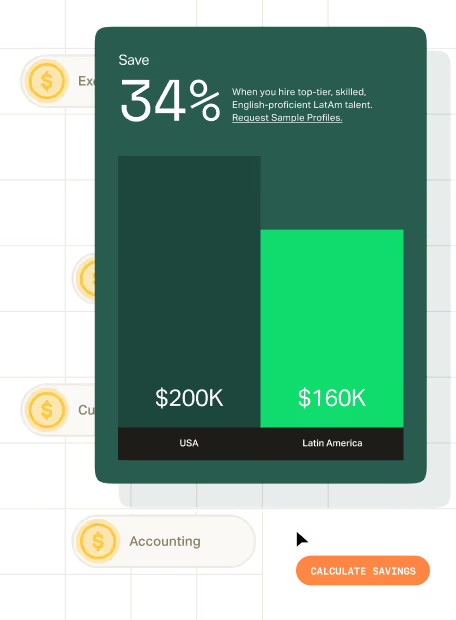
Hiring a .NET developer in Latin America costs between $30K and $108K a year depending on seniority, against $80K to $189K for the equivalent US hire, according to Hire With Near's own salary data.
Those are salary ranges rather than what a provider charges: seniority, country, benefits, and engagement model all move the final number.
To put that in concrete terms, here's how .NET developer salaries compare with equivalent US hires, according to Hire With Near's salary benchmarks:
For the most up-to-date figures, see Hire With Near's US vs Latin America Salary Guide.
Hiring a senior .NET developer in Latin America often costs less than hiring a mid-level one in the US. That isn't about paying people less than they're worth. Salaries in the region reflect a lower cost of living, so you can pay a fair local rate and still hire a more experienced engineer than you could in the US for the same annual cost.
Four things move the total beyond base salary. Seniority is the biggest, followed by country, since costs vary widely across the seven destinations above. Then come the benefits and employer contributions that go with employing someone locally.
The fourth is the engagement model, which changes how the cost arrives. Staff augmentation is usually a monthly rate that bundles employment costs, while direct hiring means you carry salary and benefits and pay a partner to find the person. Ask any provider for the all-in monthly cost per engineer before comparing quotes.
For the wider picture, how much offshore developers cost compares rates across regions.
What Are the Challenges of Offshore .NET Development?
The three main challenges of offshore .NET development are time zone gaps, code quality drift, and security and IP exposure. All three are common, and you can check a provider for each one before you sign anything. The next section shows how.
Time zone gaps
When an offshore team's workday ends as yours begins, code reviews, stand-ups, and production questions wait until the next day. On a .NET codebase, where a failed deployment or a broken integration needs a same-day answer, that delay compounds across a sprint.
Use the comparison table above to choose a region by how much of your workday it overlaps. Then, get the overlap hours in writing, as covered under the “Time zone and working-hours commitment” section below.
Code quality drift
When code quality slips on an offshore .NET engagement, it tends to happen gradually, over months of small shortcuts. The cause usually sits with how the engagement is set up. When a vendor splits engineers across several clients, hands them tickets without product context, or staffs the project below the seniority it promised, the work drifts toward quick patches. Tests get thin, and legacy .NET Framework code gets harder to migrate.
Hire With Near's engineering recruiters often point out that the developers who keep quality high over time write testable code and tie each task to what the product needs. The checks below on .NET version and stack coverage, how a provider vets technically, and what senior means in their pipeline are where you catch drift before it starts.
Security and IP exposure
On a .NET offshore development engagement, engineers usually get repository access, production credentials, and sometimes regulated customer data. The exposure comes from IP assignment that covers the vendor but not the individual engineers, and from access that isn't revoked when someone rolls off.
The code ownership, IP, and security check below lists what to get in writing. For the wider list, see our guide to the top offshore development risks and how to manage them.
How Do You Choose an Offshore .NET Development Company?
To choose an offshore .NET development company, evaluate it on six aspects: stack coverage, how they vet technically, what they mean by senior, code ownership and security, working-hours commitment, and what happens if a hire doesn't work out or the engagement ends.
From the editorial work I do interviewing Hire With Near's engineering recruiters about how they screen developers, the same failure keeps surfacing. A provider sounds credible on a call, then sends candidates who don't survive a technical interview.
A talent acquisition leader at a compliance SaaS company described it to us this way:
Right now, [our current vendor] is sending us candidates, and their resumes do look good, but when they do make it to our technical assessment and our interview rounds, our hiring team is finding that they're maybe not as senior as we're hoping for.
.NET version and stack coverage
Full-stack tells you nothing about whether a team can work on your codebase. Ask which .NET versions their engineers have shipped on, whether they've completed a Framework-to-modern-.NET migration rather than just maintained one, and how deep they go on ASP.NET, Azure, and SQL Server.
Be equally wary of a candidate who claims everything. Federico Bilello, Recruiter for Software Engineering at Hire With Near, describes the red flag he watches for:
A big red flag is when a candidate claims proficiency with an enormous variety of tools, to the point where it just doesn't make sense. There's no way someone has six years of experience with six different languages. I look for equilibrium: someone proficient with specific tools but with a background using different frameworks, so I know they're resourceful, not just a jack of all trades.
— Federico Bilello, Recruiter for Software Engineering, Hire With Near
How they vet technically
Ask a provider to walk you through their filter step by step rather than describing it in the abstract.
At Hire With Near, sourcers and recruiters with IT recruiting experience interview every candidate before you see them. The screening call covers background, communication, culture fit, and the tools the candidate has used and how, with follow-up questions shaped by what you're looking for.
At kick-off, we ask for the specific questions you want asked and use them in screening. When a candidate answers with “we,” our recruiters push for their own part, such as the main feature they developed end to end.
The technical evaluation stays with you: your team runs its own technical interviews or assessment, and we coordinate those steps. We recommend meeting the candidate before any assignment or live coding, and for teams without an engineer to run that round, we provide an interview guide.
For your own technical round, use a small, real-world task instead of a puzzle: debugging a piece of code, refactoring something for scalability, or implementing a basic API with tests. Then review it together on a call, so the candidate has to explain their choices. That shows how someone approaches clean code, which tells you more than whether the output compiles.
Pair it with a project walkthrough: ask the candidate to describe a recent full-stack solution they designed and implemented, what the stack was, what went wrong, and how they handled it. Two red flags come up repeatedly. A candidate who can't say what their own role on a past project was, and one who won't talk about mistakes.
One warning for your own process: don't stack three technical assessments on top of each other, because strong candidates drop out.
The questions tech leaders ask about hiring developers in Latin America article covers the rest of the process.
What senior means in their pipeline
Seniority is the claim most likely to be inflated, so ask what proportion of a provider's placements are genuinely mid-level or senior.
According to Hire With Near's 2026 State of LatAm Hiring Report, 98% of the engineering placements we made were mid-level or senior, with 51% senior on their own.
Ask anyone you're considering for the same breakdown, and ask who signs off technically before a candidate reaches you.
Related reading: 5 Interview Questions to Spot a Fake Senior Developer
{{state-latam-hiring}}
Code ownership, IP, and security
Get IP assignment, code ownership, and NDAs in writing before the first commit, and make sure the assignment covers the individual engineers, not only the company you're contracting with.
If you handle regulated data such as health records or payments, ask how repository access is controlled and what happens to code and data when an engineer rolls off.
Top offshore development risks and how to manage them goes deeper on the ones worth planning for.
Time zone and working-hours commitment
Ask for a written commitment on overlap hours rather than a general promise of flexibility. If your team runs a daily stand-up and expects same-day code review, you need engineers online during your workday, and that belongs in the agreement.
The replacement guarantee and the exit
Ask what happens if the hire doesn't work out, and what happens when the engagement ends. On the first: how long the guarantee runs, whether it's a replacement or a refund, and who runs the new search. On the second: what handover looks like, including documentation, repository access, and how long the outgoing team stays available.
Comparing providers on those terms is the point of building a shortlist, whether you end up with an offshore .NET development company or a recruiting partner that hires the engineer into your own team.
The best LatAm outsourcing companies is a reasonable starting list, and if your search isn't offshore-specific, our guide to hire .NET developers covers the same ground for nearshore and domestic hiring.
Final Thoughts
Working with the right offshore .NET developers, whether through one of the nearshore software development companies or a recruitment or staffing agency, gets you the specialized skills you need without a salary bill your budget can't carry.
By choosing to offshore to one of the Latin American countries above, you get overlapping working hours with your own team and remote software engineers as good as your best US hires, at 30–70% below US rates.
If you're weighing offshore .NET development against hiring at home, the best next step is to book a free consultation to talk through your requirements with our team. We'll give you salary benchmarks for the roles you're hiring and explain how the process works.
{{latam-hiring-cta-v2}}
Frequently Asked Questions
What's the difference between offshore and nearshore .NET development?
Offshore .NET development means working with developers in a distant country with little overlap with your workday. Nearshore means working with developers in a nearby region, which for US companies means Latin America, where the working day lines up with yours.
The practical difference is response time, not skill. Far-offshore suits cost-led, self-contained work that can run while your office is closed; nearshore fits when the work needs daily collaboration.
Nearshoring, offshoring, and onshoring explained covers the definitions, and nearshore vs. offshore software development in Latin America covers the comparison for engineering teams.
Can offshore teams maintain legacy ASP.NET and .NET Framework applications?
Yes, and legacy ASP.NET and .NET Framework maintenance is one of the most common types of offshore .NET work.
Ask a provider which .NET versions their engineers have shipped on, whether they've completed a Framework-to-modern-.NET migration rather than only maintained one, and how they handle security patching on an application that's no longer under active development.
A team that can only describe greenfield projects is the wrong fit for a codebase that's been in production for fifteen years.
How good is the English of offshore .NET developers?
English proficiency varies by individual rather than by country, so test it instead of assuming it. What matters for an engineer is whether they can explain a technical decision to someone who isn't a developer, walk a product manager through why a release broke, and hold their own in an architecture review.
Ask any provider how they verify it, and insist on a live, unscripted technical conversation before you hire. Hire With Near screens English on a call for exactly that reason.
How long does it take to hire an offshore .NET developer?
Most companies hiring through Hire With Near get a shortlist of candidates in 3 to 5 days and make a hire in under three weeks. In between are an intake call to agree on the requirements and salary range, then sourcing, English screening, and interviews with our recruiters. The technical round happens in your own interviews.
What usually stretches a timeline is notice periods and slow internal feedback rather than sourcing, so ask any provider how long their last three placements in your stack took from kickoff to signed offer.
What happens if an offshore .NET developer doesn't work out?
Every Hire With Near placement is backed by a 180-day replacement guarantee, double the industry standard, which means we run the search again at no additional cost.
When you compare providers, ask three things: how long the guarantee runs, whether it's a replacement or a refund, and who does the re-search. Guarantees that expire at 30 or 90 days rarely reach the point where a mismatch shows up, which is usually the first production crunch.
What other development roles can I hire offshore?
Beyond .NET developers, US companies commonly hire full-stack developers, nearshore API developers, SQL developers, and remote software engineers.
Together with the C# developers, Azure developers, back-end developers, and QA engineers covered earlier, they make up the mix most .NET teams end up hiring.
Developers in Latin America regularly bring the same technical depth as US-based professionals, with overlapping working hours and salaries 30–70% below US equivalents.







.webp)


%203.svg)

.avif)





%20(1).avif)

%20(1).png)