


%203.svg)
Key Takeaways
- Administrative assistants handle broad operational tasks while executive assistants provide focused strategic support to executives. The key difference is breadth versus depth of responsibility.
- Hire an administrative assistant when you need team support with clear direction. Hire an executive assistant when one executive needs strategic coordination.
- Latin America offers experienced administrative and executive assistants who work in US time zones at 60–80% lower costs, making it realistic for most companies to hire qualified talent within budget.
You’re spending three hours a day on email, and your calendar is a mess. You know you need help. But when you start looking at options, you’re stuck.
Should you hire an administrative assistant? An executive assistant? Are those the same thing? And where does “virtual assistant” fit in?
The job title you choose determines who applies and what skills they bring. Post for an “administrative assistant” when you need executive-level support, and you’ll get generalists who can’t manage your complex schedule.
Search for an “executive assistant” when you need broad team support, and you’ll attract overqualified candidates who’ll leave in six months.
So we’re here to help you understand when to hire an administrative assistant vs. an executive assistant, why “virtual assistant” might be the right term (or might not matter at all), and where you can find the help you need within your budget.
Difference Between an Executive Assistant and an Administrative Assistant
Administrative assistants handle broad operational tasks across teams, while executive assistants provide focused, strategic support to specific executives. The key difference is breadth vs. depth.
Administrative assistants are often generalists supporting multiple people or departments. They handle data entry, scheduling for teams, and general correspondence. Their work is reactive—“What needs to be done today?”—and requires less judgment since they’re typically given clear direction on priorities and tasks.
Executive assistants are specialists supporting executives. They manage strategic calendar decisions, act as gatekeepers, and serve as business partners to their executive.
Their work is proactive—“What should my boss focus on?”—and requires high-level judgment since they often make decisions on your behalf.
According to one of our recruiters,
An EA needs to be organized and stay one step ahead of their executive’s needs. When hiring for executive assistant roles, I look for candidates who can share examples of projects they implemented to optimize their executive’s day-to-day operations.
Where Virtual Assistants Fit In (And Why the Lines Are Blurring)
Virtual assistants can function as either administrative or executive assistants—the “virtual” part just means remote, and with many companies now remote-first, the distinction between “administrative assistant” and “virtual assistant” is becoming meaningless when it comes to general admin tasks.
But many people often use “virtual assistant” when they’re looking to delegate very specific types of tasks. You’ll hear someone say they need to hire a virtual assistant for data entry, or a “virtual assistant for social media,” or a “technical virtual assistant.”
Meanwhile, “administrative assistant” tends to stay in the realm of traditional admin work—scheduling, correspondence, data entry, coordination.
So in remote-first companies, an “administrative assistant” and a “general virtual assistant” are functionally identical roles. The only difference is emphasis: “virtual assistant” often signals you’re looking for someone to handle specific delegated tasks (and signals you’re specifically targeting remote talent pools), while “administrative assistant” suggests broader operational support.
The lines are definitely blurry, and the “virtual” part has become rather meaningless now that remote work is standard. But the term “virtual assistant” will likely stick around because it’s become shorthand for “I need to hand off specific tasks to someone remote.”
Related Reading: “Will They Work My Hours?” and Other Questions Business Owners Ask About Hiring VAs and EAs in Latin America
Which Job Title Should You Actually Use When Hiring?
When you need to hire administrative talent, choose your job title based on scope, decision-making level, and whether remote work matters. The title you use determines who applies and what skills they bring.
Use “Administrative Assistant” when:
- You need support for multiple team members or departments
- Tasks are operational: data entry, general scheduling, correspondence
- You’ll give clear direction on what needs to be done
- Role is task-based rather than strategic
Use “Executive Assistant” when:
- One specific executive (CEO, VP, etc.) needs dedicated support
- Tasks require judgment: complex calendar management, gatekeeping, prioritization
- They need to anticipate needs and solve problems independently
- Role is a strategic partner to an executive/founder
Use “Virtual Assistant” when:
- The job is remote AND you want to emphasize that in your search
- You’re specifically targeting remote talent pools
- BUT: If the job is remote anyway, “virtual assistant” and “administrative assistant” are functionally the same title if it’s for general admin work
What to search for when looking for candidates:
- If you’re browsing talent platforms: Search “administrative assistant” for generalists, “executive assistant” for specialists
- If you’re posting a job: Use the title that matches the scope, then make remote/hybrid/in-office clear in the description
- Don’t get hung up on “virtual” unless you specifically want to target remote-first candidates
The key is getting clarity before you post anything.
Before you pick a title or write a job description, get specific about what you actually need: Will this person support one executive or multiple team members? Will they need to make judgment calls independently or follow clear direction? What tasks will fill most of their day—strategic coordination or operational execution?
Once you’re clear on scope, decision-making level, and the experience you’re targeting, the right job title becomes obvious.
And more importantly, you can write a job description that attracts people with the exact skills and background you need rather than wading through hundreds of applications from candidates who don’t match.
Related reading: How to Hire a Great Executive Assistant
Where to Find Admin Assistant and Executive Assistant Candidates When You Have a Tight Budget
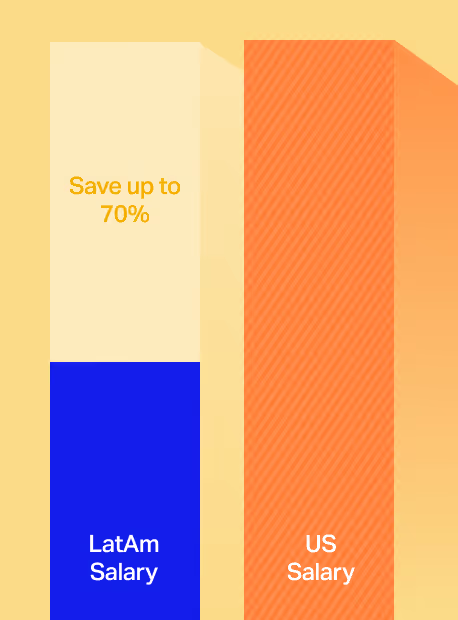
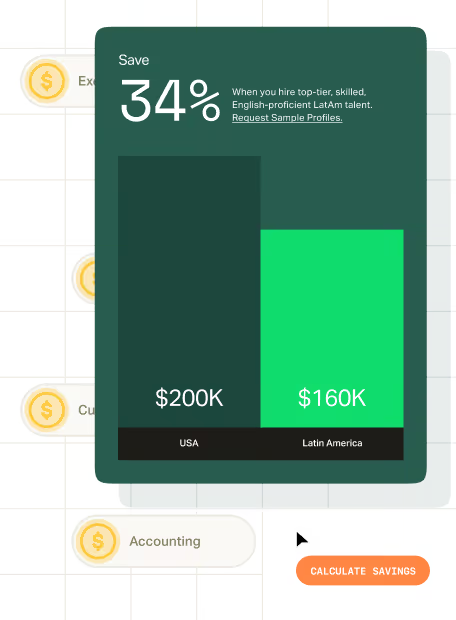
If you have perhaps been putting off hiring the support you need because you didn’t think it was within budget, Latin American talent delivers the same quality as US-based administrative and executive assistants while still working in your time zone and saving you 60–80% on labor costs.
Both administrative and executive assistant roles rank among the most popular positions US companies fill in Latin America. According to Hire With Near’s State of LatAm Hiring Report, which analyzed over 2,000 placements:
- Executive assistant ranked #4 among most-filled roles, with companies saving $20,000 to $75,000 per hire (60–81% cost savings)
- Administrative assistant ranked #10 among most-filled roles, with companies saving $21,000 to $44,000 per hire (40–71% cost savings)
- Colombia was the most popular country for filling both of those roles.
{{state-latam-hiring}}
For example, ORBA Cloud CFO, a Chicago-based provider of outsourced bookkeeping and CFO services, needed great talent that could work within their time zones. They partnered with Hire With Near to hire an executive assistant from Latin America as well as staff accountants. The results: 65% cost reduction compared to hiring in the US ($159,000 in annual savings), roles filled in as little as 13 days, and seamless collaboration through time zone alignment within two hours.
Why LatAm makes sense for admin and executive assistant roles:
- Same or close time zones to the US (most countries are within 0–3 hours of US locations)
- Strong English proficiency among top talent
- Cultural alignment with US business practices
- Professional experience with US companies
Whether you need to hire an administrative assistant for general support or hire an executive assistant for C-suite support, Latin America offers the same quality talent at significant cost savings.
Further reading: Why More US Businesses Are Hiring in Latin America: What We Learned from Talking to 2,000 Hiring Managers
Final Thoughts
Now that you know which job title to use, you can post on job boards, search talent platforms, and start reviewing applications.
But here’s what happens next: You’ll get 100+ resumes. Some will look promising. Most won’t match what you need. You’ll spend hours screening candidates, scheduling interviews, and trying to figure out who can actually do the job versus who just wrote a good resume.
If you want to skip that process entirely and get straight to interviewing qualified candidates, Hire With Near can help.
We know the administrative and executive assistant talent landscape across Latin America and focus on matching you with someone who’ll integrate seamlessly into your team from day one. Our candidates have strong English proficiency and bring professional experience with US companies.
We recommend starting with sample profiles so you can see the caliber of talent we can find for you.
We’ll send you profiles of 2–3 pre-vetted candidates. You’ll see their experience, education, skills, and English proficiency level. No meeting required. No commitment. Just real examples of the talent available.
This gives you a baseline. Most companies find that the quality exceeds their expectations, but seeing it firsthand makes the difference. If you decide to move forward, we’ll find out exactly what you’re looking for and do a custom search.
To explore the caliber of talent we can find for you, request a list of pre-vetted candidates. See what the possibilities are. With Hire With Near, you can interview candidates for free and only pay once you make a hire.
{{prevetted-banner}}
Frequently Asked Questions
Where can I find administrative or virtual assistants to hire?
You have several options for finding quality administrative and virtual assistants. If you’re considering hiring assistants in Latin American specifically, check out our guides on the best companies to hire virtual assistants in LatAm and the 10 best virtual assistant companies.
Where can I find executive assistants to hire?
For executive assistant hiring, you can work with specialized recruitment agencies or staffing companies that understand the strategic nature of the role. Our guide on the best companies to hire LatAm executive assistants breaks down options for accessing experienced EA talent in Latin America, while our list of the 5 best recruitment agencies for executive assistants covers specialized recruiters who can help you find senior-level administrative support.
Can an administrative assistant become an executive assistant?
Yes, but it requires developing strategic thinking, higher-level judgment, and experience supporting senior leaders. The best path is starting in an admin role, then transitioning to supporting higher-level executives as skills develop.
What should I include in a job description for an executive assistant?
Focus on the scope of executive support, strategic responsibilities, and decision-making authority. Include details about complex calendar management, gatekeeping responsibilities, and the level of independence required.
For a complete guide with templates and examples, see our article on how to write an executive assistant job description.
What should I include in a job description for a virtual assistant?
Clearly outline whether you need a generalist or specialist, specify required tools and platforms, and detail the scope of support (one person vs. team).
Make remote work expectations clear and highlight communication requirements. For detailed guidance and customizable templates, check out our guide on writing the perfect virtual assistant job description.
What about an office manager? Is that the same as an administrative assistant?
No. An office manager oversees office operations, manages facilities, coordinates vendors, and often supervises administrative staff. They handle systems and processes rather than supporting specific people.
An administrative assistant supports individuals or teams with scheduling, correspondence, and task execution.
If you need someone to manage your entire office infrastructure (supplies, facilities, team coordination), you want to hire an office manager. If you need someone to handle personal or team administrative tasks, you want an administrative or executive assistant.
Are there assistant roles beyond administrative and executive?
Yes, once you move past general support, you'll find assistants specialized by function or industry. A common example is a legal assistant, who handles document preparation, case organization, and administrative support inside law practices. If your work has domain-specific demands, hiring for that specialization rather than a generalist usually gets you productive faster.





.webp)
.webp)



%203.svg)
.avif)





%20(1).avif)

%20(1).png)