%203.svg)
Key Takeaways
- The most in-demand virtual assistant services in 2026 are administrative support, customer service, social media, e-commerce operations, HR coordination, content, and event coordination.
- What you pay depends on the work you delegate and the assistant's seniority: a virtual assistant in Latin America runs roughly $18,000 to $34,000 a year, versus $44,000 to $77,000 in the US.
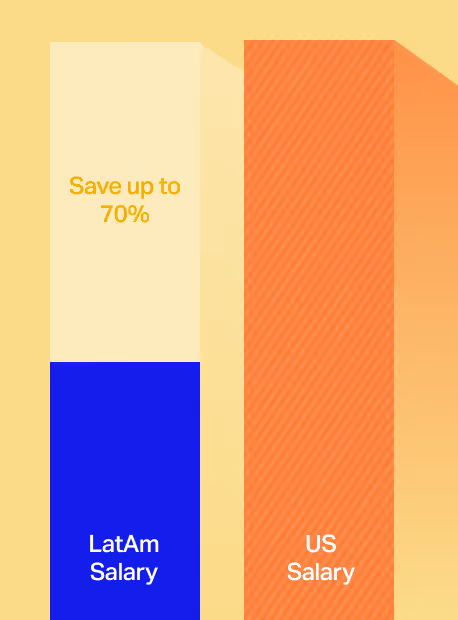
- Latin America gives you a dedicated full-time assistant working US business hours at 30–70% less than a comparable US hire, without the time zone strain of offshore alternatives.
Scheduling meetings, clearing the inbox, chasing follow-ups: the work that grows the business keeps sliding to next week because the small stuff never stops. Delegating that work to a virtual assistant costs less than most founders expect, and it builds capacity you couldn't otherwise afford.
This guide covers the most in-demand virtual assistant services in 2026, what companies delegate and why, what a VA costs, and how to find and hire the right one in Latin America.
What Can a Virtual Assistant Do for Your Business?
A virtual assistant takes recurring, time-consuming work off your plate so you can focus on the work only you can do: calendar and inbox management, customer support, social media, e-commerce operations, HR coordination, content, and event logistics.
The right hire absorbs the tasks that eat away at your week and gives you those hours back.
Companies are delegating far more to virtual assistants than they used to. As remote work became more common, the scope of what a skilled assistant handles expanded well beyond scheduling and inbox triage into whole business functions. Today's capable VA is a professional who can own a slice of your operations.
That range is also why Latin America is a strong place to hire for this work, according to Camila Banchero, Senior Operations Recruiter at Hire With Near:
In Latin America, we have a culture of adaptability and resilience. Many professionals here have grown up in environments where things change. We're very familiar with working under uncertainty, which is exactly what the operations department demands. You need to know how to wear many hats and work in a fast-paced environment.
That adaptability is the generalist's core strength: an assistant who can move between your inbox, a customer escalation, and a last-minute event change without losing the thread.
Further reading: 8 Benefits of Hiring a Virtual Assistant From Latin America
What Are the Most In-Demand Virtual Assistant Services?
The most in-demand virtual assistant services that companies frequently hand off are administrative support, customer support, sales support, social media, e-commerce, HR coordination, content, and event coordination.
Some assistants are generalists who cover several of these, while others specialize. A virtual assistant who runs e-commerce operations won't necessarily excel at HR coordination, and a content specialist likely isn't your go-to for technical support.
In larger companies, these functions are spread across multiple roles. A skilled VA consolidates them, which is why administrative recruiting in Latin America covers such a wide range of roles.
Administrative and executive support
Administrative support is the bread and butter: calendar and inbox management, scheduling, data entry, reporting, travel coordination, and document prep. This is where most companies start, and where hiring a generalist administrative assistant earns its keep.
When the work involves managing a busy executive's time, guarding their calendar, and acting as a gatekeeper, that's a different profile entirely. Hiring an executive assistant calls for more judgment and a deeper understanding of how you work, your priorities, your communication style, and who gets access to your time.
Customer support
Customer support virtual assistants handle frontline inquiries, troubleshoot common issues, and escalate the complex ones. They work help-desk tickets, respond to customer emails, and keep response times down without you carrying full-time in-house staff, typically inside your CRM and support tools.
For dedicated coverage, companies hire a customer support rep outright.
A good example is a fitness equipment brand we work with. They hired a bilingual customer service rep for $1,700 a month to cover its support queue and saved $31,600 annually.
Sales support
Sales support virtual assistants keep the pipeline moving: updating CRM records, scheduling demos, sending follow-ups, and preparing sales materials. This works well when you need light operational support for an existing sales team.
If you need someone driving pipeline, prospecting, and closing, hire dedicated sales professionals like SDRs, BDRs, or sales reps instead of stretching a VA into a role they aren't set up for.
Social media management
Social media virtual assistants schedule posts, monitor engagement, respond to comments, and track basic metrics across platforms, keeping your presence active and responsive.
Strategic campaign development, paid advertising, and brand positioning usually lead to hiring a dedicated social media manager rather than a coordinator.
E-commerce operations
E-commerce virtual assistants run the operational side of an online store: inventory tracking, order processing, shipping coordination, and order-related customer questions. They work inside platforms like Shopify, WooCommerce, or Amazon Seller Central to keep the store running.
Product photography, advanced marketing, and growth planning sit beyond a VA's scope and need dedicated specialists.
HR coordination
HR virtual assistants support recruitment coordination, onboarding paperwork, benefits administration and tracking, and employee records. They handle the administrative side of HR, so your team isn't buried in it.
Strategic HR work, like compensation planning, performance systems, or employee relations, typically needs an HR specialist.
Content production
Content-focused virtual assistants keep your content calendar moving, coordinating with writers, scheduling posts, formatting articles, and handling basic design requests. They're built for keeping workflows on track.
For high-level strategy or specialized writing, you'll want to hire dedicated content writers or remote copywriters.
Event coordination
Event coordination virtual assistants manage logistics for virtual, hybrid, or in-person events, like vendor communication, attendee registration, scheduling, and material prep. They keep the details organized and the timeline on track.
For large-scale events that need strategic planning and on-site management, hiring an event coordinator is the better fit.
{{prevetted-banner}}
How Much Does It Cost to Hire a Virtual Assistant?
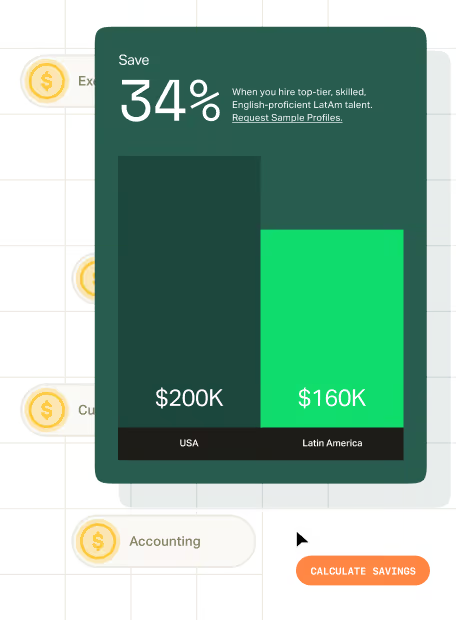
Hiring a virtual assistant in Latin America typically costs $18,000 to $34,000 a year, compared to $44,000 to $77,000 for the same role in the US.
Across the wider set of administrative and support roles, the savings run from 30% to 70%, but the exact figure depends on the work you're delegating.
Here's what it costs to hire a virtual assistant and the adjacent roles companies hire alongside them, according to Hire With Near's salary benchmarks:
For the most up-to-date figures, see Hire With Near's US vs Latin America Salary Guide.
Take California Consumer Attorneys (CCA), a Los Angeles personal injury firm that was growing fast but out of desk space, with a prior staffing agency charging a 90% markup for micromanaged assistants.
The firm hired nine operations and legal assistants in Latin America through Hire With Near at a seven-day average time-to-hire, saving $314,000 a year and doubling its caseload without expanding the office. Kathy Peterson, their Operations Manager, put it this way:
Hire With Near has allowed us to nearly double our caseload without doubling our in-office staff. I have made nine great hires through Hire With Near in just a few short months.
The point is what the same budget can hire. For what one mid-level US assistant would cost you, our salary data shows you can hire a senior assistant in Latin America, or cover two people handling different functions. That's more capability for the money you already planned to spend.
That gap is also widening. According to the U.S. Bureau of Labor Statistics, compensation costs for civilian workers rose 3.6% over the 12 months ending March 2025. Latin American salary benchmarks haven’t moved at the same pace, which means the cost advantage of hiring in the region tends to grow rather than shrink over time.
One more thing to weigh, since it's where hidden costs usually hide: your total cost is the assistant's salary plus whatever a partner charges to source, place, and (if they employ the person) handle payroll and compliance.
At Hire With Near, the fee structure is broken into the candidate's monthly compensation and our placement or staffing fee. Ask any provider you speak with to show you the same breakdown.
{{salary-guide-cta}}
Which Type of Virtual Assistant Is Right for You?
Choose a generalist virtual assistant when your needs are broad and administrative, and a specialist when one function, like social media, e-commerce, or bookkeeping, is the bulk of the work. Getting this right up front saves you from hiring someone who's a poor fit for what the job demands.
When I'm matching a virtual assistant to a US team, the first thing I assess is how broad the work really is:
- If your days revolve around calendar management, scheduling, inbox, and coordination, a generalist assistant, or an executive assistant for a busy leader, is usually the answer.
- If the work is concentrated in one area, like improving your social presence or running your store, a specialist who lives in that domain will move faster and need less direction.
Start by listing the tasks that are time-consuming or outside your expertise, then group them. A quick pass usually falls into a few buckets:
- Administrative: calendar scheduling, email management, data entry, reporting.
- Marketing: social posts, content coordination, basic design, campaign support.
- Customer relations: handling queries, managing complaints, and follow-ups.
Once you know which bucket your needs fall into, the hiring route becomes clearer.
How To Hire a Remote Virtual Assistant
Once you know the type of assistant you want, you have three ways to bring one on: you can source the candidates yourself and hire directly, you can use freelance and contractor platforms, or you can rely on a specialist staffing and recruiting partner.
Here are the three options in detail, from most work on your side to least:
- Source and hire on your own: Post the position on a job board or LinkedIn and interview the candidates yourself. Once you've chosen someone, you'll need a way to employ them legally across borders: either set up a local entity in their country, which takes time and cost, or use an employer of record, a service that becomes the legal employer on paper and handles contracts, payroll, taxes, and local compliance on your behalf.
- Freelance and contractor platforms: Marketplaces like Upwork give you fast access to contractors, which suits short-term or project-based work. For a full-time role, they're a weaker fit: you manage quality and retention alone, and the talent is usually splitting attention across several clients.
- A specialist staffing and recruiting partner: This is the simplest path for most companies hiring full-time. A partner can either place an assistant they employ (the staffing model, where they handle payroll, benefits, and compliance while you direct the work) or find and vet a permanent hire you employ yourself (the recruiting model). Either way, one relationship covers both finding the person and handling the employment side.
If you'd rather compare providers first, our guide to the best companies to hire virtual assistants in Latin America breaks down how to weigh them.
Related reading: How to Hire Admin Talent in Latin America: Costs and Top Countries for VAs, Executive Assistants, and More
What Should You Look for When Hiring a Virtual Assistant?
The virtual assistants who succeed in US-client roles share a few traits above the rest: clear communication, sound judgment, tool fluency, and the ability to prioritize under pressure. Screen for those and you'll avoid most bad hires.
In my work recruiting administrative talent at Hire With Near, communication is the single biggest separator. Since a virtual assistant deals with both your internal team and your external clients, genuine, clear, and efficient communication is a core requirement, not a nice-to-have. In interviews, the red flags I watch for are vague or generic answers, a lack of specific examples, and any difficulty explaining their thinking clearly.
The second thing I look for is judgment. A great assistant not only executes tasks, but also anticipates what you need and acts without being walked through every step.
One US small-business owner came to Hire With Near after struggling with an assistant they had hired independently:
The issue I'm having with my current assistant is that she is more of a task-doer rather than someone with any type of autonomy. Even if I lay it out for her, somehow she finds a question. I'm hiring for judgment more than anything.
That's the difference between someone you have to manage and someone who takes work off your plate.
What are the traits that predict success?
A few characteristics consistently separate strong VA hires from those that don't stick:
- Tool fluency: Comfort with the everyday remote-work stack is foundational, like Google Workspace, Slack, Notion, Trello, Zoom, and your CRM. In my experience, the resumes that stand out show real hands-on use, not a list of logos.
- Prioritization under pressure: Working remotely means managing their own time and triaging competing requests without constant oversight. An assistant who can explain how they decide what to do first is worth more than one who simply works fast.
- Reliability and attention to detail: Trustworthiness matters when someone handles your inbox, your calendar, and sometimes sensitive information. Consistent, accurate work is what lets you stop double-checking.
- Adaptability and cultural fit: Priorities shift, especially in a small company, so you want someone who adjusts quickly and works well with how your team already operates. When two candidates are equally skilled, fit is usually what decides who lasts.
Clients often ask me for someone who has worked in their exact industry. In my experience, that's rarely the differentiator for administrative roles. Communication and judgment carry far more weight than industry background.
How should virtual assistants be sourced and vetted?
Vetting a virtual assistant should include a live English assessment, tool proficiency checks across Google Workspace, Slack, Notion, and CRMs, a prioritization case study that tests how they triage urgent requests, reference checks, and confirmation that they've worked with US companies before.
Speed matters here too. The strongest candidates don't stay available for long because other companies move quickly to secure them. A drawn-out hiring process means losing the best people to faster-moving employers, which is part of why working with a partner who has already screened candidates beats sourcing cold and vetting from scratch.
Final Thoughts
Hiring a virtual assistant is one of the fastest ways to get your time back and build capacity your budget can support. The companies that get the most from it treat the assistant as part of the team and hand off whole functions rather than scattered tasks.
Choosing a candidate based in a time zone that overlaps with your workday is also helpful, and that's part of what makes Latin America the right source for this hire. The other reasons are 30–70% in cost savings and a large and experienced talent pool.
Retention also plays a part. According to Hire With Near's 2026 State of LatAm Hiring Report, remote professionals hired in Latin America stay with US companies 66% longer than US hires. That's what makes it worth building an integrated remote admin and ops team instead of churning through short-term help.
You can hire virtual assistants and other admin and ops talent who grow with your business.
At Hire With Near, we've helped 950+ companies hire pre-vetted virtual assistants in Latin America. Book a free consultation today to tell us what you need.
Within 3–5 days, we'll send you profiles of 2–3 vetted candidates. You'll see their experience, education, skills, and English proficiency level. You can interview them for free and only pay once you make a hire.
{{latam-hiring-cta-v2}}
Frequently Asked Questions
Is hiring a virtual assistant worth it for a small business?
Yes, for most small businesses, a virtual assistant pays for itself by freeing the owner's time for higher-value work. If you're spending hours each week on scheduling, inbox triage, invoicing, or customer follow-up, handing that to a dedicated assistant in Latin America, often $18,000 to $34,000 a year, is usually a small part of what your own time is worth on the work that grows the business.
The one requirement is having enough recurring work to keep them busy. If you do, the return shows up fast.
Related reading: The Hire Many Business Owners Put Off Is More Affordable Than They Think
How good is the English of virtual assistants in Latin America?
Strong, and for client-facing roles, you should verify it the same way you'd verify any skill. Many virtual assistants based in Latin America work exclusively with US companies and communicate clearly on calls, email, and chat, with a neutral accent that US clients tend to find easy to work with.
Don't take a resume's word for it: assess English in a live interview and a short work sample before you hire, especially for anyone who talks to your customers.
The mix of fluent English and alignment with US business norms is a big reason companies choose the region.
Can virtual assistants work during the same hours as my US-based team?
Yes, virtual assistants based in Latin America work during US business hours, so they overlap your team's day, whether you're on the East Coast, in the Central states, or on the West Coast.
Because the region spans roughly the same band of hours as the continental US, you get real-time collaboration: live meetings, same-hour answers, and handoffs that happen while everyone is at their desk.
That's the difference from offshore hiring in the Philippines or elsewhere in Asia, where the workday barely overlaps yours and a question sent in the afternoon waits until the next day.
What countries do virtual assistants come from, and can I request a specific country or time zone?
For most US companies, the best countries to hire virtual assistants are Colombia, Argentina, Costa Rica, and Mexico. These countries have established remote-work infrastructure, reliable internet, strong English, and working hours that line up with the US business day.
And yes, you can request a specific country or time-zone alignment. A good staffing partner matches candidates to the profile and overlap you need, so you're not guessing on quality or reliability.
Further reading: Do You Really Need a US-Based Virtual Assistant?
Do I have to hire a virtual assistant full-time?
No, but the arrangement should match your actual workload. If you have less than a full week of work, part-time and project-based help is available through freelance and contractor platforms.
If you have enough to keep someone busy, a full-time dedicated hire gives you exclusivity, deeper knowledge of your business, and someone who is genuinely part of your team rather than splitting attention across clients.
Be honest about how many hours of real work you have before you decide.
How long do virtual assistants typically stay?
Dedicated virtual assistants tend to stay significantly longer than freelancers or offshore hires, especially when they work sustainable hours in a time zone aligned with yours.
Overnight offshore shifts and gig-platform work drive the churn most companies complain about. A full-time assistant working your business hours, paid fairly for their market, has far more reason to stay.
Retention improves further when the assistant is treated as part of the team, given context and room to grow, rather than handled as disposable task labor.
How do I know if a virtual assistant has the right technical skills?
During the hiring process, use practical assessments to evaluate technical proficiency. Many companies use case studies to assess productivity, understand how candidates prioritize tasks based on urgency, and evaluate attention to detail.
Ask candidates to demonstrate their familiarity with collaboration tools like Google Workspace, Slack, Trello, or specific CRMs relevant to your business.
What other remote operations roles should I consider hiring?
Beyond virtual assistants, companies frequently hire bilingual customer service representatives in Latin America, nearshore HR generalists, and remote bookkeepers.
These roles complement virtual assistants to build comprehensive operational teams, all with the same time-zone overlap and cost advantages that make Latin America worth hiring from.







.webp)


%203.svg)
.avif)





%20(1).avif)

%20(1).png)