


%203.svg)
Key Takeaways
- Offshore RPO services hand your sourcing, screening, and interview coordination to a provider in another country, which lowers cost per hire and returns shortlists in days instead of weeks.
- The model fits companies with more open requisitions than screening capacity, especially high-volume roles like customer support, sales development, and back-office finance.
- The real trade-off is workday overlap and the oversight it forces you to add. That's why 30% of US companies looking at Latin America are switching from an offshore setup they already have.
Offshore RPO services are a way to run your hiring through a recruitment process outsourcing provider based in another country. That provider owns the pipeline work, from intake and sourcing through screening, interview coordination, offers, and onboarding, while you stay the one who hires and manages the people. Companies buy it to lower cost per hire and fill roles faster than an internal team can on its own.
If you're weighing it, the situation is probably familiar. Five requisitions are open, one person runs every first screen, and the customer service posting pulled 300 applications with maybe three worth a call. So the roles stay open, your team absorbs the work, and the growth plan that needed these hires last quarter has slid into this one.
Offshore RPO is one of the more direct routes to the benefits of global outsourcing. This guide covers how it works, what it costs, where it breaks down, and when a recruiting partner in Latin America is the better buy.
What Is Offshore RPO?
Offshore recruitment process outsourcing (RPO) is an arrangement where a company hands its recruitment functions to a provider based in another country. You get their sourcing capacity, their tools, and their reach into markets your team doesn't recruit in.
These providers handle four core parts of recruitment:
- Sourcing
- Screening
- Interviewing
- Onboarding
Where the provider sits is the whole difference between nearshoring and offshoring. Offshore usually means a provider many time zones from your working day. Nearshore means one that shares most of it. Either way, you get recruiters who do this work full time.
What's the Problem With Traditional Recruitment Methods?
In-house recruiting breaks down in five predictable places: cost, reach, capacity, consistency, and the ability to scale when hiring spikes. A one- or two-person HR function can post a role, but it can't also source passive candidates, screen 300 applications, and keep four other searches moving.
- High recruitment costs: SHRM's 2026 recruiting benchmarking puts the median cost per hire for an executive role at $15,000, up from $8,800 in 2022. That figure doesn't count the hours your own people spend screening, or what a role costs while it sits open.
- Limited talent pool: Local markets don't always reach the specialized skills a complex role needs. In ManpowerGroup's 2026 Talent Shortage Survey, 69% of US employers reported difficulty finding the skilled talent they need.
- Inefficient processes: Every hour your HR lead spends on a first screen is an hour away from the work they were hired to do.
- Inconsistent quality: Keeping the quality of hires steady is hard when the only filter is a resume read.
- Scalability issues: Ramping recruitment for growth or a seasonal spike overwhelms internal teams, because the constraint is people-hours.
Offshore RPO is aimed at four of those five. The provider absorbs the sourcing and screening hours, and you pay for hires rather than for idle capacity. Consistency is the one you still own, which is why the screening question below matters.
How Do Offshore RPO Services Work?
An offshore RPO provider takes over some or all of your hiring pipeline and runs it end to end, from the intake conversation to the new hire's first day. That's the promise of recruitment process outsourcing services: a dedicated recruiter working your requisitions as their day job.
The offshore RPO services hiring process typically runs in six steps: needs assessment, sourcing, screening and shortlisting, interviewing, offer management, and onboarding. The first three are where an engagement is won or lost.
Needs assessment
Typically, the best recruitment process outsourcing companies begin with a needs assessment covering your requirements, your culture, and your budget. This is where must-haves get separated from nice-to-haves.
Sourcing
Next, they source from a global talent pool through job boards, social media, and professional networks. That reach brings in passive candidates who aren't applying anywhere, which is where most of the strong people are.
Screening and shortlisting
A real screening process has four visible parts:
- A structured screen against the must-have skills agreed at intake
- An English evaluation when the role is client-facing
- A technical test or work sample where output can be measured
- Reference checks before anyone reaches your calendar
This is the step that decides whether the engagement is worth paying for, so ask any provider to walk you through it. What you get back should be a shortlist with notes on which must-haves each candidate meets. A folder of forwarded resumes is not one.
Interviews, offers, and onboarding
After the shortlist, the provider handles the coordination: scheduling first interviews, keeping candidates updated, negotiating salary, and organizing first-week documentation. They also keep offers competitive for the market you're hiring in, and handle compliance with local labor laws.

4 Benefits of Offshore RPO Services You Can Measure
Offshore RPO changes four things you can measure: cost per hire, time to fill, your team's screening hours, and how many candidates worth interviewing reach your calendar.
1. Cost reductions of $35,000 to $64,000 per hire
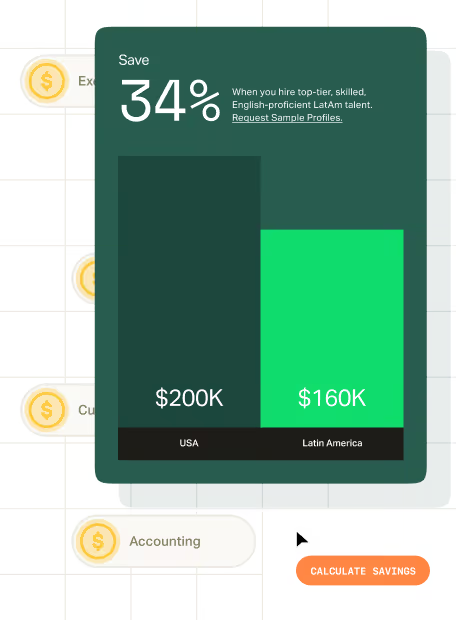
Two costs come down at once: what you spend running searches, and what the role pays in the market the provider recruits from. Hire With Near analyzed more than 2,000 placements for its 2026 State of LatAm Hiring Report. Companies saved an average of $35,000 to $64,000 per hire compared with the US equivalent.
You also stop carrying recruiting capacity you only need in bursts. Maintaining an in-house recruitment team means paying for it in the quarters when nobody is hiring.
These are the roles US companies most often hand to an offshore RPO or nearshore partner. Here's what each pays in Latin America against the US equivalent, from Hire With Near's own salary data:
For the most up-to-date figures, see Hire With Near's US vs Latin America Salary Guide.
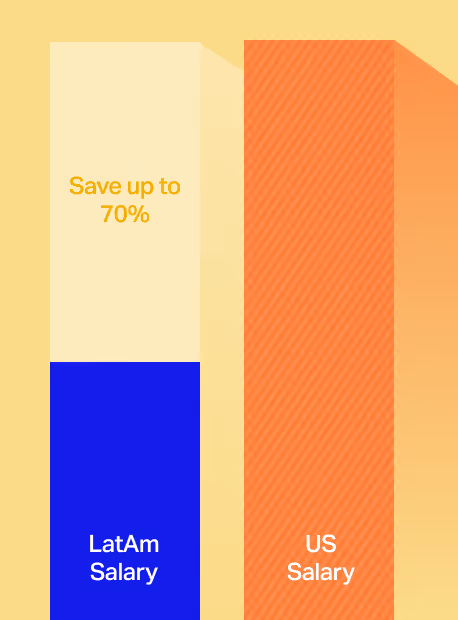
The gap is why the model pencils out: the same role, filled with senior talent in Latin America, frees budget you can put toward more hires or higher-value work. It's more capability for the same spend, not lower pay for the same job.
2. Roles filled faster, in volume, when demand jumps
Providers can add sourcing capacity in days for a growth push or a seasonal spike. If a new territory opens and you need to hire remote sales talent this quarter rather than next year, buying recruiting capacity is faster than building it.
3. Reach into talent beyond your local market
You get candidates from markets your team doesn't recruit in, not just the ones inside a US commute or a US salary band. US companies use this route to hire remote customer support professionals, engineers, and finance staff, and get their screening hours back at the same time.
4. Better odds on quality of hire
A good provider improves your odds of a hire who stays, though none can promise fit. Structured screening, work samples, and reference checks filter out the candidates who interview well and then struggle.
Retention is the number to ask about, because turnover is where the savings go. At Hire With Near, 80% of our hires stay 2+ years. What drives that is honest role definition up front, pay that's competitive for the local market, and a manager who stays involved past week one.
Offshore RPO vs. In-House Recruiting vs. a Nearshore Recruiting Partner: Which Should You Choose?
Keep recruiting in-house if you hire steadily all year and already have recruiters on payroll. Hire an offshore RPO provider if you need volume hiring capacity quickly and can work around limited daily overlap. Work with a specialist nearshore recruiting partner if you want the pipeline run for you by recruiters who share your working day.
Start with the distinction most buyers get wrong. Offshore RPO outsources the hiring process, not your team: the people you hire join your company and report to you. That's a different purchase from outsourcing the work itself to an agency that keeps them on its own team.
One-time placement fee or ongoing engagement? A one-time fee, usually tied to the role's salary, fits companies filling a defined set of roles. An ongoing engagement fits companies hiring continuously, where the partner keeps a pipeline warm so you rarely restart from zero. Ask which model a quote is, and what happens if the person leaves.
If the nearshore option is where you're leaning, this short video breaks down how nearshoring lets a growing team add hiring capacity faster than building it in-house:
Snap Diagnostics shows what the partner option looks like when it works. The Illinois sleep apnea diagnostics company was growing more than 30% a year with a single HR manager running every first screen.
Hire With Near took over the pipeline and filled 16 roles at a 19-day average time to hire. That saved $587,000 a year and returned roughly 12 hours of HR time per candidate. Their HR manager, Susan Simmermon, put it this way:
Working with Hire With Near has been very helpful. It's difficult when you're one person doing all the initial screenings and sourcing. Hire With Near took a lot of that 'workout' for me and provided great candidates quickly
— Susan Simmermon, HR manager, Snap Diagnostics
What Should You Look for in an Offshore RPO Provider?
Judge an offshore RPO provider on five things you can verify: relevant placements, your hiring priority, which hours they're reachable, employment compliance, and data protection.
The engagements that disappoint aren't the ones that pitched badly. They're the ones where nobody asked for evidence first. If you're comparing options, the best nearshore staffing companies will answer all five without hedging.
The founder of an AI transformation consultancy who has hired in Latin America through several local recruiters described the failure mode:
So if I give a recruiter a specific job description for a Go-To-Market Engineer. They maybe only cover 60 to 70% of the skill set. And I know for a fact that talent exists in LatAm. It's not like it doesn't exist. It's just the recruiters have not done the best job of sourcing the best ones.
The talent was there. The sourcing was the weak link, which is a provider question rather than a market question.
At Hire With Near, we place top talent across all industries and departments for any remote role and at all seniority levels, from individual contributors to the C-suite. We hold a 4.9 rating on G2 across 145+ reviews, as of August 2026. Check reviews.
Compatibility with your business
Ask for two or three placements in your industry, at your seniority level, in the last year, and the time to hire on each. A provider who knows your space answers with specifics; one who doesn't talk about process.
Fit with your hiring priority this quarter
Name your priority before they pitch: filling ten support roles this quarter is a different search from one hard-to-find engineer. Then ask which metric they'll report against, and how often.
Collaboration and communication
Ask who your point of contact is, which hours of your workday they're available, and what they commit to on feedback turnaround. Ask to see a weekly update from a live account.
Compliance with regulations
Ask how they handle employment and labor requirements in the countries they recruit from, and who owns that inside their organization. You want local knowledge and a named person.
Intellectual property and candidate data protection
You're handing over your hiring plans, your salary bands, and personal data on every candidate they touch. Ask what they store, who can see your requisitions, and what happens to that data after a search closes.

What Are the Real Challenges of Offshore RPO Services, and How Do You Avoid Them?
The real cost of offshore RPO usually isn't the fee. It's the part of your working day the provider doesn't share, and the oversight that gap forces you to add.
- Limited workday overlap: The further a provider's workday sits from yours, the more of your hiring runs at one round trip per day. A question you'd settle in thirty seconds face-to-face instead waits for tomorrow's overlap, and every extra step in the loop adds another day to the search.
- Requirements drift over long handoffs: A job spec you'd clarify in a two-minute call travels by email overnight instead, so every clarification costs a day. Front-load the intake with a written scorecard: must-haves, deal-breakers, and two example profiles.
- Oversight cadence: Running a pipeline you can't see needs an agreed reporting rhythm, or you learn a search is off track when the shortlist arrives late.
- Different business calendars and notice periods: Public holidays, notice periods, and interview cadence vary by country, so a plan built on a US calendar slips. Agree the dates before the search opens.
- Data security concerns: You'll share sensitive information with your provider, so handle confidentiality in the agreement rather than in conversation.
- Dependence on shared systems: The engagement runs through your ATS, your calendars, and video calls, so an outage on either side turns into missed interviews. Agree a fallback channel up front.
That trade-off is what's pushing this work closer to home. Hire With Near's research on why US companies are hiring in Latin America draws on more than 2,000 conversations with US companies. In it, 30% were moving from an existing offshore setup, and overlapping working hours was the reason they gave.
What changes is the mechanics, not the caliber of the people. Colombia, Mexico, Argentina, Brazil, and Costa Rica are the markets US companies hire from most, and a hire in any of them works during your business hours, in your time zone or an hour or two off depending on where you are in the US.
Most of Latin America doesn't observe daylight saving time, so the gap shifts with the season. That's most of a shared workday, and our guide to hiring remotely in Latin America covers how companies set it up.
{{prevetted-banner}}
How Do You Make an Offshore RPO Partnership Work?
Engagements work when both sides agree, before the first search opens, on what a good candidate looks like, what gets reported weekly, and how fast interview feedback comes back.
- Partner selection: Research and vet potential offshore RPO providers on experience in your industry, placements you can verify, and a track record at your level of role.
- The numbers you'll both watch: Write these down in week one: time to fill, cost per hire, submit-to-interview ratio, offer-acceptance rate, and 90-day retention. Review the same five on the same day every week. A submit-to-interview ratio that drops means the screen has drifted from what you asked for.
- One channel, one owner, one rhythm: A standing weekly call, one shared document for role definitions, and a named owner on each side.
- Feedback loop: Give candidate feedback within 48 hours and ask for the same in return. Slow feedback is at the top of the list of common nearshore outsourcing mistakes.
The pattern I hear most from our recruiting team isn't about sourcing. It's what happens to strong candidates while a client-side interview loop stalls. Camila Banchero, Senior Recruiter for Operations at Hire With Near, puts it plainly:
A clear interview process is critical, and it's one of the most common mistakes clients make. If you change the process or make it too long, it tires candidates out and you lose them. We help clients build a solid interview process at the kickoff call, because candidates stay more engaged when they know exactly what to expect.
— Camila Banchero, Senior Recruiter for Operations, Hire With Near
Final Thoughts
Offshore RPO is the right call when your problem is hiring capacity rather than hiring strategy. You get a filled pipeline without building an internal recruiting function, and the people you hire stay on your team.
The trade-off worth thinking hard about is overlap. If a one-day lag on every clarification would slow your hiring more than the model saves you, a nearshore partner gives you the same service inside your working day.
At Hire With Near, that means a dedicated recruiter and a shortlist of candidates in 3 to 5 days. Most of our clients make a hire in under three weeks, and every placement is backed by a 180-day replacement guarantee.
If you're weighing your options, book a free consultation today to talk through your requirements with our team. They'll explain how the process runs and give you salary benchmarks, so you have what you need to decide whether it fits.
{{consultation}}
Frequently Asked Questions
What's the difference between offshore RPO and nearshore RPO?
The difference is workday overlap: a nearshore RPO provider recruits from countries that share most of your business day, while an offshore provider usually works while your office is closed. For US companies, nearshore means Latin America, so a hire in Mexico City, Bogotá, or Buenos Aires is online during your working hours wherever your team sits.
How much do offshore RPO services cost?
Offshore RPO pricing takes one of two shapes: a one-time placement fee tied to the role's salary, or a recurring fee for an ongoing engagement. What moves the number is role seniority, hiring volume, and how much of the process the provider owns. Our US vs. Latin America salary data shows what the role pays in each market. Ask whether the fee is on base salary only, and what a replacement costs.
How long does it take an offshore RPO provider to fill a role?
Expect a shortlist in 3 to 5 days from a provider running a live pipeline, and most of our clients make a hire in under three weeks. Snap Diagnostics filled 16 roles at a 19-day average time to hire. Timelines slip on the client side: a role definition that keeps changing, or an interview loop that takes a week to schedule.
What happens if a candidate an RPO provider places doesn't work out?
At Hire With Near, every placement is backed by a 180-day replacement guarantee, double the industry standard, so the search runs again at no additional fee. Ask any provider three things: how long the window runs, whether it covers resignations as well as performance problems, and whether the replacement search is free. A 30-day window usually expires before performance issues surface.
What roles can US companies hire through a nearshore RPO partner?
US companies most often hand off high-volume and back-office searches, including customer support reps, SDRs, staff accountants, and software engineers. The skills are well defined and the volume is steady enough for a provider to keep candidates warm. Salary expectations there run 30 to 70% below comparable US rates.
What industries use offshore RPO services?
Adoption is highest where requisitions repeat, rather than in any one sector. Customer service recruiting in Latin America is one of the most common engagements, and an accounting recruiting agency relationship is the usual entry point for finance teams. SaaS, healthcare, logistics, and insurance run the same play.
Does an offshore RPO provider replace your internal recruiting team?
No. Most engagements sit alongside a small internal team. The provider runs sourcing and screening, while your HR lead keeps the final interviews, the offer decision, and coordination with hiring managers. Companies with no recruiter use RPO as their whole hiring function; those with one or two use it for volume spikes.





.webp)




%203.svg)
.avif)





%20(1).avif)

%20(1).png)