%203.svg)
Key Takeaways
- Recruitment process outsourcing (RPO) is an arrangement where a company transfers all or part of its hiring function to an external provider, who acts as a dedicated extension of the internal HR team, handling sourcing, screening, and coordination so your team only makes the final hiring decision.
- There are four main RPO models: full-cycle (end-to-end), project, selective (modular), and on-demand. The right model depends on your hiring volume, internal capacity, and how much of the process you want to hand off.
- An RPO provider that recruits in Latin America gives you access to experienced professionals who work overlapping hours with US teams. According to Hire With Near's 2026 State of LatAm Hiring Report, 84% of placements are mid-level or senior, and companies save an average of $35,000–$64,000 per hire annually.
Recruitment process outsourcing (RPO) hands your recruiting to a specialist who takes ownership of the process, the tools, and the results.
Growing companies use it when in-house recruiting can't keep up with hiring demand and when cycling through contingency agencies isn't working either.
If you've posted roles and waited weeks for qualified applicants, interviewed five candidates and offered none, or watched your HR team spend more time on scheduling than strategy, you already know what the problem feels like.
The recruiting process itself has become the bottleneck. And when recruiting is a side task for people with other jobs, you get side-task results.
In this guide, I explain what RPO is, the four models you can choose from, the benefits and tradeoffs, how to pick the right provider, and where Latin American talent fits into the picture in 2026.
What Is Recruitment Process Outsourcing (RPO)?
Recruitment process outsourcing (RPO) is an arrangement in which a company transfers part or all of its recruiting function to a specialist provider, who manages the process on an ongoing basis: sourcing, screening, pipeline management, and handoff to your hiring decision-makers.
The provider acts as an embedded extension of your HR team, accountable to your hiring goals over time, across every placement.
RPO is a subset of business process outsourcing (BPO), but where BPO can cover dozens of back-office functions from IT to finance, RPO focuses specifically on recruitment.
RPO frees your internal team to focus on retention, culture, and workforce planning.
What Is an RPO Provider?
An RPO provider is the external company that runs some or all of your recruitment process under a long-term agreement, working as your embedded talent acquisition team.
Instead of filling one role and moving on, the provider is measured against ongoing hiring goals, usually written into the contract as service levels for time-to-fill, candidate quality, and pipeline volume.
A provider typically brings four things you'd otherwise have to build yourself:
- Recruiters who work your roles every week.
- Sourcing tools and candidate databases.
- An applicant tracking system, or integration with yours.
- Reporting on where candidates come from and where they drop out.
That accountability is the main difference from a one-off agency. An agency is paid per placement. An RPO provider is judged on how well your whole hiring process performs over months.
You'll generally meet three kinds of recruitment process outsourcing providers:
- Large enterprise RPO firms that run high-volume hiring for big organizations across many locations.
- Mid-market and specialist providers that focus on growing companies, specific industries, or specific role types.
- Providers with international or nearshore reach that recruit outside the US domestic market, for example in Latin America.
How Does Recruitment Process Outsourcing Work?
Recruitment process outsourcing works as a structured engagement: you and the provider agree on scope and targets and calibrate each role with your hiring managers. The provider sources, screens, and moves candidates through to an offer while reporting on results.
I had dozens of conversations with Hire With Near's recruiting team this year. Something that comes up again and again is that engagement is won or lost in the first two weeks, when the role gets defined.
Here's how a typical RPO process runs, step by step:
- Discovery and scoping: You agree on which roles are in scope, expected hiring volume, which stages the provider owns, and the metrics you'll hold them to (time-to-fill, quality of hire, offer acceptance rate).
- Kickoff and role calibration: The provider's recruiters meet your hiring managers to pin down must-have skills, dealbreakers, salary range, and the exact interview process each candidate will go through.
- Sourcing and outreach: Recruiters search job boards, their own candidate databases, and professional networks, and reach out directly to passive candidates who aren't applying anywhere, using messaging that represents your company.
- Screening and assessment: Candidates are filtered through resume review, recruiter interviews, and skills assessments before reaching you. You should only see people who already meet the brief you agreed on in step 2.
- Interviews, offers, and onboarding handoff: The provider schedules interviews, collects feedback, manages offer negotiation, and hands the new hire over to your onboarding process.
- Reporting and improvement: You get regular reports on pipeline volume, stage-by-stage drop-off, and time-to-fill, and the process gets adjusted when a stage underperforms.
In selective (modular) RPO, the provider owns only some of these steps, most often sourcing and screening, while your team runs the rest.
Step 2 is where most engagements go right or wrong. Camila Banchero, Senior Recruiter, Operations, at Hire With Near, explains:
A clear interview process is critical, and it's one of the most common mistakes clients make. If you change the process or make it too long, it tires candidates out and you lose them. We help clients build a solid interview process at the kickoff call, because candidates stay more engaged when they know exactly what to expect.
— Camila Banchero, Senior Recruiter for Operations, Hire With Near
The biggest early signal is how specific the hiring manager gets at kickoff. A brief that says “strong communicator, five years of experience” produces a generic shortlist. A brief that names the tools, the dealbreakers, and what the hire is supposed to achieve within the first 90 days produces candidates you'll want to hire.
What Are the Benefits of Recruitment Process Outsourcing?
Recruitment process outsourcing gives you more hiring capacity without adding recruiting headcount, faster fills, stronger candidates, and specialist expertise your team doesn't have to build. It exists because recruiting is a side task at many companies, and a part-time effort often can’t keep up with the roles you need to fill.
Here are the four core benefits:
- Lower cost per hire and faster fills: A provider runs recruiting full-time, so roles fill faster and each hire carries less internal overhead.
- Scalability: Recruiting capacity grows or shrinks with your hiring plan.
- Improved candidate quality: Disciplined screening means the people in your final round are ready to join. That matters in a tight market: according to ManpowerGroup’s 2026 U.S. Talent Shortage Survey, 69% of US employers report difficulty finding the talent they need.
- Specialized expertise: You get sourcing know-how, recruiting technology, and pipeline data your team would otherwise have to build.
Lower cost per hire and faster fills
RPO lowers what each hire costs you in two ways: it cuts the internal overhead of running recruitment (time spent on administrative work, missed candidate follow-ups, slow coordination), and it fills positions faster, which reduces the cost of vacancy.
Every day a role sits open is a day of lost productivity. According to the Society for Human Resource Management's (SHRM) 2026 recruiting benchmarking data, the median time-to-fill for nonexecutive positions in the US is 39 calendar days, which means more than five weeks with that work uncovered or spread across your team.
A specialist who runs your hiring process full-time usually fills roles faster than an internal team that treats recruiting as one of ten priorities.
RPO providers also bring compensation benchmarking expertise. They know what the market is paying for specific roles, which helps you make competitive offers without overpaying and keeps you moving quickly when a good candidate is evaluating multiple offers.
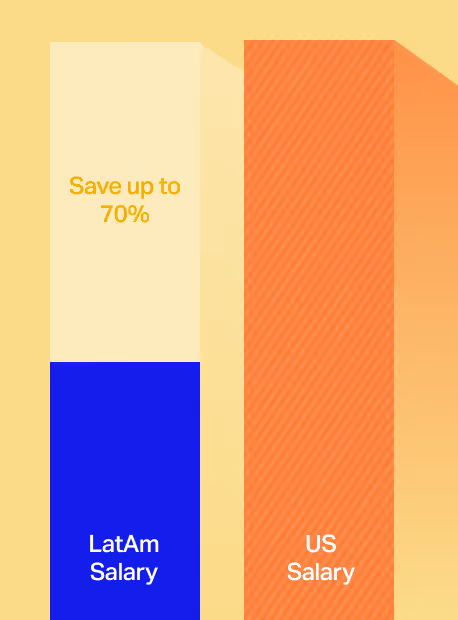
If your RPO provider also recruits in Latin America, where professionals work hours that overlap with US teams, salaries typically run 30–70% below US equivalents, reflecting the region’s lower cost of living.
Scalability
RPO capacity moves with your hiring plan, so you don't have to staff an internal recruiting team for your busiest quarter.
If hiring spikes in one quarter, the provider absorbs the additional load. If it slows, a per-hire or on-demand arrangement means you’re not paying for capacity you don’t need, while a monthly management fee keeps the team in place.
Improved candidate quality
An RPO partner’s relationship depends on your long-term satisfaction, while a staffing agency gets paid on placement. That incentive structure encourages RPO providers to invest in disciplined screening, so the candidates who reach your final round are more likely to be ready to join.
Access to specialized expertise
RPO providers bring expertise in sourcing strategies, recruitment technology, and candidate evaluation that most companies can't build in-house without significant investment. That includes industry-specific knowledge, familiarity with current compensation trends, and access to passive candidate networks that don't respond to job postings.
An RPO provider can also show you what's happening in your pipeline: where candidates are dropping off, how long each stage takes, and which sources produce the best hires. That's the kind of visibility that turns recruiting from a reactive function into a planned one.
Related reading: What Should You Know About RPO for Small Businesses?
{{state-latam-hiring}}
What Are the Potential Disadvantages of RPO?
The main disadvantages of RPO are less direct control over the process, the risk of cultural misalignment, and the internal time you still spend managing the partnership. Understanding them upfront helps you choose the right model and set the right expectations:
- Less direct control over the process: When recruiting moves outside your team, you have less visibility into day-to-day sourcing decisions and less control over how candidates are evaluated before they reach you. A detailed brief at the start of the engagement helps, but it's not a substitute for ongoing oversight.
- Cultural misalignment risk: If the provider doesn't deeply understand your team dynamics, values, and what makes someone succeed in your environment, they may surface technically qualified candidates who aren't a good fit. This risk often shows up only after a bad hire, so ask how the provider screens for fit before you sign.
- Internal bandwidth still required: RPO reduces your recruiting workload significantly, but it doesn't eliminate it. Someone on your team still needs to stay close to the partnership, review output, and hold the provider accountable to your standards.
The good news: all three of these risks are manageable. Clear success metrics from day one, a provider who invests time in understanding your culture, and regular check-ins go a long way toward keeping the engagement on track.
What Are the Common RPO Models?
The four common RPO models are full-cycle (end-to-end) RPO, project RPO, selective (modular) RPO, and on-demand RPO. The right one depends on how much of your hiring process you want to hand off and how long you need the support.
Here's how the four models compare:
Full-cycle (end-to-end) RPO
Full-cycle RPO, also called end-to-end RPO, transfers the entire recruitment function to an external provider.
When it covers hiring across a large organization with many departments or locations, it's often called enterprise RPO. You stay involved in final hiring decisions, while everything else is handled for you:
- Workforce planning
- Sourcing and screening candidates
- Interview coordination
- Assessments
- Offer management
- Onboarding
This model works best for companies with high hiring volume across multiple departments, where building and keeping an internal recruiting function would cost more than it delivers.
Providers bring their own applicant tracking systems, sourcing tools, and onboarding software, so you're not buying technology on top of headcount.
One underrated benefit: a consistent, professionally managed candidate experience improves how your company is perceived by applicants, which matters more when you're hiring at scale.
Project RPO
Project RPO hands a defined hiring push to an external provider for a set period, such as staffing a new office, a product launch, or a seasonal ramp-up.
It fits companies with short-term, high-volume hiring needs that their internal team can't absorb on top of regular work.
To get the most from project RPO, agree on the number of hires, deadlines, and success criteria with the provider before work begins.
Selective/modular RPO
Selective RPO, also called modular RPO, lets you outsource only the stages of the recruitment process where you need help.
You keep control of the stages you handle well, like interviews and final decisions, and hand off the ones where you lack time or expertise, most often candidate sourcing, screening, or both.
It's a strong option if you need specific expertise without handing over the whole function.
On-demand RPO
On-demand RPO provides recruitment support that scales with your hiring volume. If you hire 50 people in Q1 and 5 in Q3, an on-demand partner adjusts with you. You're not paying for capacity you don't need.
It's also useful for filling permanent roles faster when an urgent opening appears and for tapping specialized industry knowledge when your internal team lacks it.
How Much Does RPO Cost?
Recruitment process outsourcing cost depends on the pricing model, your hiring volume, and how complex your roles are.
Most engagements are billed as a monthly management fee, a fee per hire, or a hybrid of the two, while one-off hiring pushes are often priced as a fixed project fee. The right structure is the one where every fee is visible before you sign.
Here's how the main pricing models compare:
Any of these models can also include performance-based terms, where part of the provider's fee depends on hitting agreed metrics such as time-to-fill, quality of hire, or new-hire retention.
Pricing is where many RPO relationships come under strain: the Recruitment Process Outsourcing Association’s 2025 RPO Trends Report found that cost is the top reason organizations reconsider their RPO partnerships, followed by hiring speed and quality concerns.
Monthly management fee
A monthly management fee pays for a recruiting team and its tools on an ongoing basis. You know what you'll spend each month, which makes budgeting simple. It suits companies hiring all year steadily.
In a slow quarter, you still pay for capacity, so check how the fee scales down if hiring drops.
Cost per hire
With cost per hire, you pay when someone is hired. The fee usually bundles job advertising, sourcing, screening, and interview coordination, and some providers set it as a flat percentage of the new hire's first-year salary for a given role type. It ties spending directly to results, which suits uneven hiring.
Bear in mind that per-hire fees tend to run higher than in a retainer model, because the provider carries the risk of searches that don't close.
Hybrid pricing
Hybrid pricing combines a lower monthly management fee with a lower fee per hire. The monthly piece covers the provider's baseline capacity, and the per-hire piece rewards completed hires.
The provider is paid to stay staffed on your account, and paid more when it delivers. Ask how the two pieces are weighted, since that balance decides how your bill moves when hiring speeds up or slows down.
Project fee
A project fee is a fixed price for a defined hiring effort, such as 30 hires for a new office within six months. It's predictable and easy to approve, and it suits hiring pushes with a clear end date.
Fixed fees often come with minimum hire commitments or scope limits, so confirm what happens if you need fewer hires, or more, than planned.
What drives your RPO cost?
Whichever model you choose, these are the factors that move the price:
- Hiring volume and rate: Higher, steadier volume usually lowers the cost per hire. Sporadic hiring costs more per hire.
- Organization size and structure: Multiple departments, locations, and hiring managers mean more coordination and reporting.
- Role complexity: Specialized, technical, and senior roles need deeper sourcing and assessment than high-volume entry-level roles.
- Market conditions: Tight talent markets for a role or region take more recruiting effort.
- Location, technology, and customization: Where you hire, which tools the provider runs (ATS, sourcing platforms), and how tailored your process is all add to the fee.
For a baseline, compare RPO pricing with what hiring already costs you. SHRM's 2025 benchmarking data puts the average cost per hire at $5,475 for nonexecutive roles and $35,879 for executive roles. Contingency recruitment agencies typically charge a percentage of the hire's first-year salary for every placement, which adds up quickly when you're hiring more than a few people a year.
Our comparison of RPO vs. in-house recruitment breaks down how those costs stack up against running hiring yourself.
One thing no RPO pricing model changes is the salary line. RPO fees change what your hiring process costs. The talent market you recruit from changes what each hire costs, which is why the section on hiring outside the US below matters as much as the fee structure.
How Does RPO Compare With Other Outsourcing Models?
RPO hands you a managed recruiting process, while agencies fill individual roles and employer of record companies (EORs) handle payroll and compliance for people you've already chosen.
BPO providers run whole business functions, and nearshore staffing partners recruit and place full-time professionals in Latin America. The right choice depends on whether you need people found, people administered, or work done.
Here's what each model handles:
RPO vs. traditional recruitment agencies
Traditional staffing agencies are transactional: they fill a specific open role, collect a fee, and move on. RPO providers take over the process itself: that means a more strategic approach to building talent pipelines, recruitment technology embedded in your workflow, and expertise that carries over from hire to hire rather than being rebuilt each time.
The pricing differs too. Contingency agencies charge a placement fee, typically a percentage of the hire's first-year salary, every time they fill a role. RPO pricing is spread across a management fee, per-hire fees, or both, which makes your recruiting spend more predictable as volume grows.
For a closer look, see our breakdown of RPO vs. contingent recruitment.
RPO vs. employer of record (EOR)
RPO finds and hires the people. An employer of record (EOR) handles payroll, compliance, and local benefits for someone you've already chosen in another country, so the person can work as part of your team.
The two solve different problems, which is why many companies hiring internationally use both, or work with a partner that covers recruiting and administration together.
If you still need to find the right person, start with recruiting. If you've already found them, an EOR covers the administration.
RPO vs. BPO
BPO hands an entire business function to a provider, which delivers it with its own team. RPO is a narrower form of outsourcing that covers only recruiting, and the people it hires join your own team.
That difference matters to buyers who want dedicated hires. Hire With Near's research on why US companies turn to LatAm hiring found that roughly 1 in 8 companies make the switch specifically to escape the agency or outsourcing model: they want dedicated team members who report to them.
Engineering buyers show the same pattern. In Hire With Near’s analysis of 300 sales calls with US companies hiring engineers, 15% were leaving an outsourcing firm and another 30% were leaving an offshore team.
RPO vs. nearshore staffing
RPO providers aren't the same as directly hiring remote talent. Traditional RPO gives you a managed recruitment process, but the candidates it surfaces are typically drawn from the same domestic talent pools, at domestic salary rates.
Some companies are moving in a different direction, working with nearshore staffing partners who source and vet full-time professionals in Latin America, then place them as dedicated members of your team.
The recruitment process is still handled for you, but the talent pool is different. Professionals work overlapping hours with your team, and salaries are typically 30–70% lower than equivalent US hires.
{{salary-guide-cta}}
How Do You Choose the Right RPO Provider?
The right RPO provider is the one that fits your hiring situation, which you can judge on four areas: your own needs, the provider's capabilities, cultural fit, and geographic reach.
1. Assess your needs and goals
Start by naming the bottleneck:
- Sourcing: Not enough candidates entering the pipeline.
- Quality: Too many unqualified candidates reaching your team.
- Speed: Roles stay open too long.
- Bandwidth: Your HR team is stretched too thin to run recruiting well.
Then, define the scope you need, from sourcing through onboarding. A provider that excels at high-volume entry-level hiring may be a poor fit for senior specialist searches, and vice versa.
2. Evaluate provider capabilities
Look at their track record with your roles and industry, their technology stack, and how they report results. Ask for specifics: a provider who can quote average time-to-fill and quality-of-hire metrics for roles like yours is more credible than one offering broad assurances. Comparing the top RPO providers by specialization can help narrow the field.
Ask for full pricing transparency too. Find out what each fee includes, what triggers extra charges (setup or implementation, job advertising, assessments, background checks), whether there's a minimum-volume commitment, and what the exit or ramp-down terms are. A provider that won't put this in writing before you sign is a risk.
3. Check how the provider screens for fit
Share examples of your best past hires and what made them successful, ask how the provider evaluates fit during screening, and agree on what a quality candidate means for your organization.
4. Consider geographic scope and talent pool access
Ask whether the provider sources only US-based candidates or can hire internationally, and if so, which regions it covers and how it vets those candidates.
Providers with access to Latin American talent pools can deliver professionals who typically work overlapping hours with your team, communicate in English, and have salary expectations 30–70% below US equivalents because of the lower cost of living. A provider limited to the US domestic market can improve your process, but it can't change your cost structure.
If you're comparing partners with this reach, our roundup of the best executive search and recruiting firms in Latin America is a useful place to start.
Related reading: How Offshore RPO Services Can Cut Your Cost per Hire and Time to Fill
{{prevetted-banner}}
Can an RPO Provider Help You Hire Outside the US?
Yes, but only some can: most traditional RPO providers focus on domestic US hiring. That limits the talent pool to the same market every other US company is competing in, with the same salary expectations and the same five-plus-week hiring timelines.
More companies are taking a different approach: using recruitment outsourcing specifically to access talent in Latin America, where professionals typically work overlapping hours with US teams, often speak strong English, and where salaries typically run 30–70% below US equivalents due to differences in cost of living.
That's what we call nearshoring. Our guide to hiring remotely in Latin America walks through how it works.
In the conversations our recruiters have with US hiring managers, the pattern that emerges is consistent: companies that tried the traditional outsourcing model often ran into exactly the disconnect described by one hiring manager who switched to LatAm hiring:
Dealing with a 'middleman' is hard because we don't manage [our workers]. They're managed by the agency. So if someone's sick, it takes us hours to find out. They have to tell their manager, and the manager has to tell us.
What they want instead is a different working relationship: one where the hire reports to them, uses their tools, and grows with the business. As one hiring manager described it:
We really want to bring in people that are part of the team but that are just based somewhere else.
Hire With Near isn't a traditional RPO company. We source, vet, and place full-time professionals who work as part of your team, and under our monthly staffing model, we also handle contracts, payroll, and compliance. But the underlying function is similar: we take the hiring process off your plate and deliver qualified, interview-ready candidates. The difference is the talent pool and how the hire joins your team.
On the quality side, Franco Pereyra, Co-Founder and COO at Hire With Near, describes what companies consistently find when they hire in Latin America:
What sets Latin American talent apart from other regions is that you'll find people who are proactive and creative. People who come up with ideas and new solutions. If you're looking for folks who can bring something to the table, who will push back if they think your idea doesn't make sense, that's what you find in Latin America.
— Franco Pereyra, Co-Founder and COO, Hire With Near
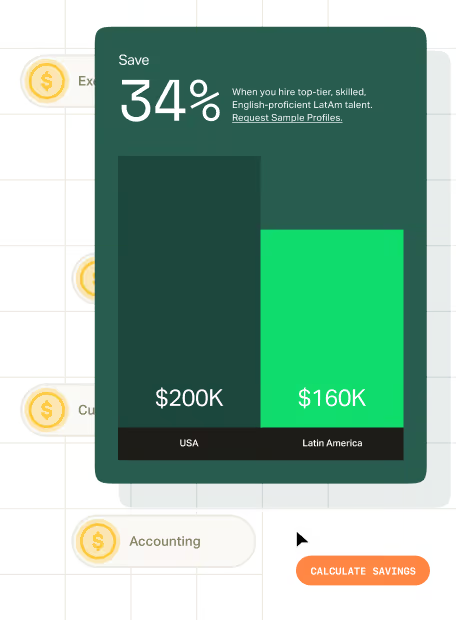
On the cost side, according to Hire With Near's 2026 State of LatAm Hiring Report, which analyzed 2,000+ placements, companies save an average of $35,000–$64,000 per hire annually. And 84% of those placements are mid-level or senior professionals.
Here's how salaries compare for some of the roles companies hire most often, according to Hire With Near's salary benchmarks:
For the most up-to-date figures, see Hire With Near's US vs Latin America Salary Guide.
CyberFortress, a cybersecurity company based in San Antonio, experienced this firsthand. When the company doubled headcount in 12 months following an acquisition, CFO Seema Chacko ran into a US shortage of finance and accounting professionals who fit the company’s culture.
Then, she engaged Hire With Near and built a 20-person finance team, including a director of accounting, an accounting team lead, and a director of global tax. The result: $1.2M in annual salary savings.
For companies exploring this model, Hire With Near's recruitment process outsourcing services page covers how the process works in practice.
How Do You Implement RPO in Your Organization?
On your side, implementing RPO follows three phases once you've chosen a provider: setting expectations, integrating technology, and monitoring performance.
1. Establishing clear expectations
Agree on the metrics you'll track (time to hire, cost per hire, and quality of hire) and on who owns which part of the process, on your side and the provider's.
Outline communication protocols so both sides can collaborate effectively and stay current on the pipeline throughout the recruitment process.
2. Integrating technology solutions
A key step in implementing RPO is integrating your organization's systems with the RPO provider's technology so candidate data flows consistently across your shared tooling.
This may include applicant tracking systems, sourcing platforms, and other recruitment tools that can shorten sourcing time and give your team a single view of every candidate's status.
When a candidate has two offers and timing is essential, a day of lag in your ATS can cost you the hire.
3. Monitoring performance and adjusting strategies
Review the provider's numbers every month: time-to-fill, offer acceptance, and how many shortlisted candidates you'd hire. When a stage slips, raise it right away.
That's what keeps an RPO partnership working after the first few months.
Final Thoughts
Recruitment process outsourcing is the right solution for companies whose hiring process has become a constraint on growth. Handing recruitment to a specialist usually shortens time-to-hire, raises candidate quality, and frees your internal team for the work that requires their institutional knowledge.
Once recruiting stops being a side task, the next question is where you recruit. A provider limited to the US market can fix your process, but every candidate still comes from the same pool every other US company is hiring from.
Adding a Latin American recruiting partner gives you access to experienced professionals who work overlapping hours with your team. Because of differences in cost of living, salaries typically run 30–70% below US equivalents.
Rankings.io, an SEO agency, is a good example. They were spending so much time recruiting that they couldn't focus on growing the business. After partnering with Hire With Near, they filled 11 roles, reduced time to hire to an average of three weeks, and saved $463,000 annually. Their HR director, Gillian Alvillar, described the experience:
The speed, the way they put everything together for us, it's just so clean and easy, and flows really well. It's made the entire hiring process incredibly smooth.
— Gillian Alvillar, Human Resources Director, Rankings.io
If your team is in the same position, book a free consultation to talk through your hiring needs.
Frequently Asked Questions
What is recruitment process outsourcing?
Recruitment process outsourcing (RPO) is an arrangement where a company transfers all or part of its recruitment function to an external provider, who manages the hiring process as a dedicated extension of the internal HR team.
Unlike a staffing agency that fills one seat and charges a placement fee, an RPO provider manages the process itself over time: sourcing, screening, coordinating interviews, and delivering hire-ready candidates.
The employer still makes the final hiring decision; the RPO partner handles everything that gets you there.
What is the difference between RPO and BPO?
Business process outsourcing (BPO) refers to the outsourcing of business functions to a third-party provider. Recruitment process outsourcing (RPO) is a specific category of BPO focused entirely on the recruitment function. BPO can cover IT, finance, customer service, and more. RPO covers sourcing, screening, and hiring.
What is sourcing RPO?
Sourcing RPO is a selective (modular) RPO arrangement where the provider handles only candidate sourcing, and often first-round screening, while your team runs interviews and makes offers.
It suits companies that have a capable internal recruiting or HR team but can't generate enough qualified candidates on their own, especially for hard-to-fill or specialized roles.
How does RPO impact our internal HR team?
RPO typically reduces the administrative load on your HR team while freeing them to focus on strategic priorities: retention, employee experience, workforce planning, and culture. The RPO provider handles the sourcing and coordination work; your team focuses on final interviews and decision-making.
Is RPO suitable for small or medium-sized businesses?
Yes. Small and medium-sized businesses often get the most from RPO, because they typically have the least internal recruiting capacity. An RPO partner gives a 20-person company access to similar sourcing tools and expertise to what large enterprises build in-house.
What we typically see is that smaller companies use RPO to hire faster and at a higher quality than they could alone, without having to build a full in-house recruiting function.
As a rule of thumb, RPO tends to pay off once you're hiring steadily across the year. If you only make one or two hires a year, per-placement recruiting usually costs less.
How do I know if RPO is a good fit for my business?
RPO is a good fit if you're hiring steadily, recruiting has become a side task that slows your HR team down, and agency fees keep adding up. Other signals: you need a consistent hiring process across several teams, or roles stay open long enough to hurt output.
It's usually a poor fit if you make only one or two hires a year, since you'd pay for a recruiting process you rarely use.
What to look out for when selecting a RPO vendor?
Look for full fee transparency, flexible contract terms, and a clear replacement guarantee. Before you sign, ask:
- What each fee includes, and whether there are setup or implementation fees.
- Whether there's a minimum-volume commitment, how long the contract runs, and what the exit or ramp-down terms are.
- How long the replacement window lasts and what triggers it.
- Which metrics they report, and their experience with your roles.
- Whether they source only in the US or internationally.
How do we measure the success of an RPO engagement?
Success metrics should be set before the engagement begins, and should include time-to-fill, cost per hire, quality of hire (often tracked via hiring manager satisfaction scores or 90-day retention), candidate satisfaction, and offer acceptance rate.
Ask any provider for its average time-to-fill on roles like yours, and compare it with your own track record before the engagement starts.
What types of roles are best suited for RPO services?
RPO works for most roles, from entry-level to director-level positions. You can use RPO for high-volume hiring across departments, including financial analysts and accountants, software engineers, sales development reps, and operations analysts.
It can also work well for specialized positions that call for specific interpersonal skills and discretion, such as executive assistants, where executive assistant recruitment agencies are a common route.
The key is matching the RPO model to your needs: full-cycle for comprehensive hiring, selective for specific functions, or project RPO for temporary surges in recruitment demand across any role type.
What are the stages of the recruitment process?
The recruitment process typically follows 6 core stages:
- Workforce planning: Defining what roles you need and when.
- Sourcing: Finding candidates through job boards, direct outreach, and networks.
- Screening: Reviewing applications and conducting initial interviews.
- Assessment: Evaluating skills and cultural fit.
- Offer management: Negotiating and extending offers.
- Onboarding
RPO providers can take ownership of all six stages, or just the ones where your internal team needs the most support.
What are the different types of RPO?
The four main RPO models are full-cycle (end-to-end), project, selective (modular), and on-demand. In full-cycle RPO, the provider manages your entire recruitment process; project RPO covers a specific hiring surge; selective RPO handles specific stages while you retain others; and on-demand RPO scales with variable hiring needs.
The right model depends on how much of the process you want to hand off and how consistent your hiring volume is.
Can an RPO provider help me hire internationally or outside the US?
Yes, some RPO providers can source internationally, including in Latin America, where professionals typically work overlapping hours with US teams and salary expectations are often 30–70% lower than US equivalents.
Hire With Near's model focuses specifically on this: sourcing and placing full-time dedicated professionals based in Latin America who integrate directly into your team.
Do RPO providers in Latin America charge only when you hire, or by retainer?
Cost-per-hire and success-fee models charge only when a hire is made, while retainer and monthly management-fee models charge for ongoing recruiting capacity whether or not a hire closes that month.
Providers recruiting in Latin America use both structures, and many also offer ongoing staffing models where payroll and compliance are handled alongside recruiting. Terms vary by provider and role, so ask for them in writing. To talk through pricing for your specific roles, book a free consultation with our team.
Can RPO help me outsource Python development work?
No. RPO finds people who join your own team, while outsourcing Python development means contracting a third-party firm to do the work itself.
If you need developers to join your team, RPO (or a nearshore staffing partner) is the right fit. If you'd rather hand off Python-specific project work entirely, see our guide to outsourcing Python development services instead.






.webp)
.webp)


%203.svg)
.avif)





%20(1).avif)

%20(1).png)