


%203.svg)
Key Takeaways
- A well-crafted legal assistant job description should clearly outline core responsibilities like case preparation, client communication, and document management while avoiding unrealistic requirements that might drive away qualified candidates.
- Including specific qualifications (like legal software proficiency and litigation support experience) and a transparent salary range helps attract skilled legal assistants who have the expertise you need and fit your budget, saving you time on unsuitable applicants.
- For remote legal assistant positions, consider expanding your search to Latin America, where many professionals have strong legal credentials, US business experience, and excellent English skills, while expecting salaries significantly lower than their US counterparts.
You need a legal assistant who can hit the ground running. Someone who understands legal procedures, can draft documents without hand-holding, and keeps your cases organized. But after weeks of posting generic job descriptions, you’re getting applications from candidates who’ve never worked in a law firm or think “legal research” means googling basic questions.
The problem runs deeper than just quantity. Poor job descriptions attract candidates who either lack the specialized skills you need or have completely unrealistic salary expectations for entry-level positions.
Then you waste hours interviewing people who don’t understand the difference between discovery and deposition.
Meanwhile, your caseload keeps growing, deadlines are approaching, and every day without the right legal assistant means you’re drowning in administrative tasks that should be delegated.
This guide will walk you through creating a legal assistant job description that speaks directly to qualified candidates, what sections matter most for attracting quality applicants, and common mistakes that drive away the legal support staff you actually need.
Why Job Descriptions Matter More Than You Think
Your legal assistant job description serves as both a filtering mechanism and your first opportunity to demonstrate that you understand what effective legal support actually looks like.
A strategic job description speeds up your hiring process by ensuring applicants can accurately assess their fit before applying. When candidates understand exactly what legal software they’ll use, what types of cases they’ll support, and what your communication style requires, you get applications from people who’ve actually done similar work.
Research shows that 75% of employees with high role clarity “are significantly more passionate about their job and report higher levels of job satisfaction than others.” And that clarity often starts with the job description.
Sets clear expectations about legal work
Generic descriptions like “provide legal support” tell candidates nothing about whether they’ll be doing family law intake, corporate document review, or litigation support.
When you’re specific about the work—“prepare discovery requests and organize exhibits for personal injury cases”—you attract candidates who’ve handled those exact tasks.
Demonstrates your firm’s professionalism
How you describe the role signals how well-organized your practice is. If your job description mentions “fast-paced environment” and “wear many hats” but doesn’t specify your case management system or typical caseload, experienced legal assistants will assume you’re disorganized or don’t have clear processes.
Filters for relevant legal experience
A clear job description helps ensure applicants understand the specific legal context they’ll be working in, reducing interviews with candidates whose experience doesn’t translate to your practice area.
What Makes a Great Job Description for Legal Assistant Roles?
The difference between good and great legal assistant job descriptions comes down to legal specificity and understanding what motivates experienced legal support professionals.
Great legal assistant job descriptions focus on the substance of legal work rather than generic administrative tasks. They emphasize the types of legal documents, court procedures, and client interactions that define the role.
Legal precision without overwhelming detail
Effective descriptions mention specific legal software and procedures but don’t list every possible task.
Focus on daily activities: “Draft pleadings and discovery documents using practice management software” is more helpful than listing every conceivable legal document type.
Realistic requirements that match actual work
One of the biggest mistakes law firms make is asking for senior-level legal experience but offering entry-level projects and compensation.
If the role involves basic document preparation and client scheduling, don’t require five years of complex litigation experience.
Clear practice area focus
Experienced legal assistants often specialize in specific areas of law. If you practice personal injury, family law, or corporate work, make that clear upfront.
This helps candidates with relevant experience self-select in while others recognize the role isn’t a good fit.
{{offshore-talent}}
What to Include in a Legal Assistant Job Description
Understanding what sections to include and how to present them effectively will help you attract qualified legal support professionals who can contribute immediately to your practice.
Job title
Your title needs to be both searchable and specific to the level of legal assistant you’re hiring. “Legal Assistant,” or “Litigation Assistant” work better than creative titles like “Legal Eagle” or “Case Ninja.”
If the role has specific focus areas, include those: “Family Law Assistant,” “Personal Injury Assistant,” or “Corporate Legal Assistant.” This helps qualified candidates find you while helping others understand if their experience aligns.
Summary of the role
This section should capture what makes this legal assistant position compelling in 2–3 sentences, giving candidates immediate context about your practice and their potential role within it.
Think of this as your elevator pitch to potential legal assistants:
- What type of law they’ll be supporting and why it matters
- How they’ll fit into your existing legal team
- What makes this opportunity different from other legal assistant roles
For example: “Join our growing personal injury practice to support our attorneys in securing favorable outcomes for accident victims. You’ll manage case files from initial intake through settlement, working directly with clients and handling discovery in a collaborative environment where your legal knowledge makes a real difference.”
Key responsibilities
Specificity about legal tasks helps candidates visualize their day-to-day work and understand the legal context they’ll be operating in.
Be specific about the actual legal work, not generic administrative tasks. Good examples:
- Prepare and format pleadings for attorney review, e-file approved documents, track discovery requests/responses
- Conduct initial client intake interviews and maintain regular communication throughout case progress
- Organize and review medical records, depositions, and expert witness reports for case preparation
- Coordinate with opposing counsel, court personnel, and expert witnesses to schedule depositions and hearings
- Maintain case files and deadlines using [specific practice management software]
Avoid vague statements like “provide legal support” or “assist attorneys.” Be concrete about what they’ll actually be doing on a daily basis and what legal knowledge they’ll need to apply.
Required skills and qualifications
Focus on what’s truly essential for success in your specific legal environment within the first 90 days.
Essential qualifications typically include:
- Specific years of legal assistant experience
- Required legal software proficiency (case management systems, court filing platforms)
- Knowledge of court procedures relevant to your practice area
- Understanding of legal terminology and document types you work with regularly
According to our recruiters who specialize in legal roles, transferable skills from other professional environments can be valuable, but legal-specific knowledge is crucial for effectiveness.
The 2024 ABA Legal Technology Survey reveals that AI adoption in law firms jumped from 19% to 30% year-over-year, making familiarity with legal technology increasingly valuable for legal assistant candidates.
Preferred qualifications
This is where you can mention nice-to-have skills that would help someone excel but aren’t deal-breakers:
- Experience with additional legal software in your tech stack
- Previous experience in your specific practice areas
- Specialized certifications (e.g., notary)
- Additional languages for client communication
Salary range
Legal assistants expect transparency about compensation, especially given the wide range of salaries in different practice areas and firm sizes.
When listing compensation:
- Provide a realistic range based on the actual experience level you need
- Clarify whether the range varies by location (especially for remote roles)
- Mention any significant benefits or professional development opportunities
- Be prepared to offer within the range you post
Including salary information isn’t just helpful—it’s becoming legally required in many states and shows you’re serious about transparency.
According to SHRM (Society for Human Resource Management), 80% of workers in the US are more likely to apply if a job posting has the salary range listed.
Location
Be explicit about where legal work gets done, as this affects everything from court appearances to client meetings:
- For on-site roles: Include the specific city and courthouse jurisdiction. Mention any flexibility for occasional remote work for document review or research.
- For hybrid roles: Specify how many days in-office are expected and whether there’s flexibility around court dates and client meetings.
- For remote roles: Clarify any geographical restrictions, time zone requirements, and how court appearances will be handled. Many legal assistant tasks can be done remotely, but some responsibilities may require physical presence. The American Bar Association reports that 82% of paralegals and legal assistants now work remotely in some capacity, with 32% working fully remote—making location flexibility a significant factor in attracting qualified candidates.
If you’re open to remote legal talent, consider that expanding your search globally can access broader talent pools with competitive compensation expectations. Top legal analysts and legal assistants with US legal system experience are available in various markets.
Perks and benefits
Beyond standard benefits, legal assistants often value:
- Flexible working hours around court schedules
- Professional development budgets for legal education
- Quality legal research tools and software
- Opportunities to attend legal conferences or continuing education
Work schedule
Legal work often involves unpredictable schedules due to court deadlines and client needs:
- Standard business hours vs. flexibility for urgent filings
- Expectations for overtime during busy case periods
- How court schedules affect daily work rhythm
- Any on-call expectations for urgent legal matters
How to apply
Make the application process straightforward for legal professionals:
- Specify required materials (resume, cover letter, writing samples)
- Clarify if you want examples of legal documents they’ve prepared
- Mention any legal knowledge assessments
- Provide a realistic timeline for your hiring process
{{salary-guide-cta}}
Common Mistakes to Avoid in Your Legal Assistant Job Descriptions
These pitfalls can significantly hurt your ability to attract quality legal support professionals and may lead to hiring mismatches that affect your practice efficiency.
Confusing legal assistant with paralegal roles
Many firms use these terms interchangeably when they have different skill requirements and compensation levels. Be clear about whether you need someone with formal paralegal training or if on-the-job legal experience is sufficient.
Unrealistic skill combinations for the salary offered
Asking for extensive litigation experience, multiple practice area knowledge, and advanced legal research skills while offering entry-level compensation signals you don’t understand the legal job market.
Vague descriptions of legal work
Generic statements like “handle legal documents” or “support attorneys” don’t give candidates enough information to determine if their legal background aligns with your needs.
Ignoring practice area specificity
Legal assistants often develop expertise in specific areas of law. If you practice family law but your job description could apply to any legal field, you’re missing opportunities to attract candidates with directly relevant experience.
This approach matters more than many firms realize: SHRM data shows the average cost-per-hire is $4,129, but bad hires can cost 30% of the employee’s first-year earnings—making accurate job requirements essential for hiring success.
Underestimating communication requirements
Legal work requires precise communication with clients, courts, and opposing counsel. Don’t overlook the importance of clear writing and professional phone manner when describing your requirements.
Sample Legal Assistant Job Description (Ready to Customize)
Legal Assistant – [Type of Practice]
About us: [Law Firm Name] is a [brief description focusing on practice areas and client service]. We’re building [specific value proposition] and need a skilled legal assistant to help us deliver exceptional representation to our clients.
The role: We’re looking for a [specific type of legal assistant based on your needs] to [main responsibility, e.g., support our personal injury attorneys, manage family law cases, handle corporate legal documentation].
You’ll [primary work description, e.g., work directly with clients throughout their cases, support multiple attorneys across various practice areas, focus on litigation support]. This role is perfect for a [ideal candidate description] who wants to [opportunity/appeal, e.g., make a meaningful impact on clients’ lives, grow their legal career, work in a collaborative environment] while [work environment description].
What you’ll do:
- [Primary responsibility with frequency, e.g., “Conduct initial client intake interviews and maintain ongoing communication throughout case progress”]
- [Core legal task, e.g., “Assist with preparing pleading templates and correspondence; proofread and e-file approved documents.”]
- [Document management responsibility, e.g., “Organize and review [types of documents relevant to your practice]”]
- [Coordination responsibility, e.g., “Schedule depositions, hearings, and meetings with [relevant parties]”]
- [Case support task, e.g., “Prepare [specific deliverables] for [case phases]”]
- [Add 2-3 more responsibilities specific to your practice area and daily needs]
- [Client/external communication responsibility if applicable]
What you’ll need:
- [Years of experience] years of experience as a [legal assistant/specific role]
- Proficiency with [your specific legal software and case management systems]
- [Required legal knowledge, e.g., “Understanding of civil litigation procedures” or “Knowledge of family court filing requirements”]
- [Communication requirements, e.g., “Excellent written and verbal communication for client interaction”]
- [Any mandatory certifications, education, or licenses]
- [Essential soft skills specific to your environment]
- [Any other truly non-negotiable requirements]
Nice to have:
- Experience with [additional software or systems that would be helpful]
- Previous experience in [your specific practice areas]
- [Helpful certifications, e.g., “Notary public certification”]
- [Additional languages if relevant to your client base]
- [Any other preferred but not required qualifications]
Salary and benefits:
- Salary range: $[X,000 - Y,000] annually [based on experience/location]
- [Health insurance, PTO, professional development budget, etc.]
- [Any unique benefits your firm offers]
Location & schedule:
- [Remote/Hybrid/On-site] position
- [Core hours requirements if applicable]
- [Time zone considerations if relevant]
- [Flexibility around court schedules]
Growth opportunities:
- [Professional development support]
- [Career advancement possibilities]
- [Continuing education opportunities]
How to apply: Send your resume and [any additional requirements] to [email/application link]. Include [specific instructions if you want writing samples, etc.]. We’ll review applications on a rolling basis and aim to respond within [timeframe].
Our hiring process includes: [brief overview of interview stages]
Final Thoughts
A thoughtfully crafted legal assistant job description connects you with legal professionals who can truly contribute to your practice’s success and client service.
The legal field demands precision, attention to detail, and specialized knowledge that can’t be learned overnight. By being clear about your practice areas, realistic about your requirements, and transparent about growth opportunities, you’ll attract legal assistants who are genuinely excited about the work rather than just looking for any administrative position.
But here’s the reality many law firms are discovering: even the perfect job description won’t solve the fundamental challenge of finding qualified legal assistants at a price point that makes sense for your practice.
California Consumer Attorneys faced exactly this problem. They needed to scale quickly but couldn’t expand their office space, and their current agency was charging nearly $3,000 per month for each legal assistant—almost the same cost as hiring locally. The agency’s micromanaging approach didn’t align with CCA’s values, and they needed a better solution.
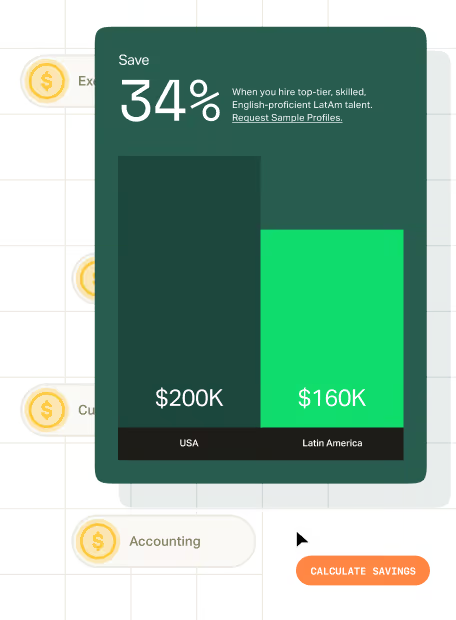
By expanding their search to include experienced legal assistants in Latin America, CCA transformed their entire operation. They hired 9 legal assistants in just a few months, with an average time-to-hire of only 7 days. The result? They saved $314K annually compared to hiring US-based assistants, doubled their caseload without expanding office space, and found professionals who integrated seamlessly into their US-based legal work.
As CCA’s Operations Manager noted:
“Every candidate I’ve received from Near has had excellent references and great experience. They’ve all been ready to jump into US-based legal work with very little training needed.”
The legal support landscape has evolved dramatically. Talented legal professionals around the world now have experience with US legal systems, procedures, and client service standards, while having salary expectations that actually fit most firms’ budgets.
Ready to see exactly what’s possible for your practice? Read CCA’s full case study to discover how they built a high-performing legal support team while saving hundreds of thousands annually.
Or see how a Texas personal injury firm took a similar approach: they hired six bilingual paralegals from Latin America for $3,400/month, saving $134,000 annually while closing a bilingual gap that local hiring couldn't solve.
Frequently Asked Questions
What’s the difference between a legal assistant and a paralegal when writing job descriptions?
The key difference lies in the scope of responsibilities and required qualifications. Legal assistants primarily handle administrative tasks like scheduling, filing, client communication, and basic document preparation.
They typically need a high school diploma plus on-the-job training or a certificate program.
Paralegals perform more substantive legal work, including legal research, drafting pleadings, case analysis, and trial preparation.
They usually require an associate’s degree in paralegal studies or equivalent certification. When writing job descriptions, be clear about which level of legal work you need. This affects both the qualifications you should require and the salary range you’ll need to offer.
Can legal assistant roles be performed remotely?
Yes, many legal assistant tasks can be done remotely, including document preparation, legal research, client communication via phone and email, case file organization, and scheduling. However, some responsibilities may require in-person presence, such as attending court hearings, meeting with clients for document signing, or handling physical evidence.
When writing a remote legal assistant job description, specify which tasks can be done remotely versus which require office presence. Also clarify your expectations for home office setup, legal software access, and data security requirements for handling confidential client information.
Consider that expanding your search to include remote candidates from other markets can help you find qualified professionals at different price points while still offering competitive compensation for their local markets.
Should I require experience in my specific practice area?
It depends on the complexity of your legal work and how much training you’re willing to provide. For specialized areas like immigration law, personal injury, or complex corporate work, relevant experience can be valuable because candidates will understand the specific procedures, terminology, and document types.
However, many core legal assistant skills transfer between practice areas. A detail-oriented professional with strong legal fundamentals can often adapt to your specific requirements with proper training. Consider making practice area experience “preferred” rather than “required” to avoid unnecessarily limiting your candidate pool.







.webp)


%203.svg)
.avif)






%20(1).avif)

%20(1).png)