


%203.svg)
Key Takeaways
- To hire a machine learning engineer remotely, follow a structured 7-step process: define your ML requirements, choose between direct hiring or staffing partners, select appropriate sourcing channels, conduct ML-specific assessments, interview thoroughly, make a competitive offer, and implement a comprehensive onboarding plan.
- When hiring remote machine learning engineers, focus on both technical expertise (Python, TensorFlow, PyTorch) and soft skills like clear communication and self-management, which are crucial for successful remote collaboration.
- Hiring remote ML engineers from regions like Latin America gives you access to a larger talent pool at 30–70% lower costs while maintaining time zone alignment for real-time collaboration.
Finding qualified machine learning engineers has become one of the biggest challenges companies face. With demand for machine learning talent far outpacing supply in the US market, hiring cycles often stretch into months while costs continue to skyrocket.
Remote hiring offers a practical solution—but only if you know how to navigate the process effectively. The good news is that machine learning engineering is inherently remote-friendly, making it possible to access global talent pools without sacrificing quality or collaboration.
This guide walks you through a proven framework for finding, evaluating, and hiring remote machine learning engineers who can deliver high-quality work without stretching your budget.
Whether you’re expanding your ML team or building one from scratch, you’ll learn how to identify genuine talent, avoid costly hiring mistakes, and set up your remote machine learning initiatives for success.
What Is a Machine Learning Engineer?
A machine learning engineer is a specialized software engineer who who builds computer programs that can learn from data and make decisions on their own, like how Netflix recommends shows or how voice assistants understand speech. They create and fine-tune these smart systems so businesses can automate tasks, improve predictions, and make better decisions.
They typically have strong foundations in computer science, statistics, and programming, with expertise in ML frameworks like TensorFlow, PyTorch, or scikit-learn. They’re responsible for creating models that solve specific business problems—from recommendation engines to fraud detection to predictive maintenance.
Machine learning engineers differ from data scientists in their stronger focus on software engineering principles and production deployment. While data scientists might build experimental models, ML engineers transform these into scalable, reliable systems that integrate with business operations.

When Do You Need to Hire a Machine Learning Engineer?
Not every company that wants to “use AI” actually needs a dedicated machine learning engineer.
Here are clear signs it’s time to bring one on board:
Your data volume has reached critical mass
If you’ve accumulated enough quality data to extract meaningful insights, a machine learning engineer can help you capitalize on this asset. Without sufficient data, even the best ML engineer will struggle to create effective models.
You have specific, complex problems that traditional analytics can’t solve
Machine learning excels at tasks like:
- Detecting patterns too complex for rule-based systems
- Making predictions based on multiple variables
- Processing unstructured data (text, images, audio)
- Creating systems that improve through feedback
Your existing engineers lack specialized ML knowledge
While many software engineers understand ML concepts, implementing production-level machine learning systems requires specialized knowledge. If your team is struggling with model optimization, deployment, or scaling, it’s time to bring in an expert.
You need to move from proof-of-concept to production
Many companies hit roadblocks when moving ML models from experimental phases into reliable production systems. This transition requires expertise in MLOps, model monitoring, and system architecture, which general software engineers may lack.
Why Hire a Remote Machine Learning Engineer?
Machine learning engineering is uniquely suited to remote work arrangements. The role involves focused development work, collaboration through code and data, and measurable outcomes—all of which can be accomplished effectively in a distributed environment.
Hiring remotely opens up several strategic advantages:
Access to a larger talent pool
A recent report by McKinsey stated that over 60% of their respondents experienced challenges hiring ML engineers.
When you’re no longer constrained by geography, you can find ML engineers with the exact skill set you need. This is particularly valuable given the specialized nature of machine learning and the shortage of qualified engineers in many local markets.
Cost optimization without quality compromise
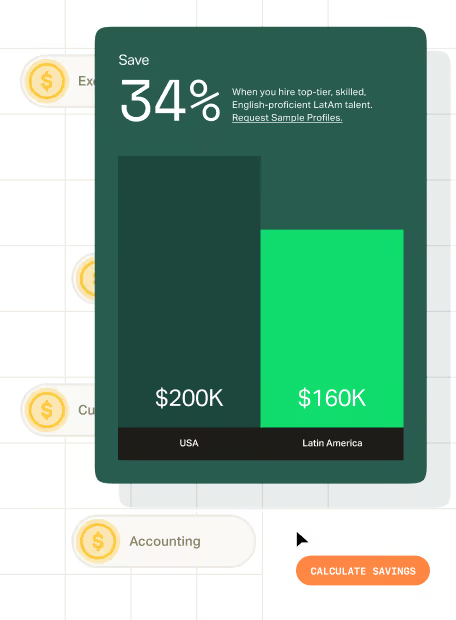
Remote hiring allows you to leverage regional salary differences while maintaining high standards. Companies typically save on compensation when hiring outside major US cities and up to 30–70% when looking outside the US, with no trade-offs in quality—when you know where to look.
This can lessen the impact of the 25% wage premium that is being reported on AI-related salaries.
Flexibility in scaling your ML initiatives
Remote hiring enables you to scale your machine learning team more easily by bypassing local talent shortages and significantly reducing costs.
When you’re not limited by the high salaries of US tech hubs, your budget stretches further, allowing you to bring on additional specialized expertise for specific projects or expand your core team in ways that would be financially prohibitive with local-only hiring.
Where to Find Remote Machine Learning Engineers
Remote hiring doesn’t necessarily mean going international—talented ML engineers can be found across the US working remotely. However, looking beyond US borders offers the most significant cost advantages while still accessing top-tier talent.
While ML talent can be found worldwide, certain regions stand out for their combination of technical expertise and cost advantages for US-based companies.
Latin America: The nearshore advantage
Latin America (LatAm) has emerged as a premier destination for hiring remote ML talent, offering unique benefits for US companies:
- Time zone alignment: Engineers in Mexico, Colombia, and Argentina work during US business hours, enabling real-time collaboration crucial for complex ML projects.
- Strong technical education: Countries like Brazil and Argentina have invested heavily in STEM education, with universities producing highly skilled ML specialists. The University of São Paulo, for example, is ranked first in Latin America for machine learning.
- Cultural compatibility: LatAm professionals often share cultural references with US teams and typically have strong English proficiency, reducing communication barriers in technical discussions.
- Cost advantage: ML engineers from LatAm typically command salaries 30–70% lower than their US counterparts without the significant quality trade-offs sometimes seen in other regions.
For example, the average annual ML engineer’s salary in LatAm ranges from $45K to $100K. This is significantly lower than the US average of $146K to $191K.
Asia: Maximum cost savings with time zone trade-offs
Asian countries typically offer the largest cost savings of all offshoring destinations, along with significant talent pools and specialization. However, the substantial time zone differences (9–12 hours from the US) require more asynchronous communication and careful project management:
- India has the world’s largest pool of STEM graduates, creating a massive talent pipeline that fuels a thriving IT market while keeping costs competitive. Indian IT firms have extensive experience with AI and ML solutions, making this a well-established offshoring destination.
- Vietnam is rapidly establishing itself as a global AI hub, with government-backed digital transformation initiatives and increasing investments from tech giants like Amazon, Samsung, NVIDIA, and Google. These investments have fueled AI research and development, boosting Vietnam’s AI readiness rankings in Southeast Asia.
- The Philippines offers a large, English-speaking workforce with growing expertise in AI-driven customer support, fraud detection, and chatbot development. The country’s IT services sector is projected to reach $2.5 billion in revenue by 2025, driven by investments in AI automation and data analytics.
Eastern Europe: Balanced time zones and costs
Eastern Europe occupies a middle ground between Latin America and Asia in terms of both time zone differences (6–9 hours from the US) and cost savings, offering a compromise for companies seeking more favorable rates than LatAm but more workday overlap than Asia.
- Poland has emerged as a European tech powerhouse with over 60,000 technology companies and a strong educational system producing highly skilled AI/ML specialists. Polish engineers are known for their technical precision and ability to handle complex AI-driven projects.
- Ukraine, despite ongoing geopolitical challenges, ranks second in Central and Eastern Europe for AI-related companies. The country’s resilient tech industry is built on a strong education system and a skilled workforce with extensive experience in machine learning development.
The right region depends on your specific priorities—whether real-time collaboration, specialized expertise, or cost optimization is your primary concern.

Essential Skills to Look for in Remote Machine Learning Engineers
Finding the right remote ML engineer means evaluating both technical capabilities and remote work aptitude. Here’s what to prioritize:
Technical skills that matter most
- Programming proficiency: Look for strong Python skills and experience with frameworks like TensorFlow, PyTorch, and Scikit-learn. Depending on your projects, knowledge of R, Java, or C++ may also be valuable.
- Mathematical foundation: Solid understanding of statistics, linear algebra, and calculus is essential for developing effective ML models and algorithms.
- Data management: Experience handling large datasets, cloud storage solutions, and data preprocessing techniques ensures your engineer can work efficiently with your data resources.
- MLOps experience: Production deployment skills, including model monitoring, versioning, and CI/CD pipelines for ML, are crucial for moving beyond proof-of-concept to business value.
- Domain knowledge: Familiarity with your industry (finance, healthcare, e-commerce, etc.) helps engineers understand the business context of ML problems.
Remote work capabilities
For successful remote collaboration, prioritize these attributes:
- Clear communication: Look for engineers who can explain complex ML concepts simply and document their work thoroughly.
- Self-management skills: Remote work requires professionals who don’t need constant supervision. The best remote ML engineers set their own deadlines, provide updates without prompting, and tackle problems before they escalate.
- Collaborative mindset: Experience with version control, project management tools, and asynchronous communication indicates readiness for remote teamwork.
- Culturally adaptable: This isn’t about knowing American sports references but understanding business expectations—meeting deadlines, owning results, and bringing solutions alongside problems.
How to Hire a Remote ML Engineer: 7-Step Process
Hiring machine learning talent is a bit of a challenge. You need specialists with niche expertise (that you likely don’t even understand) who can thrive in a remote environment. No small task.
But with a structured approach, you can cut through the complexity and find that perfect ML engineer who delivers real value from day one.
Here’s how to make it happen.
Step 1: Define your specific ML requirements
Unlike general software roles, ML engineering requires specific expertise in particular algorithms, frameworks, and domains. Be clear about:
- Types of models needed (NLP, computer vision, etc.)
- Scale of data processing required
- Production environment requirements
- Domain-specific knowledge (finance, healthcare, etc.)
The more precisely you define your needs, the easier it becomes to find a specialist who aligns with your projects rather than a generalist who might lack depth in your specific area.
And, of course, it’s hard to write your machine learning engineer job description without first getting clear on exactly what you are looking for.
Step 2: Decide between direct hiring or using a staffing partner
Determine whether you’ll manage the hiring process internally or work with a specialized recruitment partner.
Recruitment and staffing firms can significantly streamline the process by providing pre-vetted candidates, handling compliance issues, and managing international payroll—but they come with service fees.
Direct hiring gives you more control but requires more time and resources.
Step 3: Choose the right sourcing channels
If you’re going it on your own, select where you’ll look for candidates:
- General or specialized ML and AI job boards that attract technical talent
- Professional networks where ML engineers showcase their work
- Regional tech communities in your target hiring locations
- Industry conferences and ML-focused events
- Referrals from existing team members
The most effective strategy often combines multiple channels to maximize your reach.
Step 4: Screen and test candidates
Start with resume screening to identify candidates with relevant technical backgrounds. Look for experience with your required ML frameworks, similar projects, and evidence of successful deployments.
Create a practical ML skills assessment that mirrors your actual work:
- Present a simplified version of a real business problem
- Ask candidates to explain their modeling approach
- Request a small proof-of-concept implementation
- Review their data exploration and feature engineering processes
These hands-on evaluations reveal far more about a candidate’s capabilities than theoretical questions or generic coding tests.
Step 5: Conduct ML-specific interviews
For shortlisted candidates, conduct comprehensive interviews that explore both technical depth and collaboration skills:
- ML system design discussions
- Model interpretation questions
- Ethical AI considerations
- Data quality and governance understanding
Pay special attention to how clearly they communicate complex ML concepts—this skill becomes even more critical in remote settings where misunderstandings can easily occur.
For a list of questions to ask, see our article on the “Top 17 Interview Questions to Ask to Find the Best Machine Learning Engineer.”
Step 6: Make an offer and finalize the contract
Once you’ve found your ideal ML engineer, move quickly—top machine learning talent doesn’t stay available for long.
When making your offer:
- Be transparent about compensation, benefits, and performance expectations
- Clearly outline remote work policies, reporting structure, and communication requirements
- Provide details on equipment, software access, and technical support
- Consider adding specialized ML training or conference allowances as perks
Don’t leave room for ambiguity in your contract. Spell out intellectual property rights, data security expectations, and confidentiality requirements—all particularly important when handling sensitive data and proprietary ML models.
Step 7: Set up for remote ML success
Onboarding remote ML engineers requires careful planning:
- Provide clear documentation of existing data pipelines and infrastructure
- Ensure access to appropriate computing resources and permissions
- Schedule regular check-ins during the first few weeks
- Connect them with key stakeholders across departments
- Define a specific initial project with measurable outcomes
Create a structured 30/60/90 day plan that outlines expectations, learning objectives, and initial projects. This gives your new hire clear direction and helps them integrate smoothly with your team and workflows.
.avif)
Streamlining the Process with a Specialized Recruitment Partner
For many companies, especially those hiring ML engineers for the first time or those with limited internal recruiting resources, working with a specialized staffing partner can significantly streamline the process.
Benefits of using a staffing partner for ML hiring
- Pre-vetted talent pools: Good staffing partners maintain networks of pre-screened ML engineers who have already passed technical assessments, saving you weeks of initial screening.
- Market knowledge: Partners who specialize in technical roles understand current market rates, skill availability, and regional strengths for different ML specializations.
- Faster hiring timeline: While hiring ML engineers directly can take months, staffing partners can often present qualified candidates within days and complete the entire process in weeks.
- Simplified logistics: Staffing partners handle employment contracts, payment logistics, and compliance requirements for remote international talent.
- Replacement guarantees: Most reputable staffing partners offer guarantees if a placement doesn’t work out, reducing your risk.
How the process typically works
- Requirements definition: The staffing partner should spend significant time understanding not just your technical requirements but also your company culture, communication style, and project goals.
- Candidate matching: Within days, you should receive profiles of pre-vetted candidates who match your specific ML engineering needs.
- Streamlined interviews: You interview only candidates who have already passed technical assessments, focusing on project-specific questions and team fit.
- Offer and onboarding support: The partner manages offer logistics and often provides onboarding guidance for remote ML engineers.
- Ongoing support: Quality partners check in regularly to ensure a successful integration.
Common Pitfalls to Avoid When Hiring Remote ML Engineers
Even with the best process, there are common mistakes companies make when hiring remote ML talent:
- Overemphasizing credentials: Advanced degrees from prestigious institutions don’t always translate to practical ML engineering skills. Focus on demonstrated ability through projects and problem-solving.
- Neglecting soft skills: Technical brilliance without communication skills leads to isolation and misalignment in remote settings.
- Inadequate onboarding: Remote ML engineers need comprehensive documentation and clear access to data systems to be productive quickly.
- Unrealistic expectations: Be clear about the limitations of ML and set achievable goals, especially for initial projects.
- Ignoring time zone realities: If real-time collaboration is important, ensure working hours overlap sufficiently with your core team.
Final Thoughts
Hiring remote machine learning engineers doesn’t have to be a shot in the dark. By following a structured process that emphasizes both technical ML skills and remote collaboration abilities, you can build a high-performing team regardless of geographic boundaries.
The global nature of ML talent today means companies that limit their search to local markets are putting themselves at a significant disadvantage in both talent quality and cost efficiency. The most successful organizations are accessing global talent pools—particularly those with time zone alignment and cultural compatibility—to accelerate their ML initiatives.
If you’re also looking to hire data scientists, data engineers, AI developers, or analysts alongside your ML team, our guide to hiring data and AI talent in Latin America covers the full function, including roles, costs, top countries, and how to vet candidates across the department.
But why spend months navigating international hiring complexities on your own when there’s a faster path?
Near can connect you with pre-vetted machine learning engineers from Latin America in under 21 days, with no fees until you make a hire. Book a free consultation call today to get started finding the ML talent your business needs.
Frequently Asked Questions
What is nearshore outsourcing, and why does it suit machine learning hiring?
Nearshore outsourcing means hiring in nearby countries with overlapping time zones—like US companies hiring ML engineers in Latin America—rather than distant offshore regions.
For machine learning work, that time-zone overlap matters: model reviews, debugging, and deployment decisions happen in real time instead of on a next-day lag. Our guide breaks down what nearshore outsourcing is and how it compares to offshoring.
Can I hire nearshore AI engineers in Latin America, not just ML engineers?
Yes—US companies hire nearshore AI engineers across Latin America, alongside the machine learning engineers covered in this guide.
AI engineering overlaps with ML but leans more toward building and integrating AI-powered products and LLM features. If that's closer to what you need, see our guide on how to hire a nearshore AI engineer from Latin America. If your work centers on LLM workflows, you can also hire prompt engineers from Latin America to design and refine prompts and AI-driven workflows.
How long does it take to hire a machine learning engineer?
You can hire a machine learning engineer in about three to four weeks with a specialized staffing partner, versus the two-plus months a direct search often takes.
A partner that keeps a pre-vetted ML talent pool can share a shortlist within days; the rest is interviews and your decision. Sourcing solo takes longer because ML screening needs technical depth most in-house recruiters don't have.







.webp)


%203.svg)
.avif)






%20(1).avif)

%20(1).png)