

%203.svg)
Key Takeaways
- A well-crafted supply chain job description should clearly outline core responsibilities like demand planning, inventory management, and vendor coordination while avoiding unrealistic requirements that might drive away qualified candidates who have the strategic thinking you actually need.
- To attract skilled supply chain professionals, include specific qualifications (like ERP system proficiency and supply chain optimization experience) and a transparent salary range. This helps attract talent with the expertise you need and salary expectations that fit your budget, saving you time on unsuitable applicants.
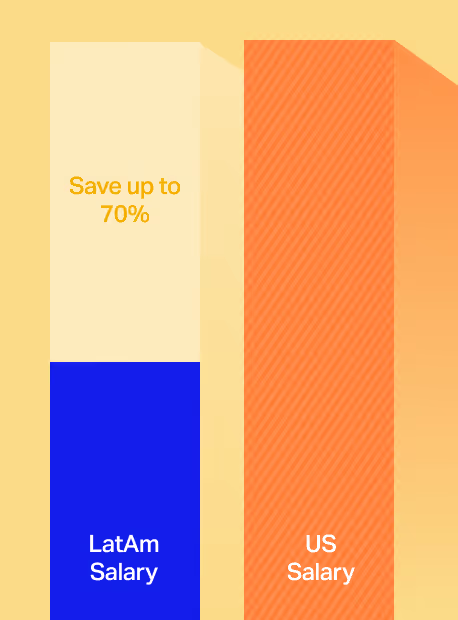
- For remote supply chain positions, consider expanding your search to Latin America, where many professionals have strong logistics credentials, US business experience, and excellent English skills, while expecting salaries up to 70% lower than their US counterparts.
You’re staring at another supply chain disruption. But this time, it’s not about delayed shipments or inventory shortages. It’s about finding someone who can actually prevent those problems from happening in the first place.
The problem isn’t just attracting applicants. Generic job descriptions that list every possible supply chain buzzword attract candidates who either lack the strategic thinking you need or have completely unrealistic salary expectations.
Then you spend weeks interviewing people who talk a good game about “optimization” but can’t explain how they’d actually streamline your specific operations.
Meanwhile, your current team is putting out fires instead of preventing them, costs keep climbing, and every day without the right supply chain professional means more inefficiencies eating into your margins.
This guide will walk you through creating a job description for supply chain roles that speaks directly to professionals who can actually solve problems, which sections matter most for attracting strategic thinkers, and the common mistakes that drive away the supply chain talent you actually want to hire.
Why Job Descriptions Matter More Than You Think
A strategic job description serves multiple functions that directly affect your hiring success and long-term operational efficiency.
It’s your first filter for identifying candidates who think strategically rather than just execute tasks. And it directly impacts both your hiring timeline and operational success.
Filters for strategic thinking over task execution
Top supply chain professionals want to see that you value problem-solving and continuous improvement, not just someone who can maintain the status quo. Generic descriptions like “manage inventory levels” tell them nothing about whether you’re looking for someone to optimize processes or just keep things running.
When you’re specific about strategic objectives—“develop supplier relationships that reduce lead times by 15% while maintaining quality standards”—you attract candidates who’ve actually delivered measurable improvements before.
Demonstrates operational maturity
How you describe the role signals whether your company understands modern supply chain practices.
If your job description focuses only on administrative tasks without mentioning data analysis, supplier relationship management, or cross-functional collaboration, experienced professionals will assume you’re not ready for strategic supply chain improvements.
Accelerates your hiring timeline
A clear job description helps ensure applicants understand both the tactical and strategic aspects of the role, reducing time spent on interviews with candidates who aren’t prepared for the complexity of supply chain work.
{{offshore-talent}}
What Makes a Great Job Description for Supply Chain Roles?
The difference between good and great supply chain job descriptions comes down to showing you understand that supply chain work is both analytical and relationship-driven, requiring both technical expertise and business acumen.
Systems and data focus
Modern supply chain work is data-driven. Top professionals expect to see mentions of ERP systems, demand planning software, and analytical tools. They also want to understand what data they’ll have access to and how decisions get made in your organization.
Lead with the business challenge
Instead of starting with generic responsibilities, open with the specific supply chain challenge you’re trying to solve:
“We’re scaling our consumer products business from $10M to $50M in revenue over the next two years, and we need a supply chain professional who can build systems that scale with us while maintaining our quality standards and customer service levels.”
This immediately attracts candidates who want to build something and have experience with growth challenges.
Address the skills gap directly
Be honest about the challenges and opportunities in your role. McKinsey reports that 90% of the companies they surveyed “lack sufficient talent to meet their supply chain digitization goals.” This creates significant opportunities for candidates who want to be part of building something meaningful.
“You’ll be joining us at a critical time as we modernize our supply chain operations. While many companies struggle with digital transformation, you’ll have the resources and support to implement cutting-edge solutions that directly impact our bottom line.”
Highlight decision-making authority
Top supply chain professionals want to know they’ll have the authority to make meaningful changes, not just maintain existing processes.
“You’ll own our entire demand planning process and have the authority to implement new forecasting methods, adjust inventory policies, and recommend supplier changes based on your analysis.”
Show cross-functional impact
Explain how the supply chain role connects to broader business success:
“Your demand forecasting and inventory optimization work directly impacts our ability to meet sales commitments while minimizing working capital requirements—critical as we scale.”
Or instead of just “forecast demand,” specify “develop demand forecasts that reduce stockouts by 20% while minimizing excess inventory carrying costs.”
Mention growth and learning opportunities
Supply chain is constantly evolving with new technologies and methodologies, so highlight development opportunities:
“You'll have opportunities to implement new demand planning software, attend industry conferences, and potentially lead supply chain projects as we expand into new markets."
What to Include in a Supply Chain Job Description
Understanding what sections to include and how to write them effectively can mean the difference between attracting strategic supply chain professionals and getting applications from people who just know the buzzwords.
Job title
Your title needs to be both searchable and specific to the type of supply chain work you need.
"Supply Chain Analyst," "Supply Chain Manager," "Procurement Specialist," or "Demand Planner" work better than vague titles like "Operations Coordinator" or creative ones like "Logistics Ninja."
If the role has specific focus areas, include those: "Senior Supply Chain Analyst - Procurement," "Supply Chain Manager - Consumer Goods," or "Demand Planning Specialist." This helps qualified candidates find you while helping others self-select out.
Summary of the role
Think of this as your elevator pitch to potential supply chain candidates. In 2–3 sentences, capture what makes this supply chain opportunity compelling:
- What supply chain challenges they'll be solving
- How they'll fit within your operations and broader team
- What makes this opportunity different from other supply chain roles
For example: "Join our growing operations team to optimize our end-to-end supply chain for our expanding consumer products business. You'll own demand planning and inventory management across 200+ SKUs, working closely with our sales and operations teams to balance service levels with cost efficiency. This role is perfect for an analytical supply chain professional who wants to drive measurable improvements in a fast-growing company."
This immediately tells candidates about the scope, complexity, cross-functional nature, and growth opportunity of the role.
Key responsibilities
Be specific about the actual work, not generic supply chain tasks. Our recruiters find that candidates respond best when they can visualize their day-to-day activities and understand how their work connects to business results.
Good examples:
- Develop and maintain demand forecasts for 200+ SKUs using historical data and market intelligence
- Manage inventory levels to achieve 95% service level while reducing carrying costs by 10%
- Lead quarterly business reviews with top 10 suppliers to negotiate terms and resolve performance issues
- Collaborate with sales and marketing teams to plan for promotional impacts and new product launches
- Analyze supply chain metrics and present monthly performance reports to executive leadership
Avoid vague statements like "optimize supply chain operations" or "manage vendor relationships." Be concrete about what they'll actually be doing and what success looks like.
Required skills and qualifications
This is where many companies go wrong by listing every supply chain skill they've ever heard of. Focus on what's truly essential for success in the first 90 days.
Essential qualifications typically include:
- Specific years of supply chain experience in relevant areas (demand planning, procurement, logistics)
- Required software proficiency (ERP systems, Excel, demand planning tools)
- Industry experience, if your products have unique requirements
- Analytical skills with examples of data-driven decision making
According to our recruiters, "Sometimes clients focus too much on industry-specific experience when adaptable supply chain skills transfer well between sectors. A strong analyst who understands demand planning principles can often succeed across different product categories."
Preferred qualifications
This is where you can mention nice-to-have skills that would help someone excel but aren't deal-breakers:
- Experience with specific ERP systems in your environment
- Professional certifications (APICS, Six Sigma, etc.)
- Previous experience in your industry vertical
- Knowledge of specific supply chain methodologies
Salary range
Supply chain professionals expect transparency about compensation, especially given the wide range of salaries across different specializations and experience levels.
Including salary information isn't just helpful—it's becoming legally required in many states and shows you're serious about transparency.
Research shows that including salary information in job postings increases application rates by 12%, with mentions of a bonus driving increases up to 40%.
For example: "Salary range: $65,000–$85,000 annually based on experience and location. Includes annual performance bonus opportunity of 10–15%."
Best practices:
- Provide a clear range: List a realistic minimum and maximum salary that reflects what you're prepared to offer
- Clarify what the range depends on: Experience level, specific supply chain expertise, or geographic location
- Be transparent about compensation structure: If the role includes bonuses tied to supply chain performance metrics, mention these
- Use "depending on experience" sparingly: Ensure the provided range still offers meaningful information
Location
Be clear and transparent about where the role can be performed. Many supply chain functions can be done remotely, which opens up significant opportunities for accessing broader talent pools.
- On-site: Include the specific city, state, and country, plus any requirements for warehouse or supplier visits.
- Remote: Specify if it is fully remote, hybrid, or requires occasional travel. Clearly state whether the role can be performed from locations outside the US.
- Time zone preferences: Indicate any specific time zone restrictions, such as requiring candidates to be within plus or minus two hours of Eastern Time, or to maintain regular overlap with suppliers and facilities in key regions.
Perks and benefits
Supply chain professionals often value benefits that support both professional development and work-life balance:
- Healthcare coverage and retirement plans
- Professional development budget for certifications and training
- Flexible working arrangements, especially for analytical work
- Performance bonuses tied to supply chain improvements
- Travel opportunities to visit suppliers or facilities
Work schedule
Supply chain work often involves coordinating across time zones and managing urgent situations, so be clear about expectations:
- Fixed schedule or flexible hours for analytical work
- Requirements for supplier calls or meetings in different time zones
- On-call expectations for supply disruptions or urgent issues
- Seasonal variations in workload (peak seasons, budget cycles)
How to apply
Make the application process straightforward while gathering the information you need to assess supply chain competency:
- Required application materials (resume, examples of process improvements)
- Any assessments that demonstrate analytical thinking
- Timeline for your hiring process
- Specific examples you'd like them to share about supply chain challenges they've solved
{{prevetted-banner}}
Common Mistakes to Avoid in Your Supply Chain Job Descriptions
These pitfalls can significantly hurt your ability to attract quality supply chain talent and often reflect deeper misunderstandings about what supply chain professionals actually do.
Unrealistic scope definition
One of the biggest mistakes companies make is asking for someone who can handle everything from procurement to logistics to demand planning at an expert level. Supply chain has many specializations, and trying to find a unicorn candidate leads to disappointment.
Focus on the 3-4 core competencies that will make the biggest difference in your specific operation, whether that's vendor management, inventory optimization, or process improvement.
Focusing only on cost reduction
While cost management is important, the best supply chain professionals think about total value: balancing cost, quality, service levels, and risk.
Job descriptions that only mention "cost savings" attract candidates who might cut corners in ways that hurt your business long-term.
Underestimating the analytical requirements
Supply chain work is highly analytical, involving data analysis, forecasting, and performance measurement.
If your job description doesn't mention data, metrics, or analytical tools, you'll miss candidates who can actually optimize your operations.
Experience with the exact software you use
Companies often get hung up on exact software matches when transferable skills matter more. A candidate who's mastered SAP can usually learn Oracle.
A really strong candidate who's done demand planning in retail can often adapt to manufacturing. Focus on analytical thinking, problem-solving ability, and communication skills; the technical tools can be taught to the right person.
According to our recruiters, "The best supply chain candidates can explain how they've used data to solve business problems, regardless of which specific software they used. We look for people who think strategically about the whole process, not just their piece of it."
Limiting your search unnecessarily
Many supply chain functions can be performed remotely, especially analytical and planning work. Restricting your search to local candidates significantly reduces your options and can increase costs.
Supply chain analysts and logistics analysts in Latin America often have experience working with US companies, understand American business practices, and can contribute effectively to remote supply chain teams while offering significant salary advantages.
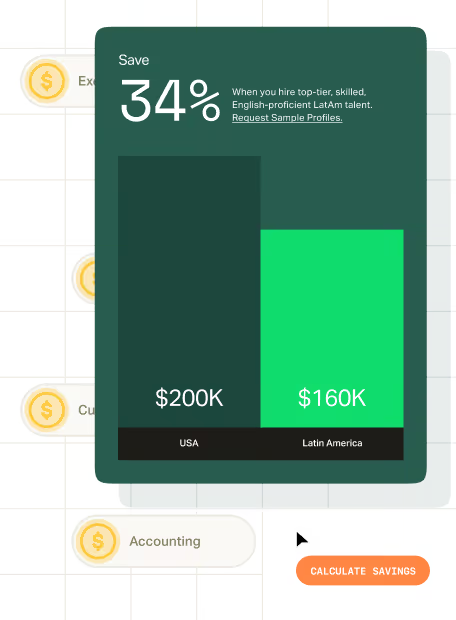
For example, you can hire a skilled supply chain analyst in LatAm for between $24,000 and $48,000. In comparison, in the US, that hire would cost you $150,000 to $191,000.
{{salary-guide-cta}}
Sample Supply Chain Job Description (Ready to Customize)
Supply Chain Analyst
About us: [Company Name] is a [brief description of company and industry]. We're [current stage, e.g., growing rapidly, expanding product lines, entering new markets] and need an experienced supply chain professional to [specific goal, e.g., optimize our inventory management, improve our demand planning, streamline our procurement processes].
The role: We're looking for an analytical supply chain professional to [specific responsibility, e.g., “own demand planning and inventory optimization for our 150+ SKU product line”]. You'll work with [lead sources and teams, e.g., sales forecasts, historical data, supplier performance metrics] while [additional responsibility, e.g., “developing supplier relationships and improving process efficiency”]. This role is perfect for a [ideal candidate description, e.g., “detail-oriented analyst with supply chain experience”] who wants to [opportunity/growth potential, e.g., “build scalable processes in a growing company”] in a [company culture/environment, e.g., collaborative, data-driven] environment.
What you'll do:
- [Specific responsibility with numbers, e.g., "Develop and maintain demand forecasts for 150+ SKUs using statistical models and market intelligence"]
- [Specific responsibility with frequency, e.g., "Manage inventory levels to achieve 95% service level while reducing carrying costs by 10%"]
- [Cross-functional responsibility, e.g., "Collaborate with sales and marketing teams to plan for promotional impacts and seasonal variations"]
- [Supplier management responsibility, e.g., "Conduct quarterly business reviews with key suppliers to evaluate performance and negotiate improvements"]
- [Reporting/analysis responsibility, e.g., "Analyze supply chain metrics and present monthly performance reports to operations leadership"]
- [Additional 2–3 core responsibilities specific to your supply chain needs]
What you'll need:
- [Years of experience] years of supply chain experience in [specific areas, e.g., demand planning, inventory management, procurement]
- Proven experience with [specific tools, e.g., ERP systems, advanced Excel, demand planning software]
- Strong analytical skills with experience in [specific capabilities, e.g., statistical forecasting, data analysis, process improvement]
- Experience working with [specific requirements, e.g., suppliers, cross-functional teams, performance metrics]
- [Any industry-specific requirements that are truly necessary]
Nice to have:
- Experience with [additional tools or systems that would be helpful]
- Professional certifications such as [relevant certifications, e.g., APICS, Six Sigma]
- Previous experience in [your industry or adjacent industries]
- Knowledge of [specific methodologies, e.g., lean principles, continuous improvement]
Salary and benefits:
- Salary range: $[X,000–Y,000] annually [based on experience/location]
- [Performance bonus structure if applicable]
- [Key benefits: health insurance, retirement plan, professional development budget]
- [Any unique benefits or perks your company offers]
Location and schedule:
- [Remote/Hybrid/On-site] position
- [Time zone requirements if applicable, e.g., "Core hours overlap with EST for supplier coordination"]
- [Travel requirements if any, e.g., "Occasional travel to supplier facilities or warehouses"]
- [Any specific schedule needs, e.g., "Flexibility for urgent supply chain issues"]
Growth opportunities:
- [Professional development support, e.g., "Annual budget for supply chain conferences and certifications"]
- [Career advancement paths, e.g., "Opportunity to lead supply chain initiatives as we expand"]
- [Learning opportunities, e.g., "Work with cutting-edge demand planning technology"]
- [Company growth story, e.g., "Join us as we scale from $10M to $50M in revenue"]
How to apply: Send your resume to [email/application link] and include:
- [Specific information you want, e.g., "A brief example of a supply chain process you improved and the results you achieved"]
- [Portfolio request if relevant, e.g., "Examples of demand forecasting accuracy or cost savings you've delivered"]
- [Motivation question, e.g., "Why you're interested in supply chain work in [your industry]"]
Our hiring process includes: [Brief overview of your interview stages, e.g., "Initial call → Technical assessment → Final interview with operations leadership"]
[Timeline information, e.g., "We'll review applications on a rolling basis and aim to respond within one week."]
Final Thoughts
A thoughtfully crafted supply chain job description connects you with professionals who can truly optimize your operations and drive measurable business improvements.
But here's the reality you're facing: companies are receiving on average 180 applications per job listing. That's 180 resumes to review, 180 potential phone screens, and 180 opportunities for unqualified candidates to waste your time.
Your job description needs to work as a filter, not a magnet. Every generic phrase like "manage supply chain operations" attracts candidates who know the buzzwords but can't deliver results. Every vague requirement pulls in applicants who'll sound good in a phone screen but lack the analytical thinking you actually need.
By being clear about your supply chain challenges, honest about your analytical requirements, and realistic about the scope of the role, you'll save yourself from reviewing applications from people who know the terminology but can't deliver results.
But there's an even better approach. Instead of posting your job and bracing for hundreds of applications, consider this: many companies have found success working with supply chain analysts and other supply chain professionals in Latin America who have the analytical skills, systems experience, and US business knowledge to contribute effectively to remote supply chain teams.
Rather than hoping the right candidate finds you among hundreds of applicants, schedule a free, no-commitment consultation call with our team. We can help you skip the overwhelm entirely and get a shortlist of three highly qualified, perfectly matched candidates in Latin America who have the proven track record to solve your specific supply chain challenges.
These aren't random applicants hoping to break into supply chain work. They're experienced professionals who've already delivered the kinds of results you're looking for, and they're available at rates that actually fit your budget.
Frequently Asked Questions
Can supply chain jobs be done remotely?
Many supply chain functions work well remotely, especially analytical roles like demand planning, procurement, and supply chain analysis.
However, roles requiring physical presence at warehouses, manufacturing facilities, or supplier sites may need hybrid arrangements. The key is being clear about which aspects of the role require in-person work versus what can be done from anywhere.
What's the difference between a supply chain analyst and supply chain specialist?
A supply chain analyst typically focuses on data analysis, forecasting, and performance measurement. They're the numbers people who identify trends and opportunities.
A supply chain specialist usually has broader operational responsibilities, managing processes, coordinating with suppliers, and implementing improvements. Think of analysts as the diagnosticians and specialists as the implementers.
What software skills are essential for supply chain professionals?
It depends on the role, but most teams look for strength in a few core toolsets. Brand names are transferable, so prioritize capability over one specific vendor.
- ERP: Working knowledge of a major platform to manage POs, MRP, BOMs, inventory, and receipts (e.g., SAP S/4HANA, Oracle, NetSuite, Microsoft Dynamics).
- Planning/APS & S&OP: Experience with demand and supply planning, scenario analysis, and capacity balancing (e.g., SAP IBP, Kinaxis RapidResponse, o9, Anaplan).
- WMS/TMS (if you own logistics): Basics of warehouse workflows, slotting, and transportation planning/visibility (e.g., Manhattan, Blue Yonder, Oracle WMS, Descartes).
- Analytics & data: Advanced Excel (PivotTables, XLOOKUP, Power Query), BI tools (Power BI, Tableau, Looker), and SQL fundamentals for querying large datasets.
- Integration & EDI: Comfort with common transaction sets and vendor portals; understanding how APIs and EDI feeds connect partners and systems.
- Trade compliance (as applicable): Familiarity with SAP GTS or e2open/Amber Road, HTS/HS classification, and export/import documentation if you ship cross-border.
- Collaboration & workflows: Use of Jira/Confluence or Asana for projects, plus clear documentation and dashboarding habits.
In your job description, name your stack so candidates can self-select, and note that equivalent experience on other platforms counts.
Should I outsource logistics functions instead of hiring supply chain staff?
Outsourcing logistics can be an effective strategy for specific functions like transportation management, warehousing, or last-mile delivery, especially when you lack the volume to justify full-time expertise or need specialized capabilities.
However, core supply chain strategy, demand planning, and supplier relationship management typically require in-house knowledge of your business.
The decision often comes down to whether the function requires deep company knowledge versus operational expertise. Many companies find success with a hybrid approach—keeping strategic planning in-house while outsourcing specific logistics operations to specialized providers.
What are the benefits of partnering with a recruitment firm for supply chain hiring?
Working with a specialized supply chain recruitment firm or recruiters for logistics companies, like Hire With Near, can significantly streamline your supply chain hiring process, especially when you need to fill multiple roles or access specialized expertise quickly.
Recruitment firms bring pre-vetted candidate pools, industry knowledge about compensation benchmarks, and expertise in assessing technical skills that may be outside your HR team's wheelhouse.
They can also help you navigate skills-based hiring approaches and identify candidates whose experience translates well between industries.
For logistics and supply chain roles specifically, specialized firms understand the nuances between different supply chain functions and can help you prioritize which skills are truly essential versus learnable on the job.
This recruiting expertise becomes particularly valuable when exploring global talent pools, as recruitment partners can handle compliance, cultural fit assessment, and ongoing relationship management.







.webp)


%203.svg)
.avif)





%20(1).avif)

%20(1).png)