


%203.svg)
Key Takeaways
- A well-crafted accountant job description should clearly outline core responsibilities like financial reporting, reconciliations, and compliance while avoiding unrealistic requirements that might drive away qualified candidates.
- Including specific qualifications and transparent salary ranges saves you time on unsuitable applicants by attracting skilled accountants who have the expertise you need and fit your budget.
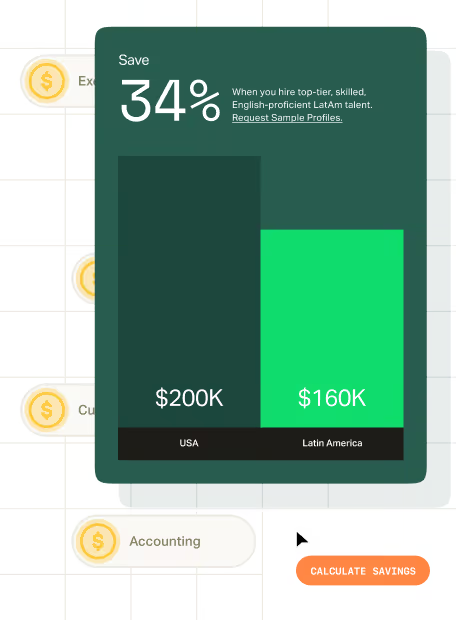
- For remote accounting positions, consider expanding your search to Latin America, where many professionals have strong accounting credentials, experience with US-based companies, and excellent English skills, while expecting compensation up to 69% lower than their US counterparts.
You’re staring at another accounting role that needs to be filled yesterday, but you know posting a generic “seeking detail-oriented accountant” description isn’t going to cut it.
Bland job descriptions attract bland candidates. Or worse, they drive away the experienced accountants you actually need. Meanwhile, you’re stuck interviewing people who either lack the skills for your specific setup or have completely unrealistic salary expectations.
Every week without the right accountant means month-end becomes a nightmare, compliance risks pile up, and your existing team gets stretched thinner.
This guide will show you how to write an accountant job description that speaks directly to qualified professionals, what sections matter most for attracting serious talent, and common mistakes that make top candidates scroll right past your posting. You’ll walk away with recruiter-backed insights and a customizable template you can use today. Use it to publish a post that filters fast and attracts accountants who can deliver.
Why Well-Written Job Descriptions for Accountants Matter More Than You Think
Your accounting job description is your first opportunity to filter for qualified candidates while demonstrating that you understand what quality accounting work actually looks like.
A well-written job description acts as your first filter, attracting qualified candidates while deterring those who aren’t a good fit.
When you’re specific about technical requirements—“Prepare monthly financial statements using QuickBooks and ensure compliance with US GAAP standards”—you attract candidates who’ve actually done that work before, which dramatically speeds up your hiring process by reducing time spent on unqualified interviews.
Just as importantly, how you describe the role demonstrates your understanding of accounting. If your job description mentions “bookkeeping duties” without specifying your month-end closing process or reporting structure, experienced accountants will question whether you have mature financial processes in place.
What Makes a Great Job Description for Accounting Roles?
The best accounting job descriptions attract top candidates by being specific about the technical work while clearly showing growth opportunities.
You probably don’t need us to tell you that you’re competing in one of the tightest labor markets in the economy. Everyone is finding it hard to find qualified accountants in the US. You need your job description to attract as many of the best-fit candidates out there.
Technical clarity without overwhelming detail
Great accounting job descriptions mention specific software, reporting requirements, and compliance standards, but they don’t list every possible accounting function.
Focus on what the accountant will do daily: “Manage full-cycle accounts payable in NetSuite and prepare weekly cash flow reports” is more helpful than a twenty-item list of general accounting duties.
Realistic requirements that match the actual work
One of the biggest mistakes companies make is asking for CPA-level skills but offering staff accountant projects and compensation. If the role involves standard bookkeeping and basic financial reporting, don’t require five years of complex revenue recognition experience.
Our recruiters frequently see companies unnecessarily limit their candidate pool by listing every possible accounting skill as “required” when many can be learned on the job. Focus on 3–4 truly essential competencies.
Honest representation of your accounting environment
If you’re a fast-growing startup where financial processes are still evolving, say that. If you’re an established company with rigorous month-end procedures and multiple entity consolidations, mention that too. Misrepresenting your environment leads to early turnover when reality doesn’t match expectations.
Clear communication about growth and learning
Strong accountants want to continuously develop their skills. Be specific about development opportunities: “You’ll have opportunities to attend industry conferences, pursue additional certifications with company support, and take on increasing responsibility as we expand our finance team from 3 to 8 professionals over the next 18 months.”
Lead with the challenge
Strong accountants are motivated by interesting problems and growth opportunities. Start your job description by highlighting what makes the work compelling:
“We’re implementing a new ERP system and need an experienced accountant to help design our chart of accounts structure and financial reporting processes as we scale from $10M to $50M in revenue.”
This immediately attracts candidates who want to work on meaningful projects rather than routine tasks.
What to Include in an Accountant Job Description
A comprehensive accounting job description should include these essential components that help finance professionals understand both the role requirements and the salary on offer.
Here are the essential components that make accounting job descriptions effective and attract the right candidates:
Job title
Your title needs to be both searchable and specific to the level of accounting work you need. “Staff Accountant,” “Senior Accountant,” or “General Accountant” work better than creative titles like “Numbers Guru” or “Financial Wizard.”
If the role has specific focus areas, include those: “Accounts Payable Accountant,” “Revenue Accountant,” or “Tax Accountant.” This helps qualified candidates find you while helping others self-select out.
Summary of the role
Think of this as your elevator pitch to potential accounting candidates. In 2–3 sentences, capture what makes this accounting opportunity compelling:
- What type of accounting work they’ll be doing and for what kind of organization
- How they’ll fit into your existing finance team
- What makes this opportunity different from other accounting roles
For example: “Join our growing finance team as a Staff Accountant supporting our SaaS business. You’ll manage the full accounting cycle from transaction recording through financial reporting, working closely with our Controller to ensure accurate monthly closes and regulatory compliance. This role is perfect for a detail-oriented professional who wants to grow their skills in a fast-paced environment with clear advancement opportunities.”
This immediately tells candidates about the industry context, reporting structure, and growth potential.
Key responsibilities
Be specific about the actual work, not generic accounting tasks. Our recruiters find that candidates respond best when they can visualize their day-to-day activities and understand the accounting processes they’ll be managing.
Good examples:
- Prepare monthly financial statements and supporting schedules using QuickBooks Enterprise
- Manage accounts payable cycle including invoice processing, approval workflows, and vendor payments
- Perform bank and credit card reconciliations within 3 business days of month-end
- Assist with quarterly tax preparation and annual audit support
- Maintain fixed asset schedules and calculate monthly depreciation
Avoid vague statements like “handle accounting duties” or “maintain financial records.” Be concrete about what they’ll actually be doing and how often.
Required skills and qualifications
This is where many companies go wrong by listing every accounting skill they’ve ever heard of. Focus on what’s truly essential for success in the first 90 days.
Essential qualifications typically include:
- Specific years of accounting experience (be realistic about your expectations)
- Required software proficiency (QuickBooks, NetSuite, Excel, etc.)
- Knowledge of relevant accounting standards (US GAAP, tax regulations)
- Industry experience if truly necessary for your business
One of our recruiters notes that multi-client experience is often a stronger predictor of success than specific certifications, as it demonstrates the ability to manage relationships and communicate effectively while staying organized and detail-oriented.
Preferred qualifications
This is where you can mention nice-to-have skills that would help someone excel but aren’t deal-breakers:
- Experience with additional software in your accounting stack
- Previous experience in your specific industry
- Additional certifications (CPA, CMA, etc.)
- Experience with specific accounting situations (multi-entity, international, etc.)
Salary range
Including salary information isn’t just helpful. It’s becoming legally required in many states and shows you’re serious about transparency.
According to SHRM, this approach works to attract more candidates:
80% of US workers are more likely to consider applying for a position if the pay range is listed in the job posting.
Best practices:
- Provide a realistic range based on the actual experience level you need
- Clarify whether the range varies by location (especially for remote roles)
- Mention any significant benefits or variable compensation components
- Be prepared to offer within the range you post
Why it matters:
- Legal compliance: States like California, New York, Illinois, and Minnesota now require salary ranges in job postings
- Attracting qualified candidates: Transparent salary information helps attract candidates who are comfortable with the compensation
- Building trust: Transparency fosters trust and can enhance your employer brand
Location
Be clear and transparent about where the accounting work can be performed:
- For on-site roles: Include the specific city and office location. Mention any flexibility for remote work during non-closing periods.
- For hybrid roles: Specify expectations for in-office time, especially during month-end closing periods.
- For remote roles: Clarify geographical restrictions, time zone requirements, and any equipment provisions.
If the role can be done remotely, expanding your search globally can dramatically increase your candidate pool while reducing costs.
You can access talented professionals in markets like Latin America, where accounting salaries typically range significantly lower than US rates, while still offering competitive compensation for those local markets.
Perks and benefits
Mention the real, tangible benefits that matter to accounting professionals:
- Healthcare coverage or stipend
- Professional development and certification support
- Paid time off and flexible scheduling
- Remote equipment stipend (for remote roles)
- Annual conference attendance or continuing education budget
According to our recruiters, paid time off (PTO) and the flexibility to observe local holidays are usually the most important perks for accounting candidates, beyond compensation.
Work schedule
Be clear about expectations, especially regarding month-end and year-end periods:
- Full-time or part-time hours
- Fixed schedule or flexible hours outside closing periods
- Required availability during month-end (typically first 5 business days)
- Any overtime expectations during busy seasons
How to apply
Make the application process straightforward by specifying:
- Required application materials (resume, references, work samples)
- Where and how to submit applications
- Any assessments or tests that will be part of the process
- Timeline for the hiring process if possible
What Are the Common Mistakes to Avoid When Looking for an Accountant?
The most damaging mistakes involve undervaluing communication skills, overemphasizing credentials, and unnecessarily limiting your candidate pool.
Underestimating the importance of communication skills
Technical accounting skills aren’t everything.
Accountants need to explain complex financial concepts to non-finance teammates, provide clear variance analysis, and document their work comprehensively. Include these soft skill requirements in your job description.
Focusing too much on credentials over competency
While certifications like CPA can be valuable, don’t let them overshadow practical experience and proven performance.
Our recruiters recommend that companies avoid requiring a CPA license unless it’s truly necessary, as this can eliminate many excellent candidates who have strong accounting skills but not formal certification.
Using generic language that doesn’t inspire
Phrases like “detail-oriented” and “organized” appear in every accounting job description.
Instead, describe the specific impact they’ll have: “Your accurate financial reporting will directly inform our executive team’s strategic decisions and help us maintain the financial transparency our investors expect.”
Limiting your search unnecessarily
If the role can be done remotely, restricting your candidate pool to local talent significantly reduces your options. Hiring offshore accountants has become increasingly common, and many companies discover that top accounting professionals in Latin America often have experience working with US companies, strong English communication skills, and competitive technical abilities.
Take CyberFortress, for example. This San Antonio-based cybersecurity company needed to rapidly expand their accounting team during a period of fast growth. By hiring 20 team members from Latin America—including three managerial-level accounting positions like a Director of Accounting and Financial Reporting—they saved an estimated $1.2 million in annual salaries while cutting their month-end closing timeline from 15 days to 10.
According to their CFO, Seema Chacko,
We hired 20 team members who share our core values: great attitude and desire to learn, resourcefulness, and adaptability. Near’s team was very responsive, and their easy-going communication fostered a seamless hiring process.
Sample Accountant Job Description (Ready to Customize)
This comprehensive template includes all the essential elements discussed above, customized for a mid-level accounting position.
Staff Accountant
About us [Company Name] is a [brief company description focusing on industry and growth stage]. We’re [current stage, e.g., growing rapidly, expanding operations] and need a detail-oriented Staff Accountant to support our finance team as we [specific growth goal or financial milestone].
The role We’re looking for an experienced Staff Accountant to join our finance team of [team size]. You’ll handle [specific accounting functions] while working closely with our [Controller/Finance Manager/CFO] to ensure accurate financial reporting and compliance. This role is perfect for an accounting professional who wants to [specific appeal, e.g., grow their skills, work with advanced systems, contribute to scaling operations].
What you’ll do:
- Prepare monthly financial statements and supporting schedules using [specific accounting software]
- Manage [specific accounting area, e.g., accounts payable, receivable] including [specific processes]
- Perform daily/weekly/monthly reconciliations for [specific accounts]
- Support quarterly tax preparation and annual audit processes
- Assist with [industry-specific accounting requirements]
- [Add 2-3 more specific responsibilities based on your needs]
What you’ll need:
- [X+] years of accounting experience with [specific requirements]
- Proficiency with [required accounting software and tools]
- Strong knowledge of [relevant accounting standards, e.g., US GAAP]
- Experience with [specific accounting processes essential for the role]
- [Any truly required certifications or educational background]
Nice to have:
- Experience in [your industry or related industries]
- Knowledge of [additional software or systems that would be helpful]
- [Relevant certifications that aren’t required, e.g., CPA, CMA]
- [Any other preferred qualifications]
Salary and benefits:
- Salary range: $[X,000 – Y,000] annually [based on experience and location]
- [Competitive benefits, including health insurance, retirement plan, etc.]
- [Professional development budget and certification support]
- [Remote work setup or office location details]
Location & schedule:
- [Remote/Hybrid/On-site] position
- [Core hours requirements if any]
- [Time zone considerations for remote positions]
- [Special schedule requirements during month-end/year-end]
Growth opportunities:
- [Professional development and certification support]
- [Clear advancement paths within the finance team]
- [Opportunities to work with new systems or take on additional responsibilities]
How to apply Send your resume and [any additional requirements] to [email/application link]. Include [specific instructions if you want cover letter, references, etc.]. We’ll review applications on a rolling basis and aim to respond within [timeframe].
Our hiring process includes: [brief overview of interview stages]
For a template for other finance professionals, see our guide on writing job descriptions for finance roles.
{{prevetted-banner}}
Final Thoughts
You now have everything you need to write an accountant job description that attracts qualified candidates and speeds up your hiring process.
By being specific about technical requirements, transparent about compensation, and realistic about qualifications, you’ll connect with accounting professionals who can actually do the work you need done.
But if you’re looking to hire right now and want to skip the process of posting across multiple job boards and screening hundreds of applications, there’s a faster way.
Instead of waiting weeks or months to find the right accountant, we can present you with three pre-vetted, top accounting candidates within a week of our first conversation.
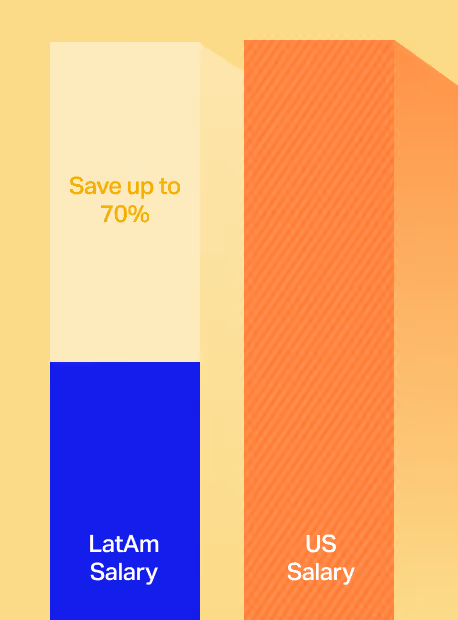
These are accounting professionals with US GAAP experience, strong English skills, and the technical expertise you’re looking for. The only difference with US candidates is that their salary expectations are 30–70% lower.
You can interview them at no cost and with zero commitment to explore what’s possible when you expand your search to Latin America.
Ready to fast-track your accounting hiring? Book a free consultation to discuss your specific needs and see qualified, pre-vetted accounting candidates within days, not months.
Frequently Asked Questions
What’s the difference between an accountant and a bookkeeper?
Bookkeepers handle day-to-day transaction recording: data entry, basic reconciliations, and maintaining financial records.
Accountants analyze that data to prepare financial statements, ensure compliance with accounting standards, and provide strategic financial insights to management.
If you need someone to categorize transactions and maintain records, you want to hire a bookkeeper. If you need financial analysis, reporting, and advisory work, you need an accountant.
We also have a guide to writing job descriptions for bookkeepers.
Do accountants need a CPA license?
Not necessarily. A CPA license is required for specific functions like signing audited financial statements or representing clients before the IRS, but many excellent accountants work without CPA certification.
Focus on the actual work requirements. If you need basic financial reporting and analysis, CPA certification may be preferred but not required. If you need audit work or tax representation, then yes, you’ll need a licensed CPA.
What accounting software should I require candidates to know?
Focus on the software you actually use daily. QuickBooks is the most common for small to mid-sized businesses, while larger companies often use NetSuite, SAP, or Oracle. Don’t list every accounting platform, specify your primary system and mention that experience with similar platforms is acceptable.
Most accounting professionals can adapt to new software quickly if they understand core accounting principles.
How much should I expect to pay an accountant?
According to the Bureau of Labor Statistics, the median salary for accountants in the US is $81,680 annually. However, this varies significantly by location, experience level, and specific responsibilities.
For remote positions, expanding your search to regions like Latin America can provide access to experienced professionals at 30–70% lower salary expectations while maintaining quality. The salary expectations of an accountant in Latin America range from $24,000 to $54,000.
Can accounting work be done remotely?
Absolutely. Most accounting functions—financial reporting, reconciliations, analysis, and even audit support—can be performed remotely with proper systems and communication protocols.
The key is having cloud-based accounting software, clear documentation processes, and regular check-ins during critical periods like month-end closing. Many companies successfully operate with fully remote accounting teams.
Should I outsource accounting work instead of hiring a full-time accountant?
Outsourcing accounting can work if you only need specialized accounting expertise occasionally, but it has downsides: you’re sharing your accountant’s attention with multiple clients, and you lose control over priorities and timelines.
A better alternative that gives you similar cost savings is hiring a dedicated remote accountant from Latin America. You get full-time, focused support from someone who understands your business and processes, at 30-70% less than US salaries, without the divided attention that comes with outsourced services.
Where is the best place to find and hire accountants?
Start here: our comprehensive guide to hiring accountants. It covers channels, screening, best practices, and salary benchmarks.










%203.svg)
.avif)





%20(1).avif)

%20(1).png)