%203.svg)
Key Takeaways
- You can hire qualified accountants through job boards, referrals, professional networks, or a specialist recruiting partner like Hire With Near.
- Great accountants have strong technical skills, attention to detail, and proven experience with US GAAP standards.
- In the US, hiring an accountant typically costs between $65,000 and $139,000, depending on experience level, but hiring in Latin America can reduce that by 49-71% while maintaining quality.
You're three months into a search for an accountant. The candidates clearing your technical bar want salaries your budget can't absorb. The ones in range can't handle the complexity your books actually require.
That gap between the skills you need and the budget you have isn't unusual. According to a Near analysis of 2,000+ hiring conversations, 41% of companies hiring finance and accounting talent in Latin America cite budget constraints as the primary driver.
But that’s not the end of the story. Qualified accountants, even those at the senior level, are financially viable at Latin America rates, even when they aren’t at US market rates. Knowing about Latin American teams can save money, but you’ll need some context first.
This guide covers how to hire an accountant who fits your needs and budget. We'll walk through must-have skills, current salary expectations, the best ways to find quality candidates, and the hiring mistakes that waste time and money, so you can start strong.
What Does an Accountant Do?
An accountant is responsible for managing several important long-term financial tasks, including:
- Keeping financial records
- Maintaining regulatory compliance
- Offering financial analysis
- Handling tax filings and strategy
In addition to these operational duties, they may provide insights to help you make better business decisions.
These are essential team members, with the employment of accountants and auditors projected to grow 5% from 2024 to 2034, according to the US Bureau of Labor Statistics. This is faster than the 4% average for all occupations. About 124,200 openings for accountants and auditors are projected each year over the decade.
That demand is growing at the same time the US accounting pipeline is shrinking. The number of candidates sitting for the CPA exam has decreased by 27% over the past decade, according to Accounting Today, citing AICPA data. That combination of rising openings and a thinning domestic supply is exactly why more companies are turning to Latin America to fill accounting roles.
Accountants vs. bookkeepers
Accountants differ from bookkeepers in scope and depth. Bookkeepers focus on recording transactions and maintaining ledgers. Accountants analyze financial data, prepare comprehensive reports, keep the business in regulatory compliance, and often provide strategic financial guidance.
How Much Does It Cost to Hire an Accountant?
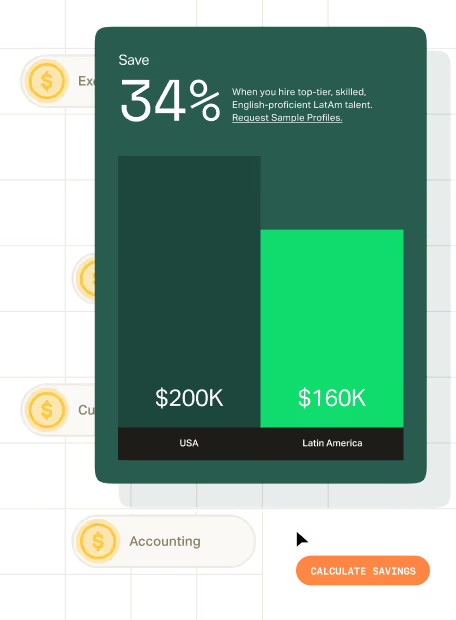
In the United States, hiring an accountant typically costs between $65,000 and $139,000 annually, depending on experience level. For many companies, especially those needing senior-level expertise, these ranges can quickly strain the budget.
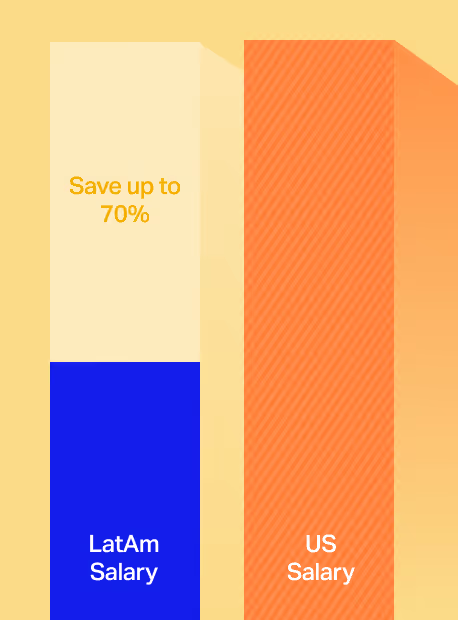
That’s one reason more businesses are looking internationally. Hiring in Latin America can reduce costs by 49–71% while maintaining comparable quality and experience.
To break this down further, US accountant salaries vary significantly by experience level, and the savings become clear when compared side by side:
According to Near’s 2026 State of LatAm Hiring Report, companies typically save between $33,000 and $66,000 per year when hiring accountants in Latin America compared to US-based equivalents.
Importantly, these savings are not driven by lower-quality talent. Latin American accountants often hold equivalent education, certifications, and professional experience as their US counterparts. The difference comes from regional cost-of-living factors, not capability.
For most companies, Latin America is not primarily a source of junior, entry-level talent. The same report shows that 84% of Near’s accountant placements are mid-level or senior professionals. Companies are hiring experienced talent (just at more accessible price points).
This change offers a strategic advantage for companies that make it. They get senior-level accountants for the cost of junior US talent. In some cases, they can even build an entire finance team for what a single US-based hire would cost.
By hiring accountants in Latin America, companies gain access to experienced professionals while making their budgets go significantly further.
Related reading: How a Software Company Hired a Staff Accountant in Latin America for $2,500/Month and Saved 64%
What Skills Should You Look For When Hiring an Accountant?
Great accountants need technical proficiency, but they also require strong communication, an ownership mindset, and the ability to work independently.
In my five years sourcing finance and consulting talent at Near, the most common mistake I see clients make is optimizing for credentials over capability. A CPA designation matters less than whether the person can actually run your close, communicate clearly, and flag problems before they grow.
Evaluating an accountant's skills isn't a one-size-fits-all approach. It depends heavily on the seniority level you're targeting.
A junior accountant might excel at executing routine bookkeeping tasks and following established procedures, but needs guidance on complex financial analysis and regulatory compliance issues. Meanwhile, a senior accountant should be able to independently manage multiple client portfolios, handle complex tax situations, and provide strategic financial insights to business leaders.
Understanding these distinctions helps you evaluate candidates fairly and set realistic expectations for performance.
Here's how accounting skills typically progress across experience levels:
Regardless of seniority level, all accountants should demonstrate certain fundamental capabilities.
Here are the core skills to evaluate:
Hard skills (the must-haves)
- US GAAP knowledge: This is essential for any accountant supporting US-based businesses. Look for candidates who can explain specific accounting principles and have experience applying them in practice.
- Software proficiency: QuickBooks and NetSuite are must-haves for most roles. Look for candidates who are comfortable with these accounting tools, as well as Sage or Xero, and can walk you through their actual workflow in each tool.
- Financial analysis and reporting: Strong accountants interpret data and create meaningful reports that help business leaders make decisions.
- Tax preparation experience: Depending on your needs, look for experience with business tax filings, payroll taxes, and familiarity with relevant tax codes.
- Industry-specific knowledge: While not always essential, experience in your industry (healthcare, construction, e-commerce, etc.) can be valuable for understanding unique accounting requirements.
One thing that consistently surprises US clients is that Latin American accounting programs are genuinely rigorous. One client, a Big Four CPA, told us the curriculum in Latin American countries struck them as more thorough than their own US program. That tracks with what I see in placements, because candidates from Argentina, especially, where the accounting degree takes five to six years to complete, often arrive with stronger technical foundations than clients expect.
Soft skills (equally important)
- Attention to detail: In accounting, small errors can have big consequences. Look for candidates who naturally catch inconsistencies and double-check their work.
- Proactive problem-solving: The best accountants identify potential issues before they become problems and suggest solutions rather than just flagging concerns.
- Time management: Managing deadlines for multiple clients or departments while maintaining accuracy requires strong organizational skills.
- Adaptability: Accounting software, regulations, and business needs change frequently. Strong candidates should be comfortable learning new systems and adjusting to evolving requirements.
Nice-to-have skills (the differentiators)
- Advanced certifications: CPA, CMA, or other professional certifications demonstrate commitment to the field and advanced knowledge.
- ERP system experience: Experience with enterprise systems like NetSuite, SAP, or Oracle can be valuable for larger organizations.
- Process improvement: Accountants who can speed up month-end close, cut manual steps, or automate recurring tasks add extra value beyond basic financial management.
Red flags to watch for: Be on alert for candidates who can't explain the specific achievements on their own resume, give vague answers when you probe deeper, or haven't researched your company at all before the interview. Resume typos should also give you pause because attention to detail is non-negotiable in accounting.
Where Can You Find and Hire Great Accountants?
You have three main options to hire accountants in Latin America, including a DIY approach, freelance platforms, and a specialist staffing partner. The right one depends on how much time you have, whether you're hiring internationally, and whether you need help sourcing or just employing.
Option 1: DIY via job boards and an Employer of Record
This path requires posting on a job board for hiring in Latin America or a platform like LinkedIn or Indeed. Then, you handle your own sourcing and screen candidates yourself. Once you've found someone, you use an Employer of Record to handle the employment, payroll, and compliance side.
The key trade-off is that an EOR handles employment logistics, not recruiting, so the full sourcing and screening burden stays with you. For companies with in-house recruiting capacity and time to run a thorough search, this works. For most, it's a heavier lift than it looks.
If you're evaluating EOR providers, see this overview of EOR companies to understand what to look for.
Best for: companies with internal recruiting bandwidth and a clear picture of the candidate they need.
Option 2: Freelance platforms
Platforms like Upwork or Toptal give you fast access to contractors. For short-term or project-based accounting work, they can quickly fill a gap.
But for full-time accounting hires, they're not the right fit. Per-hour billing, no employment continuity, and limited accountability make it hard to build the kind of stable, integrated accounting function most businesses need. The result for full-time roles is typically turnover and availability gaps. However, specialist staffing gives you fundamentally different results for full-time remote hires.
Best for: one-off projects or short-term contractor needs, not full-time hires.
Option 3: Specialist staffing partner (recommended)
A specialist partner like Hire With Near handles sourcing, vetting, compliance, and ongoing employment in one package. You describe the role; we present qualified candidates. Once you hire, we handle payroll, benefits, compliance, and any employment logistics.
For Latin America hiring specifically, a specialist partner also handles US GAAP and English proficiency screening, time zone coordination, and market salary benchmarking — all the things that slow down a self-directed search.
There’s a very real speed difference, with most companies that work with a specialist staffing partner interviewing qualified candidates within days, not weeks. Check out the best companies to hire LatAm finance talent to see how the options compare, or download the hiring remotely in Latin America guide for a practical overview of the full process.
Best for: companies that need help finding great full-time talent and want compliance, payroll, and benefits handled without building internal international HR expertise.
Why Working With a Recruiting Partner Makes a Difference
A trusted recruitment partner helps you reach more qualified candidates and quickly make the right hire.
Some companies hire accountants on their own, and that can work fine. However, when the stakes are high, the timeline is tight, or you're hiring outside your usual network, working with a recruiting partner makes a big difference.
Here's when expert help is particularly valuable:
- Hiring internationally: Navigating different labor laws, payment systems, and cultural differences can be complex. A specialized recruitment partner handles these logistics while maintaining compliance.
- You need specific expertise: If you need an accountant with experience in your exact industry or with specific software systems, recruiters have access to candidates with those precise qualifications. They are prescreened before you ever see a resume.
- Time is critical: Rather than spending weeks posting jobs and screening candidates, you could be interviewing qualified professionals within days.
- Quality is non-negotiable: Recruitment partners typically have extensive vetting processes that go beyond what most companies can do internally. This includes skills assessments, reference checks, and cultural fit evaluation.
A recruitment partner with experience in accounting roles can also provide guidance on realistic salary expectations, common interview questions, and red flags to watch for. That expertise comes from placing hundreds of candidates in similar positions.
If you're evaluating which firms to work with, this roundup of nearshore staffing companies covers the top options and what distinguishes each. And if you're still on the fence about whether Latin America is the right move, see why US companies hire in Latin America for a clear breakdown of the drivers.
For example, CyberFortress, a rapidly growing cybersecurity company, used Hire by Near to place a Director of Accounting and Financial Reporting and a Director of Global Tax, saving the company an estimated $1,200,000 in annual salaries.
As their CFO noted:
We hired 20 team members who share our core values: great attitude and desire to learn, resourcefulness, and adaptability. Near's team was very responsive, and their easy-going communication fostered a seamless hiring process.
The company was also able to cut their month-end closing timeline from 15 days to 10 days with their new Latin American accounting team.
Another example is a marketing agency that needed to replace a departing accountant fast, without taking on a six-figure US salary for a role they were deliberately scoping down. Hire With Near placed a full-cycle accountant from Latin America in under three weeks, saving the agency about 61% compared to a US equivalent hire.
How to Hire the Best Accountant: Best Practices
Following a systematic approach leads to better hiring results, whether you're looking for someone locally or internationally.
Here's what experienced hiring managers do when hiring accountants:
Stage 1: Before and during sourcing
Define your specific accounting needs clearly
Don't fall into the "accounting generalist" trap. Be specific about whether you need someone focused on accounts payable/receivable, financial reporting, tax preparation, or full-cycle accounting.
Consider your true priorities. Do you need someone with deep expertise in your industry's specific accounting requirements (like construction job costing or e-commerce inventory management), or is general US GAAP knowledge sufficient? Would you rather hire a junior accountant you can train to your systems, or pay more for someone who can immediately handle complex financial analysis?
The clearer your expectations, the easier it is to filter for the right fit and avoid wasting time on candidates who look good on paper but aren't aligned with your actual needs.
Craft a job description that attracts quality candidates
Your job description should be specific about daily responsibilities, required software, and the types of clients or departments they'll support. Instead of listing every possible accounting task, focus on what they'll actually do 80% of the time.
Be clear about whether this is a client-facing role requiring strong communication skills or primarily behind-the-scenes work focused on accuracy and efficiency. Include details about your company's accounting software, transaction volume, and whether they'll work independently or as part of a finance team.
Stage 2: Screening and evaluation
Test practical skills, not just credentials
While certifications matter, the best way to evaluate an accountant is through a practical assessment. Consider giving candidates a realistic scenario from your business. This could be a bank reconciliation with discrepancies, a journal entry correction, or explaining how they'd handle a specific compliance requirement in your industry.
This approach reveals how candidates think through problems, not just what they memorized for certification exams.
Our recruiters strongly recommend practical tests whenever specific software proficiency is critical to the role.
Look for clear communication and detail orientation
In our experience, placing hundreds of accounting professionals, communication skills often separate good accountants from great ones. The best candidates can explain complex financial concepts clearly without being condescending, and they ask clarifying questions when requirements aren't clear.
Assess cultural fit and work style compatibility
Great technical skills mean nothing if the person can't work effectively with your team or manage their workload appropriately. Pay attention to how they communicate, approach problems, and handle ambiguity during the interview process.
For remote or international hires, evaluate their ability to work independently and communicate proactively when they need guidance or encounter issues.
Stage 3: Making the offer and closing the deal
Move quickly with competitive offers
Quality accountants, especially those with US client experience, are in demand. The accounting profession faces unemployment rates of just 1.6% compared to the national average of 4.1%, creating fierce competition for qualified candidates. Once you've found the right candidate, act fast.
To improve the chances of them accepting your offer, structure it to include clear expectations about growth opportunities, professional development, and how success will be measured.
For more insights on making compelling offers, see our guide on making a good job offer to hire and retain top talent.
Set clear expectations for onboarding
Whether hiring locally or internationally, establish clear processes for system access, communication protocols, and initial projects. For international hires, coordinate the required working hour overlap early and make sure they have everything needed to be productive from day one.
For additional guidance on successful remote onboarding, see our resources on how to make remote hires feel like part of the team.
Top Interview Questions for Hiring Accountants That Reveal the Right Fit
These interview questions uncover how accounting candidates think and collaborate.
In my experience sourcing finance candidates at Near, I can tell someone is a good fit by the way they express themselves. They give very straightforward, sharp answers to specific questions and get directly to the point. When a candidate is vague, circling around the question, or struggles to articulate what they actually did in a role, that's the signal to investigate further.
The first two things I always want to understand are whether the candidate has worked with US-based clients before and whether they can manage multiple client workloads simultaneously. Both tell me a lot about whether they'll integrate well with a US team and handle the demands of your environment.
I use these questions to learn more.
"Tell me about a time you found a critical error in financial records. How did you handle it?"
This reveals their attention to detail, problem-solving approach, and communication skills.
Strong answers should include how they investigated the error, what steps they took to correct it, and how they prevented similar issues. Look for candidates who take ownership rather than just pointing fingers.
"How do you prioritize when you have multiple deadlines approaching?"
Accounting involves constant deadlines: month-end close, tax filings, and reporting requirements.
You want someone who can manage competing priorities without sacrificing accuracy. Listen for specific systems or approaches they use to stay organized.
"Describe your experience working with [specific software your company uses]."
Rather than accepting "I'm proficient in QuickBooks," dig deeper.
Ask them to walk through their typical month-end process using the software, or how they'd handle a specific scenario. This separates candidates who've actually used the software from those who just claim familiarity.
"Walk me through your experience working with US-based clients."
This is essential when hiring internationally. Candidates who've already worked with US companies understand the communication expectations, the reporting cadence, and the professional norms your team operates by.
Listen for specific details about how they handled time zone coordination, client communication, or adapting to US GAAP requirements on the job.
"How do you handle working with clients who don't understand accounting principles?"
This question is particularly relevant if you're an accounting firm, CPA practice, or bookkeeping service where your accountants will interact directly with clients. Even for in-house positions, this reveals how they'd communicate with non-finance team members who may not understand accounting concepts.
You want someone who can explain complex financial concepts in simple terms without being condescending. Strong candidates will give examples of how they've educated clients or colleagues while maintaining professional relationships.
"Tell me about the most challenging accounting project you've worked on."
This reveals their problem-solving abilities, resilience, and whether they've handled complexity similar to what they'll face in your organization. Pay attention to how they approached the challenge and what they learned from it.
Common Mistakes to Avoid When Hiring Accountants
These five pitfalls can cost you the right hire, as well as time and money. But they're easily avoidable with a strategic approach.
1. Focusing only on technical certifications
CPA credentials and software certifications matter, but they don't guarantee someone will be effective in your specific environment. Some of the best accountants we've placed don't have every certification, but excel at practical application and client service.
Focus on finding someone who can do the actual work you need done, not just someone who looks impressive on paper.
2. Underestimating the importance of English proficiency
This is especially relevant when hiring internationally.
Be realistic about your English requirements. If the role involves daily client communication, invest in candidates with strong verbal skills. For behind-the-scenes work, strong written communication may be more important than a light accent.
3. Having unrealistic salary expectations for international hires
One of the fastest ways to lose top accounting talent is by underestimating what constitutes a competitive offer in international markets. Companies often focus so heavily on maximizing cost savings that they miss the market realities of their target region.
For example, in established markets like Latin America, qualified accountants already have experience working with US companies and understand their market value accordingly.
Their salary expectations will be higher than local market rates because they bring specialized skills like US GAAP knowledge, English proficiency, and experience with US business practices.
Companies that approach international hiring with outdated assumptions about "cheap offshore labor" often find themselves unable to attract quality candidates. The best international accounting professionals know their worth and have multiple opportunities. They won't accept below-market offers.
This is where working with a recruitment partner who understands local market dynamics becomes invaluable. They can guide you toward salary ranges that will actually attract strong candidates while still delivering meaningful cost savings compared to US hiring.
4. Overlooking industry-specific experience when it matters
Not all accounting is the same. An accountant with extensive retail experience might struggle with construction job costing, and someone focused on B2B services might not understand e-commerce accounting complexities.
If your industry has unique requirements, such as specialized inventory management, project-based accounting, or regulatory compliance, prioritize relevant experience over general accounting credentials.
5. Ignoring time-zone and collaboration realities
Cross-border hiring works best when your working hours overlap.
If you choose regions with large time differences, plan for asynchronous workflows (SOPs, handoff checklists), or you'll create delays around month-end close. Hiring in Latin America often solves this with nearly complete US-hour overlap.
Final Thoughts
Finding the right accountant comes down to matching skills, communication, timezone, and budget. Latin America has made that combination accessible.
It’s definitely possible to hire an accountant who can handle your books accurately, meet deadlines, and integrate with your team. The challenge is finding that combination of skills, communication ability, and cultural fit at a rate your budget can support.
For many companies, the answer is hiring accountants in Latin America through accounting recruiters who understand the talent pool, screen for US GAAP proficiency, and manage compliance requirements. Latin American accountants typically work in your time zone and communicate effectively in English. They bring the technical expertise your US-based team relies on but at rates that make senior-level accounting support far more attainable.
If you’re also exploring other finance roles, check our guide to hiring finance and accounting talent in Latin America for a full breakdown of roles, costs, and how to vet for GAAP fluency across the function.
If you want to explore what hiring an accountant in Latin America would look like for your situation, book a free consultation to talk through your specific requirements with our team. They'll give you current salary benchmarks for the level you need and walk you through the process so you have the information to decide if it's right for you.
Frequently Asked Questions
Should I outsource my accounting or hire in-house?
If your books are complex and changing fast, in-house gives you daily context and tighter cross-team collaboration.
If you need specialist depth (multi-entity close, sales tax, US GAAP combined with tax season surges) without adding headcount, outsourcing or a fractional model is efficient.
See our breakdown of finance outsourcing for a detailed comparison of the options.
What's the difference between an accountant and a bookkeeper?
Bookkeepers focus on daily transaction recording and maintaining ledgers, while accountants typically have broader responsibilities and can handle more complex financial analysis and tax preparation.
If you think a bookkeeper might be what you actually need, check out our guide to hiring a bookkeeper for more specific guidance.
Should I hire a CPA or is a regular accountant sufficient?
This depends on your specific needs. CPAs are required for certain functions, like auditing financial statements and representing you before the IRS.
For most day-to-day accounting needs, including financial reporting and basic tax preparation, a skilled accountant without CPA certification can be excellent and more cost-effective.
What's the difference between an accountant and a controller?
Controllers are senior-level financial professionals who oversee entire accounting departments and financial operations.
While accountants handle specific accounting tasks and analysis, controllers manage financial strategy, supervise accounting staff, and report directly to executives or boards.
You might need to hire a controller instead of an accountant if you have multiple accounting staff to manage, complex financial operations across departments, need someone to lead financial planning and budgeting processes, or require executive-level financial reporting and analysis.
How do I know if I need a full-time or part-time accountant?
Consider your transaction volume, business complexity, and growth stage. Companies processing hundreds of transactions monthly, managing multiple revenue streams, or facing upcoming audits typically benefit from full-time support. Smaller businesses with straightforward finances often start with part-time help and scale up as needed.
How much should I budget for hiring an accountant?
For a small business, US-based accountants typically expect $65,000-$139,000 annually, depending on experience level. Current compensation benchmarks put mid-level Latin American accountants at $30,000-$42,000/year and senior professionals at $42,000-$60,000/year. A simple bookkeeping oversight requires less investment than financial analysis and strategic guidance.
Can accountants advise on pensions?
Yes, accountants can advise on pension-related topics, though the scope depends on the role and experience level.
Most accountants with US client experience are familiar with the tax treatment of retirement accounts, including 401(k) plans, IRA contributions, and how those interact with a company's financials and tax filings.
For straightforward questions about retirement account tax treatment and payroll deduction structures, a qualified accountant handles these well. For complex pension consulting, actuarial calculations, or plan design, you may also want to involve a CPA or benefits specialist.
Latin American accountants placed by Hire With Near who specialize in US-facing roles are typically comfortable with retirement account structures and can advise on the financial and tax dimensions.
What other finance and accounting roles can I hire from Latin America?
Beyond general accountants, US companies regularly hire a full range of finance and accounting professionals from Latin America, including staff accountants, tax accountants, revenue accountants, controllers, bookkeepers, financial analysts, and QuickBooks experts. Latin American professionals in these roles typically bring US GAAP knowledge, English proficiency, and working hours that overlap with US business hours, at lower rates than US equivalents.







.webp)


%203.svg)
.avif)





%20(1).avif)

%20(1).png)