


%203.svg)
Key Takeaways
- Finance job descriptions attract top talent when they specify actual financial tasks like monthly close processes and variance analysis rather than listing generic accounting duties and unrealistic skill combinations.
- Effective finance job descriptions require six essential elements: accurate job titles, compelling role summaries, specific daily responsibilities, realistic qualifications, transparent salary ranges, and clear location requirements.
- Avoid combining multiple finance roles into one position, asking for senior skills with junior compensation, and restricting your search to local candidates when remote work is possible.
You need a finance job description you can post today. One that attracts qualified professionals instead of generating hundreds of applications from people who think "financial analysis" means updating a basic spreadsheet.
When your job posting attracts candidates who've never worked with financial statements or don't understand the difference between cash and accrual accounting, you waste days interviewing people who can't actually do the work. Meanwhile, your financial reporting deadlines keep approaching, and you're still handling tasks that should have been delegated weeks ago.
This guide gives you everything you need to write a finance job description that works as your first filter, attracting candidates with real financial expertise while helping unqualified applicants self-select out.
You'll get a ready-to-use template so you can customize it and post it this afternoon.
Why Job Descriptions Matter More Than You Think
Your finance job description is your first filter for financial competence and cultural fit.
With 76% of CFOs in US reporting significant talent shortages in finance and accounting, a strategic job description determines whether you spend weeks interviewing people who can’t tell the difference between cash and accrual accounting or connect directly with professionals who understand your financial needs.
Here’s what a well-written finance job description accomplishes:
Filters for financial sophistication early
Experienced finance professionals can immediately tell whether you understand the role you’re trying to fill. If your job description mentions “handle all financial tasks” without specifying whether you need bookkeeping, financial analysis, or strategic planning, serious candidates will assume you don’t know what you’re looking for.
When you’re specific about responsibilities like “prepare monthly variance analysis comparing actual vs. budget performance” or “maintain compliance with revenue recognition standards,” you attract candidates who’ve done exactly that work before.
Demonstrates your business maturity
How you describe financial responsibilities signals your sophistication as an employer. If your job description focuses on basic data entry tasks but requires a finance degree, experienced professionals will question whether this role offers growth potential or whether you understand the value of financial expertise.
Speeds up your decision-making process
Clear job descriptions help ensure applicants understand both the technical requirements and the business context. This means fewer interviews with people who are technically qualified but don’t understand your industry, and more conversations with candidates who can contribute from day one.
What Makes a Great Job Description for Finance Roles?
The difference between good and great finance job descriptions comes down to clarity about what financial work actually needs to be done and honest representation of the role’s scope and growth potential.
Great descriptions specify actual financial tasks and systems without creating impossible requirement lists, while matching compensation expectations to the real responsibilities involved.
Financial specificity without overwhelming detail
Great finance job descriptions mention specific tasks and systems without creating an impossible laundry list. Focus on what they’ll do regularly: “You’ll manage our monthly close process in NetSuite, prepare board-ready financial statements, and analyze variance trends,” is more helpful than listing every possible accounting software and financial task.
Clear distinction between different finance roles
Finance encompasses everything from data entry to strategic planning. Be honest about where this role sits on that spectrum. A financial analyst needs different skills from a controller, who needs different skills from a bookkeeper. Don’t muddy the waters by combining responsibilities that typically belong to different roles or experience levels.
Transparent growth trajectory
Strong finance candidates want to understand how this role fits into their career progression. Whether this is an opportunity to move from bookkeeping to analysis, from individual contributor to team leadership, or from tactical work to strategic planning, make the potential path clear.
Lead with the financial challenge
Strong finance professionals are motivated by meaningful work. Start your job description by highlighting what makes the financial work interesting: “You'll help us scale our financial operations from $10M to $50M revenue while building the reporting infrastructure that guides strategic decisions." This immediately shows the scope and impact of the role.
Be specific about your financial environment
Rather than generic statements about "fast-paced environment," describe how your finance team actually operates: "Our finance team values accuracy and transparency, with monthly close completed by the 5th business day and detailed variance analysis presented to leadership quarterly."
This helps candidates assess whether your financial processes match their experience level and working style.
What Should You Include in a Finance Job Description?
A comprehensive finance job description should include six essential components: a clear job title that reflects actual responsibilities, a compelling role summary, specific daily responsibilities, realistic required qualifications, transparent salary ranges, and explicit location/schedule requirements.
These are the essential components that help finance professionals understand both the role requirements and growth opportunity.
Job title
Your job title needs to accurately reflect the role's responsibilities and seniority level. "Financial Analyst," "Investment Analyst," or "Finance Manager" each signal different expectations for experience, responsibilities, and compensation.
If the role has specific focus areas, include those: "Tax Accountant," "Private Equity Analyst," or "Credit Analyst." This helps qualified candidates find you while helping others understand whether they're a good fit.
Summary of the role
Think of this as your elevator pitch to potential candidates. In 2–3 sentences, capture what makes this finance opportunity compelling:
- What financial challenges they'll help solve
- How they'll fit into your existing finance team or operations
- What makes this opportunity different from other finance roles
For example: "Join our finance team to support our rapid growth from $10M to $50M ARR over the next two years. You'll own financial reporting and analysis, working closely with department heads to build budgets and track performance against growth targets. This role is perfect for someone who wants hands-on experience building scalable financial processes at a growing company."
This immediately tells candidates about business growth, team collaboration, and learning opportunities.
Key responsibilities
Be specific about the actual financial work, not generic accounting tasks.
Good examples:
- Prepare monthly financial statements and variance analysis using QuickBooks and Excel
- Manage accounts payable process, including invoice approval workflow and vendor payment scheduling
- Support annual budget development and quarterly forecasting updates
- Maintain compliance with revenue recognition standards and document processes for audit
- Collaborate with department heads to analyze spending trends and identify cost optimization opportunities
Avoid vague statements like "handle all accounting duties" or "support financial operations." Be concrete about what they'll do daily, weekly, and monthly.
Required skills and qualifications
This is where many companies create unnecessary barriers by listing every financial skill they've ever heard of. Focus on what's truly essential for success in the first 90 days.
Essential qualifications typically include:
- Specific years of relevant finance/accounting experience
- Required software proficiency (QuickBooks, NetSuite, Excel, etc.)
- Knowledge of accounting principles (US GAAP, tax regulations)
- Any industry-specific knowledge that's truly necessary for your business
Preferred experience
This is where you can mention nice-to-have skills that would help someone excel but aren't deal-breakers:
- Experience with additional financial systems in your stack
- Previous experience in your specific industry
- Advanced certifications like CPA (unless truly required)
- Knowledge of specific financial processes unique to your business
Salary range
Including salary information demonstrates transparency and helps attract candidates whose expectations align with your budget. According to data from the US Chamber of Commerce, finance roles are among the hardest to fill, making competitive compensation crucial for attracting talent.
When listing compensation:
- Provide a realistic range based on the actual experience level you need
- Clarify whether the range varies by location (especially for remote roles)
- Mention any performance bonuses or benefits that significantly impact total compensation
- Be prepared to offer within the range you post
For example: "Salary range: $65,000-$80,000 annually, based on experience and location. Performance bonus potential of up to 15% annually."
Legal compliance considerations: Several states now require salary ranges in job postings, including California, New York, Illinois, and Minnesota.
Beyond compliance, research by SHRM shows that including salary ranges increases applications.
Plus, they also found that:
65% of organizations that list pay ranges on job postings say that doing so makes them more competitive in attracting top talent.
Location
Be explicit about where work gets done, especially since many finance roles can be performed remotely:
- For on-site roles: Include the specific city and office location. Mention any flexibility for remote work during busy periods like month-end closing.
- For hybrid roles: Specify how many days in-office are expected and whether there's flexibility around month-end or year-end periods.
- For remote roles: Clarify any geographical restrictions and time zone requirements for collaboration with other departments or external partners.
If you're open to remote talent, consider expanding your search globally. Finance roles can often be filled faster and more affordably by accessing international talent pools with competitive compensation expectations while maintaining the same professional standards.
Perks and benefits
Finance professionals often value stability and professional development opportunities. Beyond standard benefits, mention:
- Flexible working hours or remote work options
- Professional development budgets for certifications or conferences
- Performance-based bonuses tied to financial metrics
- Growth opportunities into senior finance roles
- Quality technology and tools for financial analysis
Work schedule
Finance work often has cyclical demands, so be transparent about expectations:
- Full-time or part-time hours
- Any core collaboration hours with other departments
- Expectations during busy periods (month-end, quarter-end, year-end)
- Time zone requirements for remote roles
- Any after-hours availability needs during closing periods
How to apply
Make the application process straightforward by specifying:
- Required application materials (resume, references, work samples)
- Any assessments that will be part of the process
- Timeline for the hiring process
- Specific qualifications or experience you want highlighted in applications
What Are the Common Mistakes to Avoid in Finance Job Descriptions?
The biggest mistakes companies make include combining multiple finance roles into one position, asking for senior-level skills while offering junior-level work or compensation, and restricting searches to local candidates when roles can be done remotely.
These pitfalls significantly reduce your qualified candidate pool and signal to experienced professionals that you don't understand finance roles or market realities.
Unrealistic expectations that don't match the actual role
This is the most common mistake companies make, and it takes several forms: combining responsibilities from multiple finance roles (like expecting one person to handle both daily bookkeeping and strategic planning) or requiring senior-level credentials while offering junior-level work and compensation.
Each finance position requires different skills and experience levels. Be realistic about what you actually need and can afford. If the role involves basic transaction processing and simple reports, don't require a CPA and five years of complex financial modeling experience.
Focus on requirements that match the actual work and compensation you're offering.
Asking for "entry-level finance professional with advanced financial modeling experience" or "staff accountant who can also handle strategic planning" signals that you don't understand different finance roles or market realities.
Overemphasizing software requirements
While proficiency with financial software is important, don't make specific platform experience a hard requirement unless it's truly essential.
A strong finance professional can typically learn new software systems quickly if they understand underlying accounting principles.
Limiting your search unnecessarily
If the role can be done remotely, restricting your candidate pool to one geographic area significantly reduces your options. Finance and accounting roles are among the most location-independent positions, and many companies find success accessing global talent pools.
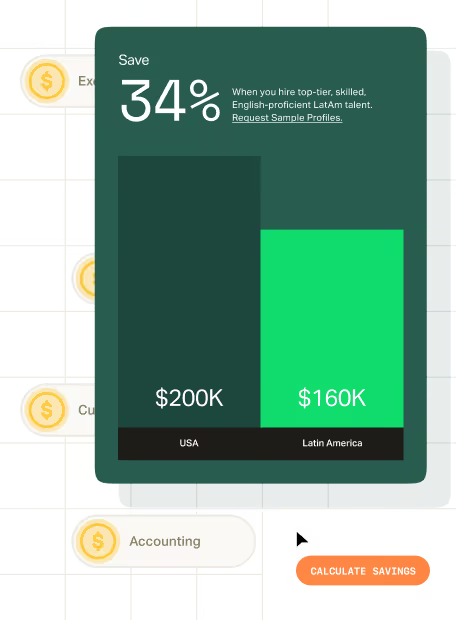
Many US companies are discovering exceptional finance talent in Latin America, where professionals often have experience working with US companies, strong accounting credentials, and excellent English skills, while having salary expectations significantly below US market rates.
A perfect example is CyberFortress, which transformed its entire finance operation by hiring Latin American talent. Near helped them hire professionals with strong accounting credentials, US business experience, and excellent English skills. They are now saving $1.2M annually compared to US market rates.
According to their CFO, Seema Chacko:
We hired 20 team members who share our core values: great attitude and desire to learn, resourcefulness, and adaptability. Near’s team was very responsive, and their easy-going communication fostered a seamless hiring process.
Sample Finance Job Description (Ready to Customize)
The following template is written specifically for a Finance Analyst role, but you can easily adapt it to any finance position you're hiring for. Simply adjust the responsibilities, qualifications, and salary range to match your specific role requirements.
Finance Analyst
About us: [Company Name] is a [brief company description focusing on growth stage and mission]. We're scaling from [current stage] to [growth goals] and need a talented Finance Analyst to help build financial processes that support this growth while maintaining accuracy and compliance.
The role: We're looking for a detail-oriented Finance Analyst to join our [team size] finance team. You'll own [specific financial areas like budgeting, reporting, analysis] while working closely with [relevant departments] to [specific outcomes]. This role is perfect for someone who wants [specific appeal, e.g., growth opportunity, technical challenges, industry experience].
What you'll do:
- Prepare monthly financial statements and variance analysis using [your accounting software]
- Support annual budgeting process and quarterly forecasting updates
- Analyze [specific financial metrics relevant to your business] and present findings to leadership
- Manage [specific processes like revenue recognition, etc.]
- Collaborate with [specific teams] to [specific financial outcomes]
- [Add 2-3 more specific responsibilities relevant to your needs]
What you'll need:
- [X+] years of finance or accounting experience
- Proficiency with [your primary financial software, e.g., QuickBooks, NetSuite]
- Strong knowledge of [specific accounting principles, e.g., US GAAP, tax regulations]
- Advanced Excel skills including [specific functions you use regularly]
- [Any industry-specific knowledge that's truly required]
- [Communication requirements, e.g., client-facing, presentation skills]
Nice to have:
- Experience with [additional financial software in your stack]
- Previous work in [your industry or related industries]
- [Relevant certifications like CPA, CMA, etc.]
- [Any specialized knowledge that would be helpful but not required]
Salary and benefits:
- Salary range: $[X,000 – Y,000] annually, based on experience and location
- [Mention any performance bonuses or variable compensation]
- [Key benefits: health insurance, retirement plan, PTO, etc.]
- [Any unique benefits your company offers]
Location:
- [Remote/Hybrid/On-site] position
- [Time zone requirements if remote, e.g., "Within 2+/- hours of EST for team collaboration"]
- [Any travel requirements for in-person meetings or training]
- [Equipment provisions for remote work if applicable]
Work schedule:
- [Full-time/Part-time], [number] hours per week
- [Core hours requirements for team collaboration]
- [Expectations during busy periods like month-end, quarter-end]
- [Any flexibility in scheduling outside of core requirements]
Growth opportunities:
- [Professional development support like conference attendance or certification reimbursement]
- [Career advancement possibilities within finance team]
- [Learning opportunities as company scales]
- [Any mentorship or cross-training opportunities]
How to apply: Send your resume to [email/application link] and include:
- [Any specific information you want in applications]
- [Portfolio or work sample requirements if applicable]
- [Specific questions you want answered in cover letters]
Our hiring process includes: [brief overview of interview stages] [Timeline information like "We review applications weekly and aim to respond within one week."]
Note: If you need a template for a job description for an accountant role, we have a separate guide.
Final Thoughts
You now have everything you need to write a finance job description that attracts qualified professionals instead of wasting time with unqualified applicants. By being specific about financial responsibilities, realistic about requirements, and transparent about compensation, you'll connect with candidates who can actually handle your financial challenges.
But if you need to fill this role quickly and want to skip the weeks of posting, screening, and interviewing, there's a faster path forward.
Rather than posting your job description across multiple platforms and sorting through hundreds of applications, we can present you with three pre-vetted finance candidates within a week. These aren't random applicants. They're experienced professionals who have already been screened for the specific skills and experience you need.
Whether you're hiring a financial analyst, controller, finance manager, or even an experienced CFO, you can interview top Latin American finance talent for free with no commitment.
It's a chance to see firsthand the caliber of professionals available while potentially solving your finance hiring challenge in days rather than months.
The talent shortage in finance is real, but it doesn't have to slow down your business growth. While other companies spend months competing for the same limited pool of local candidates, you could have your finance role filled and your new hire contributing within weeks.
Schedule a free consultation to discuss your specific finance hiring needs and see how quickly we can connect you with qualified candidates who are ready to support your business growth.
Frequently Asked Questions
What qualifications should I require for finance professionals?
Focus on 3-4 essential qualifications that directly impact job performance: relevant years of experience, proficiency with your primary financial software (QuickBooks, NetSuite, Excel), and knowledge of accounting principles like US GAAP. Avoid creating wish lists of every possible finance skill. This scares away qualified candidates while encouraging unqualified ones to apply anyway.
Should I include salary ranges in finance job postings?
Yes. It's legally required in states like California, New York, Illinois, and Minnesota, and it builds trust with candidates while filtering for budget alignment. Provide a realistic range you're actually prepared to offer, clarify if it varies by experience or location, and mention any performance bonuses that significantly impact total compensation.
What software skills should I list as requirements vs. nice-to-have?
List your primary financial software as required (QuickBooks, NetSuite, etc.) along with Excel proficiency. Put additional tools in the "nice-to-have" section. As our recruiters note, most experienced finance professionals can learn new software quickly if they understand underlying accounting principles.
How do I attract finance talent if I can't match big company salaries?
Be honest about other forms of value: growth opportunities, work-life balance, equity upside, or the chance to build financial processes from scratch. Also consider nearshore hiring in Latin America, where finance professionals have more competitive salary expectations while maintaining the same professional standards.
Should I outsource finance work or hire a dedicated finance professional?
While outsourcing finance roles can offer cost savings, hiring a dedicated finance professional is usually the better long-term choice. Plus, you can achieve similar cost savings by expanding your search to regions like Latin America. A full-time finance hire becomes fully invested in your business, integrates seamlessly with your team, provides consistent availability for urgent needs, and grows with your company over time.
Outsourced providers typically work with multiple clients, have limited availability, and maintain transactional relationships rather than strategic partnerships. If you're considering the outsourcing route, explore the top finance and accounting outsourcing companies to compare providers and understand what each offers.
Should I work with a recruitment or staffing firm to hire finance professionals?
Working with a specialized finance recruitment firm can significantly speed up your hiring process and improve candidate quality, especially if you're exploring global talent pools or hiring for niche finance roles.
The best finance staffing agencies have established networks of pre-vetted candidates, understand current market rates, and can handle complex requirements like US GAAP knowledge or specific ERP system experience.
This is particularly valuable when hiring finance talent from Latin America, where specialized firms understand local market dynamics, can assess English proficiency and cultural fit, and have relationships with professionals who have US business experience. While you'll pay a fee, the time savings, reduced risk of bad hires, and access to candidates you wouldn't find on your own often make it worthwhile, especially for senior finance roles or when you need to fill positions quickly.










%203.svg)
.avif)






%20(1).avif)

%20(1).png)