.avif)


%203.svg)
Key Takeaways:
- Hiring a skilled product manager requires finding someone who can bridge business strategy, user needs, and technical execution while leading cross-functional teams toward measurable outcomes.
- US-based product managers typically expect $87,000–$155,000 annually, while Latin American PMs with equivalent experience and skills command $36,000–$50,000, delivering the same strategic thinking and product leadership at 70% less cost.
- The best product managers combine hard skills like roadmap planning and data analysis with soft skills like stakeholder communication and adaptability.
You’ve finally gotten budget approval for a product manager. But now you’re staring at a blank job description, unsure what to include—or whether you can even afford the salary ranges you’re seeing online.
Without clarity on what skills actually matter versus what’s just nice-to-have, you risk two outcomes: either you write a job post so vague that you attract hundreds of unqualified applicants, or you list so many requirements that qualified candidates scroll past.
Meanwhile, your engineering team is making product decisions in a vacuum, your roadmap keeps shifting based on whoever spoke loudest in the last meeting, and features are shipping without anyone checking if they actually solve customer problems.
This guide covers the practical foundations you need before you can start interviewing: what a product manager will realistically cost you, the specific skills that separate strong PMs from average ones (so you can write a job description that attracts the right people), and where to actually find qualified candidates beyond posting on LinkedIn and hoping for the best.
What Does a Product Manager Do?
A product manager owns the product roadmap and makes sure development efforts align with business goals and user needs.
They sit between engineering, design, marketing, and leadership—translating strategy into execution. They define what gets built and why, prioritize features based on impact and feasibility, and guide cross-functional teams through the product development process.
Product managers don’t necessarily write code or design interfaces (though some have those skills). They focus on the “what” and “why” while engineers and designers handle the “how.”
Day-to-day, they’re gathering user feedback, analyzing product metrics, updating roadmaps, running sprint planning, managing stakeholder expectations, and making calls on scope and timing. A strong PM keeps teams aligned and products moving forward without becoming a bottleneck.
How Much Does It Cost to Hire a Product Manager?
The salary of a senior PM in the US, $155,000 to $163,000, is out of reach for many growing companies.
Product managers command premium salaries because they sit at the intersection of business strategy, user needs, and technical execution. Companies are essentially paying for someone who can translate market opportunities into profitable products while keeping engineering teams focused on what actually matters.
Here’s what you’re looking at for US-based PM hires:
- Jr. product manager salary: $87K – $143K annually
- Product manager salary (mid-level): $143K – $155K annually
- Sr. product manager salary: $155K – $163K annually
If you’re a startup or scaling business and those senior PM salaries are outside your budget, you’re not alone. This is exactly why many US companies look outside the US to hire top product management talent—not to cut corners, but to access the same caliber of strategic thinkers and execution-focused PMs at rates that don’t strain the budget.
Hiring in Latin America has emerged as a particularly strong option for US companies hiring product managers.
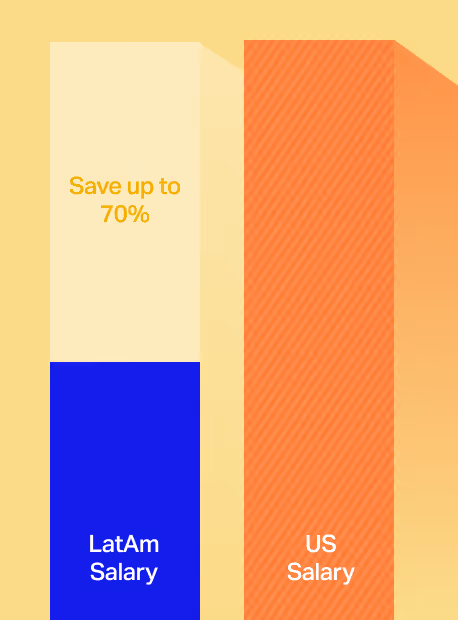
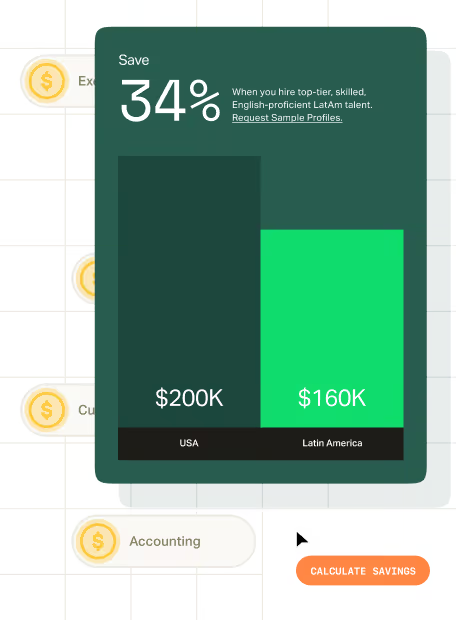
Here’s the cost difference you can expect, based on our experience placing hundreds of PMs from the region:
We regularly see that hiring product managers in Latin America can reduce costs for US companies by up to 70%.
These cost differences reflect regional living costs, not differences in talent quality. Many Latin American product managers have worked with US companies, understand American business practices, and bring the same strategic thinking and product instincts as their US counterparts.
In many cases, a $46K–$50K offer for a senior PM in Latin America is highly competitive locally—often 20–30% above market rates—which helps you attract and retain top performers.
If you’re building a product team on a budget or want to allocate savings toward other growth areas like R&D or marketing, international hiring—especially in regions like Latin America with strong time zone overlap—can provide significant cost efficiency without compromising on product leadership.
Further reading: Why More US Businesses Are Hiring in Latin America: What We Learned from Talking to 2,000 Hiring Managers
{{salary-guide-us-latam}}
What Skills Should You Look for When Hiring a Product Manager?
Great product managers need a blend of strategic thinking, communication skills, and the ability to drive execution across teams.
Vardan Avagov, VP Product at Jellysmack, sums it up perfectly:
The best Product Managers have the mind of an engineer, the voice of an ambassador and the heart of a designer.
This captures the three-dimensional nature of the role: analytical problem-solving, stakeholder influence, and user empathy. Here’s what to look for in PM candidates across these dimensions:
Hard skills for product managers (the must-haves)
Product managers should have hands-on experience with core product management disciplines:
- Product roadmap development: They should be able to create and maintain roadmaps that balance business goals, user needs, and technical constraints. Look for experience translating strategy into phased development plans.
- Requirements gathering and prioritization: Strong PMs know how to collect input from stakeholders, users, and data—then prioritize ruthlessly based on impact and effort. Ask how they’ve made tough scope decisions under tight timelines.
- Data analysis and metrics: Product managers should be comfortable working with analytics tools, interpreting product data, and defining success metrics. They don’t need to be data scientists, but they should make data-informed decisions.
- Agile and sprint planning: Most product teams work in Agile or similar frameworks. Your PM should understand sprint planning, backlog grooming, user story creation, and how to keep development cycles productive.
- User research and UX principles: While they may not run every user test, great PMs understand research methods, can interpret user feedback, and work effectively with design teams to improve product experiences.
- Technical fluency: They don’t need to code, but they should grasp technical concepts well enough to have productive conversations with engineers about feasibility, architecture, and trade-offs.
Soft skills for product managers (equally important)
Product management is as much about people and process as it is about product. Look for these interpersonal and organizational abilities in top PM candidates:
- Strong stakeholder communication: Product managers constantly balance competing interests from leadership, sales, engineering, and users. Strong candidates can communicate priorities clearly, manage expectations, and keep everyone aligned.
- Decision-making under ambiguity: Product managers rarely have perfect information. They need to make judgment calls based on incomplete data and move forward confidently without getting paralyzed by uncertainty.
- Cross-functional leadership: PMs don’t manage teams directly but must influence and coordinate across engineering, design, marketing, and support. Look for examples of how they’ve driven alignment without formal authority.
- Adaptability and problem-solving: Product plans change constantly. Great PMs pivot quickly when new information emerges, handle setbacks constructively, and find creative solutions to constraints.
- Ownership mentality: The best product managers think like founders—they take full responsibility for outcomes, don’t wait for direction, and proactively solve problems before they escalate.
- User-centric mindset: This might be the most fundamental quality of all. As Maïa Metz, former VP Product at Aircall, emphasizes: “As a PM you are expected to carry the voice of the user at all times.” Great product managers internalize user feedback, advocate for it in every meeting, and use it to challenge assumptions when features drift from real user needs.
Nice-to-have skills for product managers (the differentiators)
These aren’t essential, but they can elevate a PM candidate from qualified to exceptional—especially for specific industries or growth stages:
- SQL or basic coding ability helps PMs work more independently and communicate more effectively with technical teams.
- Growth or marketing experience brings valuable perspectives on acquisition and retention for consumer products or SaaS.
- Domain expertise in industries like fintech, healthcare, or e-commerce helps PMs ramp faster and make more informed decisions.
- Design thinking or UX background tends to strengthen user empathy and bridges product strategy with experience more naturally.
- Experience with remote or distributed teams proves valuable if you’re building a remote product organization and need someone who can coordinate across time zones and async work.
{{state-latam-hiring}}
Where Can You Find and Hire Great Product Managers?
Hiring a product manager starts with deciding where to look—and understanding that each approach comes with different trade-offs around cost, talent availability, and team dynamics.
Deciding between local, national, or global talent pools
- Local/in-office hiring gives you direct collaboration and face time with your PM. This works well for early-stage startups that need constant alignment or companies with deeply collaborative cultures. The downsides? You’re limited to your metro area’s talent pool and paying premium local rates.
- Remote US-based hiring expands your candidate pool significantly. You can hire PMs from anywhere in the country, which means access to more experienced candidates and specialized expertise. You’ll still pay US-level compensation, but you get much broader access to talent. Time zones across the US are manageable, and everyone shares similar workplace norms.
- International/offshore hiring opens up the widest talent pool and delivers significant cost savings due to differences in cost of living (as mentioned previously). Latin America has become particularly attractive for US companies because of strong time zone alignment (typically 0–3 hours difference), cultural compatibility, and excellent English proficiency among senior professionals.
Nearshoring to Latin America also offers a middle ground between offshoring to Asia (which creates time zone challenges) and hiring domestically (which strains budgets). You get real-time collaboration during US business hours, which matters for a role that depends on constant stakeholder communication.
Other international options like Eastern Europe and Southeast Asia also offer talented product managers, though time zone differences can complicate synchronous collaboration.
Choosing the right sourcing channel
Once you’ve decided where to hire geographically, you need to figure out how to actually find candidates.
Here’s a comparison of different sourcing methods:
Job boards specifically targeted to PMs, like ProductHired or Mind the Product Jobs, attract PM talent actively looking for work and can be a good place to start if you have time to manage the process yourself. Attending product management meetups (virtual or in-person) and conferences like ProductCon can also surface strong candidates.
Why Working With a Recruiting Partner Makes a Difference When Hiring a Product Manager
Working with a specialist recruitment agency to hire a product manager can help ensure you make the right hire, access more qualified candidates faster, and avoid delays.
Many companies hire product managers on their own. And that can work just fine.
However, when the stakes are high, the timeline is tight, or you’re hiring outside your usual network, working with a recruiting partner makes a big difference.
Here’s where expert sourcing and hiring help really pays off:
- Speed and efficiency: Recruiting partners maintain pre-vetted talent pools and can present qualified candidates within days instead of weeks. For a role like product manager—where you need someone who can balance strategy, technical understanding, and stakeholder management—screening takes time. A good recruiter has already done that work.
- Access to hidden talent: The best product managers aren’t always actively job hunting. Recruiters have relationships with passive candidates who might consider a move for the right opportunity but aren’t browsing job boards.
- International hiring expertise: If you’re considering hiring in Latin America, Eastern Europe, or Southeast Asia, a recruiter handles salary benchmarking, cultural fit screening, English proficiency screening, international background checks, and even international payments. They know which regions have the strongest PM talent, what competitive offers look like locally, and how to navigate employment laws you’re unfamiliar with.
- Better candidate experience: Product managers are evaluating you as much as you’re evaluating them. A professional recruiting process—with clear timelines, structured interviews, and prompt feedback—signals that your company is organized and respects their time.
In our experience placing product managers for US companies, we see how working with us changes the hiring process for our clients. It reduces screening and sourcing time from weeks to days, alleviates the pressure on internal recruitment teams who are already juggling multiple open roles, and opens up the possibility of hiring in Latin America at up to 70% lower rates—something most companies wouldn’t feel comfortable doing without a partner who knows how to navigate the region’s talent market and identify candidates with the right mix of technical understanding and strategic thinking.
{{prevetted-banner}}
Final Thoughts
Hiring a product manager starts with understanding what you’re actually looking for—someone who can translate customer needs into a product roadmap your engineering team can execute on.
When you know what hiring a PM will cost, which skills separate strategic thinkers from task managers, and where to find candidates beyond the usual job boards, you can move quickly.
The companies that hire great PMs aren’t necessarily the ones with the biggest budgets—they’re the ones who know exactly what they need and where to find it.
Once you’ve identified strong candidates, the next critical step is evaluating them effectively. For detailed strategies on interviewing, screening, and avoiding common hiring mistakes, check out our companion guide: Product Manager Interview Questions and Hiring Best Practices.
But if you’re ready to move beyond skimming through dozens of generic applications, Near can help. We don’t just post your job and wait for applications to roll in. Our specialist hunters and recruiters actively source top product managers in Latin America who match your specific requirements—whether that’s experience in your industry, familiarity with your product methodology, or a track record of launching products similar to yours.
Within 3–5 days from you giving us the green light, you’ll have 3 pre-vetted candidates in your inbox who actually fit what you’re looking for.
These aren’t random applicants—they’re people our recruiters personally evaluated for their strategic thinking, communication skills, and ability to work cross-functionally with engineering and design teams. You interview the best fits, not everyone who clicked “apply.”
You could run your entire hiring process in parallel with Near and see which approach lands you the better PM faster. Or you could skip the job board grind entirely and go straight to interviewing pre-screened candidates.
Either way, you’re days away from talking to top product managers in Latin America.
Book a free consultation and let’s find your next PM. There’s no fee to interview and explore the talent we can find for you. With Near, you only pay if you make a hire.
Frequently Asked Questions
What’s the difference between a product manager and a project manager?
Product managers own the “what” and “why”—they define which features to build based on customer needs and business goals. Project managers own the “how” and “when”—they coordinate timelines, resources, and deliverables to get those features shipped. While some companies blend these roles, a product manager focuses on strategy and vision, while a project manager focuses on execution and delivery.
If you need someone to define your roadmap, hire a PM. If you need someone to keep teams on track, hire a project manager.
Further reading: 6 Top Recruitment Agencies for Finding Great Project Managers
Should I hire a product manager before or after building my engineering team?
Hire your core engineering team first. A product manager needs developers to work with—they can’t execute on a product strategy without engineers to build it. Once you have 2–3 engineers, that’s when a PM becomes valuable to prioritize their work, gather customer feedback, and translate business requirements into technical specifications.
Hiring a PM too early means they’ll spend time writing specs with no one to implement them.
What other roles work alongside a product manager?
Product managers typically collaborate closely with UX/UI designers (who translate product requirements into user interfaces), software engineers (who build the features), and QA testers (who ensure quality before launch).
Depending on your product, you might also need data analysts to inform product decisions with usage metrics, or technical writers to create documentation. Many companies start by hiring software engineers, then add a product manager once the team reaches 3–5 people, followed by hiring a UX/UI designer and QA engineer as the product matures.
What’s the difference between a product manager and a product owner?
Product managers focus on long-term strategy and business outcomes, while product owners manage sprint backlogs and tactical execution within Agile frameworks.



.webp)
.webp)


.webp)


%203.svg)
.avif)





%20(1).avif)

%20(1).png)