


%203.svg)
Key Takeaways:
- Successful PM hiring requires a structured three-stage process: defining clear requirements before sourcing, rigorous screening that tests both strategic thinking and execution speed, and moving quickly to close strong candidates before other companies do.
- The best interview questions reveal how candidates think under pressure, handle failure, navigate stakeholder conflicts, and balance shipping speed with quality.
- Modern product teams need PMs with a “builder mentality” who can prototype quickly and iterate based on user feedback, not just write strategy documents.
You’ve identified what skills to look for in a product manager and where to find candidates. Now comes the hardest part: actually sourcing candidates, evaluating them effectively, and making the right hire.
(This is part of our series on hiring product managers. If you haven’t already, start with our main guide on how to hire a product manager to understand the role, required skills, average PM salaries, and where to find candidates.)
Product management is a cross-functional role where process matters. To hire well, you need a clear bar and a repeatable way to assess it beyond “tell me about yourself” questions.
This guide walks you through hiring best practices, the interview questions that actually reveal fit, and the common mistakes to avoid.
Best Practices for Hiring a Top Product Manager
Hiring the right product manager requires a strategic approach: defining precise role requirements before sourcing, rigorously screening for strategic thinking and cross-functional leadership, and moving decisively to close strong candidates within 2–3 weeks.
Stage 1: Before and during sourcing PM candidates
Define what you actually need in a PM
Be specific about what kind of product manager you need. Are you looking for someone to define a new product from scratch, optimize an existing one, or scale a proven model? Do you need deep technical fluency or stronger business acumen?
Trying to hire a “full-stack PM” who can do everything usually means you’ll end up with someone who’s mediocre at all of it. Prioritize the 2-3 most critical capabilities for this role and your current stage of growth.
Write a job description that attracts the right PM candidates
Your product manager job description should be clear about expectations, responsibilities, and what success looks like in the first 90 days. Avoid vague language like “strategic thinker” or “data-driven” without explaining what those mean in practice.
Include specifics: Which products will they own? What teams will they work with? What metrics will they be accountable for? Be honest about challenges too. Great PMs are attracted to hard problems, not sanitized job posts.
Need help crafting a compelling job description? Check out our job description generator for product managers.
Stage 2: Screening and evaluation of PM candidates
Look for strategic thinking, not just execution
Anyone can create a roadmap or run a sprint. The best product managers think several steps ahead. During screening calls, ask candidates to walk you through a product decision they made—why they prioritized certain features, what trade-offs they considered, and how they measured success.
Listen for whether they can articulate the “why” behind their choices, not just the “what.” Strong PMs connect product decisions back to business outcomes and user needs.
As Peter Yang, Product Lead at Roblox, puts it:
AI has collapsed the time from idea → prototype to hours. Companies and teams that can build in the morning and get user feedback by lunch will win over those still doing waterfall development.
This means looking for PMs who can prototype quickly, test with users, and iterate—not just document strategy.
Test for cross-functional leadership
Product managers succeed or fail based on their ability to influence. Ask about situations where they had to align stakeholders with competing priorities, or times when engineering pushed back on scope. How did they handle it?
Look for candidates who can balance firmness on outcomes with flexibility on execution. They should be able to advocate for the product without steamrolling their teammates.
Assess genuine user-centricity, not just lip service
Every PM candidate will claim to be “user-focused” or “customer-obsessed.” The difference is whether they actually carry the voice of the user in their decision-making.
Maïa Metz, former VP Product at Aircall, calls this “probably the most important of all” PM qualities:
As a PM you are expected to carry the voice of the user at all times.
During interviews, ask candidates to describe how they gathered user insights for a recent product decision. Did they actually talk to users themselves, or just read reports from researchers? Can they name specific users and their problems? Do they light up when discussing user feedback, or treat it like just another data point?
One simple test Metz recommends: hiring PMs who are themselves users of your product. They’ll have more authentic empathy and won’t need to rely solely on formal research to understand user pain points.
Assess communication skills
Pay attention to how candidates explain complex trade-offs during the interview. Can they make technical concepts accessible to non-technical stakeholders? Do they write clear, concise follow-up emails?
For international candidates, strong English proficiency is critical. But don’t confuse accent with capability—focus on clarity of thought and expression, not pronunciation.
Stage 3: Making the offer and closing the deal
Move quickly once you find the right person
Top product managers are usually evaluating multiple opportunities. If you’ve found someone strong, don’t drag out the process. Delays signal indecision or disorganization.
Make sure your interview process is structured and efficient. Ideally, a candidate should move from first conversation to offer within 2-3 weeks. Any longer and you risk losing them to a faster-moving competitor.
Structure a compelling offer
Consider how a product manager will evaluate your offer. They care about impact and ownership. Can they influence product strategy? Will they have a real seat at the table?
Beyond salary, emphasize what they’ll be building, the problems they’ll solve, and how their work will shape the business. For senior PMs, equity, growth opportunities, and leadership runway matter as much as base compensation.
If you’re hiring internationally, make sure you know what a competitive offer looks like. A $50K offer might seem low by US standards, but for a senior PM in Colombia, it’s competitive and attractive.
Need more guidance on structuring offers that close top talent? Read our guide on making a good job offer or see our US vs LatAm Salary Guide.
{{salary-guide-cta}}
Top Interview Questions for Hiring Product Managers
The most revealing product manager interview questions test prioritization frameworks, accountability for failures, stakeholder influence skills, and judgment on shipping trade-offs.
Resumes tell you what someone has done. Interviews reveal how they think. For product managers, the quality of their thinking matters more than the length of their resume.
Here are four questions that surface strategic judgment, collaboration skills, and ownership mentality:
“Walk me through a time you had to prioritize competing features with limited resources. How did you decide what to build first?”
What it reveals: This question gets at prioritization skills and strategic thinking. Great PMs can explain their framework for making tough calls. Listen for whether they considered user impact, business value, technical complexity, and team bandwidth.
What to look for: Strong answers will include specific trade-offs they made and how they communicated those decisions to stakeholders. They should mention data (user feedback, metrics, market research) but also acknowledge when they had to make judgment calls without perfect information.
Red flags: Vague answers like “we built what users wanted” or “leadership told us what to prioritize” suggest a PM who’s order-taking rather than leading. If they can’t articulate why they chose A over B, they may not have been driving the decision.
“Tell me about a product launch that didn’t go as planned. What happened, and how did you respond?”
What it reveals: Product launches rarely go perfectly. This question shows how candidates handle failure, take accountability, and learn from mistakes.
What to look for: Listen for ownership. Did they blame engineering, marketing, or users—or did they take responsibility for what they could have done differently? Strong candidates will explain what they learned and how they applied those lessons to future launches.
Red flags: Deflecting blame or claiming they’ve never had a failed launch. Possible. But unlikely. If a candidate can’t discuss a meaningful setback, they either lack self-awareness or weren’t deeply involved in the work.
“Describe a time you had to get buy-in from stakeholders who disagreed with your product decision. How did you approach it?”
What it reveals: Product managers constantly navigate conflicting opinions from engineering, sales, leadership, and users. This question assesses influence, communication, and negotiation skills.
What to look for: Strong PMs explain how they understood the other side’s concerns, found common ground, and presented data or reasoning that shifted perspectives. They should demonstrate flexibility—adjusting their approach when faced with valid objections—but also conviction when the product direction is sound.
Red flags: Answers that suggest they bulldozed dissent or always deferred to the loudest voice in the room. Good PMs balance confidence with humility.
“How do you decide when a product is ‘good enough’ to ship versus when it needs more iteration?”
What it reveals: This tests judgment, risk tolerance, and understanding of MVP principles. Great PMs know when to ship imperfect products and when to hold back.
What to look for: They should mention factors like user impact, competitive pressure, technical debt, and team morale. Strong candidates articulate a clear threshold—maybe it’s based on core functionality, error rates, or user feedback from beta testing.
Red flags: Saying they always ship fast or always wait for perfection. Neither extreme works. The best PMs are pragmatic and context-dependent.
If you’re hiring remotely, consider adding questions that specifically address remote work skills, like our 15 best interview questions to ask remote workers.
{{state-latam-hiring}}
Common Mistakes to Avoid When Hiring Product Managers
Five critical mistakes derail PM hiring: overvaluing resume credentials, expecting one person to do everything, undervaluing communication skills, moving too slowly on strong candidates, and overlooking hands-on builder mentality in favor of pure strategy skills.
Even with a solid process, it’s easy to make hiring missteps that lead to bad fits or missed opportunities.
Here are five mistakes we see companies make repeatedly:
Hiring based purely on resume credentials
A PM who worked at Google or led a successful product at a well-known startup isn’t automatically the right fit for your company. Large-company PMs often struggle at startups where they need to build from scratch with limited resources. Similarly, a PM who thrived in a fast-moving consumer app may not have the patience for enterprise SaaS sales cycles.
Solution: Focus on the type of problems they’ve solved, not just where they solved them. Ask about their role in past successes: Were they driving decisions or executing someone else’s strategy?
Expecting one person to do everything
Product managers already wear multiple hats. But some companies pile on unrealistic expectations: “We need a PM who can also do UX design, run growth experiments, manage a P&L, and write SQL queries.”
That’s not a product manager. That’s a small product team disguised as one role.
Solution: Clarify the 2 to 3 core responsibilities that matter most. If you need design or growth expertise, hire specialists or give your PM the budget to work with contractors. Overloading a PM guarantees burnout and mediocre results across every function.
Undervaluing communication and collaboration skills
Technical chops and strategic thinking matter, but a PM who can’t communicate clearly or build relationships with engineering and design will struggle.
Product management is fundamentally a people job. If someone can’t explain their thinking, handle pushback constructively, or keep stakeholders aligned, they’ll create more problems than they solve.
Solution: Test communication during the interview. Ask them to explain a technical concept to someone non-technical, or walk you through how they’d present a controversial roadmap decision to leadership. Pay attention to clarity, empathy, and whether they listen as well as they talk.
Moving too slowly on strong candidates
Top product managers have options. If you take three weeks to schedule a second interview or another two weeks to make an offer, your top choice has probably accepted somewhere else.
Hiring thoughtfully doesn’t mean hiring slowly. You can be deliberate and fast.
Solution: Streamline your process. Decide upfront who needs to be involved in interviews and what you’re evaluating at each stage. Set internal deadlines for feedback and offers. Strong candidates respect a process that’s efficient and decisive.
Overlooking the “builder mentality” in favor of pure strategy skills
Many companies still hire PMs based primarily on their strategic thinking and stakeholder management skills—important qualities, but no longer sufficient on their own.
According to Peter Yang, Product Lead at Roblox, he’s seeing that many:
AI-native companies don’t want PMs who stick to their lane… Instead, these companies want T-shaped builders—people with deep expertise in one area and enough breadth to contribute to many others.
Yang adds that the key differentiator is simple:
What hiring managers want to see is proof of work: “What are you building in your spare time? People who like to tinker and build—they express themselves through prototypes, not docs.”
The disconnect between taking courses and actually building is massive. Certificates or credentials have their place. But what matters is whether candidates can spin up prototypes, test with real users, and iterate based on feedback.
Solution: During interviews, ask candidates what they’ve built recently—even side projects or prototypes. Look for PMs who can demonstrate hands-on work, not just strategy decks. The ability to prototype quickly with modern tools demonstrates the kind of “figure it out” energy that modern product teams need.
Ask them to show you something they’ve shipped, walk you through their process, and explain what they learned from real user feedback.
Final Thoughts
You’ve got the framework. You know what to look for, how to evaluate candidates, and which mistakes to avoid.
Now it comes down to execution.
The difference between a good PM and a great one isn’t subtle. It shows up in every product decision, every stakeholder conversation, every roadmap prioritization call.
If you’re ready to hire but want to skip the months of trial and error, Near can help.
Sourcing and screening PM candidates is time-consuming work. You’re competing for talent with other companies that may be in a position to move faster.
And if you’re doing this while also running your product function, building your roadmap, and managing stakeholders, something’s going to slip.
If you want to skip the sourcing and screening stages and jump straight to interviewing 3-5 strong candidates who’ve already been vetted for strategic thinking, communication skills, and culture fit, our process is built to make that happen fast.
You could run your entire hiring process in parallel with Near and see which approach lands you the better PM faster. Or you could skip the job board grind entirely and go straight to interviewing pre-screened candidates.
Book a free consultation and let’s find your next PM.
Frequently Asked Questions
Should I hire a product manager before or after building my engineering team?
Hire your core engineering team first. A product manager needs developers to work with—they can’t execute on a product strategy without engineers to build it.
Once you have 2–3 engineers, that’s when a PM becomes valuable to prioritize their work, gather customer feedback, and translate business requirements into technical specifications.
Hiring a PM too early means they’ll spend time writing specs with no one to implement them.
What other roles work alongside a product manager?
Product managers typically collaborate closely with UX/UI designers (who translate product requirements into user interfaces), software engineers (who build the features), and QA engineers (who ensure quality before launch).
Depending on your product, you might also need data analysts to inform product decisions with usage metrics, or technical writers to create documentation, or Salesforce managers if your product runs on or integrates with Salesforce.
How much does it cost to hire a Product Manager?
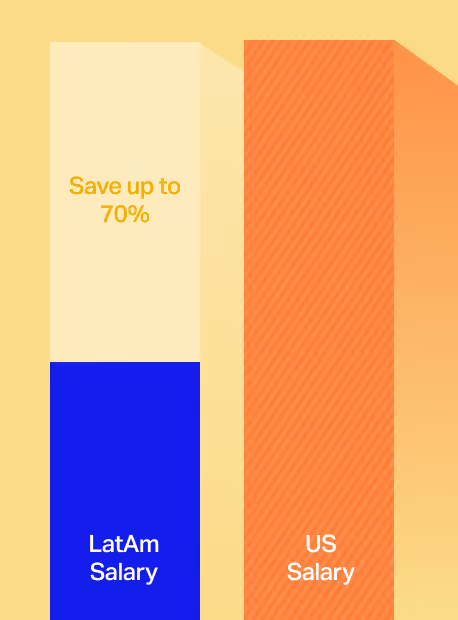
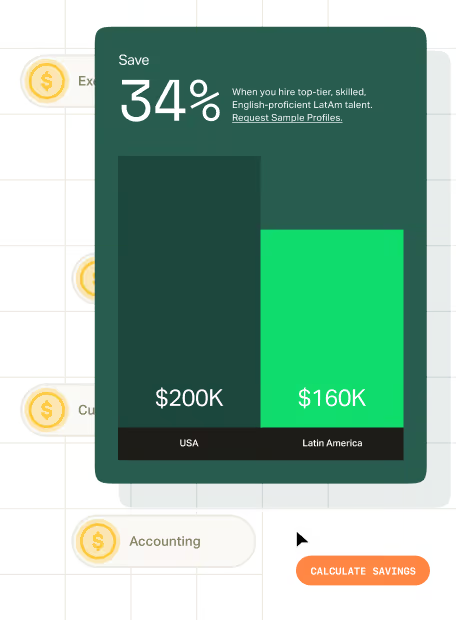
Product manager salaries vary significantly by experience level and location. In the US, mid-level PMs typically earn $143,000-$155,000, while senior PMs earn $155,000-$163,000. When hiring in Latin America, you can access the same caliber of talent for $42,000–$50,000, saving up to 70% annually while maintaining quality.
What’s the difference between a product manager and a product owner?
Product managers focus on long-term strategy, market fit, and business outcomes. They define what problems to solve and which features to build.
Product owners manage sprint backlogs and tactical execution within Agile/Scrum frameworks. They break down features into user stories and keep development teams unblocked during sprints.






.webp)


%203.svg)
.avif)




%20(1).avif)

%20(1).png)