



%203.svg)
Key Takeaways
- Product managers focus on long-term strategy and business outcomes while product owners manage sprint backlogs and tactical execution within Agile frameworks.
- Choose a product manager when defining strategy and market fit matter most, or a product owner if you use scrum and sprint execution and backlog management are priorities.
- Product managers at many companies handle both strategic roadmap planning and tactical backlog management, combining PM and PO responsibilities into one role.
You’re looking to hire someone to own your product roadmap and work with your development team. You search “product manager job description” and “product owner job description”—and the results look almost identical.
So what’s the difference? Do you need a product manager or a product owner? Can one person do both? And does it even matter?
Short answer: Yes, it matters—but probably less than you think.
Here’s what you need to know to make the right hire.
What Is a Product Manager?
A product manager owns the product strategy and vision. They’re responsible for understanding market needs, defining what gets built and why, and ensuring the product delivers business value.
Product managers spend their time:
- Researching user needs and market opportunities
- Defining product strategy and roadmap
- Prioritizing features based on business impact
- Working with engineering, design, marketing, and sales
- Analyzing product metrics and iterating based on data
- Communicating vision to stakeholders and leadership
The PM role is broad and strategic. They’re thinking about the “why” behind the product: why this feature matters, why now, why this solves a real problem worth solving.
What Is a Product Owner?
A product owner is a role that comes from Agile/Scrum frameworks. They own the product backlog and work closely with the development team to ensure work gets done efficiently.
Product owners spend their time:
- Managing and prioritizing the product backlog
- Writing user stories and acceptance criteria
- Answering development team questions during sprints
- Participating in sprint planning, reviews, and retrospectives
- Making tactical decisions about scope and implementation
- Ensuring the team delivers working software each sprint
The PO role is usually more tactical and execution-focused than that of a product manager. They’re thinking about the “what” and “how”—what gets built this sprint, how to break down features into deliverable chunks.
Further reading: The Benefits of Nearshore Agile Development and How to Find the Talent You Need
The Key Differences Between a Product Manager and a Product Owner
Here’s where the roles differ:
Product Manager vs. Product Owner
When You Need a Product Manager
You need a product manager when:
- You’re figuring out what to build. If you’re still validating product-market fit, exploring new markets, or deciding which direction to take your product, you need strategic thinking more than backlog management.
- You have multiple stakeholders. If your product decisions involve sales, marketing, customer success, and leadership—not just engineering—you need someone who can navigate those relationships.
- Business outcomes matter more than shipping velocity. If you’d rather ship one high-impact feature than ten low-impact ones, you need someone focused on business value, not just throughput.
- You’re pre-Agile or multi-methodology. Not every company runs Scrum. If you’re not doing formal sprints, the “product owner” role doesn’t fit your process.
When You Need a Product Owner
You need a product owner when:
- You’re running Scrum and need someone in that role. If your development team follows Scrum ceremonies, someone needs to own the backlog and be available for daily questions.
- Your strategy is set; execution is the problem. If you know what to build but struggle to ship it efficiently, you need someone focused on unblocking the team and managing workflow.
- You have a dedicated Scrum team. Product owners work best when embedded with a single team. If you have multiple teams or cross-functional coordination, a PM makes more sense.
- The development process is your bottleneck. If your team keeps getting blocked by unclear requirements or scope creep, a product owner who can clarify and prioritize in real-time helps.
{{state-latam-hiring}}
Can One Person Do Both the Product Manager and Product Owner Roles?
Yes. And at many companies, they do.
In practice, especially at startups and mid-size companies, the person with “product manager” in their title does both jobs. They set strategy and manage the backlog. They talk to customers and write user stories.
This is totally normal and often necessary.
The distinction between PM and PO matters most at:
- Large enterprises running formal Agile with multiple teams
- Agencies that need a dedicated PO on client teams
- Companies with separate strategy and execution teams (rare, but it happens)
For most growing companies, you’re hiring someone to do product management work, which includes the backlog management and sprint participation that technically falls under “product owner.”
What This Means for Your Hiring
If you know exactly which role you need—a dedicated product owner for your Scrum team or a strategic product manager—hire for that. But if you’re unsure or need someone who can handle both strategy and execution, here’s how to approach it:
- Use “Product Manager” in your job title. It’s the more common term, attracts a broader candidate pool, and doesn’t lock you into Agile-specific expectations.
- Be clear about day-to-day work. In your job description, mention both strategic responsibilities (roadmap, user research, metrics) and execution responsibilities (backlog management, sprint planning, working with eng team daily).
- Don’t get hung up on terminology. During interviews, focus on whether candidates can do the actual work, regardless of what their previous title was. A great product owner can probably do product management. A strong product manager definitely knows how to manage a backlog.
- Ask about their experience with Agile. If you run Scrum, make sure they’re comfortable with sprint ceremonies and backlog management. If you don’t, make sure they can work within your actual process.
- Look for strategic thinking and execution skills. The best hires can do both. They can think big picture (product strategy, user needs, business outcomes) and get tactical (user stories, acceptance criteria, sprint planning).
For more detailed guidance on what skills to prioritize and how to evaluate PM candidates, check out our comprehensive How to Hire a Product Manager: Your Complete 2025 Guide.
Interview Questions That Reveal the Full Skill Set for Product Management
When interviewing candidates, ask questions that test both strategic and tactical abilities:
- Strategic thinking: “Walk me through how you decided what to build in your last product. What did you prioritize and why?”
- Execution focus: “How do you work with engineering teams during a sprint? What happens when scope changes mid-sprint?”
- Backlog management: “How do you decide what goes in the backlog versus what stays in the icebox?”
- Stakeholder balance: “Tell me about a time stakeholders wanted one thing and your dev team pushed back. How did you handle it?”
These questions surface whether candidates can operate at both levels—strategic vision and tactical execution.
For a complete set of interview questions and hiring best practices, see our guide: Product Manager Interview Questions and Hiring Best Practices.
{{prevetted-banner}}
Final Thoughts
The difference between product manager and product owner matters for job descriptions and Agile purists—but not as much as finding someone who can do the actual work.
Most companies need someone who can think strategically about the product and work tactically with the development team. Whether you call that person a product manager, product owner, or both doesn’t matter nearly as much as hiring someone with the right skills.
Focus less on the title and more on the responsibilities. Do you need someone who can set product strategy, talk to users, prioritize a roadmap, work with stakeholders, manage a backlog, and keep your dev team unblocked?
That’s what you’re hiring for. Everything else is semantics.
If you’re ready to hire but want help finding product management talent who can handle both strategy and execution, book a free consultation with Near. We can help you hire top product managers and product owners in Latin America. We’ll find you the right person for your actual needs, regardless of what you call the role.
Frequently Asked Questions
Where can I find and hire product managers or product owners?
You can hire product managers through LinkedIn, product management job boards (ProductHired, Mind the Product), referrals, or specialized tech recruitment partners. If you’re hiring internationally, working with a recruitment partner who specializes in offshore tech talent handles vetting, compliance, and cultural fit screening—especially valuable when hiring outside your local market.
Where is the best place to hire product managers or product owners?
In our experience, Latin America is one of the best places to hire product managers and product owners for US companies. The region offers strong time zone alignment (typically 0-3 hours difference from US time zones), which matters when your PM needs to participate in daily standups, sprint planning, and stakeholder meetings in real time.
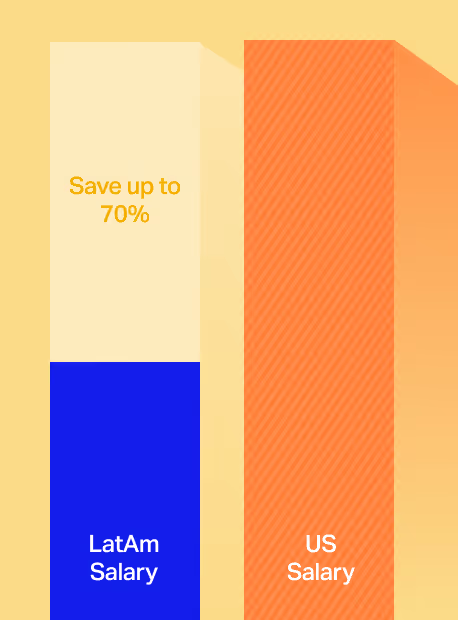
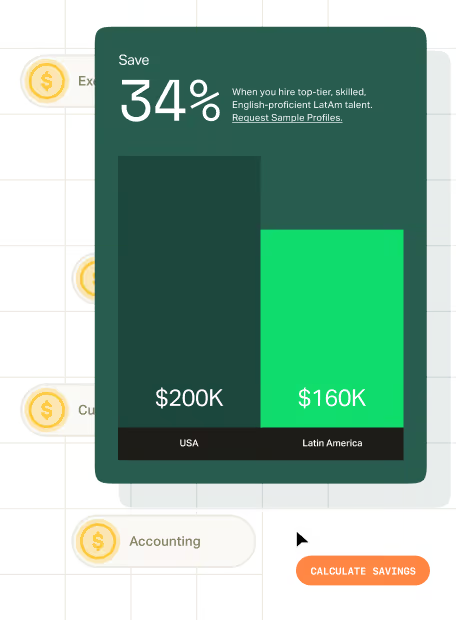
You also get significant cost savings: a senior product manager costs $155K to $163K in the US versus $46K to $50K in Latin America, without sacrificing quality or experience.
Many LatAm product managers have worked with US tech companies, understand American business practices, and bring the same strategic thinking you’d expect from US-based candidates.
If you’re looking for experienced product management talent at rates that don’t strain your budget, Latin America delivers both quality and value.
Further reading: Why More US Businesses Are Hiring in Latin America: What We Learned from Talking to 2,000 Hiring Managers
Do product owners need experience with Agile development?
Yes, product owners are specifically defined within Agile/Scrum frameworks, so Agile experience isn’t optional—it’s fundamental to the role. They need to be comfortable with sprint planning, backlog refinement, user story writing, and daily standups. If you’re considering agile offshore software development or agile development outsourcing, make sure your product owner understands how to work with distributed teams across time zones while maintaining Agile ceremonies and velocity.
What other roles should I consider to build a strong product team?
This depends on stage, but if you’re building or scaling a product function, these roles often matter just as much as “PM vs. PO”:
- Product Designer (to stop PMs from being UI designers by default)
- Engineering Lead / EM / Tech Lead (to own technical direction and delivery health)
- QA Engineer / Test Automation (to keep quality from becoming a release blocker)
- Data Analyst / Data Engineer (so decisions aren’t all gut feel)
- Product Marketing Manager (so the market actually understands what you built)










%203.svg)
.avif)




%20(1).avif)

%20(1).png)
