

%203.svg)
Key Takeaways
- The best place to look for an offshore web developer depends on how much vetting you want to handle yourself: freelance marketplaces for self-directed sourcing, vetted platforms for pre-screened talent, and staffing partners like Hire With Near for a dedicated, full-time developer placed and supported end to end.
- Latin America gives US teams the strongest combination of developer depth, working-hours overlap, and cost savings, with senior web developers running $66,000–$84,000 a year compared to $147,000 for equivalent US hires.
- The vetting signal that separates strong offshore hires from costly ones isn’t the resume: it’s whether a developer can explain a past project clearly to a non-engineer, which also tells you how they’ll function in your standups and code reviews.
The best place to hire an offshore web developer depends on how much of the search you want to run yourself: freelance marketplaces if you want to source and vet on your own, and staffing and recruiting partners if you want pre-screened developers who work in your time zone.
If you’ve tried offshore hiring before, you already know the failure modes: teams in Asia whose day ends as yours begins, freelancers who delivered and then went dark. The fix isn’t abandoning offshore hiring. It’s hiring in the right region with the right process.
This article covers the best sites to find offshore web developers in 2026, what to screen for, and what it costs, with a close look at Latin America, which gives US teams the deepest talent pool with full US-business-hours overlap.
Why Should I Hire Offshore Web Developers?
Most companies turn to offshore web developers for cost efficiency. Here’s why offshore hiring can move your projects forward faster.
Cost efficiency for budget optimization
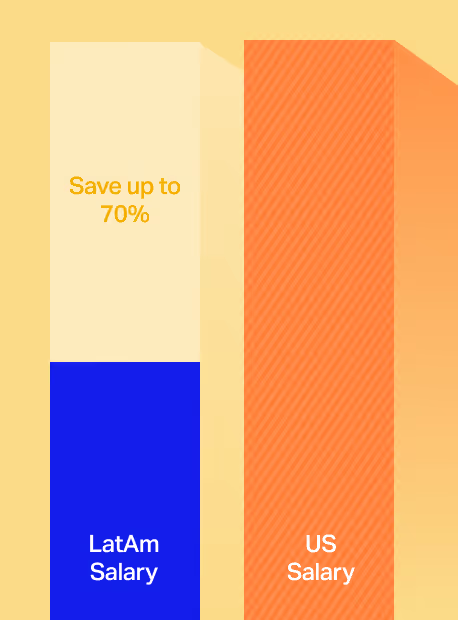
Offshore web development lets companies get more capability for the same budget. In regions like Latin America, Asia, and Eastern Europe, a lower cost of living means the salary that funds a mid-level developer at home can hire a senior professional abroad. Many of the professionals hold advanced degrees and carry years of production experience.
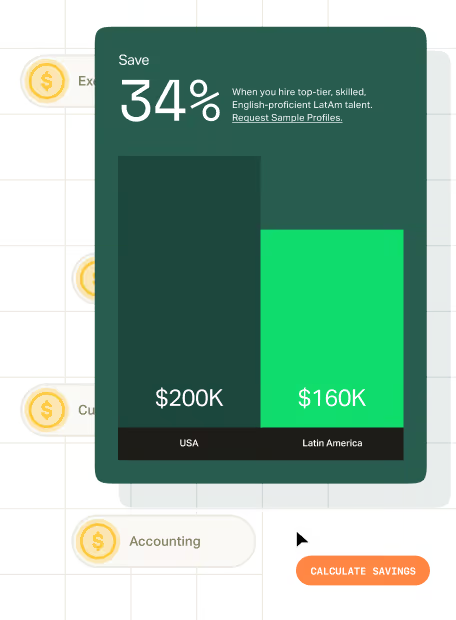
A senior web developer in the US might command $147,000 a year. The same experience level in Latin America, for example, runs $66,000–$84,000, stretching that budget much further, without treating the hire as a place to cut corners. The money you save can go straight into product, marketing, or customer acquisition.
Access to a broader talent pool
Offshore hiring breaks geographic barriers, opening access to developers who work in the latest languages and frameworks. That range means you can find the exact skill set a complex project needs.
According to GitHub’s Octoverse 2025 report, Brazil alone now has 6.9 million GitHub accounts. Country-level figures for the rest of Latin America weren’t released in the 2025 edition, but the 2024 report counted Mexico at 1.9 million-plus, Argentina at 1.1 million-plus, and Colombia at 1 million-plus, all with double-digit year-over-year growth.
If you want to go deeper into the region, our guide to hiring developers in Latin America walks through where the talent is and how to reach it.
Scalability and business agility
Offshore teams give you the flexibility to scale up or down as project demands change. You can take on a short-term build or run a long-lived application without carrying a full in-house bench.
One way to add that flexibility is through nearshore staff augmentation: a vendor places dedicated developers from their bench onto your team, working under your direction while the vendor handles employment. You get the added capacity without handling recruiting and payroll infrastructure of your own.
This agility lets you respond to market changes quickly and keep operations efficient.
Related reading: How To Find the Best Offshore Joomla Developers: Top Partners and the Skills To Look For
{{latam-hiring-calculator}}
What to Look for in an Offshore Web Developer
When hiring an offshore website developer, screen for four things: verified technical depth, real English fluency, time-zone overlap, and full-time commitment. Across the editorial work I do turning Hire With Near’s recruiters’ expertise into guidance for hiring managers, these are the four that separate the hires that work out from the ones that don’t.
First, know what kind of web developer you need. Front-end developers build what users see and interact with. Full-stack developers work across the front end and the server, database, and logic behind it. Platform specialists focus on a specific system, like a WordPress developer, a Shopify developer, or a Squarespace developer.
Then screen for the non-negotiables:
- Real English fluency, not accent: The ability to articulate a technical decision with ease and document it matters more than how someone sounds.
- Time-zone overlap: A developer who works your hours is a developer you can actually collaborate with. The closer the time zone, the more of the working day you share, which means standups happen live, blockers get cleared the same day, and code review doesn’t wait until the next morning.
- Full-time commitment, not client-juggling. A developer splitting attention across five clients isn’t the same hire as one dedicated to your team.
- Verified technical depth, not a resume: Resumes lie, and AI-generated CVs are everywhere. What Hire With Near’s recruiters flag when they screen web developers is proof of production work: ask for work samples, check references, and run a live or take-home technical evaluation. Ask any provider exactly what their screen includes before a candidate reaches you.
Natasha Tarapow, Hire With Near’s Recruitment Consultant, explains what she looks for:
We always ask candidates to tell us about a project they’ve worked on — not just that they use this language and that one, but what their role was and what they actually did. It’s important that they can explain their work to someone who isn’t a developer. If they can do that, that tells me a lot.
If you want the role screened end to end, you can hire a web developer through a staffing partner that runs this filter before you ever see a candidate. I’ll share 10 of the best options in the next section.
What Are the Top Websites To Hire Offshore Web Developers?
The strongest options for hiring an offshore web developer range from open freelance marketplaces like Upwork to vetted platforms like Toptal and Arc and dedicated Latin American staffing partners like Hire With Near, BairesDev, and Revelo. Each fits a different kind of hire.
The rating threshold for inclusion was 4.4 or higher with at least 50 client reviews on an approved platform (G2, Clutch, Trustpilot, or ClearlyRated).
You’ll notice Hire With Near is on this list, and we’ll be transparent about what we offer and where others may be a better fit.
If you want to compare the field more broadly, our roundups of recruitment and staffing agencies for hiring developers and the best nearshore staffing companies cover adjacent options.
Below is a quick comparison, followed by the full listing for each:
1. Hire With Near
%2012.23.42%E2%80%AFp.%E2%80%AFm..webp)
Website: hirewithnear.com
Headquarters: United States
Rating: 4.9/5 on G2 (140+ reviews) as of July 2026
Services: Full-service nearshore staffing and recruiting, RPO, staff augmentation, executive search
Focus Regions: Latin America only
Hire With Near is a full-service staffing and recruiting agency that helps US companies of all sizes hire top-performing remote talent in Latin America across all departments and industries, including web development. We handle sourcing, vetting, payroll, compliance, and onboarding end to end, so hiring feels simple on your side.
We’re the only firm on this list that places developers in Latin America exclusively for US clients, which is exactly why we lead with time-zone overlap.
We’re not a platform and we don’t supply temps. We screen for real-world impact, present pre-vetted developers, and handle the payroll and compliance behind the hire.
Our work is backed by a 4.9/5 G2 rating across 140 verified reviews and a track record of placing web developers, not just office roles, based in Latin America.
Rankings.io, an Inc. 5000 SEO agency, is one example. They came to us with a single HR manager, no bandwidth to run multiple technical searches at once, and a history of inefficient staffing agencies.
We filled 11 roles from Latin America, including two web developers and a web designer, at an average three-week time-to-hire, cutting their salary costs 54% and resulting in $463,000 in annual savings.
Key features:
- One partner, one process: Scale across functions, not just web development, with one dedicated team and a repeatable hiring cadence. First candidates in 3-5 days with video introductions, most hires in under 3 weeks. We remember what worked last time, and we adapt based on your feedback so hiring gets easier and more effective over time.
- Quality-first approach: Our 97% placement rate and 9.1+ client satisfaction come from obsessing over fit, not just skills but the drive, readiness, and cultural match to contribute from day one. We screen for real-world impact, not just keywords, so you interview developers who can build in production.
- Transparent pricing: We show you benchmarks and fees up front. You set salaries for your hires. No hidden markups. No upfront costs, you only pay after hiring a candidate.
- Long-term retention: 80% of our hires stay 2+ years because they’re building institutional knowledge and personally investing in your success, not hopping between contract gigs.
Best for: US companies that want a dedicated, full-time web developer in Latin America placed and supported end to end, not a marketplace gig.
Client perspective: “The candidate quality was better than expected, making it harder to decide who to hire. I’m excited to continue working with them and look forward to hiring more people using Hire With Near. They helped find a candidate who streamlined our work, had years of experience we thought weren’t possible to find, and addressed the challenges with previous team members.” — Customer review on G2
Limitations: We place talent only in Latin America, so we’re not a fit if you specifically need developers in Asia or Eastern Europe. We’re a recruiting and staffing partner, not a project-delivery shop that manages the build for you.
Pricing: Two models: direct hire (one-time recruiting fee) or a staffing model (monthly fee with payroll and compliance included). No upfront cost.
2. Upwork
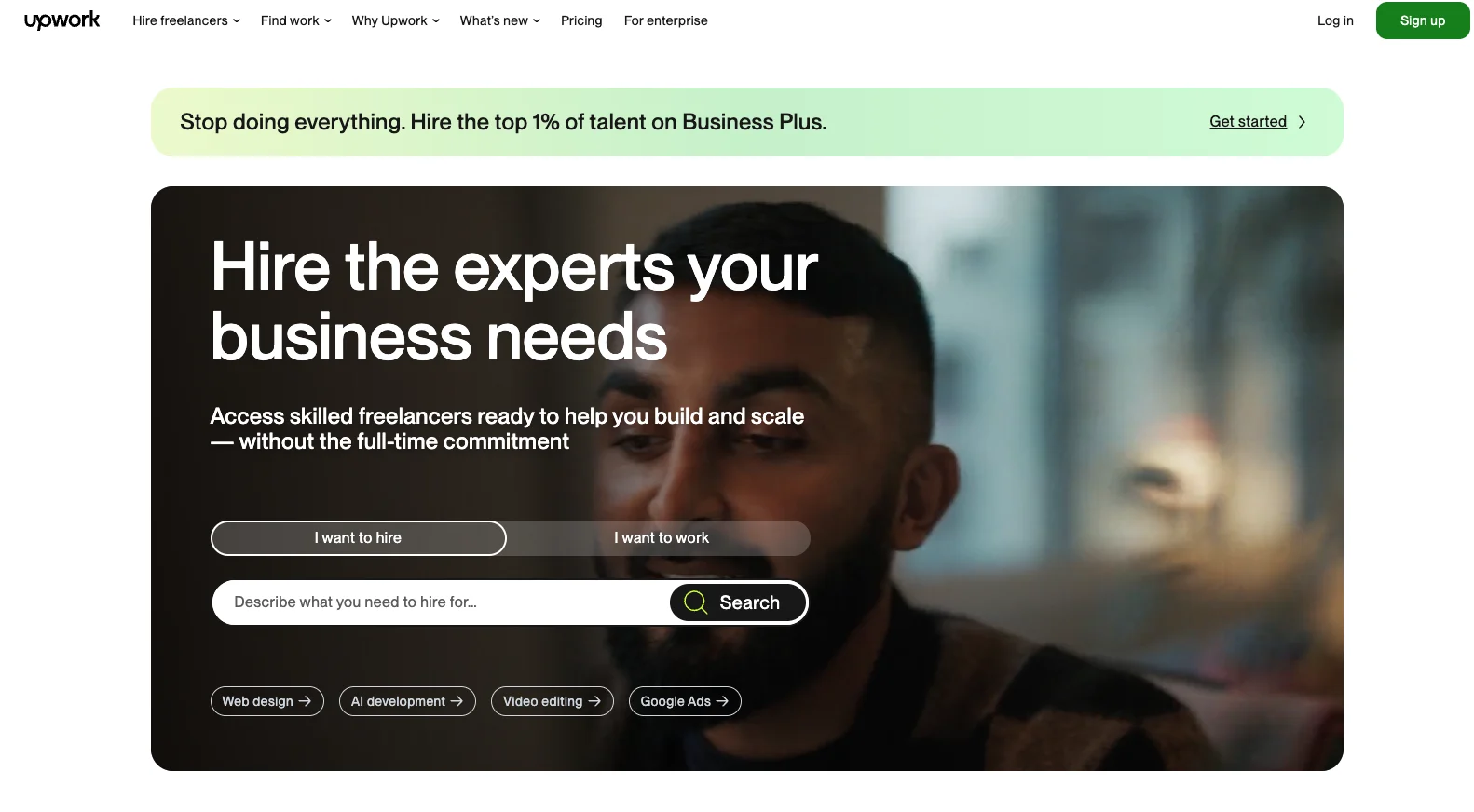
Website: upwork.com
Headquarters: United States
Rating: 4.5/5 on G2 (3,205+ reviews) as of July 2026
Services: Freelance marketplace, contractor payments, project tracking
Focus Regions: Global
I included Upwork for the sheer breadth of its marketplace: it’s a well-established global platform offering freelance developers for projects of any scale, with built-in tools for tracking, communication, and payments.
With developers skilled in everything from front-end work to machine learning, it’s a flexible option for both short-term tasks and ongoing projects, provided you’re comfortable running the sourcing and vetting yourself.
Key features:
- Vast global pool of freelancers across front-end, back-end, and specialized development.
- Built-in contracts, time tracking, and payment protection for hourly or fixed-price work.
- Self-service model: you post the role, review proposals, and screen candidates directly.
Best for: Teams that want to source and vet developers on their own and manage the relationship directly.
Client perspective: “Each freelancer I have hired has had strong communication skills and competence in their field of expertise. Upwork’s rating system for freelancers is an excellent start.” — Customer review on G2
Limitations: Vetting is on you. The marketplace lists talent but doesn’t pre-screen for your role. Quality and commitment vary widely by freelancer.
Pricing: Free to post, but Upwork charges service and contract fees on freelancer earnings and client payments.
3. Toptal
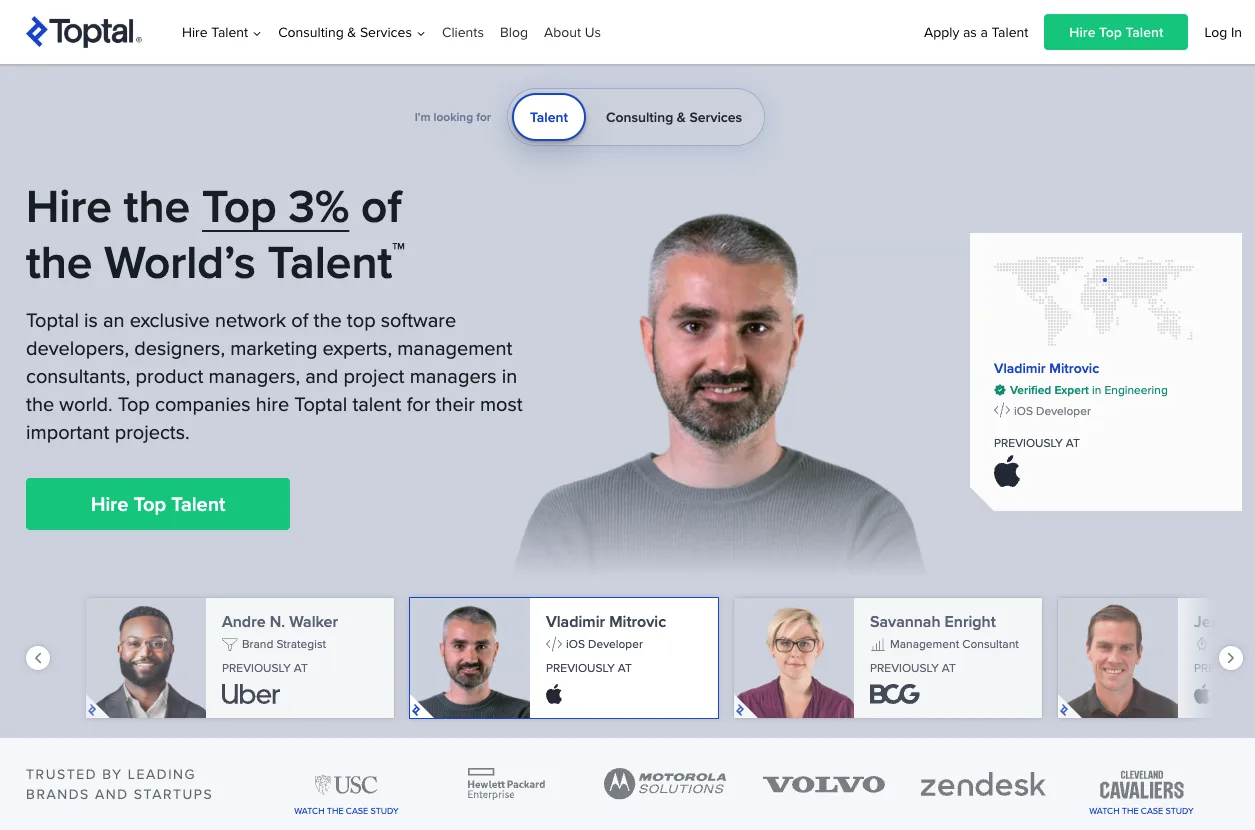
Website: toptal.com
Headquarters: United States
Rating: 4.7/5 on G2 (265+ reviews) as of July 2026
Services: Vetted freelance network, dedicated matching, contract and full-time placements
Focus Regions: Global
Toptal earned a spot on this list because of its rigorous screening: the platform filters developers down to the top 3% worldwide and pairs clients with dedicated matchers for high-stakes work.
That quality focus makes it a preferred choice when precision is important, though the vetting comes at a premium that suits enterprise-grade projects more than tight budgets.
Key features:
- Top-3% screening process for developers, designers, and other technical roles.
- Personalized matching with account managers for enterprise-grade engagements.
- Options for both contract and full-time hires with a trial period.
Best for: Companies that need heavily vetted senior talent for high-stakes projects and can pay a premium for it.
Client perspective: “We’ve been impressed by how quickly Toptal was able to get us a brilliant freelancer. They found someone who could complete exactly what we needed in a very short amount of time.” — Client review on Clutch
Limitations: Premium pricing puts it out of reach for smaller budgets. Talent is global, so time-zone overlap depends on the individual match.
Pricing: Not publicly listed. Premium rates with a refundable trial period.
If you’re weighing Toptal against Hire With Near, see how the two compare on talent quality, fees, and time-to-hire in our Hire With Near vs. Toptal breakdown.
4. BairesDev

Website: bairesdev.com
Headquarters: United States/Argentina
Rating: 4.9/5 on Clutch (60+ reviews) as of July 2026
Services: Nearshore software development, dedicated teams, end-to-end delivery
Focus Regions: LatAm, Global
What stood out about BairesDev is their nearshore delivery model: they build dedicated development teams for US clients, leaning on time-zone compatibility and cultural alignment.
Their agile-trained teams handle industry-specific solutions from healthcare to finance, offering end-to-end support from ideation to deployment, which makes them a fit for companies that want a partner to own the entire development process.
Key features:
- Dedicated nearshore teams with full US time-zone overlap.
- End-to-end project delivery, from planning through deployment.
- Industry-specific experience across healthcare, finance, and more.
Best for: Companies that want a nearshore partner to manage a full development project rather than place an individual hire.
Client perspective: “BairesDev effectively sources and filters talent, building a team that perfectly fits our needs. They all have experience in financial services, which is exactly what we wanted.” — Customer review on Clutch
Limitations: Built around project delivery and teams, so less suited to hiring a single dedicated developer onto your own payroll. Pricing not publicly listed.
Pricing: Not publicly listed; project- and team-based engagements.
5. Arc
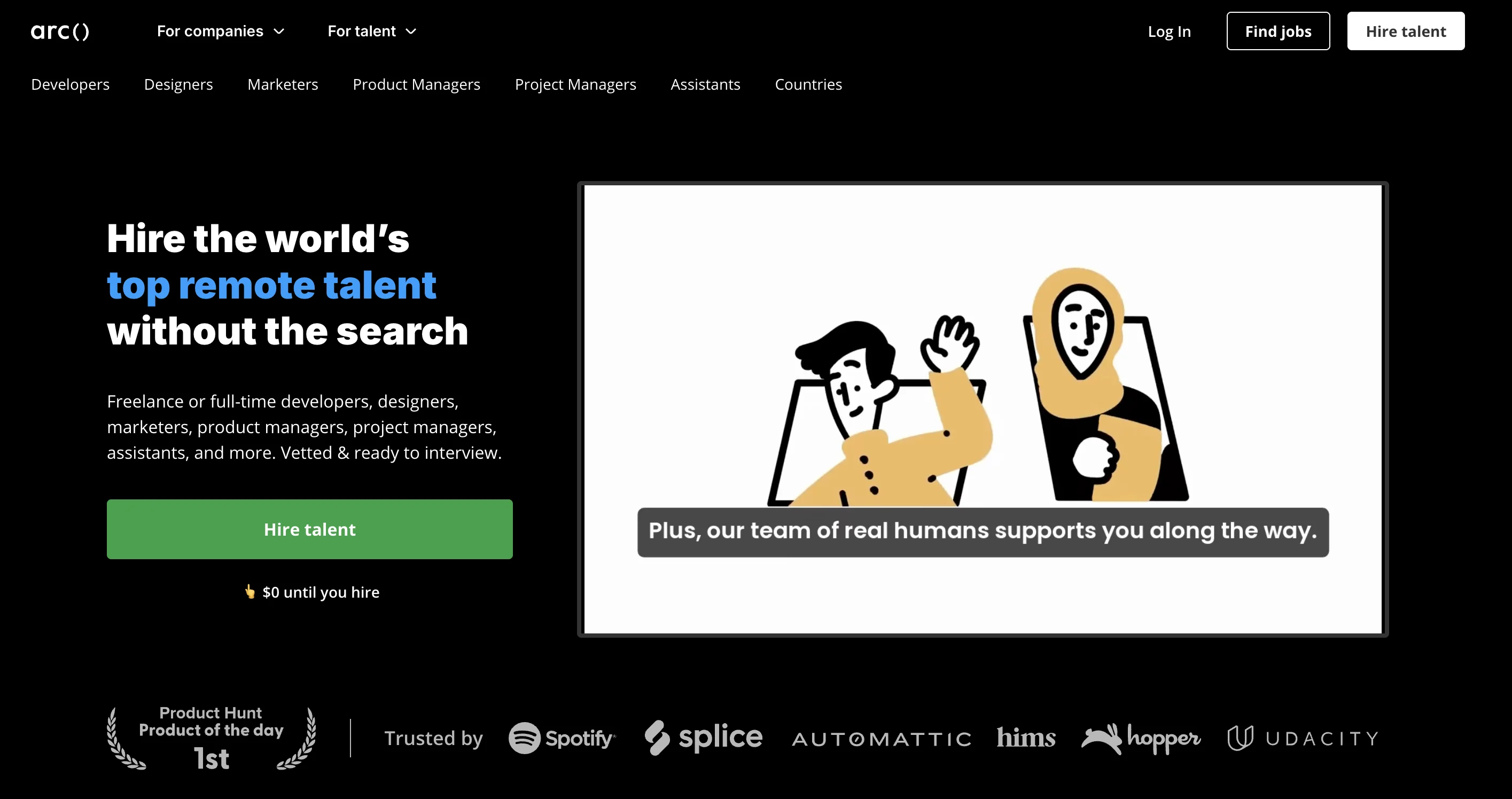
Website: arc.dev
Headquarters: United States
Rating: 4.4/5 on Trustpilot (195+ reviews) as of July 2026
Services: Vetted developer marketplace, full-time and contract hiring
Focus Regions: Global
Arc made this best offshore web developer websites list because of its balance between vetting and flexibility: the platform connects businesses with pre-vetted remote developers and offers both full-time and contract options.
Its pool spans current languages and frameworks, giving teams a middle ground between an open marketplace and a high-touch agency.
Key features:
- Pre-vetted remote developers across modern stacks.
- Both full-time and contract hiring paths.
- Faster matching than an open marketplace, with lighter overhead than an agency.
Best for: Teams that want vetted remote developers with the choice of full-time or contract, and are comfortable managing the hire.
Client perspective: “We gain access to developers with strong technical skills and unique perspectives. All of our Arc hires have been instrumental in driving innovation within our company.” — Customer review on G2
Limitations: Global talent means time-zone overlap varies by candidate. Support is lighter than a full-service staffing partner.
Pricing: Not publicly listed; varies by full-time or contract engagement.
6. Onix Systems
%2012.31.05%E2%80%AFp.%E2%80%AFm..webp)
Website: onix-systems.com
Headquarters: United States/Ukraine
Rating: 4.8/5 on Clutch (50+ reviews) as of July 2026
Services: Custom web development, cloud applications, niche-industry solutions
Focus Regions: Eastern Europe, Global
I chose Onix Systems based on their custom-build depth: they’re an offshore development company specializing in tailored web solutions for niche markets like healthcare and the fintech industry.
Their work with advanced frameworks and cloud-based applications makes them a strong option for complex, requirements-heavy builds where client-focused collaboration matters.
Key features:
- Custom web and cloud development for specialized industries.
- Experience with advanced frameworks and complex, requirements-heavy builds.
- Client-focused delivery with a focus on hitting business goals on time.
Best for: Companies with a complex, custom build in a niche industry that want a specialized development company.
Client perspective: “The team consistently went above and beyond in addressing challenges. They didn’t just wait for issues to arise; they anticipated potential problems and offered proactive solutions. This approach saved us time and resources, and it also demonstrated their commitment to delivering a high-quality product.” — Customer review on Clutch
Limitations: Based in Eastern Europe, so US time zone overlap is partial. Oriented to project delivery rather than placing an individual developer on your team.
Pricing: Not publicly listed; project-based.
7. CloudDevs
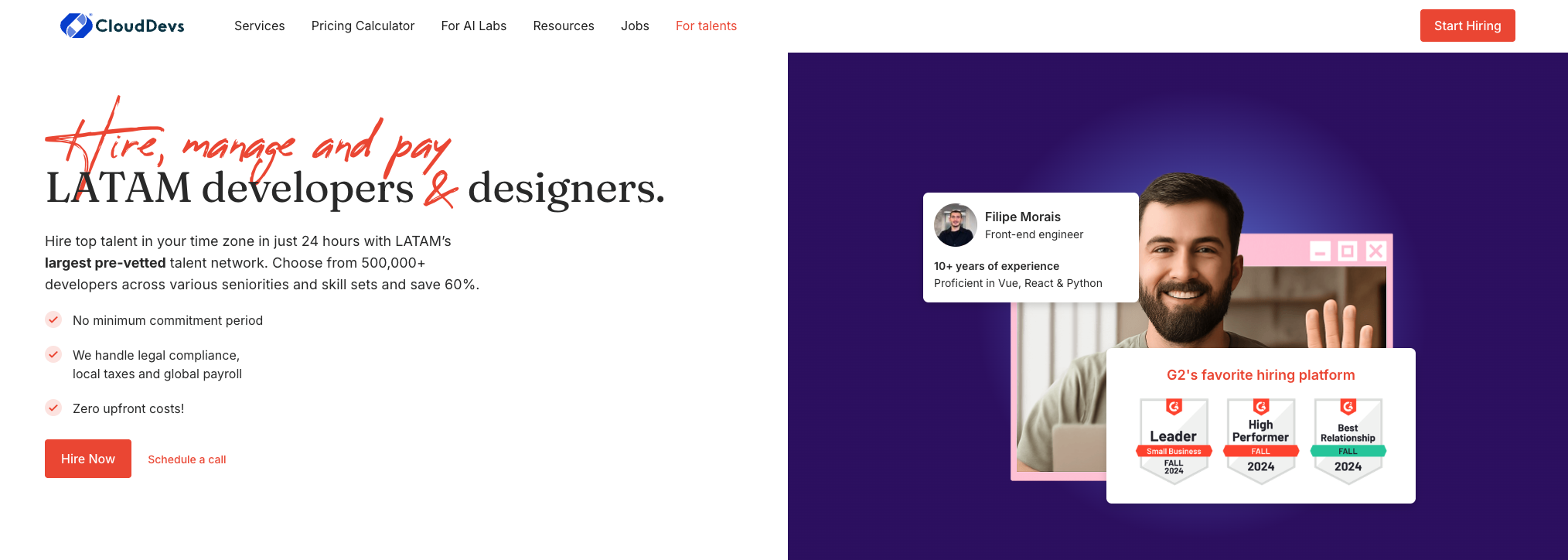
Website: clouddevs.com
Headquarters: United States
Rating: 4.9/5 on G2 (160+ reviews) as of July 2026
Services: Pre-vetted developer platform, LatAm talent, quick matching
Focus Regions: LatAm
The reason CloudDevs made this top offshore web developer sites list is speed to a vetted, time-zone-aligned hire: the platform connects US companies with pre-vetted Latin American developers and matches quickly.
It sits between a marketplace and a staffing agency, giving teams fast access to screened LatAm talent without running a full search themselves.
Key features:
- Matched with a vetted Latin American developer within 24–48 hours, with guaranteed US time-zone alignment.
- A 7-day (up to 40-hour) risk-free trial before you commit, with a free replacement if the fit isn’t right.
- Pay-as-you-go weekly billing with no long-term contracts or upfront recruitment fees.
Best for: US teams that want a fast match to a vetted LatAm developer with minimal search overhead.
Client perspective: “From the beginning, everything was clearly communicated, timelines were respected, and expectations were well aligned. The team handled every step with professionalism, making the experience smooth and stress-free.” — Customer review on G2
Limitations: Focused on individual developer matches rather than hiring full managed teams. Support scope is lighter than a full-service recruiting partner.
Pricing: Not publicly listed; hourly and longer-term engagements.
8. Revelo
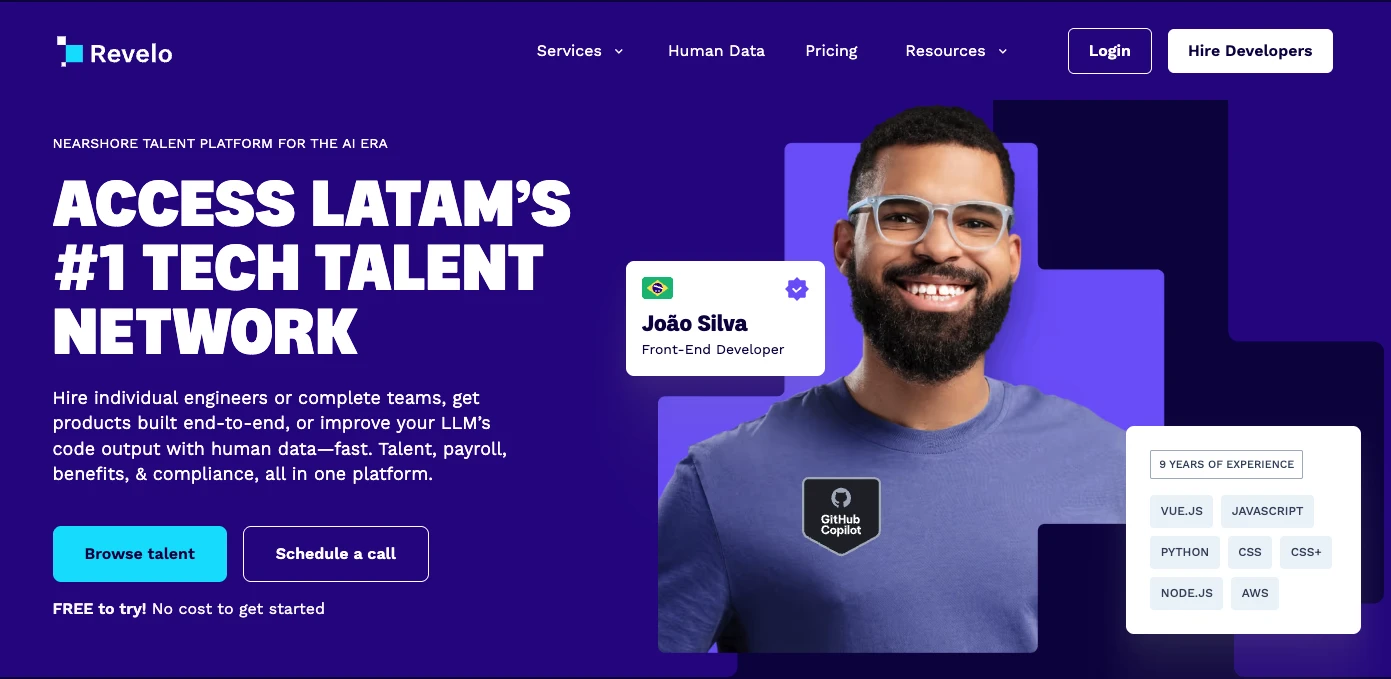
Website: revelo.com
Headquarters: United States / Brazil
Rating: 4.7/5 on G2 (125+ reviews) as of July 2026
Services: LatAm talent platform, vetted engineers, payroll and compliance support
Focus Regions: LatAm
Revelo caught my attention for its time-zone-first LatAm model: the platform places pre-vetted Latin American engineers with US companies and layers on payroll and compliance support.
With a large screened talent base, it’s a fit for teams that want an ongoing engineering hire rather than a one-off project.
Key features:
- Pre-vetted Latin American engineers aligned to US time zones.
- Payroll, compliance, and management support layered onto the hire.
- A large screened talent base across engineering roles.
Best for: US teams that want a time-zone-aligned LatAm engineer with payroll and compliance handled.
Client perspective: “The Revelo team self-organizes to meet our needs - they move us through a streamlined hiring flow we co-designed. They qualify candidates, administer our aptitude tests and bring us the cream of the crop.” — Customer review on G2
Limitations: Concentrated on engineering roles, so less suited to broader cross-functional hiring. Pricing not publicly listed.
Pricing: Not publicly listed; monthly per-hire model.
If you’re deciding between Revelo and Hire With Near, our head-to-head comparison of Hire With Near vs. Revelo breaks down the differences in vetting, pricing, and placement model.
9. BEON.tech
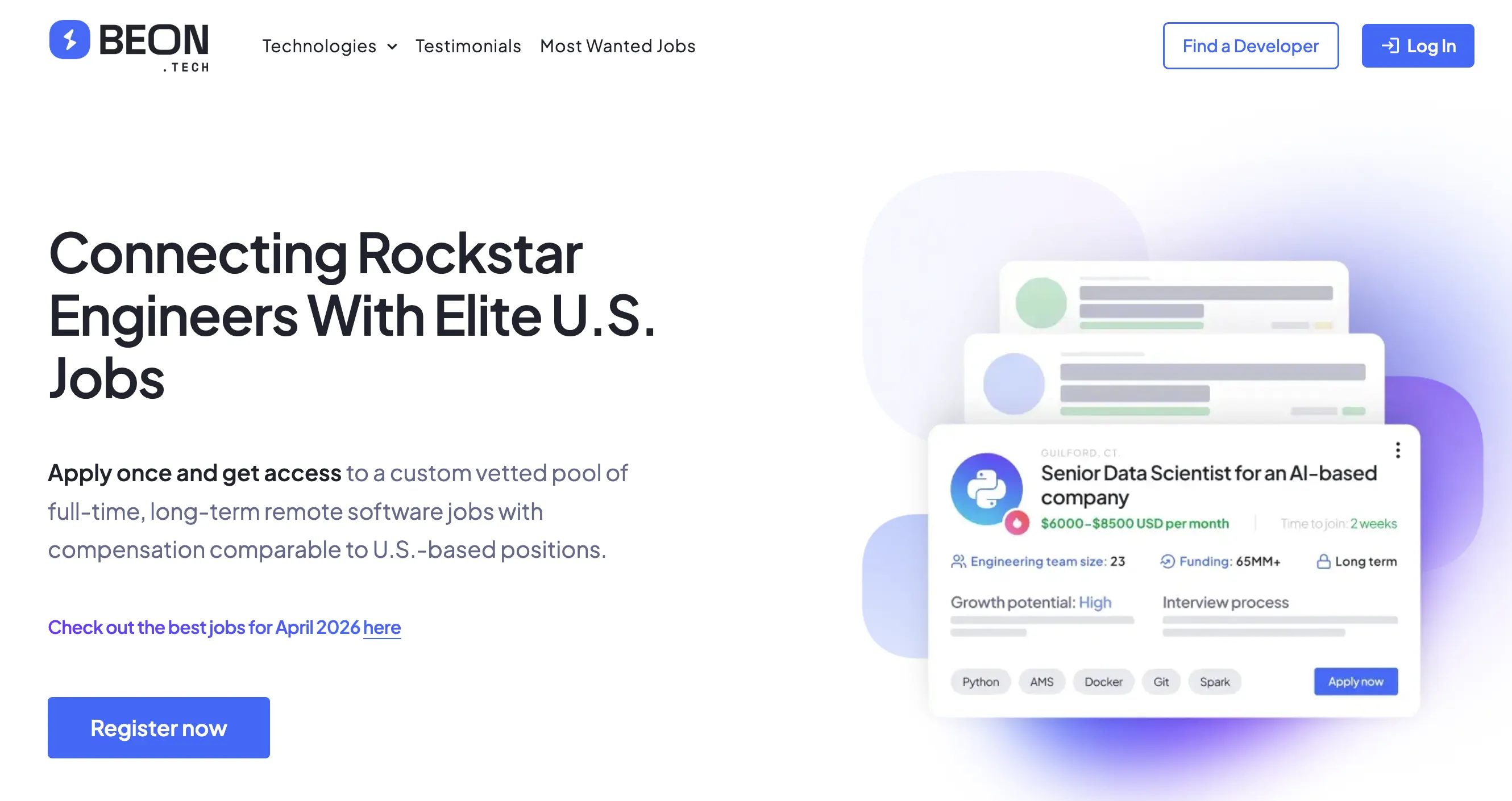
Website: beon.tech
Headquarters: United States/Argentina
Rating: 4.9/5 on Clutch (65+ reviews) as of July 2026
Services: LatAm developer placement, dedicated hires, team integration
Focus Regions: LatAm
BEON.tech is on this list because of their startup-focused LatAm model: they place dedicated Latin American developers with US companies and emphasize cultural and time-zone fit.
Their screening and integration support make them a fit for growing teams that want a developer to embed rather than a rotating contractor.
Key features:
- Multi-step vetting by senior engineers and psychologists, with a 1-in-3 hire rate from submitted profiles.
- A dedicated Talent Experience Manager who stays involved after the hire to protect retention.
- Unlimited replacements at no extra cost, with all-inclusive monthly rates covering salary, benefits, and equipment.
Best for: US startups that want a dedicated LatAm developer who integrates into the team long-term.
Client perspective: “Engineering output increased by more than 40% after onboarding BEON.tech developers, with consistent sprint completion rates and reduced backlog carryover.” — Customer review on Clutch
Limitations: Smaller review footprint than the largest platforms. Focused on developer placement rather than full-service cross-functional hiring.
Pricing: Not publicly listed; monthly per-hire model.
10. Andela
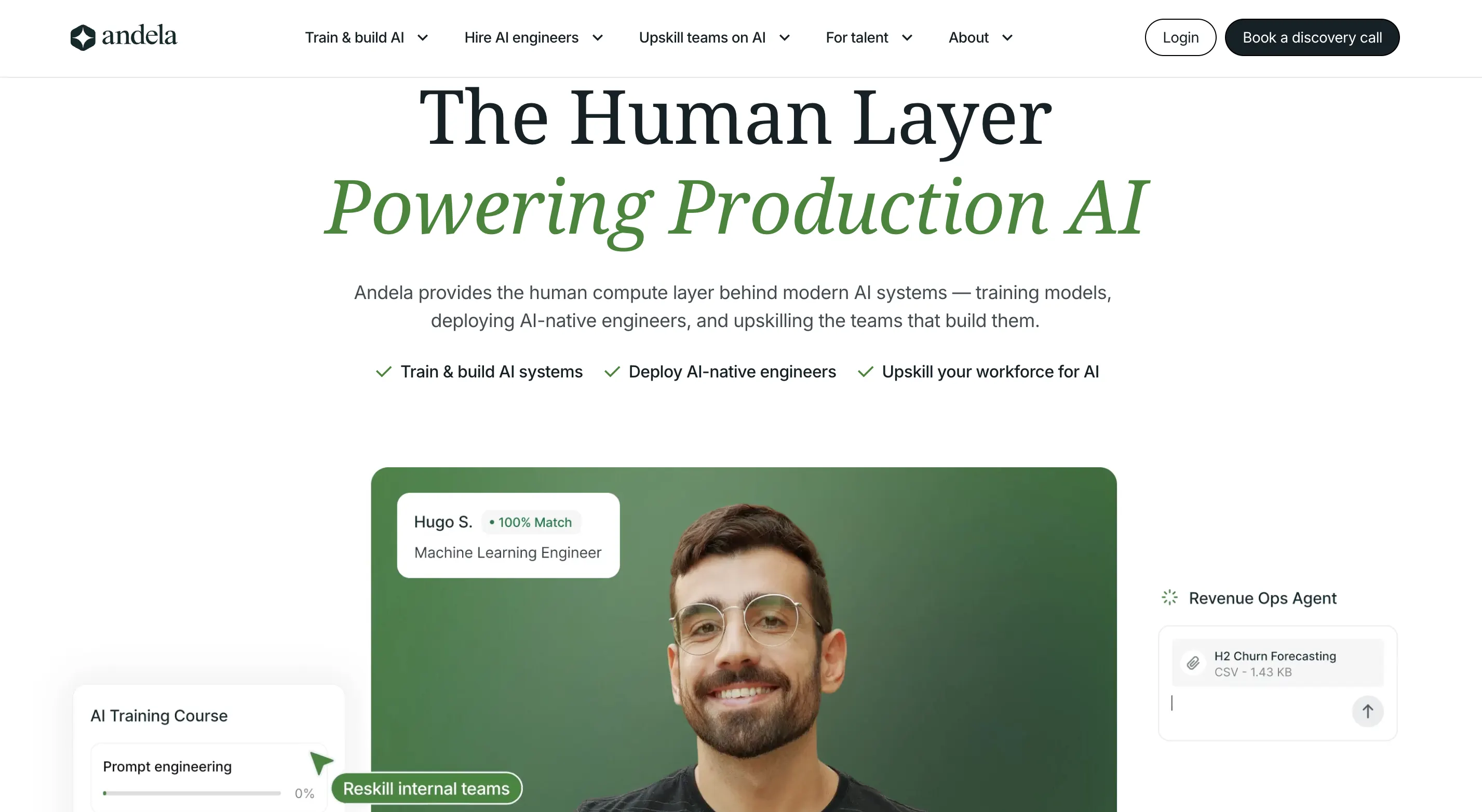
Website: andela.com
Headquarters: United States
Rating: 4.7/5 on G2 (110+ reviews) as of July 2026
Services: Global talent marketplace, vetted engineers, team scaling
Focus Regions: Global (including Latin America and Africa)
I included Andela on this list for their global scale: the marketplace connects companies with vetted remote engineers across regions, including Latin America and Africa, and supports scaling engineering teams quickly.
Their reach suits companies that want a large screened pool and are hiring across multiple time zones.
Key features:
- AI-powered matching across 150,000+ vetted technologists in 135+ countries, with a reported 96% match success rate.
- Multi-stage vetting covering English proficiency, live technical interviews, and 500+ real-world coding challenges.
- 15-business-day trial period, 90-day onboarding support, and contractor payments handled in 100+ countries.
Best for: Companies scaling engineering across regions that want a large vetted global pool.
Client perspective: “Andela has customers across the globe and talent from Andela is delivering high-quality work. The support team is also very responsible. The matches and delivery managers from Andela ensure the win both for talent and client.” — Customer review on G2
Limitations: Global reach means time zone overlap depends on which region you hire from. Less LatAm-specific than the region-focused platforms on this list.
Pricing: Not publicly listed; engagement-based.
{{consultation}}
How to Hire an Offshore Web Developer
Hiring an offshore developer takes careful planning and a structured process to get strong results. Here’s the step-by-step guide:
1. Define your objectives
Start by clearly outlining your project’s goals, technical requirements, and key deliverables. Specify the programming languages, frameworks, and tools necessary for the work.
A well-defined scope means developers understand your expectations before they start and can match their skills to what the project really needs. That prevents costly rework and misunderstandings later.
2. Research and shortlist recruitment platforms
Look into multiple platforms that specialize in connecting businesses with remote developers, like specialist developer recruitment agencies. Evaluate these providers based on customer reviews and case studies. Prioritize those with a strong track record in finding top talent similar to your requirements.
Skipping this step is how companies end up with a partner who can’t deliver the role.
Alternatively, you can also search for candidates yourself by using a self-service platform like Upwork.
3. Evaluate technical expertise and experience
Ask your recruitment partner for a shortlist of candidates or build a list from freelance marketplaces.
Whether you’re looking to hire a Squarespace developer or a full-stack engineer, evaluate potential candidates through interviews, coding tests, and work samples of their completed projects. If you’re working with a good recruitment company, they should do a lot of this for you, and we certainly do at Hire With Near.
Confirm their technical skills match your project’s stack and requirements, focusing on proficiency in the relevant tools and technologies.
Then assess their problem-solving approach and communication skills, since both shape how well they can work with your team.
4. Clarify costs and payment terms
Clarify hourly rates, payment schedules, and any additional fees upfront. This will prevent budget overruns and establish trust between you and your service provider or freelancer.
5. Discuss the project management methodology
Agree on a project management approach, whether agile, waterfall, or another methodology. This keeps collaboration smooth and progress reports on schedule.
6. Establish communication protocols
Tell candidates up front how you’ll work together: which tools you use (Slack, Jira, Linear, or whatever your team runs on), how often you’ll check in, and who owns updates and reporting. Set these expectations before day one, not after the first missed handoff.
Clear protocols matter more than time zone overlap alone. When both sides share habits around standups, feedback loops, and async updates, the relationship stays productive even when you’re not online at the same moment.
That said, the more real-time collaboration your work needs, the more a close time zone pays off: a question raised in a standup gets answered the same day, not the next morning.
7. Start small with a trial project
Start with a smaller, low-risk assignment to gauge the developer’s capabilities and workflow compatibility. Monitor their responsiveness, quality of work, and adherence to deadlines during this phase.
A trial project minimizes risks and provides valuable insights into the potential for a long-term collaboration.
8. Build a strong relationship
The developers who deliver the most over time are the ones who feel like team members, not vendors on a contract. That’s why treating onboarding seriously is so important: share context about the product, the codebase, and how decisions get made in the same way you would with a US hire.
Give feedback regularly, not just when something goes wrong. A quick “that PR was clean, nice work” carries more than most managers realize. It signals that you’re paying attention and that the relationship is two-way.
Finally, if the relationship is working, say so and show it with raises and expanded responsibility. The retention data on Latin American hires is strong, but retention isn’t passive. The developers who stay longest are the ones who feel invested in the outcome.
If you want a deeper walkthrough for this specific role, our guide on how to hire a web developer covers the full process step by step.
Related reading: Outsourcing to Website Developers: How to Find the Right Talent
How Much Does It Cost to Hire Offshore Web Developers?
The cost of hiring offshore developers varies significantly by region, influenced by living costs and market demand. According to Hire With Near’s 2026 State of LatAm Hiring Report, companies save 28–59% hiring software engineers in Latin America, and demand for the role grew 250% year over year.
- United States: Average annual salaries range from $55K to $147K, with higher costs offset by local market familiarity, proximity, and a straightforward legal framework.
- Latin America: Depending on seniority and stack, web developer salaries in Latin America run roughly $30K to $108K a year, combining strong talent with cultural compatibility and overlapping time zones for US businesses.
- Eastern Europe: Average annual rates range from $32K to $64K, offering high technical expertise and a growing reputation for innovation.
- Asia: Salaries are typically $8K to $45K annually, the lowest of any region, alongside a large talent pool.
The point isn’t finding the region that offers the cheapest developer. It’s getting senior talent on a mid-level US budget without the time-zone penalties that come with offshoring to Asia or Eastern Europe. Latin America gives you both.
The savings free you to reinvest in product, marketing, or other strategic areas, while the working-hours overlap means your team actually functions in real time.
Here’s what core web development roles cost in Latin America compared to equivalent US hires, according to Hire With Near’s salary benchmarks:
For the most up-to-date salary information, check our US vs. Latin America Salary Guide.
Final Thoughts
Hiring offshore web developers gives you access to skilled talent while controlling costs and scaling efficiently. The key is choosing the right region and partner for quality, communication, and cultural fit.
Latin America has emerged as the sweet spot for US companies. You get the budget advantages of offshore hiring without sacrificing real-time collaboration or dealing with major cultural barriers.
Developers in the region are skilled, the working hours overlap, and the cultural compatibility makes integration straightforward. If you want the full picture before you start, our guide to hiring remotely in Latin America walks through it.
If you want to explore hiring a web developer in Latin America, book a free consultation to talk through your specific requirements with our team. We’ll give you salary benchmarks and explain the process so you have the information you need to decide if it’s right for you.
Frequently Asked Questions
How do you vet an offshore web developer’s technical skills?
A reputable platform or staffing partner runs a real technical evaluation, work samples, a live or take-home coding assessment, and reference checks, before any candidate reaches you.
The screen that catches the “senior” developer who can’t ship in production is a hands-on one: reviewing actual code they wrote, watching them solve a problem in real time, and confirming past work with the people who managed it.
Ask any provider exactly what their screen includes and who does it. If the answer is vague, that is your signal to keep looking.
How long does it take to hire an offshore web developer?
Hiring an offshore web developer takes anywhere from a few days on a freelance marketplace to a few weeks through a vetted staffing partner.
On a marketplace like Upwork, you can contract a freelancer for a project within days, though the vetting is on you.
A vetted partner typically presents pre-screened candidates in a matter of days and fills the role in under three weeks, because the sourcing and technical screening are already done. Hire With Near, for example, delivers a shortlist within three to five days and closes most hires in under three weeks.
The slowest path is a direct overseas hire with a long notice period, which can stretch to months before the person starts.
Which countries are best for hiring offshore web developers?
For US companies, Latin America (Brazil, Mexico, Argentina, and Colombia) is the strongest region, because it pairs deep developer talent and strong business English with working hours that overlap your own.
Your Latin American hire is online during your business day, wherever your team sits in the US, so code review, standups, and debugging happen in real time.
Eastern Europe and Asia offer large talent pools too, but they trade away that overlap: a developer in those regions often ends their day as yours begins. If real-time collaboration matters, the region you choose matters more than the size of the pool.
Related reading: Discover the 22 Best Countries to Hire Remote Software Engineers and Developers
Is web development dead because of AI?
No, web development isn’t dead. AI has changed what developers spend their time on, not whether companies need them. AI tools can scaffold code, suggest fixes, and speed up routine work, but they still need a skilled developer to architect a system, review output for security and performance, integrate services, and make judgment calls a model can’t.
What has shifted is the bar: companies increasingly want developers who use AI tools well and can review what those tools produce. Demand for that skill set is climbing, not falling.
What other developer and tech roles can I hire from Latin America?
Companies across virtually every industry hire a wide range of developer and tech roles from Latin America, not just generalist web developers.
Beyond a website developer, US teams regularly hire a front-end developer, a full-stack developer, an e-commerce developer, and platform specialists like a WordPress developer or a Shopify developer. Hire With Near also places broader IT and tech talent in Latin America, from DevOps engineers to QA and data roles.
Latin American talent in these roles offers the same technical depth as US professionals, with better time-zone overlap than offshore alternatives and significant cost savings.
We tried offshore hiring before and the time-zone gap was a problem. Is Latin America different?
Yes, Latin America is different because the region works during US business hours, so you get real-time collaboration instead of overnight delays. A developer in Mexico, Colombia, Brazil, or Argentina is online when your team is online, wherever you sit in the US, which means live standups, same-day answers, and code review that doesn’t wait until tomorrow.
That is the opposite of a traditional offshore model in Asia, where a question sent in the afternoon waits a full day for a reply. If a distant time zone was what broke offshore hiring for you before, nearshore hiring in Latin America is a different model.
Our rundown of the questions tech leaders ask when hiring in LatAm goes deeper on how collaboration actually works day to day.







.webp)


%203.svg)
.avif)





%20(1).avif)

%20(1).png)