


%203.svg)
Key Takeaways
- A well-crafted marketing job description should clearly outline core responsibilities like campaign development, performance analysis, and cross-functional collaboration while avoiding generic buzzwords that fail to differentiate your role from competitors.
- Including specific qualifications (like platform expertise and proven campaign results) and a transparent salary range helps attract skilled marketing professionals who have the experience you need and fit your budget, saving you time on unsuitable applicants.
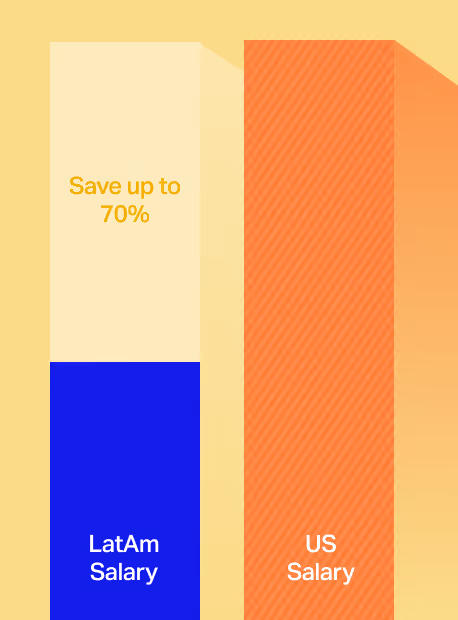
- For remote marketing positions, consider expanding your search to Latin America, where many professionals have strong marketing credentials, US business experience, excellent English skills, and salary expectations 30–70% lower than those of their US counterparts.
You’ve got a marketing role to fill and a blank page in front of you. You could copy the usual “rockstar marketer wanted” template, but you already know that’s not going to attract the kind of candidates you actually want.
The problem? Most marketing job descriptions sound the same and say very little. They list out a bunch of tools, throw in vague goals like “build brand awareness,” and somehow expect to attract strategic, results-driven professionals.
That disconnect is what slows down your hiring process and fills your pipeline with the wrong candidates—people who can check boxes but can’t level up your team.
This guide will show you how to write a job description that draws in the kind of marketers who can move the needle.
Why Job Descriptions Matter More Than You Think
Your marketing job description is your first opportunity to demonstrate that you understand marketing and can distinguish between genuine expertise and surface-level familiarity.
Here’s what a strategic job description accomplishes for your marketing hiring process:
Filters for strategic thinking over tactical execution
The best marketing professionals want to understand the bigger picture before they apply. Generic descriptions like “manage social media accounts” tell them nothing about your customer acquisition strategy, attribution models, or how marketing success gets measured at your company.
When you’re specific about strategic responsibilities—“develop multi-channel campaigns to reduce customer acquisition cost by 20% while maintaining lead quality”—you attract candidates who think about marketing as a business driver.
Signals your marketing sophistication
How you describe the role reveals how well you understand modern marketing. If your job description mentions “building brand awareness” but doesn’t specify measurement frameworks, performance metrics, or how marketing integrates with sales, experienced marketers will assume you’re still treating marketing as an art project rather than a science.
Speeds up your hiring process
A clear job description helps ensure applicants can actually handle complex campaign development, data analysis, and strategic planning. When candidates can quickly assess whether they have the analytical capabilities and strategic experience you need, you get better quality applications and fewer interviews that go nowhere.
What Makes a Great Job Description for Marketing Roles?
The difference between good and great marketing job descriptions comes down to demonstrating that you understand marketing as both a creative and analytical discipline.
Focus on outcomes, not activities
Great marketing job descriptions emphasize results over tasks. Instead of “create content for social media,” specify “develop a content strategy that increases qualified lead generation by 30% across LinkedIn and Instagram.” This shows you understand that marketing activities should drive measurable business outcomes.
Our recruiters frequently see this pattern: companies list extensive tactical skills but don’t explain how those tactics connect to broader business goals.
Balance creativity with analytics
Top marketing professionals want to know they’ll have both creative freedom and access to data that lets them optimize performance. The best job descriptions mention both the creative aspects (“develop compelling campaign concepts”) and the analytical requirements (“analyze performance data to optimize campaign ROI”).
Clear integration with business strategy
Top marketers want to understand how their work connects to revenue, growth, and business objectives. Great job descriptions explain how marketing fits into the broader company strategy and what success looks like from a business perspective.
This kind of clarity doesn’t have to be theoretical—here’s an example from a recent marketing job description we developed for a client hiring a Marketing Ops Developer.
It shows exactly how to position the role within the broader business context, clarify cross-functional expectations, and attract candidates who want to own outcomes:

This kind of framing helps candidates visualize what success looks like, why the role matters, and how they’ll directly impact business outcomes. That’s what attracts the right kind of talent.
What to Include in a Marketing Job Description
Creating an effective marketing job description requires balancing specificity with broad appeal. Here are the essential components that help you attract qualified marketing professionals while filtering out mismatched candidates.
Job title
Your title needs to be both searchable and specific enough to attract the right level of candidate. “Marketing Manager,” “Digital Marketing Specialist,” or “Content Marketing Manager” work better than creative titles like “Growth Hacker” or “Brand Evangelist.”
Summary of the role
Think of this as your elevator pitch to potential marketing candidates. In 2–3 sentences, capture what makes this marketing opportunity compelling:
- What marketing challenges they’ll solve and for what type of business
- How they’ll fit into your existing marketing and business development efforts
- What makes this opportunity different from other marketing roles
For example: “Join our growing marketing team to develop and execute integrated campaigns that drive qualified lead generation for our B2B software platform. You’ll own campaign strategy from concept through optimization, working closely with our sales team to ensure marketing-qualified leads (MQLs) convert effectively. This role is perfect for a data-driven marketer who wants to directly impact revenue growth in a collaborative environment.”
This immediately tells candidates about the marketing focus, measurement expectations, cross-functional requirements, and company culture.
Key responsibilities
Be specific about the actual work, not generic marketing tasks. Our recruiters find that candidates respond best when they can understand both the strategic and tactical aspects of the role.
Good examples:
- Develop and execute multi-channel campaigns across paid search, social media, and email to generate 500+ qualified leads per month
- Analyze campaign performance data using Google Analytics and HubSpot to optimize conversion rates and reduce customer acquisition costs
- Create content strategy for blog, social media, and email that supports lead nurturing and customer retention objectives
- Collaborate with sales team to develop MQL criteria and ensure smooth handoff processes
- Manage marketing automation workflows that nurture prospects through the customer journey
Avoid vague statements like “manage marketing campaigns.” Be concrete about what they’ll actually be creating, measuring, and optimizing.
Required skills and qualifications
This is where many companies go wrong by listing every possible marketing skill they’ve ever heard of. Focus on what’s truly essential for success in the first 90 days.
Essential qualifications typically include:
- Specific years of experience in B2B or B2C marketing (be realistic about your expectations)
- Required platform proficiency (HubSpot, Google Ads, Facebook Ads Manager, etc.)
- Analytical skills with specific tools (Google Analytics, Excel, SQL, etc.)
- Proven track record of campaign performance (be specific about metrics)
Our recruiters note that companies often overvalue specific tool experience when strategic thinking and analytical capabilities matter more. Many marketing platforms can be learned relatively quickly if someone understands fundamental marketing principles.
Preferred qualifications
This is where you can mention nice-to-have skills that would help someone excel but aren’t deal-breakers:
- Experience with additional marketing tools in your stack
- Previous experience in your specific industry vertical
- Knowledge of particular marketing methodologies (growth hacking, account-based marketing, etc.)
- Additional skills like basic design or copywriting abilities—especially for smaller teams—can also be a plus
Salary range
Including salary information isn’t just helpful—it’s becoming legally required in many states and shows you’re serious about attracting qualified candidates.
According to SHRM research, 80% of candidates are more likely to apply if the salary range is listed in a job description.
When listing compensation:
- Provide a realistic minimum and maximum that reflects what you’re prepared to offer
- Clarify if the range varies based on experience, role level, or location
- Be transparent about any variable components (performance bonuses, commission structures)
- Use “depending on experience” thoughtfully while still providing meaningful information
For example: “Salary range: $65,000–$85,000 depending on experience and location, plus performance-based bonuses tied to lead generation and campaign ROI targets.”
Location and work setup
Be explicit about where marketing work gets done, especially since many marketing roles can be performed remotely:
- For on-site roles: Include the specific city and office location. Mention any flexibility for remote work during campaign planning or analysis periods.
- For hybrid roles: Specify expectations for in-office time, team meetings, and any client interaction requirements if you are an agency.
- For remote roles: Clarify geographical restrictions, time zone requirements for team collaboration, and customer interaction expectations.
Tools and marketing stack
Give marketing professionals a clear picture of their daily toolkit:
- Marketing automation platform (HubSpot, Marketo, Pardot, etc.)
- Analytics and measurement tools (Google Analytics, Adobe Analytics, etc.)
- Advertising platforms (Google Ads, Facebook Ads Manager, LinkedIn Campaign Manager)
- Content creation and design tools (Canva, Adobe Creative Suite, etc.)
- CRM integration and lead management systems
Focus on tools they’ll use frequently rather than creating an exhaustive list of every marketing technology in your environment.
Team structure and collaboration
Marketing professionals want to understand how they’ll work with other departments and how marketing decisions get made:
- Marketing team size and reporting structure for the role
- Collaboration with sales, product, and customer success teams
- How marketing performance gets measured and reported
Growth and learning opportunities
Top marketing professionals are motivated by continuous learning and career advancement. Mention:
- Opportunities to work with new marketing channels or technologies
- Conference attendance or professional development budgets
- Career advancement paths
- Cross-functional project opportunities that expand skill sets
Common Mistakes to Avoid in Your Marketing Job Descriptions
These pitfalls can significantly hurt your ability to attract quality marketing talent:
Combining too many specializations into one role
The biggest mistake we often see is that companies try to combine everything they need into one role, expecting a single person to handle all marketing-related tasks. They come thinking that all those responsibilities can be covered by just one person, but there’s often a knowledge gap about what marketing roles actually entail.
Focus on 2–3 core areas where you truly need expertise, rather than asking for someone who can handle everything from SEO to paid advertising to content creation to event marketing. It’s tempting to try and find one person to do it all—especially for budget-conscious or early-stage companies—but this often leads to burnout or disappointing performance.
(If budget is what’s driving you to combine multiple roles into one, there’s a smarter way to scale. Offshore hiring can give you access to top-tier marketing talent for a fraction of US rates without sacrificing quality.)
Vague success metrics
Statements like “increase brand awareness” or “drive growth” without specifics create confusion about what success actually looks like. Marketing professionals want to understand how their work will be measured and what targets they’ll be expected to hit.
Underestimating the importance of analytical skills
While creativity is important, don’t overlook the analytical capabilities that separate good marketers from great ones. Modern marketing requires constant testing, measurement, and optimization based on data.
Our recruiters frequently see companies focus too heavily on years of experience when analytical thinking and results-driven approach matter more.
Limiting your search unnecessarily
If the role can be done remotely, restricting your candidate pool to one city or region significantly reduces your options. Marketing is increasingly location-independent, and expanding your search to include remote marketing talent can dramatically increase your candidate pool while reducing hiring costs.
Many US companies are discovering that top LatAm marketing professionals often have experience working with US companies, strong English communication skills, and competitive marketing abilities, while having salary expectations significantly below US market rates.
{{state-latam-hiring}}
How to Make Your Marketing Job Description Stand Out
The best marketing candidates are evaluating whether your company understands modern marketing and offers genuine growth opportunities.
Here’s how to differentiate your job posting and appeal to high-performing marketing professionals:
Lead with the marketing challenge
Strong marketers are motivated by interesting problems. Start your job description by highlighting what makes the marketing work technically compelling:
“We’re scaling our customer acquisition from 100 to 1,000 new customers monthly while maintaining our current 15% conversion rate and $50 customer acquisition cost. You’ll build the marketing systems and processes that make this growth sustainable.”
This immediately attracts candidates who want to work on meaningful marketing challenges rather than just execute routine campaigns.
Be specific about your marketing culture
Rather than generic statements about “collaborative environment,” describe how your marketing team actually operates:
“Our marketing team values data-driven decision making, rapid experimentation, and cross-functional collaboration. We run 3–5 campaign tests monthly, analyze results weekly, and adjust strategy based on performance data rather than assumptions.”
This helps candidates assess cultural fit and attracts marketers who appreciate mature marketing practices.
Highlight measurement and growth opportunities
Top marketing professionals want to continuously improve their skills and see clear career progression. Be specific about learning opportunities:
“You’ll have access to marketing conferences, certification programs, and our internal marketing training library. As we grow the marketing team from 3 to 8 people this year, there will be opportunities to mentor junior marketers and potentially lead specialized marketing functions.”
Show the business impact
Connect marketing work to business outcomes rather than just marketing metrics:
“The campaigns you develop directly impact our revenue growth—every 100 MQL you generate typically converts to $50,000 in new monthly recurring revenue. You’ll see how your marketing work translates to business results.”
Address compensation competitively
If you can’t match the highest market rates, be honest about other forms of value:
“While we’re not the highest-paying company in marketing, we offer significant professional development opportunities, flexible working arrangements, and the chance to build marketing programs from the ground up as we scale.”
{{prevetted-banner}}
Sample Marketing Job Description (Ready to Customize)
[Digital Marketing Manager]
About us: [Company Name] is [brief description of company and what you do]. We’re [current stage, e.g., growing rapidly, scaling our marketing efforts, expanding into new markets] and need a [level of experience] marketing professional to [specific goal, e.g., help us reach $XM in revenue, expand our customer base, optimize our acquisition funnel].
The role: We’re looking for a [specific type of marketer, e.g., data-driven growth marketing manager, creative campaign developer, analytical performance marketer] to [specific responsibility, e.g., own our digital acquisition strategy, develop our content marketing engine, optimize our paid advertising performance].
You’ll work with [lead sources, e.g., paid advertising budgets, inbound content strategy, email marketing database] while [additional responsibility, e.g., collaborating with sales, developing new channel strategies, optimizing conversion funnels].
This role is perfect for a [ideal candidate description] who wants to [opportunity/growth potential] in a [company culture/environment] environment.
What you’ll do:
- [Specific responsibility with numbers, e.g., “Develop and execute paid advertising campaigns across Google and Facebook that generate 300+ qualified leads monthly”]
- [Specific responsibility with metrics, e.g., “Analyze campaign performance data to maintain customer acquisition costs below $75 while improving lead quality scores”]
- [Content/creative responsibility, e.g., “Create content strategy for blog and social media that supports lead nurturing and drives 25% of our MQLs”]
- [Collaboration responsibility, e.g., “Work with sales team to optimize lead handoff processes and improve marketing-to-sales conversion rates”]
- [Analytics/optimization responsibility, e.g., “Use Google Analytics and HubSpot to track customer journey performance and identify optimization opportunities”]
- [Additional 2–3 core responsibilities specific to your marketing needs]
What you’ll need:
- [Years of experience] years of [type of marketing, e.g., B2B digital marketing, performance marketing, content marketing] experience
- Proven track record of [specific achievement, e.g., managing $X monthly ad spend, generating X% conversion rate improvements, growing organic traffic]
- Proficiency with [required tools, e.g., Google Ads, HubSpot, Google Analytics, Facebook Ads Manager]
- Experience with [target market, e.g., B2B SaaS, e-commerce, professional services] marketing
- [Any industry-specific requirements that are truly necessary]
Nice to have:
- Experience with [additional tools or platforms that would be helpful]
- Previous experience in [your industry or adjacent industries]
- Knowledge of [specific marketing methodologies, e.g., growth hacking, account-based marketing, marketing automation]
- [Additional skills like design, copywriting, or technical abilities]
Compensation & benefits:
- Salary range: $[X,000–Y,000] annually [based on experience/location]
- [Performance bonus structure if applicable, e.g., “Plus quarterly performance bonuses based on lead generation and campaign ROI”]
- [Key benefits: health insurance, PTO, professional development budget, etc.]
Marketing stack:
- [Marketing automation platform, e.g., “HubSpot for lead management and email marketing”]
- [Analytics tools, e.g., “Google Analytics and Data Studio for performance tracking”]
- [Advertising platforms, e.g., “Google Ads and Facebook Ads Manager for paid acquisition”]
- [Content tools, e.g., “Canva and Adobe Creative Suite for content creation”]
- [Any specialized tools they’ll need to learn]
Location & schedule:
- [Remote/Hybrid/On-site] position
- [Time zone requirements, e.g., “Core hours: 10 AM – 3 PM EST for team collaboration”]
- [Any travel requirements if applicable, e.g., “Occasional travel for conferences or client meetings”]
- [Any specific schedule needs, e.g., “Flexibility for campaign launches and performance monitoring”]
Growth opportunities:
- [Career advancement paths, e.g., “Clear path to Senior Marketing Manager with team leadership responsibilities”]
- [Professional development, e.g., “$2,000 annual budget for conferences, courses, and certifications”]
- [Leadership opportunities, e.g., “Opportunity to mentor junior marketers as we scale the team”]
- [Company growth story, e.g., “Join us as we scale from $2M to $20M ARR over the next 3 years”]
How to apply: Send your resume to [email/application link] and include:
- [Specific information you want, e.g., “Examples of campaigns you’ve managed and their performance results”]
- [Portfolio or case study request, e.g., “One detailed case study of a marketing campaign you’re particularly proud of”]
- [Motivation question, e.g., “Why you’re interested in marketing for [your industry/product type]”]
Our hiring process includes: [Brief overview of your interview stages, e.g., “Initial call → Portfolio review → Marketing strategy discussion → Final interview with leadership”]
[Timeline information, e.g., “We’ll review applications on a rolling basis and aim to respond within 48 hours.”]
Final Thoughts
A thoughtfully crafted marketing job description connects you with marketing professionals who can truly drive growth for your business.
By being clear about success metrics, honest about your marketing sophistication level, and realistic about the scope of responsibilities, you’ll save yourself from reviewing piles of unqualified applications and speed up your entire hiring process.
The reality is that top marketing talent exists globally, not just in your local market. While you’re competing with every other company for US talent, there are experienced, results-driven marketing professionals in Latin America who have the strategic thinking you need, the analytical skills you want, and salary expectations that fit your budget.
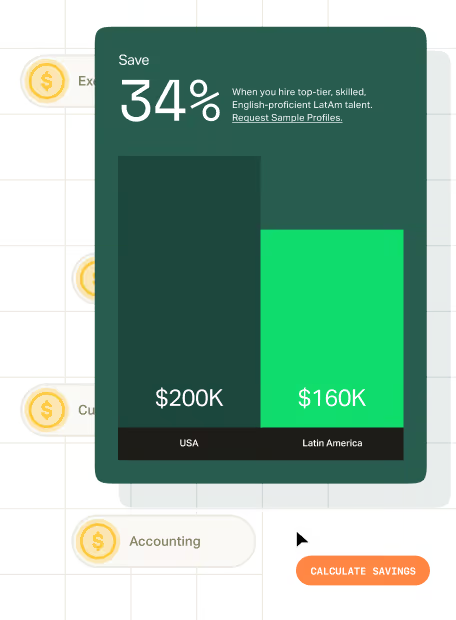
Before you post that job description and limit yourself to local hiring, consider this: building a high-performing marketing team for 68% less isn’t just about cost savings. It’s about accessing the caliber of talent you need to grow.
To see exactly the kind of savings you could realize, check out our Marketing Roles Salary Guide: US vs. Latin America to compare typical salary ranges and understand how global hiring could stretch your marketing budget further, without compromising on quality.
Frequently Asked Questions
What’s better: hiring a marketing generalist or a specialist?
This depends on your business stage and marketing maturity. Early-stage companies often need generalists who can wear multiple hats—someone who can write content, manage social media, run basic paid ads, and analyze performance across channels.
More established companies typically benefit from specialists who can dive deep into specific areas like SEO, paid advertising, or marketing automation.
Our recruiters see companies struggle when they try to find a “unicorn” candidate who’s expert-level in everything from content creation to advanced analytics to paid media management. Be realistic about whether you need breadth or depth, and consider building a team with complementary specializations rather than expecting one person to be world-class at every marketing discipline.
How do I assess cultural fit for remote marketing roles?
Cultural fit isn’t about whether someone would be fun to grab a coffee with. It’s about how they work, communicate, and make decisions. For remote marketing roles, look for candidates who are proactive, self-directed, and comfortable with asynchronous collaboration. Ask how they prefer to receive feedback, how they stay aligned across time zones, and how they’ve handled shifting priorities in the past.
The goal is to understand whether they’ll thrive in your specific work environment.
Need help knowing what to ask?Use these 10 effective interview questions for remote marketing professionals to uncover communication styles, collaboration habits, and work values that go beyond the resume
How specific should I be about marketing tools and platforms?
Mention your core platforms but don’t get obsessed with exact tool experience.
For example, if you use HubSpot, mention it, but don’t reject candidates who have similar experience with Marketo or Pardot. Many marketing platforms can be learned relatively quickly if someone understands fundamental marketing principles and has worked with similar tools.
Focus more on whether they’ve managed comparable responsibilities—like email campaign management, lead scoring, or attribution tracking—regardless of the specific platform. The exception is highly technical roles where platform expertise is genuinely mission-critical to immediate productivity.
When should I consider hiring offshore marketing talent?
If you’re struggling to find qualified candidates, keep losing top talent to bigger budgets, or need to scale your team without overspending, it’s time to consider hiring offshore. Many marketing roles can be done just as effectively by remote professionals based in countries with strong marketing expertise, high English proficiency, and better cost efficiency.
Offshore hiring isn’t just a stopgap. It can be a long-term strategy to build a high-performing team without burning through your budget. Whether you’re looking for an email marketing specialist, content writer, or Google ads expert, the right hire might not be local—but they’ll still feel like part of your core team.
Curious where to look first?Here’s a breakdown of the best countries to hire remote marketing talent.
What industries hire marketing talent?
Marketing professionals are hired across virtually every industry. Any business that needs to attract customers, build a brand, or drive growth needs people who can do that work effectively.
Creative agencies and studios hire marketers to grow their own business pipelines alongside delivering client work. Customer service businesses use marketing to drive acquisition, build loyalty programs, and manage brand reputation. AI and machine learning companies need marketers who can communicate complex products clearly and build awareness in fast-moving, competitive categories.
Administrative services firms, from staffing companies to outsourced operations providers, rely on marketing to generate leads and stand out in crowded markets.










%203.svg)
.avif)





%20(1).avif)

%20(1).png)