%203.svg)
Key Takeaways
- Hiring offshore SEO talent typically means sourcing from Latin America, where you access the same quality at 52–68% of a US salary. Unlike India or the Philippines, LatAm specialists work in your time zone, making real-time collaboration possible.
- SEO specialists in Latin America earn an average of $33,000 annually compared to $74,500 in the US (a 56% savings), and LatAm-based hires stay 66% longer than US equivalents, meaning the cost advantage compounds over time.
- Working with a specialist nearshore staffing partner reduces hiring timelines from 2–3 months to 2–4 weeks, handles compliance and payroll, and provides pre-vetted candidates screened for both traditional SEO skills and AI-powered search fluency.
Hiring offshore SEO talent means finding a full-time specialist outside the US, in locations where you can access the same quality at 52-68% of a US salary. It's a practical solution for companies that need someone to own keyword strategy, technical execution, and increasingly, visibility in AI-powered search.
But the role you're hiring for isn't what it was two years ago. Modern SEO now requires professionals who understand how to show up in AI-powered results, earn citations in LLMs like ChatGPT and Claude, and adapt strategy for a world where more searches end without a click.
With 75% of US employers reporting difficulty finding skilled candidates, according to ManpowerGroup, hiring domestically is slow and costly. The offshore option, India or the Philippines, solves the budget problem but creates another: A 12–15 hour time zone gap that breaks down the real-time collaboration good SEO requires.
That's why more US companies are turning to a third path: Latin America.
This guide covers everything about how to hire offshore SEO talent: The key benefits, what it costs, how to evaluate candidates for both traditional and AI-driven search, and exactly what steps to take.
What Does an Offshore SEO Specialist Do?
An offshore SEO specialist manages the work that drives organic search visibility for your website: Keyword research, on-page optimization, technical audits, link building, content strategy, and analytics reporting. The only difference is that they're working from a different country.
Day to day, they're identifying ranking opportunities, fixing crawl issues, optimizing page structure, building backlinks, and measuring results across tools like Google Search Console, Ahrefs, and Semrush.
Modern SEO specialists should also be versed in how AI-powered search engines work. That means understanding answer engine optimization (AEO), how large language models surface content, and how to capture visibility in zero-click search results where users get answers directly in Google's AI Overviews without clicking through.
Before hiring, it helps to know which type of SEO professional you actually need:
- SEO specialist: Executes keyword research, on-page optimization, and technical fixes. Best for companies with an existing content program that needs disciplined execution.
- SEO manager: Oversees SEO strategy, manages content calendars, and coordinates across teams. Best for companies scaling an SEO program.
- Technical SEO specialist: Focuses on site architecture, crawlability, Core Web Vitals, and schema markup. Best for sites with structural performance problems.
- SEO copywriter: Writes optimized content for target keywords. Best paired with an SEO specialist who handles strategy.
What Are the Benefits of Hiring Offshore SEO Talent?
Hiring offshore SEO talent delivers three primary advantages: Significant cost savings compared to US hires, access to specialized professionals who understand both traditional SEO and emerging AI-powered search requirements, and greater operational flexibility to scale your team based on business needs.
Tapping into the global SEO talent pool can significantly boost your digital marketing efforts while optimizing costs. Below are the primary benefits.
Cost savings
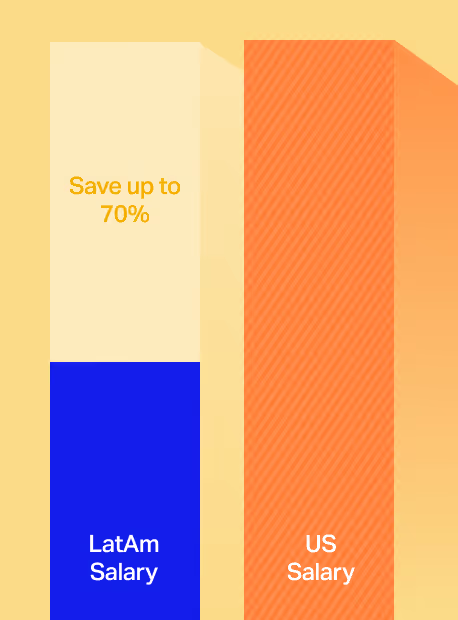
Labor costs in countries like India, the Philippines, and Latin America are considerably lower than in the US. According to Hire With Near's State of LatAm Hiring Report, which analyzed over 2,000 placements, SEO specialists in Latin America earn an average of $33,000 annually compared to $74,500 in the US, a 56% cost savings. This allows you to hire at a higher experience level than you may be able to afford domestically.
You can access high-quality SEO services like keyword research and link building at a fraction of the cost, freeing up budget for other critical operations or investments.
{{salary-guide-cta}}
Access to specialized SEO skills
Offshore markets have deep pools of highly specialized SEO talent. These professionals stay current with the latest trends and technologies, including AI-powered search, LLM visibility, and zero-click optimization, because working with US clients requires it.
By hiring SEO specialists in offshore locations, you tap into this expertise and ensure your SEO strategies are built for both traditional search and the channels where your audience is increasingly finding you.
Focus on core business activities
When you delegate SEO work to offshore specialists, your in-house team can focus on core business functions that directly impact your bottom line. The specialist owns the SEO program, while your team focuses on growing the business.
Faster time-to-fill than US hiring
Urgent SEO needs, like penalty recovery, site migrations, new content programs, can’t wait six months for a hire. Most SEO roles filled through Hire With Near are placed in 7–28 days, compared to the 3–6 month average for US equivalents. That speed advantage is meaningful when organic search is actively underperforming and every week without a fix costs you traffic.
Mid- and senior-level talent, not junior labor
A common misconception about offshore hiring is that you're getting junior-level support. Hire With Near's 2026 State of LatAm Hiring Report tells a different story: 84% of placements in 2025 were mid-level or senior positions, including SEO/SEM directors and strategists.
These are experienced professionals who deliver strategic value while still saving you 40–56% over their US counterparts.

Greater ability to scale operations
Scaling your marketing function is simpler when you have access to a broad talent pool. You can hire offshore SEO talent as needed to support growing demands, whether expanding into new markets, increasing content production, or enhancing technical SEO.
Rankings.io, an Inc. 5000 digital marketing agency specializing in SEO for law firm, hired 11 roles through Hire With Near, including multiple SEO specialists, and saved $463,000 annually (a 54% cost reduction) while reducing time-to-hire to three weeks.
Gillian Alvillar, Human Resources Director at Rankings.io, shared:
When I check with the department managers, they all say, 'It's like 100 out of 10.' The talent we've brought in through Hire With Near has been professional, articulate, intelligent, and absolutely the right fit for our team.
How Much Does It Cost to Hire an Offshore SEO Specialist?
The average SEO specialist based in Latin America earns $33,000 annually, compared to $74,500 for a US-based specialist, representing a 56% savings, based on Hire with Near's 2026 State of LatAm Hiring Report.
The table below shows salary ranges by level and role, based on current compensation benchmarks:
The cost advantage compounds over time. LatAm-based hires stay 66% longer than US hires. That means you're not just saving on salary, you're also saving on the cost of turnover and re-hiring.
For a broader salary context across all marketing roles, see Hire With Near's salary guide.
Ready to see candidates? Browse Hire With Near's SEO specialists and get video shortlists in 3–5 days.
How Do You Overcome the Challenges of Hiring Offshore SEO Professionals?
The three main challenges when hiring offshore SEO professionals are time zone differences, communication barriers, and compliance complexity. All three can be addressed through strategic planning.
Nearshoring to Latin America eliminates most time zone issues. Focusing on countries with high English proficiency (Argentina, Mexico, Colombia) makes communication clear and productive. Partnering with specialist staffing firms handles compliance and legal requirements, cutting hiring timelines from 2–3 months to 2–4 weeks.
Time zone differences
One frequently cited challenge is time zone gaps making real-time communication and collaboration difficult. Research from Harvard Business School and INFORMS found that each additional hour of time zone difference reduces real-time communication by 11%.
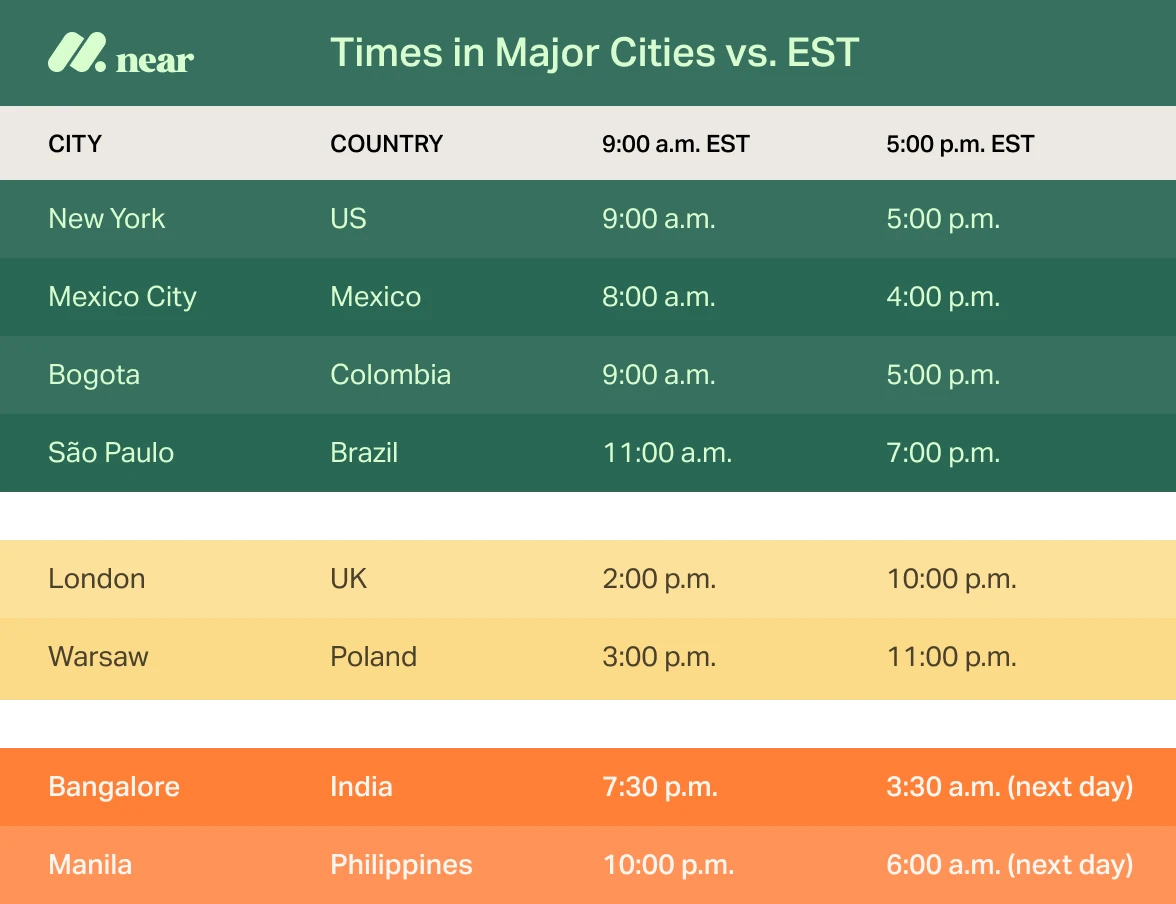
That finding helps explain why nearshore LatAm teams consistently outperform offshore Asia teams on collaboration-heavy roles like SEO, where keyword strategy, content review, and reporting require frequent back-and-forth.
According to Hire With Near's analysis of 2,000+ hiring conversations, 30% of US companies switching to LatAm are specifically leaving offshore regions like Asia because of time zone misalignment. One client put it plainly:
We're prioritizing LatAm now because for the roles we need at the moment we want them to work in tandem with our US hires as opposed to off hours. We'd rather they work at the same time.
In the short video below, Hire With Near's COO Franco Pereyra explains what the time zone gap looks like in practice and why a 1-2 hour adjustment in LatAm is a fundamentally different problem than a 12-hour gap with Asia:
Solution: Schedule overlapping work hours wherever possible. Use project management and communication tools to maintain alignment. Nearshoring to Latin America eliminates most of this friction.
Communication barriers
Language differences and varying English proficiency levels can sometimes lead to misunderstandings.
Solution: Establish clear communication protocols. Use simple, concise language and confirm understanding regularly. For nearshore hiring, prioritize countries with strong English proficiency, like Argentina, Colombia, and Mexico for LatAm.
In Asia, the Philippines is an alternative, but it carries the time zone drawbacks that make offshore hiring frustrating in the first place.
Cultural differences
Cultural disparities can affect work styles, expectations, and mutual understanding. Communication norms around directness, feedback, and hierarchy vary by region, and in a role like SEO, where strategy discussions and content direction require ongoing back-and-forth, those differences can slow things down if they're not accounted for upfront.
Solution: Foster an inclusive company culture that values diverse working styles. For SEO specifically, cultural alignment matters more than many hiring managers expect.
Natasha Tarapow, Senior Recruiter at Hire With Near, has seen this pattern across hundreds of placements:
The problem companies have with hiring in India isn't technical ability. It's cultural fit. They take a long time to answer Slack messages, they don't notify their managers about what they're working on. In Latin America, we found that talent is not that way. We're very communicative. People really try to go above and beyond in their jobs.
Quality control
Ensuring high work quality can be challenging when team members are geographically dispersed. SEO work is particularly exposed to this risk: Keyword strategies, content briefs, and technical recommendations all require a level of judgment and context that's hard to verify from a job title or resume alone.
Without a structured vetting process, you may not discover the gaps until rankings drop.
Solution: Implement rigorous vetting and interview processes to select highly skilled professionals. Set clear performance metrics and expectations from the start and use regular check-ins and project reviews to monitor progress and provide feedback.
Legal and compliance issues
Navigating different labor laws and regulatory requirements presents complex challenges when hiring offshore talent. Each country has its own rules around contracts, taxes, intellectual property, and termination.
Solution: Seek guidance from legal professionals experienced in international employment law. Use recruitment firms to keep your hires compliant with local regulations. Draft contracts that clearly outline terms, responsibilities, and expectations.
Further reading: A Comprehensive Guide to Hiring Remote Foreign Employees
Data security
Sharing sensitive information across borders may raise security concerns. SEO work often involves access to Google Analytics, Search Console, CMS platforms, and proprietary content strategies, and without clear data handling agreements and access controls in place, that exposure can be difficult to manage from a distance.
Solution: Use secure communication channels and project management tools. Implement strong cybersecurity measures. Make sure offshore teams adhere to company data protection policies and industry standards.
Why Should You Work with a Specialist Staffing Partner for Offshore SEO Hiring?
Knowing how to hire offshore SEO talent independently is possible, but the three biggest barriers, legal compliance, payroll management, and candidate vetting, make it harder than it needs to be.
Navigating international labor laws, managing payroll across borders, handling compliance requirements, and vetting candidates in unfamiliar markets create an overwhelming administrative burden that a specialist SEO staffing and recruitment partner can take off your plate.
Compliance and legal expertise
A specialist international recruitment partner has the legal infrastructure and expertise to handle complex labor laws and tax regulations, keeping your hires compliant from day one.
This eliminates costly legal mistakes and lets you focus on building your team rather than trying to understand foreign regulations.
Simplified payroll and benefits administration
Managing international payroll, currency conversions, benefits packages, and tax withholdings across multiple countries is time-consuming and error-prone.
Staffing partners handle all administration, providing a single point of contact for payroll processing while keeping your SEO specialists on competitive, locally appropriate compensation packages.
Pre-vetted candidate pools
Rather than sifting through hundreds of resumes from unfamiliar markets, recruitment partners provide access to pre-vetted candidates already screened for SEO skills, English proficiency, and cultural fit. This dramatically reduces time-to-hire and improves candidate quality.
For SEO roles specifically, that vetting should go beyond a resume check. Strong partners assess real-world impact: Whether a candidate has truly moved rankings, recovered traffic after a penalty, or built a content program from scratch.
That's the difference between a hire who can talk about SEO and one who can deliver results from day one.
{{prevetted-banner}}
Faster time-to-hire
Independent offshore hiring typically requires 2–3 months or longer. Specialist staffing partners can reduce this timeline to 2–4 weeks by drawing on existing talent networks, pre-built intake and vetting processes, and market expertise.
For instance, R/nd, a branding and digital strategy agency, hired a senior SEO strategist through Hire With Near and reduced their hiring timeline to two weeks. They ended up saving 60% on overhead costs, equivalent to $175,000 annually.
Their co-founder and CEO, Drew Prescott, noted:
Near not only helped us navigate the hiring process, but fundamentally changed our approach to building our team. Their ability to connect us with high-quality, dedicated talent has been invaluable.
Ongoing support and risk mitigation
Quality staffing partners don't disappear after placement. They provide ongoing support to make sure the hire integrates well, handle administrative issues that come up, and often offer replacement guarantees if hires don't work out. This reduces risk and supports long-term success.
By working with a nearshore specialist staffing partner, you gain access to offshore SEO talent without the administrative headaches, legal risks, or time investment required for independent hiring.
Step-by-Step Process for Hiring Offshore SEO Talent
Following a structured process is the most reliable way to hire the right SEO professional for your team. Here are eight steps to get from goal to hire, whether you're looking to hire an SEO specialist remotely or through a nearshore staffing partner.
1. Define your SEO goals
Start by clarifying what you need this hire to accomplish. A specialist who excels at technical audits is a different hire from one who builds content programs.
Setting specific goals, like improving rankings for core keywords, recovering from a Google penalty, or scaling content production, helps you identify the right seniority level and skill set.
Our guide to writing job descriptions for SEO roles covers the key skills to include.
2. Choose your hiring approach
The most consequential decision when you hire an SEO specialist remotely is whether to go independently or through a staffing partner.
Independent hiring through job boards typically takes 2–3 months and requires you to navigate international compliance on your own.
A specialist recruiting partner cuts that timeline to 2–4 weeks and handles the compliance work. For most companies, the time savings alone justify the partnership fee.
If you're still weighing which region to hire from, our guide on hiring offshore SEO talent from LatAm vs. India vs. the Philippines breaks down the key differences.
3. Verify credentials and track record
Examine candidates' experience and references before moving to interviews. Check portfolios, client testimonials, and case studies to assess the quality and measurability of their past work. Look for specific, measurable outcomes like traffic growth, ranking improvements, or penalty recoveries, not just a list of responsibilities.
4. Assess technical skills and cultural fit
Interview shortlisted candidates and conduct assessments that evaluate SEO knowledge, problem-solving ability, and technical depth. Ask about specific projects, not general approaches.
Our recruiting team has found that a few questions reveal a lot:
- “Walk me through a specific SEO project you owned: What was the goal, what did you do, and what were the results?” A strong answer demonstrates tools, judgment, and hands-on execution. Candidates who list many tools but can’t speak to specific results are a red flag.
- “How do you approach a site that has lost significant organic traffic after a Google update?” Reveals diagnostic thinking and whether the candidate stays current.
- “How do you optimize content for AI-powered search, not just traditional Google?” A 2026 must-ask. Strong candidates will speak to answer engine optimization (AEO), zero-click results, and LLM surfacing.
- “How do you communicate progress and blockers with a remote US-based team?” Assesses English fluency, async habits, and proactivity. This question also evaluates English proficiency and alignment with your team's communication style.
Structured interviews, where every candidate is asked the same questions in the same order, are better predictors of job performance than unstructured ones. The questions above are designed with that in mind.
Use them consistently across all candidates so you're comparing like for like, not just going with whoever made the best impression in conversation.
5. Discuss budget and set salary expectations
Have open conversations about budget and payment terms upfront. Use current compensation benchmarks as a reference point and make sure there are no hidden costs.
Clarify whether the fee covers payroll, compliance, and any replacement guarantees before you sign anything. Payment structures should be transparent from the first conversation, not buried in a contract.
For a full breakdown of what SEO and marketing roles cost in LatAm versus the US, see our marketing roles salary guide.
{{latam-hiring-calculator}}
6. Set expectations and deliverables
Define expectations, roles, and deliverables before the hire starts. Agree on key performance indicators, reporting cadence, and how you'll measure success in the first 30, 60, and 90 days.
Cover contract terms, confidentiality, and performance standards at this stage. Legal review is recommended for international contracts.
7. Onboard with tools and access
A good onboarding process sets the tone for the entire working relationship. Provide access to your SEO tools, analytics platforms, Google Search Console, and project management systems.
Make sure your new hire understands your existing content program, target audiences, and current ranking priorities before they start executing.
8. Monitor performance with regular check-ins
Track performance against the KPIs you set in Step 6. Use analytics tools and frequent check-ins to evaluate progress and course-correct early.
Regular communication keeps the work on track and lets you build on what's working.
How to Choose the Right SEO Staffing and Hiring Partner
Choosing the right SEO staffing and hiring partner requires more than comparing prices. The most common failure point in offshore hiring isn't cost or technical skill: It's communication and cultural fit. A quality staffing firm screens for both explicitly.
Look for a partner who can demonstrate knowledge of both traditional SEO and LLM/AI optimization requirements (so candidates are evaluated against current skill standards), and a proven process for vetting English proficiency and US workplace alignment, not just technical skills.
Here's a practical framework for evaluating and comparing SEO staffing partners:
What Skills Should You Look for in an Offshore SEO Specialist?
The right offshore SEO hire combines technical execution with strategic judgment. For US-facing roles, cultural fluency with US search behavior matters too.
Here is a checklist of the main skills to evaluate:
- Keyword research and strategy: Proficiency with Ahrefs, SEMrush, or Moz; ability to build keyword clusters, not just find individual keywords
- On-page and technical SEO: Experience with crawl audits, Core Web Vitals, schema markup, and page speed optimization
- Analytics and reporting: Fluent in GA4 and Google Search Console; can build reports that connect SEO activity to business outcomes
- Content strategy: Understands how to align content programs with keyword intent, not just produce content volume
- AEO and LLM optimization: Can speak to how AI Overviews, answer engine optimization, and zero-click search affect content strategy (a 2026 requirement for any senior hire)
- Communication and collaboration: Strong English, comfortable in async and real-time collaboration with US teams
What Are the Top Countries for Hiring SEO Talent?
Latin America has emerged as the leading region for offshore SEO hiring, and specifically nearshore SEO talent, with Colombia, Brazil, Mexico, and Argentina representing top locations due to excellent US time zone overlap, strong English proficiency, and cultural compatibility.
.webp)
Certain countries have become hubs for skilled SEO professionals due to strong educational backgrounds, English proficiency, and competitive compensation.
Here are the best countries to consider:
Colombia
Colombia is Hire With Near's #1 hiring destination, representing 23% of all placements in 2025 according to the 2026 State of LatAm Hiring Report.
The country offers strong talent in SEO, marketing, and sales roles, with professionals who bring both technical expertise and excellent English proficiency.
Colombia's time zone alignment with the US means real-time collaboration works well. For marketing teams specifically, Colombian talent has been among the strongest performers in Hire With Near's placement history.
Brazil
Brazil has a large pool of skilled professionals proficient in both English and Portuguese, making it a strong choice for businesses targeting audiences in either language. Brazil is particularly well-represented in Hire With Near's marketing placements.
Mexico
Proximity to the US and minimal time zone differences make Mexico an ideal nearshoring location. Many professionals speak both English and Spanish and have strong backgrounds in digital marketing. For SEO roles targeting US Spanish-speaking audiences, Mexico-based specialists offer a distinct advantage.
Argentina
Argentina has a rich talent pool of tech-savvy individuals with strong analytical skills. The country's high English proficiency (26th globally and 1st in LatAm, according to the 2025 EF Proficiency Index) makes it well-suited for SEO roles requiring clear communication with US teams.
Further reading: Nearshore Outsourcing in Argentina: What You Need To Know
Cultural alignment is crucial to SEO roles, because the work requires understanding US search behavior, audience language, and content preferences.
Sofía Berardi, Senior Recruiter at Hire With Near, has observed this firsthand:
When clients interview Latin American candidates, they're often surprised at just how familiar and aligned we are, and it makes collaboration feel very natural. We consume the same products, watch the same content, and engage with the same brands.
India
India remains a widely used SEO offshoring destination due to its large technical talent pool and competitive rates relative to US salaries.
However, it's worth noting the time zone gap: India Standard Time is 9.5–13.5 hours ahead of US time zones, which may create collaboration friction for roles requiring regular communication.
The Philippines
The Philippines offers SEO professionals with strong English proficiency and US cultural familiarity.
But just like India, the time zone gap (12–15 hours ahead of US Pacific time) creates coordination challenges for roles requiring real-time collaboration, which is why many US companies have shifted from Philippines-based hiring to LatAm-based nearshoring.
For a deeper breakdown of where to hire and why, see our guide on the best countries to hire offshore SEO talent.
Final Thoughts
For most US companies prioritizing real-time collaboration and team integration, nearshore Latin America is the stronger choice for SEO hiring. If you're still figuring out how to hire offshore SEO talent the right way, without the time zone friction, compliance headaches, or quality control risks, the answer is almost always the same: Start with LatAm.
SEO roles require constant back-and-forth: Keyword strategy meetings, content reviews, reporting calls, and fast responses when rankings shift. When your SEO specialist works the same hours as your team, those interactions happen naturally. That's a genuine performance advantage, not just a convenience.
Having supported 2,000+ placements, we've seen this consistently: Companies that prioritize time zone alignment and cultural fit get better results from their SEO hires.
At Hire With Near, we connect US companies with top-tier SEO specialists in Latin America, handling everything from vetting and compliance to payroll and ongoing support, cutting hiring timelines from months to weeks. Our 180-day guarantee means you're covered if the hire doesn't work out.
Schedule a free consultation to discuss your SEO hiring needs.
Frequently Asked Questions
What's the difference between traditional SEO specialists and those who understand AI-powered search?
Traditional SEO specialists focus on keyword optimization, backlinks, and technical SEO for search engines like Google. Modern SEO professionals also optimize for AI-powered search engines, large language models (LLMs) like ChatGPT and Claude, answer engine optimization (AEO), and adapt strategies for increasing zero-click searches where users get answers directly in search results.
When hiring offshore SEO talent, look for candidates who demonstrate knowledge of both traditional techniques and emerging AI optimization strategies.
Read our guide on how to identify A-player SEO talent.
How long does it typically take to hire offshore SEO talent?
The timeline varies depending on your approach. Independent hiring through job boards typically takes 2-3 months or longer, as you'll need to source candidates, conduct multiple interview rounds, handle international background checks, and navigate compliance issues.
Working with a specialist staffing partner like Hire With Near can reduce this to 2-4 weeks by providing pre-vetted candidates and handling all administrative requirements.
Should I hire a junior or senior offshore SEO professional?
This depends on your current SEO maturity and internal capabilities. If you already have an established SEO strategy and in-house expertise, a junior or mid-level offshore specialist can execute tactical work effectively.
However, if you're building SEO from scratch or need strategic direction, invest in a senior offshore SEO professional. Most US companies underestimate how much value senior offshore talent brings—according to Hire With Near's State of LatAm Hiring Report, 84% of placements in 2025 were mid-level or senior positions, with one-third being senior-level roles, including strategists and directors. These experienced professionals deliver strategic value while still providing 40-50% cost savings over US hires.
What other marketing roles can I hire from Latin America?
SEO specialists work especially well alongside content writers, who execute the content strategies your SEO team develops, digital marketing specialists, who manage paid campaigns that complement organic efforts, SEO managers, who own the overall SEO program and coordinate execution across your content and technical teams, and social media managers who amplify your content across social channels. For businesses that serve customers in specific cities or regions, local SEO experts focus on visibility in local search results.
Many companies build complete, high-performing marketing teams across these complementary roles.
Is SEO dead or evolving in 2026?
SEO is not dead. It’s evolving significantly. AI-powered search engines, zero-click results, and answer engine optimization have changed the job requirements, but organic search remains a primary acquisition channel for most US businesses.
The modern SEO specialist needs to understand both traditional optimization and how to optimize for large language models, AI Overviews, and voice search.
A strong nearshore SEO hire in 2026 should be able to speak to both traditional Google SEO and the emerging AI-powered search landscape.
How do I hire offshore SEO talent from Latin America?
The fastest path is to work with a nearshore staffing firm that specializes in marketing roles.
Define your goals, identify the seniority level you need, and engage a recruiting partner who provides pre-vetted candidates screened for SEO skills, English proficiency, and cultural fit.
Expect a 2–4 week timeline. If you're ready to move, visit our SEO specialist hiring page to start the conversation.
What industries hire SEO professionals from Latin America?
SEO professionals based in Latin America are hired across nearly every industry that depends on organic search for customer acquisition.
SaaS companies hire SEO talent to build content programs and capture search demand from their target buyers. IT and tech companies use LatAm SEO specialists to compete for developer tools and enterprise software keywords.
Creative agencies hire nearshore SEO talent to support client campaigns. Finance companies need SEO specialists who understand compliance-sensitive content, and real estate companies hire SEO talent to dominate local and regional search.
How do I know if a nearshore SEO specialist will understand US audiences?
Latin American professionals hired for US-facing roles consistently demonstrate strong familiarity with US culture, consumer behavior, and content preferences, and this is especially true for marketing roles like SEO. Cultural alignment is a real advantage, not just a talking point.
Hire With Near screens specifically for this during the recruiting process, so you're evaluating candidates who already understand your market.
What sets Latin American SEO talent apart from candidates in other offshore regions?
Latin American SEO professionals combine time zone alignment, cultural familiarity with US audiences, and a proactive work style that's harder to find in other offshore regions. That combination matters more for SEO than for purely technical roles.
Franco Pereyra, Co-founder and COO at Hire With Near, describes it this way: “What sets Latin American talent apart from other regions is that you'll find people who are proactive and creative: people who come up with ideas and new solutions, who won't just be a yes man. If you're looking for folks who can bring something to the table, who will push back if they think your idea doesn't make sense, that's what you find in Latin America.”







.webp)


%203.svg)
.avif)





%20(1).avif)

%20(1).png)