%203.svg)
Key Takeaways
- SEO specialists today require traditional optimization skills plus generative engine optimization (GEO) fundamentals to optimize for AI-powered search engines and LLM visibility.
- Hiring SEO specialists costs $57,000–$124,000 annually in the US, but Latin American talent offers equivalent expertise at $24,000–$48,000, up to 68% less.
- You can find strong SEO talent through specialized job boards, professional networks, freelance platforms, and recruiting partners.
To hire an SEO specialist who can hold your organic rankings and get your content cited in AI answers, screen for classic SEO fundamentals plus generative engine optimization skills. Then, look at Latin America: Hire With Near places SEO specialists who work your hours for $24,000 to $48,000 a year.
That combination has become expensive at home. AI Overviews are absorbing clicks your content used to earn, and the US candidates who understand both traditional and generative search are quoting six figures. The ones inside your budget can only run the old playbook, so the role stays open while organic pipeline thins out.
This guide covers what an SEO specialist costs, what to screen for, where to find candidates, and how to evaluate them on business impact.
Why Do SEO Specialists Still Drive Business Growth in an AI Search Era?
SEO specialists who understand modern search can drive measurable business growth, but only if they’re equipped for today’s AI-driven search environment.
While traditional Google search still matters, ending up on page one isn’t the traffic driver it once was.
Within Google itself, AI overviews are changing habits. Pew Research Center data shows that users are less likely to click on links when there’s an AI overview present. Just 8% of searches with an AI overview resulted in clicks to websites, compared to 15% for searches without them.
Buyers are also starting their research inside AI tools: G2’s 2026 AI Search Insight Report, a survey of 1,076 B2B decision makers, found that 51% of B2B software buyers now begin software research with an AI chatbot more often than Google.
In more than a decade writing for B2B audiences, the pages I see cited in AI answers are the ones that answer a specific question cleanly and back it with reliable data.
A good SEO specialist optimizes for traditional search engines, AI Overviews, and the LLMs that pull from your content to answer user queries, so you can still drive traffic to your site.
Here’s what SEO specialists can deliver for your business:
Organic visibility across multiple search platforms
Top SEO specialists understand how to optimize content so that it performs across:
- “Traditional” search results (Google, Bing)
- AI overviews
- Social search platforms (TikTok, YouTube, LinkedIn, Pinterest)
- Voice search optimization (Alexa, Siri, Google Assistant)
Content that shows up in AI-generated responses
When someone asks ChatGPT or Perplexity a question about your industry, you want your company’s content to get cited and referenced.
This requires understanding how LLM models evaluate source credibility, content structure, and topical authority. SEO specialists will be trying to ensure that their strategy accounts for all the current best practices in this area.
Sustainable growth through authority building
Top SEO specialists focus on building genuine expertise and authority that withstands algorithm changes. They create comprehensive content strategies that establish your company as the go-to source in your industry, rather than chasing quick ranking wins that disappear with the next update.
How Much Does It Cost to Hire an SEO Specialist?
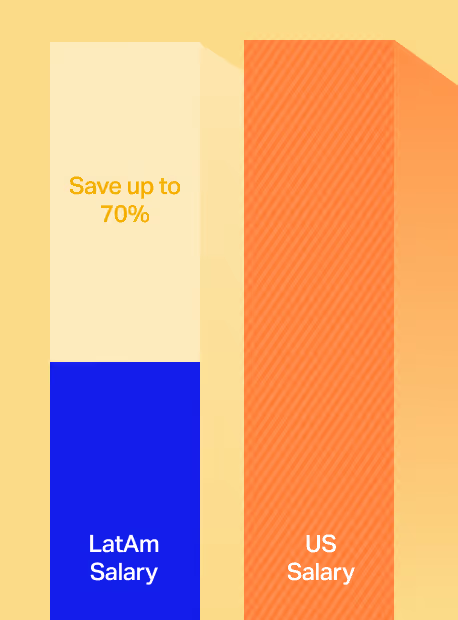
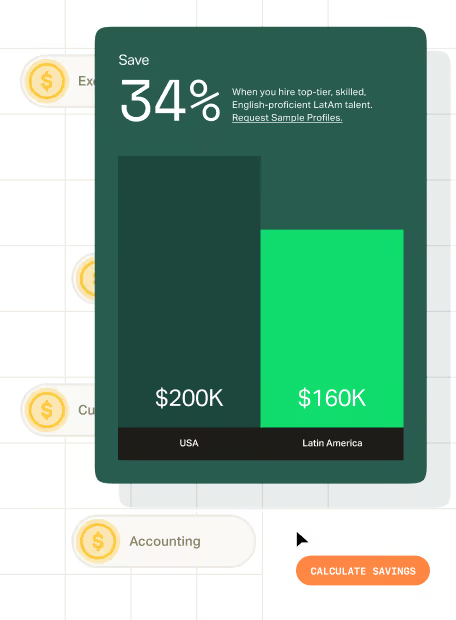
In the US, hiring an SEO specialist typically costs between $57,000–$124,000 annually, but hiring in Latin America can reduce that by up to 68%.
If you’re trying to build out your marketing team without burning through your budget, those US salary expectations can stop you in your tracks.
A junior specialist in the US at $57,000 might not have the experience you need, especially when the role demands someone who gets both traditional SEO and the new AI search game. A domestic senior specialist at $124,000 might be outside your budget.
That’s why companies look outside the US to hire. From our experience sourcing SEO specialists across Latin America, the same caliber of expertise you'd find in the US is available at salaries between $24,000 and $48,000.
Here’s what an SEO specialist based in Latin America charges compared to an equivalent US hire, according to Hire With Near’s salary benchmarks:
For the most up-to-date figures, see Hire With Near’s US vs Latin America Salary Guide.
These aren’t cost differences because the talent is any less capable. It’s just regional market rates and cost of living. You’re getting the same strategic thinking and technical chops, without the US price tag.
According to Hire With Near’s 2026 State of LatAm Hiring Report, 84% of our Latin American placements are mid-level or senior, up to and including SEO/SEM director hires.
According to our recruiters who specialize in this role:
SEO specialists are relatively easy to source because there’s a huge talent pool in Latin America. There’s no shortage of great SEO professionals here, and from a cost perspective, it’s a great deal for clients.
What Skills Should You Look For When Hiring an SEO Specialist?
You need someone who understands how to show up in LLM outputs as well as Google, now that AI search is part of how millions of customers discover solutions. That means having a strong grasp of the SEO fundamentals paired with the ability to test new ways to win visibility in AI-generated answers.
Beyond classic rankings, today’s SEO must structure authoritative, extractable content that AI systems want to cite.
The best specialists treat classic SEO as the baseline and add generative engine optimization (GEO) visibility best practices: structuring pages so they’re easy to cite, answering questions clearly, using schema, and monitoring where and when your brand appears in AI Overviews and answer engines (and why).
They should understand how Google’s AI features surface links and how engines like Perplexity pick sources.
Expectations also shift with seniority: a junior specialist needs guidance on technical SEO and strategy, while a senior one should build SEO and GEO strategies independently and tie them to business objectives.
Here are the core skills to evaluate:
Hard skills (the must-haves)
These technical competencies form the foundation of effective SEO work across all experience levels:
- Keyword research and analysis fundamentals: All candidates should understand how to identify relevant keywords, assess search intent, and use basic keyword research tools like Google Keyword Planner. More experienced specialists should demonstrate proficiency with advanced tools like SEMrush or Ahrefs.
- On-page optimization basics: Solid understanding of title tags, meta descriptions, header structure, and basic content optimization principles. This includes knowing how to optimize for both search engines and user experience without over-optimization.
- Google Analytics and Search Console proficiency: Ability to navigate these essential platforms, set up basic tracking, and interpret fundamental SEO metrics. All candidates should understand how to connect SEO activities to measurable outcomes.
- Content optimization understanding: Knowledge of how content supports SEO goals, including topic targeting, keyword integration, and user intent matching. They should understand the relationship between content quality and search performance.
- Basic technical SEO awareness: Understanding of site speed, mobile optimization, crawlability, and other technical factors that impact search performance. Junior specialists need awareness; senior specialists need implementation skills.
- GEO fundamentals: This covers understanding how to optimize content for AI-powered search engines and LLMs, including structured data markup, natural language content creation, and the key difference between optimizing for traditional rankings versus AI citation.
- AI Overviews and featured snippet optimization: This focuses specifically on creating content that gets selected for Google’s AI Overviews, featured snippets, and answer boxes, including Q&A formatting, schema markup, and creating authoritative content that AI systems prefer to reference.
Soft skills (equally important)
Technical skills execute the work, but these soft skills determine how effectively your SEO specialist integrates with your team:
- Strategic thinking: The best SEO specialists don’t just follow playbooks. They analyze your specific business, competition, and goals to develop customized strategies. Look for candidates who ask about your customer journey and business objectives.
- Clear communication: SEO work often requires explaining technical concepts to non-technical stakeholders. Your specialist should be able to translate rankings and traffic into business impact that executives understand.
- Patience and persistence: SEO results take time, and algorithms change frequently. Strong candidates understand this reality and can manage expectations while maintaining consistent optimization efforts over months, not weeks.
- Adaptability: Google updates its algorithm hundreds of times yearly. Look for candidates who stay current with industry changes and can pivot strategies when necessary.
- Project management: SEO involves coordinating with content teams, developers, and marketing colleagues. Your specialist should be organized, proactive, and able to manage multiple optimization projects simultaneously.
Nice-to-have skills (the differentiators)
These skills aren’t essential but give candidates an edge:
- Local SEO experience: A local SEO expert is valuable for businesses with physical locations or geographic targeting needs
- E-commerce SEO knowledge: Specialized understanding of product pages, category optimization, and conversion-focused SEO
- International SEO expertise: For companies targeting multiple countries or languages
- Basic HTML/CSS skills: Helpful for implementing technical fixes without always relying on developers
- PPC understanding: Knowing how paid and organic search work together can inform better keyword strategies
In our experience placing SEO specialists, the most successful candidates typically combine strong technical skills with genuine curiosity about how businesses grow; they see SEO as a business function, not just a technical discipline.
Where Can You Find and Hire Great SEO Specialists?
You can find strong SEO specialists through job boards, referrals, freelance platforms, and recruiting partners. Your location and sourcing strategy will determine quality and cost.
Finding SEO specialists involves two key decisions:
- Where your specialist will be located (local, national, or international)
- Where and how you’ll find and hire candidates in that location
Let’s walk through each part of the decision.
Deciding between local, national, or global talent
Each approach offers distinct advantages:
- Local/in-office hiring provides direct collaboration and simplified management but typically comes with the highest costs and smallest talent pool. This works best when you need constant face-to-face interaction or have complex compliance requirements.
- Remote US-based talent expands your options while maintaining familiar business practices and time zones. However, you’ll still pay US market rates, which can be prohibitive for smaller companies or those needing multiple SEO specialists.
- International/global hiring opens up access to talent at 30–70% lower cost than US hires. However, you may need to navigate time zone differences, cultural nuances, and international compliance requirements depending on the region you choose.
If you’re open to offshore hiring, Latin America offers strong SEO expertise, working hours that overlap your business day wherever your team is, cultural alignment with US business practices, and salaries up to 68% below US rates. Our guide to hiring remotely in Latin America covers the practical setup.
Written English quality is one of the questions marketing leaders ask about hiring in Latin America, and because SEO output is published writing that carries your brand, ask for samples of published work in English rather than a language-level badge.
Companies also find value in hiring offshore SEO talent in Southeast Asia and Eastern Europe, though time zone differences can complicate collaboration for roles requiring frequent communication.
For a closer look at your options, compare hiring SEO talent in LatAm vs. India vs. the Philippines and see which SEO roles you should offshore.
{{state-latam-hiring}}
Choosing the right sourcing channel
Freelance platforms
Freelancing websites like Toptal, Upwork, and Guru are useful platforms for hiring freelance marketers like SEO experts.
They work well when you need someone for a specific project or want to test a specialist before making a longer commitment. You can review portfolios, read client feedback, and compare rates easily.
The downside? Quality is all over the map. You’ll sift through mediocre candidates to find the good ones, and platform fees add 10–20% to your costs (or to the freelancers’ rates).
If you need someone who understands your business deeply or requires ongoing strategic work, freelancers might not be the right fit.
Professional networks and referrals
Getting recommendations from your network often delivers the highest-quality candidates. Someone you trust has already worked with them, so you skip a lot of the guesswork around reliability and work style.
The catch is that your pool is limited to who your contacts know. If you need specialized industry experience or specific technical skills, your network might come up empty. LinkedIn can expand this somewhat, but building relationships and getting meaningful referrals takes time.
Job boards
Job boards can work, but you need to know what you’re getting into. Specialized boards like SEOJobs attract practitioners looking for dedicated roles. General remote boards like We Work Remotely cast a wider net.
But expect that if you post a job for an SEO specialist and you’ll get swamped. Expect 100+ applications, many from candidates who clearly didn’t read your requirements. If you don’t have time to screen hundreds of resumes and portfolios, job boards can become a time sink rather than a solution.
Job boards work best when you have clear hiring criteria, time to review applications thoroughly, and a good screening process.
Skip them if you’re in a hurry or don’t enjoy evaluating candidates.
Related reading: Nearshore Hiring: Job Boards & Agencies to Find Remote Talent
Recruiting agencies
Working with a recruiting agency makes sense when you need to move fast or you’re hiring internationally.
The right agency brings four main benefits:
- Faster hiring: Instead of spending weeks posting jobs and screening candidates, agencies present you with a shortlist of qualified specialists, often within days.
- Pre-vetted candidates: Good agencies don’t just match keywords. They’ve already assessed technical skills, communication ability, and work style. You skip the first round of screening entirely.
- Understanding what separates strong SEO professionals from mediocre ones: Agencies with experience sourcing SEO talent can identify the subtle differences between candidates who understand SEO theory and those who can execute strategy under real business pressure.
- Expertise in international hiring: If you’re considering talent outside the US, specialist recruiters handle the complexity of international hiring, from legal compliance to cultural fit assessment, so the process is as easy as hiring within the US.
The downside is cost. You’ll pay agency fees, though this is often offset by faster hiring and better matches. Agencies work best when you value speed and quality over controlling every detail of the process.
How to Hire the Best SEO Specialist: Best Practices
Hire on business impact: define the outcome you need, write the job description around that problem, screen portfolios and communication, then test your shortlist with a 30/60/90 case study.
Candidates will talk confidently about keywords, backlinks, and traffic charts, but if they can’t connect that work to leads, pipeline, and revenue, they won’t move the needle for your business.
Stage 1: Before and during sourcing
Define your SEO priorities before hunting for talent
Companies routinely default to “find someone great at SEO” without clarifying what success actually looks like for their business.
Do you need someone focused on technical optimization, content-driven organic growth, local search visibility, or e-commerce SEO? Are you primarily competing on informational content or transactional keywords?
We’ve found that companies get better results when they prioritize depth over breadth. A SaaS company hiring an SEO specialist, for example, should focus on finding a specialist who excels at product-led content and high-intent keyword strategy rather than having a generalist trying to handle everything.
Craft a job description that attracts serious professionals
Your job description should emphasize specific SEO challenges rather than generic requirements. Instead of “looking for an SEO expert,” describe the actual work: “optimize our B2B software site to rank for competitive keywords.”
The more context you provide about your competitive landscape, target audience, and business model, the better the candidates you’ll attract.
Stage 2: Screening and evaluation
Review their portfolio and case studies
Request a portfolio or case studies from the candidates that demonstrate their previous SEO-related projects and successes. Analyze these materials to assess their industry experience, their ability to achieve tangible results, and the strategies they utilized to overcome challenges.
Evaluate communication and collaboration skills
SEO work requires constant coordination with content teams, developers, and marketing colleagues. During interviews, pay attention to how candidates explain complex concepts, ask clarifying questions, and handle disagreement or pushback.
Ask about a time they had to convince stakeholders to implement an SEO recommendation that required budget and engineering time. Strong candidates will demonstrate diplomacy, data-driven arguments, and persistence without being pushy.
Give a case study test to your shortlist
After interviews, assign a short case study exercise.
We suggest this case study for our clients, and you’re welcome to use it as well:
Task: Identify 10 keywords that would almost certainly bring in new business if they ranked on page one.
Create a 30-, 60-, and 90-day plan to get there.
Include the resources, freelancers, or hires you would use.
Then explain what additional steps you would take to become highly visible in LLM-generated search results for those same keywords.
It’s really great at determining how strong a candidate is and if they understand the current reality of search. It reveals:
- Whether they can prioritize high-value keywords over vanity terms
- Their ability to plan strategically and operationally
- How they think about resourcing to hit goals
- Their understanding of LLM-specific tactics
Weighing up your top candidates
Once you have completed the interviews and reviewed the case study exercise, you should be down to the people who can clearly do the job.
Now the goal is to figure out who will do it best for your business. Our playbook on how to identify the A-players breaks the signals down further.
Look for:
- Business-first mindset: They talk about leads, pipeline, and revenue before they talk about rankings and traffic.
- Strategic and operational balance: They can set direction and also get into the details of execution.
- Resource planning: They understand they can’t do everything alone and have a plan for managing internal and external contributors.
- Adaptability: They’re already testing new approaches for LLM search and can adjust quickly as this space evolves.
- Clarity and communication: They explain complex strategies simply, showing they can work well with cross-functional teams.
Beware of:
- Candidates who rely on outdated SEO tactics and ignore LLM search
- Overemphasis on vanity metrics instead of high-intent outcomes
- Lack of experience managing a team or coordinating multiple contributors
The right choice will be the candidate who not only knows the playbook but can adapt it to your goals, your resources, and the changing search landscape.
Stage 3: Making the offer and closing the deal
Perform reference and background checks
Always check candidates’ references to validate their past work experience and achievements. Speaking with former employers or clients can provide additional insights into the candidate’s work style, reliability, and impact on previous SEO campaigns.
Move quickly once you find the right fit
Here’s what we’ve learned after making thousands of placements: the best candidates evaluate offers differently than average ones. They’re not just comparing salaries. They’re assessing whether you can make decisions quickly and whether working with you will be straightforward or a constant battle.
A drawn-out decision process signals to strong candidates that you might be indecisive about other things, too. We’ve seen companies lose their top choice because they took three weeks to “think it over” while a competitor made an offer in three days.
If someone checks all your boxes and you’re confident they can do the job, make the offer. The small risk of moving quickly is far outweighed by the cost of losing a great hire to a more decisive competitor.
For guidance on crafting competitive offers that attract and retain top talent, see our article about making a good job offer to hire and retain top talent.
What Are the Top Interview Questions for Hiring SEO Specialists Who Will Also Excel at GEO?
These questions help you identify candidates who can handle both traditional SEO and GEO, so your business stays visible as search evolves.
They are real questions we recommend that our clients use.
“Walk me through an SEO initiative you’ve personally led in the last 12 months.”
This question, recommended by our VP of Marketing, Andres Bahamon, separates strategic SEO professionals from those who just execute tactics. You’re looking for candidates who had an active role leading strategy, not just following someone else’s playbook.
The best answers will demonstrate they understand SEO as a business function that drives pipeline and leads, not just rankings and traffic.
Strong candidates should explain their decision-making process and resource management approach. They should mention coordinating with internal or external writers, content editors, and other team members, because no one executes successful SEO initiatives alone.
Look for advanced tool usage beyond basic Semrush, like NLP tools and strategic keyword selection based on business impact rather than search volume alone. Listen for mention of consideration of content volume and internal linking strategy.
The key is often in your follow-up questions, like “Why did you make that decision? How did that translate into more business?”
Red flags include focusing only on vanity metrics without connecting to business impact, or candidates who can’t explain how their SEO work actually drove leads or revenue for the company.
“Describe your experience generating traffic from LLMs.”
This question immediately separates candidates who understand the current search landscape from those still living in the past.
It’s another one from Hire With Near’s VP of Marketing, and he notes,
If candidates don’t understand how LLMs are changing the game, that’s already a red flag.
— Andres Bahamon, VP of Marketing, Hire With Near
Strong SEO specialists should demonstrate awareness that AI-powered search engines are changing how users find information, even if their direct experience is limited.
What you want to hear is how they’re approaching SEO as the baseline for being surfaced by LLMs, because good traditional SEO foundations are essential for AI visibility.
Look for candidates who discuss investing in brand mentions, backlinks, and PR efforts specifically to support LLM optimization.
Strong answers will show they’re already testing and measuring impact, not just theorizing. They might mention tracking brand mentions in AI responses, optimizing content for featured snippets that feed into AI summaries, or understanding how traditional SEO supports LLM visibility.
The best candidates will explain how they’re tracking this impact and measuring results in conversions, leads, or whatever metrics matter to the business.
Major red flags include dismissing AI search as irrelevant, claiming extensive experience without specific examples, or candidates who haven’t at least started experimenting in this area.
“Walk me through how you’d approach SEO and GEO for our specific business model.”
This question reveals strategic thinking and research habits. Strong candidates will ask clarifying questions about your target audience, competition, current performance, and business goals before suggesting tactics.
Listen for candidates who want to understand your customer journey, competitive landscape, and conversion funnel.
Weak responses jump straight into generic tactics without understanding your unique situation.
“How do you measure whether your SEO and LLM strategies are working?”
This question assesses whether candidates understand the connection between SEO activities and business outcomes. Strong responses will go beyond basic metrics like rankings and traffic to include conversion rates, lead quality, and revenue attribution.
They should understand that LLM-generated traffic might convert differently from traditional search traffic. (At least one study showed that conversions from traffic from LLMs are 9x higher than from traditional search.)
The best candidates track both traditional SEO metrics and newer indicators like brand mentions in AI responses and featured snippet captures.
They should also understand attribution challenges and how to connect SEO efforts to business growth.
What Are the Most Common Mistakes to Avoid When Hiring SEO Specialists?
The four costliest mistakes are expecting results in weeks, hiring on past rankings alone, treating SEO as purely technical work, and limiting the search to US candidates. Even experienced hiring managers make these errors.
Here are the most common pitfalls and how to avoid them:
1. Expecting immediate results and quick wins
SEO is a long-term strategy that typically takes 3–6 months to show results. Companies that expect overnight ranking improvements often create unrealistic pressure that leads to poor tactics or frustrated specialists.
During interviews, set clear expectations about timelines and discuss how you’ll measure progress during the initial months.
Strong candidates will appreciate your realistic understanding of SEO timelines and be more likely to join your team.
2. Hiring based solely on past ranking achievements
“We took a client from page 3 to #1 for their main keyword” sounds impressive, but it doesn’t tell the full story. What was the competition level? How long did it take? What was the business impact beyond rankings?
Past successes matter, but they need context. Use the interview questions we suggested to get candidates to explain their role in specific achievements, the challenges they faced, and how their work connected to business outcomes.
Look for ownership of the process, not just credit for results.
3. Overlooking content strategy and communication skills
Companies often treat SEO as purely technical work, but modern SEO requires close collaboration with content creators, designers, and developers. Specialists who can’t communicate clearly or provide strategic guidance will limit their own effectiveness.
During interviews, evaluate how candidates explain complex concepts, provide feedback, and handle disagreement. These soft skills often determine whether an SEO specialist becomes a valuable team member or a bottleneck.
4. Limiting your search to US hires only
This might be the biggest mistake of all. Great SEO talent exists everywhere, and restricting your search to the US means missing candidates who could be perfect for your role.
For example, hiring marketing talent in Latin America puts you in front of professionals who’ve built SEO strategies for Fortune 500 companies, scaled startups, and solved the exact challenges you’re facing. You can hire seasoned specialists who understand US business culture, work with the same tools you use, and deliver results at up to 68% lower costs than US hires.
Take R\nd, a US-based company that was struggling with a long hiring process for marketing roles. After expanding their search to Latin America, and with the help of Hire With Near, they cut their hiring time to just 2 weeks and slashed overhead costs.
They hired for 3 roles, including a senior SEO strategist, and ended up saving $175,000 annually compared to hiring in the US.
They didn’t compromise on quality. They found better candidates faster than they ever had domestically.
Drew Prescott, R\nd’s co-founder and CEO, put it this way:
Hire With Near not only helped us navigate the hiring process but fundamentally changed our approach to building our team. Their ability to connect us with high-quality, dedicated talent has been invaluable.
— Drew Prescott, Co-founder and CEO, R\nd
Final Thoughts
The right SEO specialist optimizes for today’s algorithms while building the foundation that keeps you visible as AI reshapes how customers find solutions.
You can spend months posting job descriptions and sifting through hundreds of applications. Or you can skip that and start interviewing pre-vetted candidates next week.
We’ve already done the hard work. Within days of a kickoff call, we’ll connect you with Latin American SEO specialists or SEO managers who’ve built strategies for companies just like yours.
Not convinced international hiring is right for you? Fair enough. Talk to us anyway, understand our process, then interview our candidates for free. No commitment, no pressure.
If you want a concrete example of what smart SEO hiring can unlock, see how Rankings.io hired six SEO specialists plus other marketing roles in 3 weeks and saved $463,000 annually compared to hiring in the US.
Whatever your organic program needs (technical fixes, content strategy, or someone to run the whole thing), our team can help you hire remote marketing talent from Latin America who fits your specific needs, works during your hours, and delivers results at rates that make sense.
Schedule a free, no-commitment consultation call today.
{{consultation}}
Frequently Asked Questions
What does an SEO specialist do?
An SEO specialist drives organic traffic growth by optimizing website content for search engines.
SEO specialists typically focus on three core areas: technical SEO (site speed, crawlability, structured data), on-page optimization (content, keywords, meta tags), and off-page strategies (link building, local SEO).
They:
- Run technical audits (crawlability, site speed, structured data)
- Map search intent to content strategy and on-page optimization
- Build authority through digital PR and partnerships
- Tie all of it to pipeline and revenue, not just ranking position
How to hire an SEO specialist?
Define the outcome you need most, write the job description around that problem, screen for classic SEO fundamentals plus generative engine optimization skill, test your shortlist with a 30/60/90 case study, and decide on business impact rather than past rankings. The best-practices section above covers each stage.
What is the average salary for an SEO specialist?
The salary of an SEO specialist in the US ranges from $57,000 to $124,000 annually. Rates can vary widely depending on your industry and the professional’s experience and location.
If you’re open to offshore SEO talent in other countries, salary expectations are lower due to lower costs of living.
For example, SEO experts in Latin America expect between $24,000 and $48,000 annually, according to Hire With Near’s US vs. Latin America Salary Guide, up to 68% below US rates.
What are the key metrics to track the success of an SEO specialist’s initiatives?
To gauge the effectiveness of your SEO strategies, you should track organic traffic, search engine rankings for targeted keywords, backlink quantity and quality, domain authority, click-through rates, and conversion rates.
Monitoring these metrics over time will provide insights into the performance of your SEO efforts and help you make data-driven decisions to optimize your campaigns further.
Can an SEO specialist guarantee that my site will rank first on Google?
No ethical SEO specialist can guarantee a first-place ranking on Google due to the unpredictable nature of search engine algorithms.
However, an experienced SEO professional can improve your chances of ranking well by fixing technical issues, structuring content around search intent, and building topical authority.
What are white-hat and black-hat SEO strategies?
“White-hat” SEO strategies adhere to search engine guidelines and focus on providing real value to users. In contrast, “black-hat” SEO strategies attempt to “game” search engines with tactics like keyword stuffing or cloaking, which can result in penalties or bans.
When hiring an SEO specialist, you want to ensure that they will use ethical white-hat practices and avoid black-hat tactics that can hurt your business’s reputation and rankings.
When should I hire an SEO specialist?
You should hire an SEO specialist when your website isn’t getting the traffic you need or when you want to implement better SEO practices as part of your digital marketing strategy.
Both established businesses and startups may find hiring an SEO specialist a necessary step to optimize their marketing strategies and drive sales.
Is SEO being phased out?
No. SEO is not being phased out; what changed is how visibility gets earned. AI Overviews and answer engines now sit between your content and the reader, so the work shifts toward structuring pages that get cited and tracking brand mentions in AI answers alongside rankings. That is why you screen for GEO capability.
Should I outsource SEO or hire an in-house SEO specialist?
Outsourcing SEO services works well for short-term projects or when you need specific expertise you don’t have internally. Agencies bring established processes and diverse experience across industries, but you’re sharing their attention with other clients.
Hiring a dedicated SEO specialist, whether they’re in-office or remote, typically delivers better long-term value, because they build institutional knowledge over time and focus exclusively on your business.
Cost considerations often drive companies toward outsourcing, but hiring an offshore SEO specialist can provide the same cost benefits while giving you dedicated, full-time expertise.
Hire With Near’s research into why US companies hire in Latin America found marketing is the function companies move first when they leave an outsourcing arrangement, cited by 44% of those that switched. An SVP at a mid-market digital marketing agency put it this way:
We work with some offshore partners, and right now it’s, like, not the same people, so it’s hard to kind of standardize or set expectations consistently and have that person or that team grow with us effectively.
Which industries hire SEO specialists?
SEO specialists are hired across virtually every industry. Any business that relies on organic search to attract customers, generate leads, or build brand visibility needs someone who can manage that function.
The stakes are highest in a few places. We handle recruiting SEO specialists for insurance companies, one of the most competitive SEO environments in existence, where ranking for high-intent keywords directly drives policy quotes and revenue.
And recruiting for marketing agencies and in-house teams, who hire SEO specialists both for their own growth and for client work. Creative studios, AI and machine learning companies, and customer-service-driven businesses rely on SEO too.







.webp)


%203.svg)
.avif)





%20(1).avif)

%20(1).png)