%203.svg)
Key Takeaways
- For US companies hiring offshore SEO talent, Latin America offers the strongest combination of time zone alignment, cultural fit with US audiences, and cost savings of 52–68% compared to US rates.
- India excels at technical SEO work (audits, page speed, indexing) and offers competitive rates, but time zone gaps of 9–12 hours make real-time collaboration difficult for most US teams.
- The Philippines scores well on English proficiency and content output, but a 13–15 hour time difference with the US West Coast is the most commonly cited reason US companies report their offshore arrangement didn't meet expectations.
For US marketing teams looking to scale their SEO operations at a lower cost, the choice between hiring in Latin America, India, and the Philippines is rarely just about price. The real question is: How much does the time zone gap cost you?
Hiring offshore SEO talent from any of these three regions can reduce your payroll significantly compared to US rates. But cost isn't the only variable that's gotten more complicated. Search itself has changed: AI Overviews are absorbing clicks that used to go to organic results and LLMs like ChatGPT and Claude are becoming discovery channels in their own right. The SEO hire you need in 2026 must understand all of it and know how to adjust strategy as the rules keep shifting.
According to Hire With Near's research on more than 2,000 US companies exploring nearshore hiring, 30% are switching specifically from offshore arrangements in India or the Philippines. The most common reason is the time zone gap, which made real-time collaboration impossible.
This article breaks down the key differences between hiring offshore SEO talent from Latin America, India, and the Philippines across availability, infrastructure, time zones, English proficiency, cultural alignment, cost, and specialization strengths.
Summary: How Do LatAm, India, and the Philippines Compare for Offshore SEO Hiring?
The table below captures the key differences at a glance. Each factor is covered in detail in the sections that follow.
Offshoring SEO to LatAm vs. India vs. the Philippines: Key Differences
Latin America, India, and the Philippines each offer real talent, but they differ meaningfully across time zone alignment, English proficiency, cultural fit, and cost structure.
Those differences matter more for SEO than for many other roles, because SEO requires ongoing collaboration: Strategy calls, content reviews, performance check-ins, and quick pivots when an algorithm update hits.
Understanding where each region excels and where it creates friction before you hire can save you from making an expensive correction six months in.
Availability of SEO talent
All three regions have real SEO talent, but they differ in depth, specialization, and trajectory.
According to Digital Marketing Philippines, the country has an estimated 16,000 SEO practitioners, growing at roughly 10% annually, with particular strength in content-focused and link-building roles.
India's talent base is significantly larger, driven by a high volume of technical graduates and a well-established digital marketing agency ecosystem that produces SEO professionals at scale.
Latin America's SEO talent pool is growing fast: SEO and digital marketing roles are among the most requested remote profiles in the region, according to Coursera's Global Skills Report 2024, and content-related hiring rose 19% in 2024, according to Semrush's State of Content Marketing report. For US companies specifically, LatAm also offers the advantage of professionals already experienced in working with North American clients and brands.
For a practical walkthrough of the full process, see our guide on how to hire offshore SEO talent.
Technological infrastructure
India leads the three regions in internet reach, with internet penetration rates consistently among the highest in Asia and a tech workforce that has grown rapidly over the past decade.
The Philippines lags slightly behind regional peers in Southeast Asia, though connectivity in major cities like Manila and Cebu is reliable for remote work.
In Latin America, the technology sector is growing quickly. In major metro areas like Buenos Aires, Medellín, and Lima, you'll find infrastructure comparable to that of many US cities. More than 74% of the LatAm population has internet access, and the top English-speaking SEO professionals are almost always located in large urban centers with reliable connectivity.
Time zone compatibility
Overlapping working hours are where Latin America wins decisively. Most LatAm countries share 0–3 hours of difference with US time zones, meaning your SEO team is reachable during your working day without anyone adjusting their schedule drastically.
India and the Philippines are at least 9–12 hours ahead of the US East Coast, putting them 13–15 hours ahead of West Coast teams.
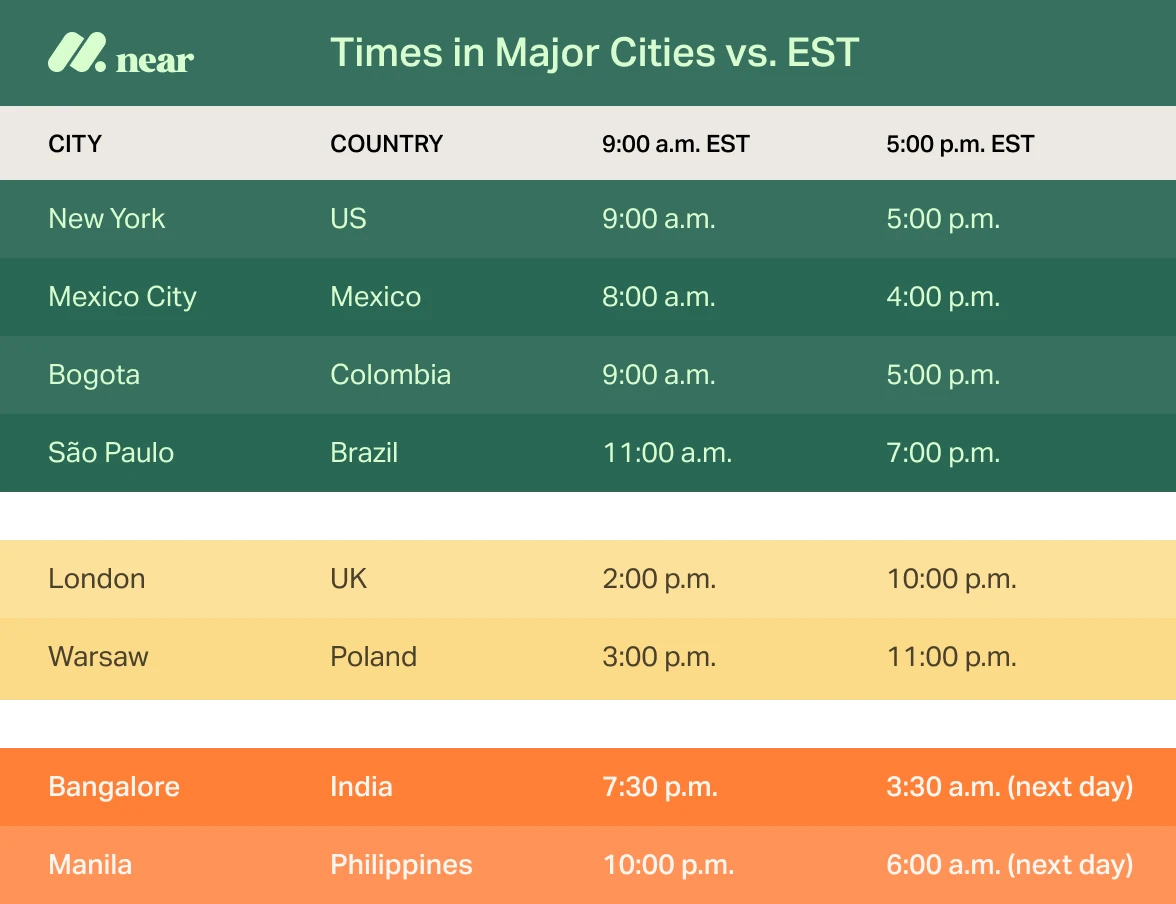
Research from Harvard Business School and INFORMS found that each additional hour of time zone difference reduces real-time communication by 11%. The study specifically recommends organizing distributed teams along a north-south axis (like US-LatAm) rather than east-west to preserve workday overlap. At a 12-hour gap, the math is stark.
One finance leader who spent nearly a year managing a team in Mumbai, India, put it this way:
The talent is solid...but boy, trying to manage someone in such a different time zone has been hard. Hiring in LatAm and staying kind of within the same reasonable time zone just makes so much more sense for us.
A CFO at another company described turning down the Philippines for a similar reason:
We looked at the Philippines, but my team pushed back. With a 15-hour difference, they knew it wouldn't work. The controller-level staff already had huge workloads. What they needed wasn't just another body. It was someone they could work with in real time, side by side, to get through it. That's why we moved the search to LatAm.
For an SEO function specifically, time zone gaps compound fast. Strategy calls, content reviews, and client reporting require real-time back-and-forth. When your SEO specialist is signing off for the day as you're starting yours, iterations slow down and deadlines get pushed.
English language proficiency
All three regions have professionals who are proficient in English, but the quality and orientation differ.
The Philippines scores highest overall: Philippine schools conduct instruction in US English and the education system is closely aligned with US standards.
Certain LatAm countries match or closely approach Filipino English proficiency. Argentina, for example, ranks 26th globally for English proficiency, according to the EF English Proficiency Index 2025, being the best-positioned country in Latin America.
India's English proficiency is generally rated moderate, and it tends toward UK English conventions rather than US English. For SEO content written for US audiences, where voice, phrasing, and idiomatic language matter for engagement and time-on-page, that distinction can affect output quality.
Cultural alignment with US businesses
Cultural fit matters more in SEO than in purely technical roles, because SEO often involves content strategy, audience understanding, and communication with clients or internal stakeholders. You want an SEO professional who understands not just your keywords, but your audience.
Latin American talent has a geographic and cultural proximity to the US that India and the Philippines don't. US business culture, consumer behavior, and media influence are embedded across LatAm, especially in major cities. That shows up in how LatAm SEO professionals approach strategy and content.
Franco Pereyra, COO of Hire With Near, explains what this looks like in practice:
What sets Latin American talent apart from other regions is that you'll find people who are proactive and creative — people who come up with ideas and new solutions, who won't just be a yes man. If you're looking for folks who can bring something to the table, who will push back if they think your idea doesn't make sense, that's what you find in LatAm.
That proactive quality matters especially in an SEO context. An SEO specialist who will challenge a weak content brief or flag a strategy that isn't working is more valuable than one who executes tasks quietly and waits for direction.
Natasha Tarapow, Senior Recruiter at Hire With Near, sees this difference play out regularly when companies come to her after hiring in other regions:
The problem companies have with hiring in India isn't technical ability — it's cultural fit. They find people who are very strong technically, and they come in at lower rates than US hires, but they're not a good cultural fit. They take a long time to answer Slack messages, they don't notify their managers about what they're working on. In Latin America, we found that talent is not that way. We're very communicative. People really try to go above and beyond in their jobs.
Cost
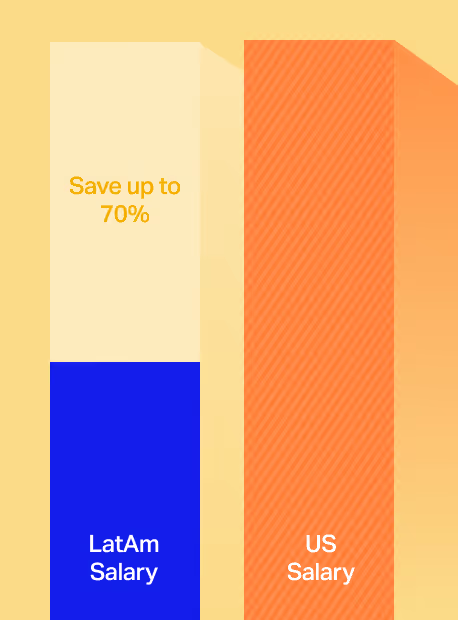
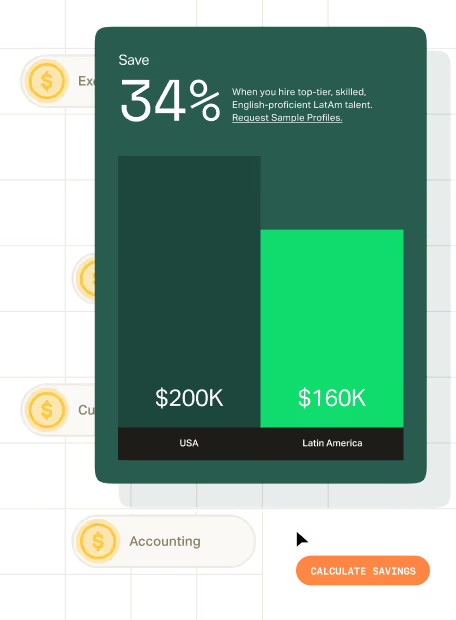
For LatAm, the savings compared to US rates are meaningful and well-documented: You can save 52–68% or more when hiring SEO talent in the region. A mid-level SEO specialist in Latin America typically earns $30,000–$42,000 per year, compared to $63,000–$103,000 for a US equivalent, a savings of 52–59% at the mid-level, with an even wider range at junior and senior levels.
India and Philippines-based SEO specialists often command lower annual salaries than their LatAm counterparts, but those savings narrow when you factor in the management overhead of a 12-hour time zone gap, higher revision rates on US-facing content, and the cultural friction that Tarapow describes.
{{salary-guide-cta}}
SEO service specializations
Different regions tend to excel at different types of SEO work. Knowing these strengths helps you choose the right talent pool for your specific needs.
- LatAm: The strongest pick if you need someone with a solid understanding of US business culture and consumer behavior. LatAm SEO professionals excel at building high-quality links, writing blog and social content that resonates with US audiences, developing long-term SEO strategies, and multilingual SEO in Spanish or Portuguese.
- The Philippines: A reliable option for content writing and keyword research, given strong English proficiency. Content may not always align as closely with US audience nuances, but the Philippines is a solid choice for technical writing and output volume.
- India: The strongest pick for technical SEO. India has a deep bench of technically skilled professionals well-suited to website audits, page speed optimization, structured data, and fixing indexing errors.
Real-World Result: What Switching to Nearshore SEO Talent from LatAm Looks Like
Rankings.io is an Inc. 5000 digital marketing agency that specializes exclusively in SEO for law firms, one of the most competitive niches in search. They know what good SEO talent looks like, and their standards are high.
When their client base grew faster than their one-person HR team could handle, leadership was spending 3–5 hours per role on sourcing and interviewing, time that should've been going toward client work. They had tried other staffing agencies and found the process convoluted and slow. Their initial goal with Hire With Near was straightforward: Fill five critical roles with LatAm professionals in the same time zone, at a rate that fit their budget.
They ended up filling 11 roles in three weeks, including SEO specialists, a web designer, a project manager, and a paid ads specialist. The annual salary savings compared to equivalent US hires came to $463,000, a 54% reduction.
But the number that stands out isn't the cost saving. It's what Gillian Alvillar, their HR Director, said when she checked in with department managers after the hires:
When I check with the department managers, they all say, 'It's like 100 out of 10.' The talent we've brought in through Hire With Near has been professional, articulate, intelligent, and absolutely the right fit for our team.
For an SEO agency whose entire business depends on the quality of their search talent, that's the result that matters.
How Much Does Offshore SEO Talent Cost?
The table below shows what SEO roles actually cost in Latin America versus the US. The savings are significant at every level, but the gap is widest at senior levels, where US salaries climb fastest.
India and the Philippines often come in below the LatAm range for comparable roles. The gap is real. But it's worth asking what the time zone difference actually costs in management hours, slower iteration cycles, and content revisions when writing for a US audience. For many US companies, the math ends up closer than it looks on the salary line alone.
If your SEO needs are primarily technical (audits, indexing, page speed), India's lower rates may make sense. If you need someone who can develop strategy, write content for US audiences, collaborate in real time, and push back when your brief is weak, LatAm's cost structure is hard to beat relative to the value delivered.
For a complete view of LatAm vs. US compensation by role, see our Salary Guide.
Factors To Consider When Choosing an Offshore Location for SEO Hiring
The right offshore SEO location depends on four factors: Skill requirements, SEO strategy complexity, collaboration needs, and cost efficiency. For most US companies building a long-term SEO function, LatAm delivers on three of the four.
Here is what each factor means in practice:
1. Skill requirements
If you need quick, efficient execution of defined technical tasks, India is worth considering. If you want thorough, long-term SEO results that require strategy, content creation, and ongoing collaboration, Latin America is the stronger option. The Philippines falls in between: Strong on content output, less reliable for a US audience specificity.
For a deeper look at what to screen for when hiring, see our guide on hiring SEO specialists.
2. SEO strategy
Long-term SEO strategy requires critical thinking, audience understanding, and the ability to adapt as results come in. That kind of work depends on a specialist who can communicate clearly, challenge weak ideas, and operate proactively.
Latin American talent's combination of time zone alignment, cultural familiarity with US audiences, and proactive work style makes it the strongest fit for building an SEO strategy that moves rankings.
Thanks to overlapping working hours and a deeper understanding of the US customer base, LatAm SEO professionals are better positioned to develop and adjust strategy in sync with your team.
{{prevetted-banner}}
3. Communication and collaboration needs
LatAm professionals are reachable during your working day. You can pick up the phone, hop on a call, or get a Slack response without waiting until the next day. That matters for SEO work, where content cycles, algorithm updates, and client reviews often require fast turnarounds.
If you have tasks that can be completed asynchronously with a longer deadline, India and the Philippines remain viable. But if you need a collaborative partner on your SEO program, proximity in working hours isn’t optional.
4. Cost efficiency
The cheapest hire rarely delivers the best return. What matters in SEO is results per dollar, and that calculation includes time zone friction, revision cycles, and how long it takes a new hire to work independently without hand-holding.
One specific risk worth naming: Some very low-cost SEO freelancers in any region may use black-hat tactics, manipulative link schemes, keyword stuffing, or other techniques that violate search engine guidelines. The short-term results can look promising, but the penalties are severe, like ranking drops, manual actions, or content removal from search entirely. Paying the lowest rate without vetting the candidate's approach is a risk that can end up costing far more than the savings.
The right approach is balancing savings with value. LatAm SEO talent offers a rate structure that is meaningfully lower than the US, with the cultural alignment and collaboration quality that makes those savings durable.
Final Thoughts
For US companies hiring offshore SEO talent, the decision between Latin America, India, and the Philippines comes down to what your SEO function actually needs to succeed.
India wins on technical depth and the lowest absolute cost. The Philippines scores well on English proficiency and content volume. But for the full package, Latin America is the strongest choice for most US companies building a durable SEO function.
If you want to explore what that looks like in practice, read our guide on the best countries to hire offshore SEO talent, or book a free consultation with Hire With Near to get a shortlist of vetted LatAm SEO professionals in your time zone.
Frequently Asked Questions
What is the best country for offshore SEO talent?
Latin America is the best overall choice for US companies hiring offshore SEO talent, particularly when the work involves strategy, US-audience content, link building, or real-time collaboration.
The Philippines performs well for content output and keyword research due to high English proficiency. India is the strongest option for technical SEO tasks like audits, indexing, and page speed work.
The right answer depends on your SEO priorities, but for most US companies building a long-term SEO function, LatAm's combination of time zone alignment, cultural fit, and 52–68% cost savings compared to US rates makes it the strongest option.
How much does it cost to hire an offshore SEO specialist from LatAm vs. India vs. the Philippines?
A mid-level SEO specialist in Latin America typically earns $30,000–$42,000 per year, compared to $63,000–$103,000 for a US-based equivalent, a savings of 52–59%.
India and the Philippines generally come in at lower absolute rates than LatAm, often in the $12,000–$28,000 range for comparable roles, though specific rates vary by seniority and specialization.
The salary gap between LatAm and offshore Asian markets is real, but it narrows when you factor in the management overhead of a 12-hour time zone gap and the cost of content that doesn't resonate with US audiences.
What are the risks of hiring SEO talent from India or the Philippines?
The primary risk with India and the Philippines is the time zone gap: 9–12 hours with India and 13–15 hours with the Philippines, which means real-time collaboration is structurally difficult.
Beyond scheduling, India-based SEO professionals may be less culturally aligned with US consumer expectations, which affects content quality. In the Philippines, English proficiency is strong, but the 15-hour gap with the US West Coast is the most common reason US companies report their offshore arrangement didn't work.
Both regions also carry the general risk of low-cost providers using black-hat SEO tactics, although vetting is essential regardless of where you hire.
Is LatAm SEO talent good enough for technical SEO work?
Yes, Latin America has strong technical SEO professionals, though India's talent pool is larger and more deeply focused on technical execution specifically.
LatAm SEO specialists regularly handle website audits, structured data, Core Web Vitals, and indexing work. What LatAm adds beyond technical competence is the ability to collaborate in real time and align technical recommendations with broader content strategy.
For companies that need both technical SEO and content-driven SEO working in concert, LatAm is well-suited to handle both. For companies whose SEO needs are purely technical and asynchronous, India may offer a cost advantage.
What industries benefit most from hiring offshore SEO talent in Latin America?
Nearly every industry hires SEO talent in Latin America, but demand is especially strong in sectors where content strategy, inbound marketing, and online visibility are central to revenue growth.
SaaS companies hire LatAm SEO specialists to support product-led growth and content marketing at scale. Finance companies use them for compliant, high-quality content targeting competitive financial keywords.
Real estate and healthcare businesses rely on LatAm SEO professionals for local SEO and long-form content that requires audience specificity. IT and tech companies are among the most active hirers, using LatAm talent to support technical content programs alongside development teams.
How do I vet offshore SEO talent to avoid black-hat practices?
The most reliable vetting approach is asking candidates to walk you through a past SEO campaign: What they did, why they did it, and how they measured success. Strong candidates will talk about sustainable on-page optimization, content strategy, and white-hat link building.
Red flags include vague answers about link schemes, promises of fast ranking results, or the inability to explain their methodology. Ask specifically about how they handle Google algorithm updates and what they would do if a tactic they were using were penalized.
In our experience working with companies hiring SEO roles, the quality of a candidate's strategic thinking in the first interview is the most reliable predictor of whether their approach is sustainable.
For a full framework on evaluating candidates, see our SEO specialist hiring playbook.
What other marketing roles can I hire in Latin America?
Beyond SEO specialists, US companies work with Latin America-based professionals across a wide range of marketing roles, including SEO managers, SEO copywriters, local SEO experts, content marketing managers, digital marketing managers, and SEO analysts.
Latin American marketing professionals bring the same strategic depth as their US counterparts, with the added benefit of working in US time zones and costing significantly less.







.webp)


%203.svg)
.avif)





%20(1).avif)

%20(1).png)