


%203.svg)
Key Takeaways
- Outsource social media when you need short-term help for specific campaigns, are testing whether social will drive growth, or require specialized expertise temporarily.
- Build in-house social media capacity when you need brand ownership, institutional knowledge, real-time agility, and team members who understand your business deeply.
- Hiring social media professionals in Latin America provides dedicated in-house team members at costs comparable to agency outsourcing while delivering time zone alignment and cultural understanding.
Social media keeps coming up as something your company should be doing more intentionally. Not just posting when someone remembers, but showing up consistently to support growth.
The problem is, no one on your team has the time or focus to own it properly. So you start weighing the options.
Outsourcing social media marketing feels like the fastest path forward. Hiring someone in-house feels like the right long-term move, but also like a luxury you might not be able to afford yet.
And the longer the decision drags on, the more social stays in limbo: active enough to feel like work, but not strategic enough to move the needle.
This guide is designed to help you think through that decision. We’ll break down when outsourcing social media makes sense, where it tends to create tradeoffs, and how some teams build in-house ownership in a way that fits tighter budgets and growing teams.
What Does Social Media Outsourcing Mean?
Social media outsourcing means paying an external agency or freelancer to handle your social media presence instead of building an in-house team—but the term covers vastly different service models with different levels of control, quality, and results.
Here’s what you’re usually choosing between:
- Full-service agencies handle everything: strategy, content creation, community management, analytics, and reporting. You get a complete package, but you’re also paying for project managers, account coordinators, and agency overhead.
- Specialized agencies focus on specific pieces like paid social advertising, influencer marketing, or content creation. They go deep on one thing, but you’ll need to coordinate with your other team members or contractors for the full picture.
- Freelance social media specialists are independent contractors who typically charge $50–$150+ per hour. Some work on retainer, others take on project-based work. The advantage is flexibility. The downside is you’re often managing multiple freelancers if you need different skill sets.
What all of these have in common: you’re renting attention and expertise rather than building it in-house. Whether that’s the right move depends on where you are as a business and what you’re trying to accomplish with social media.
What Social Media Services Do Companies Outsource?
Social media marketing isn’t one job. It’s multiple specialized roles working together, and companies can outsource the entire strategy or individual pieces depending on their needs and budget.
Understanding these different functions helps you figure out what you actually need and whether outsourcing gives you access to all of them or just some of them.
- Social media manager: This is the strategic leadership role. A social media manager owns your overall strategy, content planning, publishing schedule, and performance metrics. They’re the ones deciding what platforms you should be on, what content resonates with your audience, and how social media ties into your broader marketing goals. This person typically coordinates with (or manages) all the other social media functions.
- Community manager: While the social media manager plans the strategy, the community manager handles the day-to-day engagement. They’re responding to comments, answering DMs, building relationships with followers, and managing your brand reputation across platforms. They’re your front line for customer interaction on social, and that’s why, according to HubSpot, 64% of companies they surveyed had dedicated community managers.
- Content creator: Content creators develop the actual posts—captions, content ideas, story concepts. Some specialize in specific formats like Instagram carousels or TikTok scripts. They understand what performs on each platform and how to package your message for maximum engagement.
- Graphic designer: Every scroll-stopping social post needs strong visuals. Graphic designers create branded templates, infographics, and static images that make your content stand out in crowded feeds. They maintain visual consistency across all your social channels.
- Video editor: With short-form video dominating social media, video editors are increasingly essential. They edit content for TikTok, Instagram Reels, YouTube Shorts, and LinkedIn videos—adding captions, transitions, effects, and making raw footage platform-ready.
- Copywriter: Strong copy makes the difference between a post that converts and one that gets scrolled past. Social media copywriters craft compelling captions, ad copy, and messaging that drive engagement, clicks, and conversions. They understand how to write for each platform’s unique style and audience expectations.
How this affects your outsourcing decision
When you hire a full-service agency, you’re theoretically getting all these roles bundled together.
If you go the freelancer route, you’re probably hiring specialists in 1 to 2 of these areas. Need a video editor? That’s one person. Need a graphic designer? That’s another. Community management? Someone else. Suddenly, you’re coordinating three or four different people, managing their schedules, and hoping their work meshes together.
This is why many companies eventually realize that when you outsource piecemeal, you become the project manager, which is its own full-time job. We’ll talk more about that hidden cost in a minute.
When Social Media Outsourcing Makes Sense
There are situations where outsourcing your social media is the smartest move.
- You need to move fast. Outsourcing gets you started immediately. No 3-month hiring process, no onboarding, no benefits administration. An agency or experienced freelancer can begin posting within days. If you’re launching a product next month and have zero social presence, speed might be worth the premium.
- You’re still figuring things out. If you’re early stage and genuinely don’t know if social media will be a key growth channel for you, outsourcing lets you test without commitment. You can try different platforms, experiment with content styles, and see what resonates before building an entire function around it.
- You need very specialized expertise for a specific project. Running TikTok Shop campaigns requires different skills than organic LinkedIn thought leadership. If you need someone who lives and breathes a specific platform or tactic—and you only need them for a few months—outsourcing makes sense. No point hiring a full-time TikTok specialist if you’re just testing the channel.
- You’re seasonal or project-based. Maybe you’re an e-commerce brand that goes hard during Q4 for BFCM and stays relatively quiet the rest of the year. Or you’re launching campaigns tied to specific events. Scaling an agency relationship up and down is easier than hiring and laying off employees.
- You don’t have the capacity to manage someone. If nobody on your team has time to onboard, train, and provide feedback to a new hire, outsourcing might be your only viable option right now. An experienced agency or freelancer should need less hand-holding (though they’ll still need direction).
The pattern here? Outsourcing works best when your needs are temporary, specialized, or experimental. Where it sometimes starts breaking down is when social media becomes a core, ongoing part of your growth strategy. That’s when the hidden costs start stacking up.

The Challenges and Downsides of Social Media Outsourcing
While outsourcing often appears cheaper and easier on paper, many companies discover significant challenges that undermine results, including loss of brand voice, communication delays, and hidden management overhead that makes the true cost higher than expected.
Your brand voice gets diluted
Agencies juggle 10, 20, sometimes 50+ clients at once. Your account is one slice of their business. No matter how good their creative brief process is, they’re unlikely to understand your brand voice the way someone living and breathing your company every day does.
What ends up happening? Your social content starts sounding generic. The posts are fine—professionally executed, on-brand enough—but they don’t quite sound like you. Followers can tell. The engagement numbers show it.
The middleman problem slows everything down
This is what we often hear from companies that have worked with outsourcing agencies:
Dealing with a “middleman” is hard because we don’t manage [the folks assigned to our account]. They’re managed by the agency. So if someone’s sick, it takes us hours to find out. They have to tell their manager, and the manager has to tell us.
You often can’t just Slack the designer to make a quick change. You have to email the account manager, who messages their internal team, who makes the edit, which goes through their QA process, then gets sent back to you for approval. What should take 20 minutes takes two days.
They don’t build institutional knowledge in the same way in-house teams do
Every campaign brief requires extensive context. Every new offer means another kickoff call to get the agency up to speed.
Why? Because agencies don’t live in your business. They don’t sit in your team meetings. They don’t hear customer feedback firsthand. They don’t understand why you pivoted strategy last quarter.
And then there’s turnover. Your account manager leaves, and you start over with someone new who needs to learn everything again.
The management overhead that is often overlooked
Here’s the thing agencies don’t mention in their pitch decks: you still need someone internally to manage them.
Someone has to:
- Write creative briefs for every campaign
- Review and approve content before it goes live
- Go through revision rounds when content doesn’t quite hit the mark
- Provide feedback on what’s working and what’s not
- Coordinate with your sales, product, and customer success teams
- Translate your business priorities into social media objectives
- Track whether the agency is actually driving results
For many companies, this ends up being a significant chunk of a marketing manager or founder’s time—perhaps 5+ hours per week that you weren’t accounting for when you signed the agency contract.

The Alternative to Social Media Outsourcing: Building Your Own Social Media Team
Building your own in-house social media capability—whether that’s one dedicated person or a small team—gives you brand ownership, institutional knowledge, and strategic alignment that outsourcing can never match.
What a dedicated social media hire brings that outsourcing often can’t
- Deep brand knowledge that compounds over time. Your hire learns your voice, your values, your customer pain points. After six months, they know your brand better than any agency ever could, and they’re creating content that genuinely feels like it came from inside your company—because it did.
- Seamless collaboration with other teams. They sit in on sales calls and hear what prospects actually ask. They talk to customer success and learn what makes customers happy (or frustrated). They work with product and know what’s launching before it goes public. This cross-functional knowledge shows up in more relevant, timely content.
- Ownership mentality. Your success is their success. When a post drives a spike in demo requests, they feel that win. When engagement drops, they dig into why and test solutions. Agencies move on to the next client. Your team member doubles down on what works for you.
- Agility when priorities shift. New competitor launches? Your team member pivots the content strategy that day. Customer feedback reveals a common objection? It becomes a social series by next week. You’re not waiting for the next agency check-in call.
- Institutional knowledge that grows. They remember what worked last holiday season. They know which content formats your audience loves and which fall flat. They understand your product roadmap and how to tease upcoming features. This knowledge doesn’t walk out the door with an account manager’s resignation.
The obstacle most companies hit
This all sounds great in theory. So why do so many companies default to outsourcing instead?
They think they can’t afford to build their own team.
- “We can’t afford a US-based social media manager at $80,000 per year plus benefits.”
- “We don’t have time for a 3-month hiring process.”
- “We need someone NOW and hiring feels too slow.”
- “We’re not sure this role will work out long-term, so paying someone’s salary feels risky.”
These are all legitimate concerns. For most small to mid-size companies, adding an $80K+ salary with benefits and overhead is a significant commitment. If you’re not 100% confident in the hire, it feels safer to pay an agency $5K+/month—even if the results aren’t quite what you hoped for.
It’s a real bind. You want to build your own capability, but the math doesn’t work with US salaries. So you keep paying agencies even though you’re not thrilled with the results.
But building in-house capability doesn’t have to mean US salaries. Hiring in Latin America has become a viable path for companies in this situation.
Why Hiring a Social Media Professional in Latin America Makes Sense for So Many US Companies
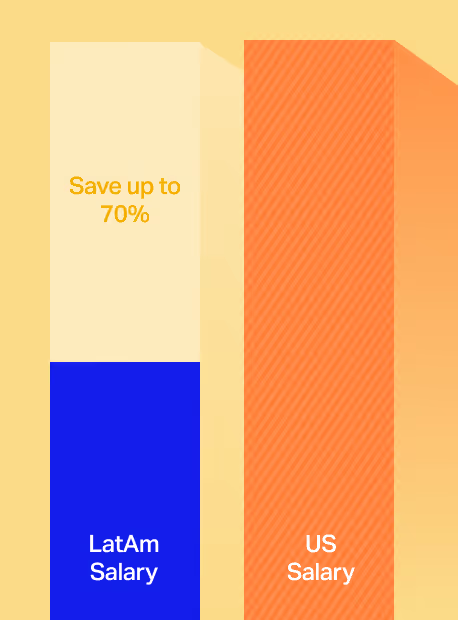
Hiring a social media professional in Latin America gives you the dedication and brand ownership of an in-house hire at a cost that’s competitive with agency outsourcing (or less)—while avoiding the common pitfalls of traditional offshore regions like significant time zone differences and cultural misalignment.
The core problem hiring in Latin America solves
You want your own dedicated social media team, not rented attention from an agency juggling 30 other clients. But US salaries make that feel impossible. So you default to outsourcing even though you know it’s not ideal.
Latin American hiring solves this gap. And the reason is simple. Living costs in Latin America are lower than in the US, which means talented social media professionals have lower salary expectations while maintaining the same level of expertise and experience.
You’re not compromising on quality to get affordability, and you’re not settling for an outsourcing relationship when what you really want is a committed team member.
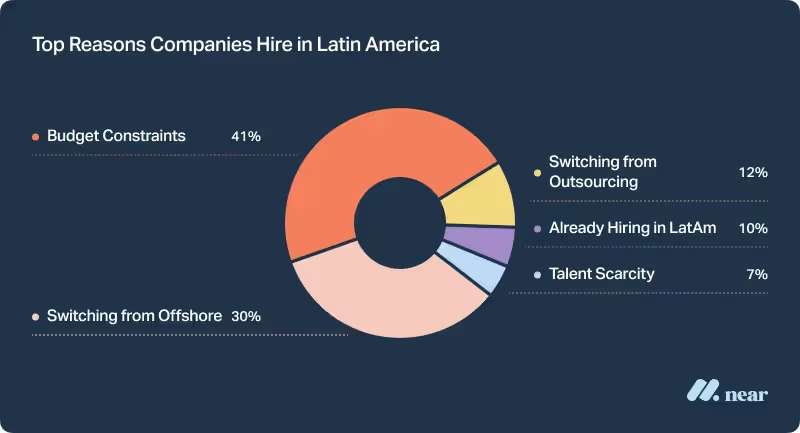
In fact, our recent report on why US companies hire in Latin America showed that 12% of companies were looking to switch to hiring their own team members instead of outsourcing.
Why hire social media professionals in Latin America specifically (and not the Philippines or India)
There are talented social media professionals everywhere. So why do we specifically recommend Latin America for US companies?
Time zone overlap
LatAm professionals work during US business hours. That means real-time collaboration, live responses to trending topics, and the ability to publish content during optimal US engagement windows (which is when your audience is actually online).
Compare that to working with someone in Manila or Mumbai, where the time difference is 12-13 hours. When your social media manager is asleep during your entire workday, you can’t respond to customer inquiries in the comments, you can’t capitalize on trending topics, and you can’t hop on a quick call without scheduling it the day before.
When a customer complaint blows up on Twitter at 2 pm on a Tuesday, you need someone who can respond right then and there.
Social media moves fast. You need someone who’s online when your audience is online.
Cultural alignment
Latin American professionals understand US market trends, consumer behavior, and cultural references that are essential for social media content. They’ve often worked with US companies before and know what resonates with American audiences.
Social media is inherently cultural. What’s funny, what’s compelling, what feels authentic—these things vary dramatically across cultures. Hiring someone who already understands your market means your content lands better from day one.
Communication style
Beyond just English fluency (which is strong across LatAm), there’s an alignment in business communication norms and expectations. Direct messaging style, meeting etiquette, feedback culture—these things feel familiar in ways that make collaboration smoother.
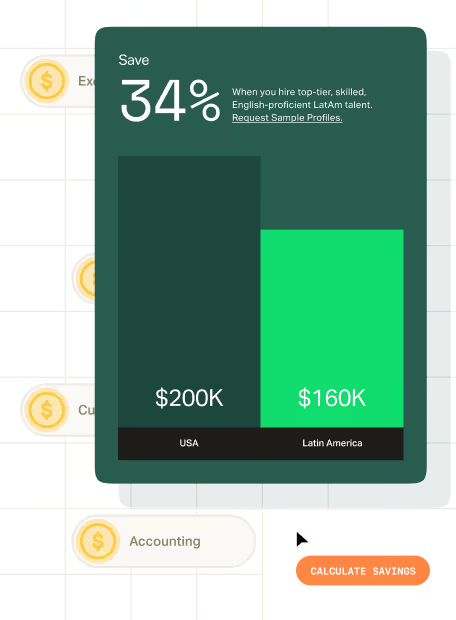
Cost comparison: LatAm vs. US social media roles salaries
Here’s what you can expect to pay for social media roles in Latin America compared to US salaries:
Average Salaries for Social Media Roles - US vs. Latin America
For a comprehensive breakdown of LatAm and US salary ranges across all marketing roles, check out our full US vs. LatAm salary guide.
How to Decide: Outsourcing vs. Hiring Your Own Team
The decision between outsourcing and hiring comes down to three factors: how strategic social media is to your growth, whether you need consistent brand building or project-based execution, and whether you have the budget to invest in long-term capability (which LatAm hiring makes accessible).
Choose outsourcing if:
- You need very short-term help. For example, 3-6 months for a specific campaign or product launch.
- You’re still testing social as a channel. You genuinely don’t know whether social media will drive meaningful growth for your business.
- You need hyper-specialized expertise temporarily. You need someone who’s already an expert in a very specific platform or tactic.
- You don’t have capacity to onboard and manage someone. No one on your team has time to onboard and then manage a new hire.
Choose hiring (especially in LatAm) if:
- Social media is—or should be—a consistent growth channel for the next 2+ years.
- You want someone who deeply understands your brand and customers. If brand voice matters to you (and it should), you need someone who lives and breathes your company.
- You need agility to respond quickly to trends, customer feedback, or market changes.
- You want to build long-term capability instead of renting it. Think about where you want to be in two years. Do you want to still be dependent on an agency?
- You’ve been frustrated by agency communication delays or generic content.
Questions to ask yourself:
“Do we need someone who thinks about our social media presence every day, or just executes what we tell them?”
If it’s the former, you need a hire. If it’s the latter, maybe a freelancer works fine.
“Are we building brand awareness as a core growth lever, or is this just ‘we should probably post something’?”
If social media is strategic, treat it strategically. That means building capability in-house.
“Do we have enough context and direction to give a freelancer or agency, or do we need someone to own the strategy?”
If you don’t have time to manage them closely, you probably need someone who can operate independently, which typically means a dedicated hire who learns your business deeply.
Final Thoughts
Both outsourcing your social media and building your own in-house social media capacity have their place. If you need short-term help, specialized expertise for a specific campaign, or you’re genuinely still testing whether social media will work for your business—outsourcing can make sense.
But for most growing companies, once social media becomes a consistent part of your growth strategy, the economics shift. You’re paying similar (or higher) costs to agencies but getting a fraction of the value. Your brand voice and messaging consistency suffer. Communication slows down. You’re constantly re-explaining context that a dedicated team member would already know.
This is why hiring in Latin America is becoming so popular with growing US businesses. You get the dedication and ownership of a full-time team member who understands your business, grows with your company, and operates during your business hours at a cost that’s competitive with agency retainers.
At Near, we’ve helped hundreds of companies build high-performing marketing teams within budget.
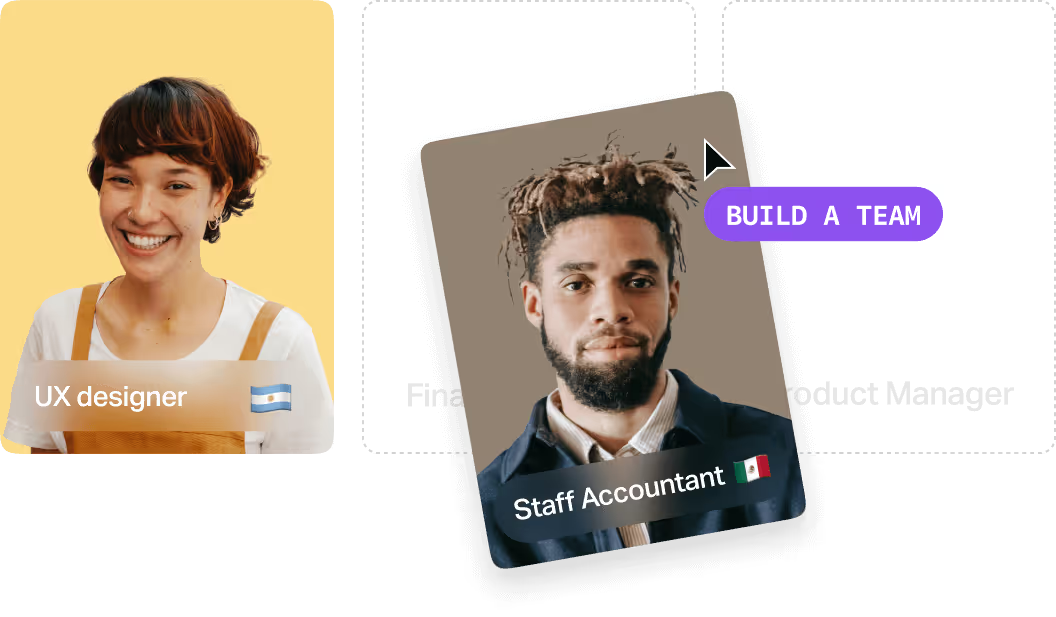
We connect US companies with top marketing talent across Latin America—including social media managers, content creators, community managers, graphic designers, video editors, and copywriters who work in your time zone and bring the strategic thinking and execution skills your brand needs.
We handle everything from sourcing to vetting to payroll and compliance, so hiring feels simple on your side. No platforms to learn, no endless resume screening, no guessing about quality. Just curated candidates who are ready to become part of your team.
We know most companies don’t have a clear picture of what marketing talent actually looks like in LatAm.
That’s why we recommend starting with sample profiles.
We’ll send you profiles of 2–3 pre-vetted candidates. You’ll see their experience, education, skills, and English proficiency level. No meeting required. No commitment. Just real examples of the talent available.
This gives you a baseline. Most companies find that the talent exceeds their expectations, but seeing it firsthand makes the difference. If you then decide to hire with us, we find out exactly what you’re looking for, and our specialist recruiters and hunters run a custom search.
To explore the caliber of marketing talent we can find for you, get a list of pre-vetted candidates. See what the possibilities are. With Near, you can interview candidates for free and only pay once you make a hire.
{{prevetted-banner}}
Frequently Asked Questions
How do I know if I’m ready to hire my own social media professional?
You’re ready when social media is a consistent part of your growth strategy (not just sporadic posting), when you have budget for a dedicated hire, and when you have at least one person internally who can onboard and provide direction.
Check out our guide on how to hire a social media manager for the full hiring process.
Where can I find freelance social media marketers if I want to test before committing to a hire?
We’ve written a comprehensive guide on where to hire freelance marketers that covers the best platforms and what to watch out for. Just remember: freelancers are great for short-term projects but rarely deliver the consistent brand building that a dedicated hire provides.
How do I vet social media candidates for culture fit and strategic thinking?
Strong interview questions are essential. Our guide on effective interview questions for remote marketing professionals includes specific questions that reveal strategic thinking, not just execution capabilities.
Related reading: How To Identify and Recruit Top Remote Marketing Talent
What’s the best country to hire offshore or nearshore marketing talent from?
There’s no single “best” country—it depends on your budget, the role, and specific skill needs. Different countries have different strengths. We break down the tradeoffs in our article on the best countries to hire remote marketing talent.
Should I work with a marketing recruitment agency or hire social media talent directly?
The major benefit of working with a recruitment or staffing company is when you’re hiring outside the US, they make the process as seamless and easy as hiring domestically.
Most companies don’t know local talent markets in Latin America, don’t have networks to source candidates, and aren’t familiar with payroll, compliance, or employment laws in different countries. A good recruiting partner handles all of that.
Beyond international hiring, recruitment agencies also handle vetting, provide shortlists of qualified candidates, save you time on sourcing and initial screening, and often offer guarantees if a hire doesn’t work out.
Direct hiring gives you more control over the process and eliminates the recruitment fee, but requires significant time investment in sourcing, screening, interviewing, and managing the hiring process yourself.
Our comparison of marketing recruitment agencies and B2B marketing recruitment agencies can help you build a shortlist of companies to consider.
Related reading: Best Companies to Hire LatAm Marketers
How do I outsource social media marketing?
Start by defining what you need—full-service management (strategy, content, community management) or specific services like just content creation or paid ads. Then decide between hiring a full-service agency, specialized agency, or freelancers based on your budget and how much coordination you’re willing to manage.
For agencies, get referrals from other businesses in your industry, review their client portfolio to see if they’ve worked with companies like yours, and request case studies showing measurable results.
During the vetting process, ask how they’ll learn your brand voice, who specifically will work on your account, and what their process looks like for revisions and approvals.
For freelancers, platforms like Upwork and others can connect you with independent social media specialists and managers. Review their portfolios carefully, check references from past clients, and start with a paid test project before committing to a long-term retainer.
Whichever route you choose, set clear expectations upfront: define success metrics, establish communication cadence (weekly check-ins are standard), clarify approval processes, and document your brand guidelines thoroughly. Most importantly, assign someone internally to manage the relationship—outsourcing still requires coordination and strategic direction from your team.







.webp)


%203.svg)
.avif)




%20(1).avif)

%20(1).png)