Low Hire, Low Fire: 102 Leaders Explain Why US Companies Aren’t Adding New Roles
We asked 102 US hiring leaders whether their companies are adding new roles. 84 aren’t. Here’s why, in their own words, and what would get them hiring again.
If you’ve tried to get a new role approved this year, you know how long the wait can be. The team has more work than it can comfortably handle, but the answer is still “let’s wait and see.”
That’s the US job market economists have been calling “low hire, low fire” for over a year: companies aren’t letting many people go, but they aren’t adding many either.
The monthly numbers show what’s happening, but they don’t explain why companies keep putting off hiring. So I asked US founders, hiring managers, and department heads whether their companies are hiring right now and, if not, what’s behind that decision.
Their answers reveal the reasons companies are holding off, which roles are still getting approved, and what would need to change for more companies to start hiring.
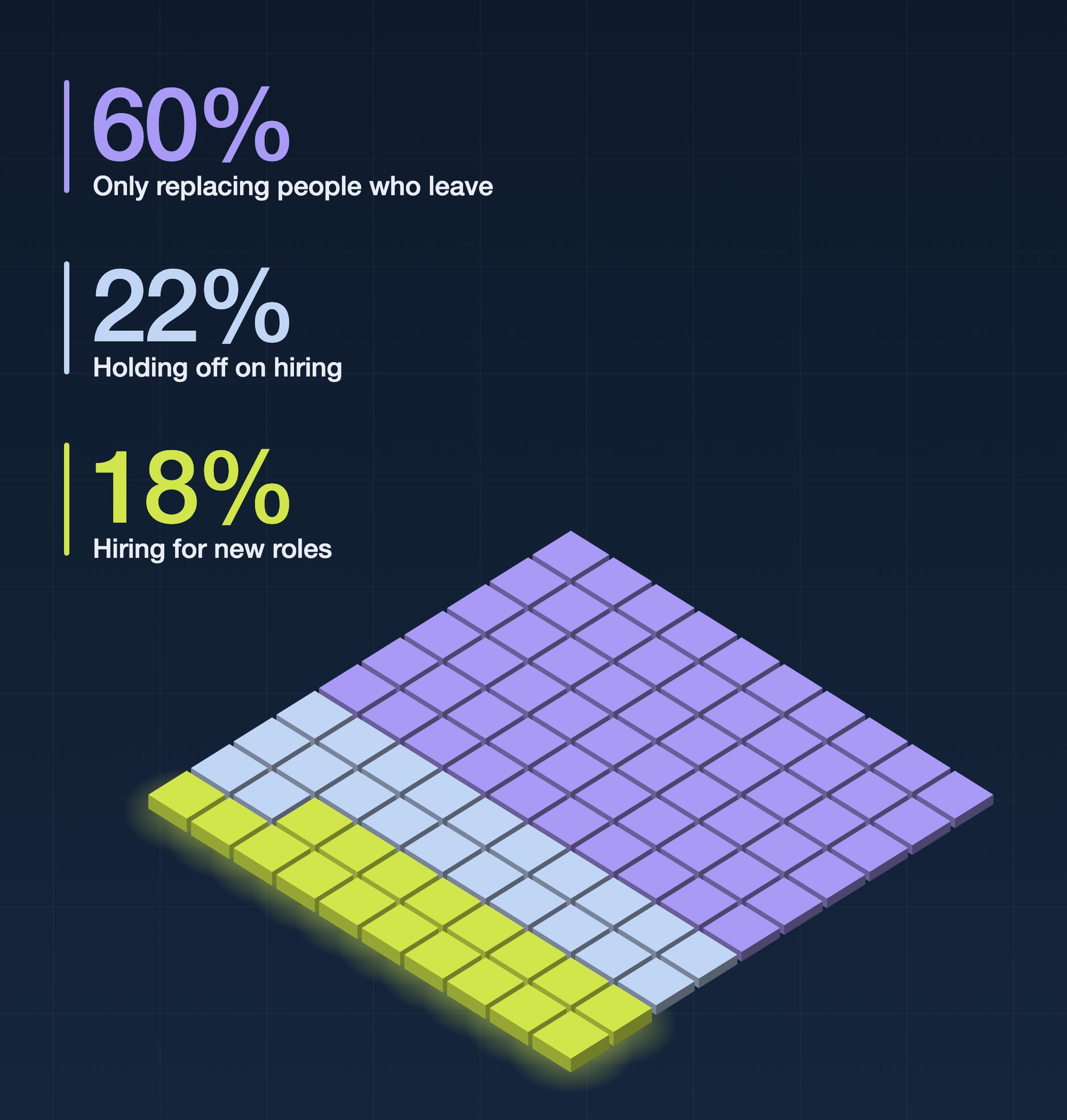
- Of the 102 US companies that told me about their hiring, 60% are only replacing people who leave, 22% are holding off, and 18% are hiring for new roles.
- The most common reason is demand that isn’t steady enough to justify a full-time salary (43% of those not adding roles), followed by AI and automation taking over work a new hire would have done (21%).
- What would change it is sustained demand: several months of steady orders, longer contracts, or specific deals closing. Several of them said one good month isn’t enough.

What Does “Low Hire, Low Fire” Mean for US Companies?
“Low hire, low fire” describes a labor market where companies are letting relatively few people go, but aren’t hiring many new employees either. Fewer people are moving between jobs, and the workforce isn’t changing much.
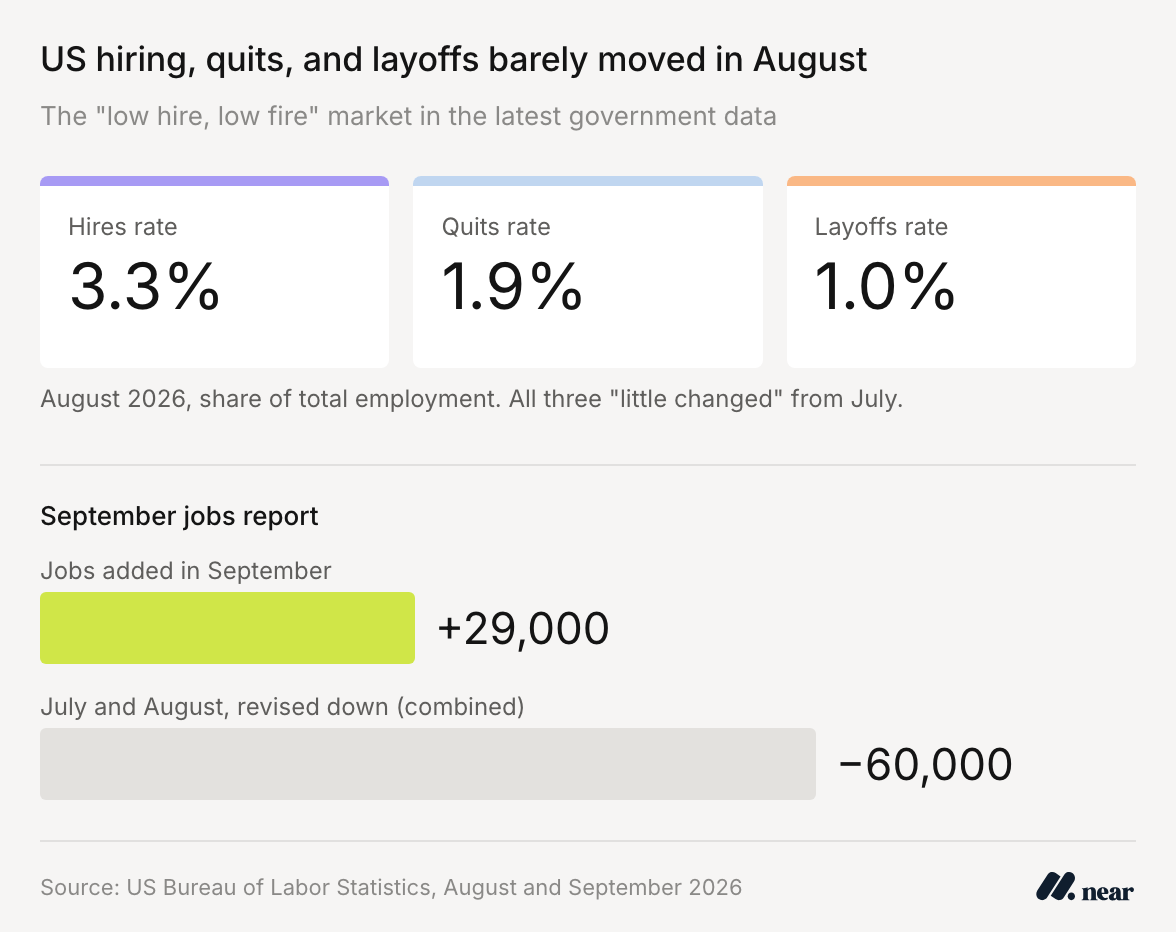
The latest government data shows exactly that. In August, the hiring rate was 3.3%, the layoffs rate was 1.0%, and the quits rate was 1.9%, all “little changed,” according to the US Bureau of Labor Statistics (BLS). US employers added only 29,000 jobs in September, while the BLS jobs report revised estimates for July and August down by a combined 60,000.
Companies’ own plans point in the same direction. Outplacement firm Challenger, Gray & Christmas reported the weakest September hiring plans since 2011 and the fewest September job cuts since 2022. “Companies are in a wait-and-see period right now,” said Andy Challenger, the company’s Chief Revenue Officer.
Some economists see this pattern becoming the norm rather than a temporary slowdown. In September, Sneha Puri, an economist at Indeed Hiring Lab who focuses on the US labor market, said: “The labor market remains low-hire and low-fire… it’s starting to look less like a phase and more like the new normal.”
How Many US Companies Are Holding Off on Hiring?
To find out what’s behind those numbers, I asked US founders, hiring managers, HR leaders, and department heads two things between October 21 and 26: is your company hiring right now, and if it’s holding off, why?
Most of the companies I heard from aren’t adding roles. Of 102 US companies, 60% are only replacing people who leave, 22% are holding off on hiring altogether, and 18% are hiring for new roles.
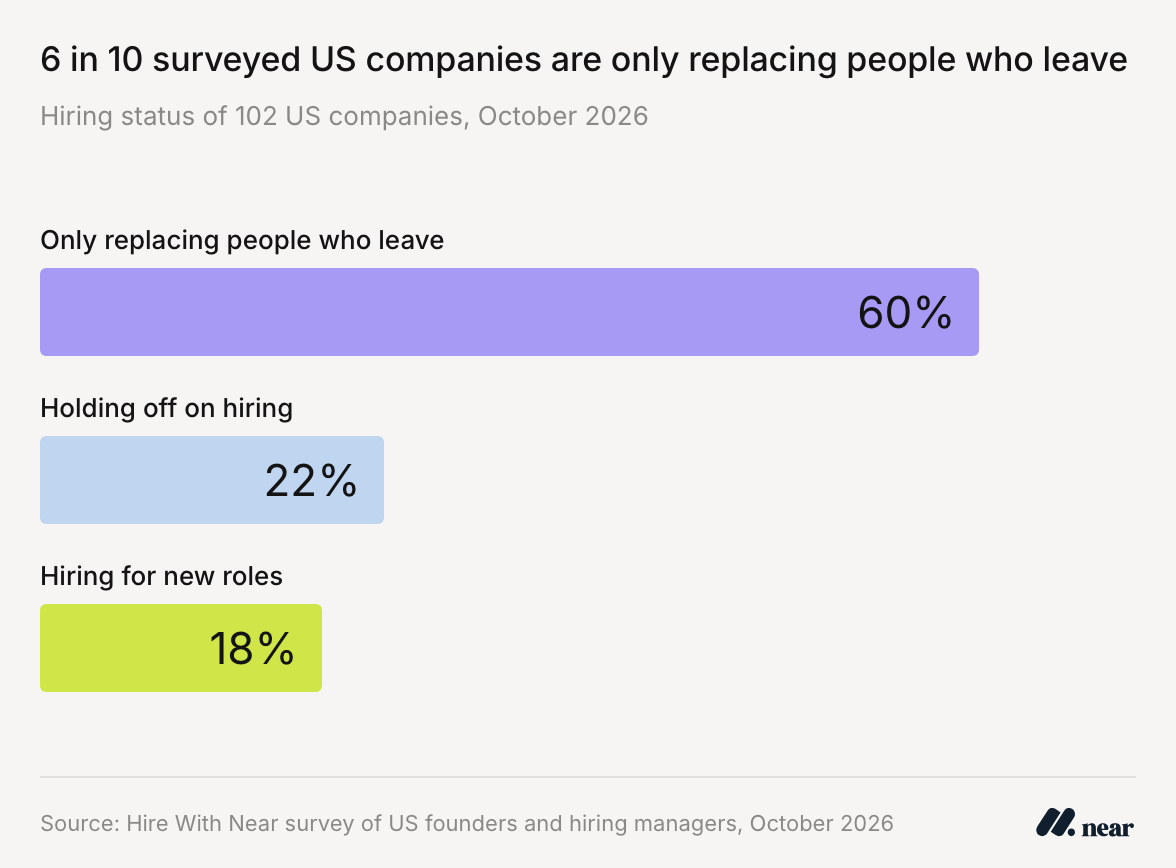
In practice, “only replacing” and “holding off” blur together. Some companies that said they’re holding off also said they’d backfill a key person who left, and some that said they’re only replacing are, in effect, frozen for anything new.
Acquire.com, a California-based marketplace for buying and selling startups, is a good example of how ordinary this has become. Its business is healthy, and it’s still only backfilling. Andrew Gazdecki, its CEO, described the call his team made last quarter:
As of right now, we’re just backfilling, not hiring for anything new. We were contemplating another partnerships manager last quarter, but decided not to go for it. Still, deal flow was healthy, and everything was just operating smoothly. We’d have to see some real growth in platform metrics and a true pivot from our clients before doing something like that.
— Andrew Gazdecki, CEO, Acquire.com
Why Are US Companies Holding Off on Hiring?
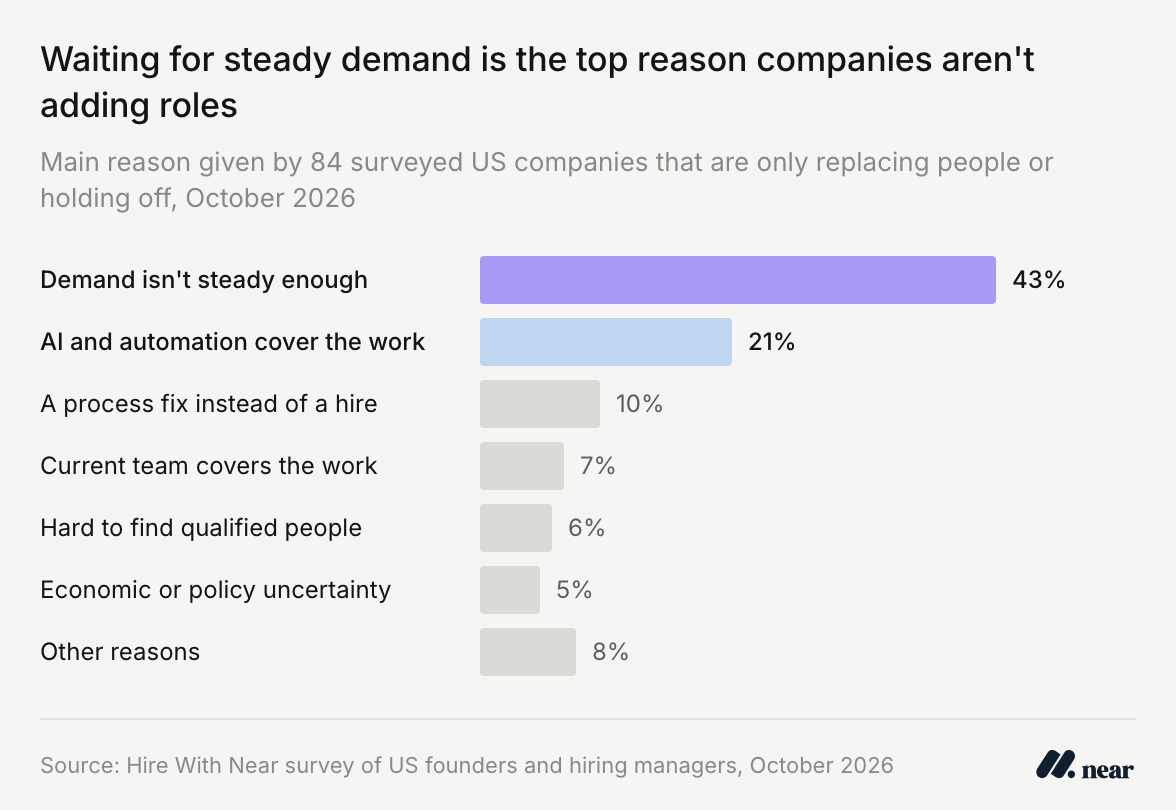
The most common reason companies shared is waiting for demand to prove it will last before committing to a salary. Of the 84 companies that are only replacing people or holding off, 36 (43%) gave that as their main reason, and 18 (21%) said AI or automation now covers work a new hire would have done.
Demand is too unpredictable to commit to another salary
For most of these companies, it’s a timing problem. A salary is a long commitment, and several of these owners told me they can only forecast demand a few months at a time. Some have the work right now but can’t be sure it will last. Others are watching demand slip and can’t tell when it will come back.
For those with demand right now, a busy month, a seasonal spike, or a promising pipeline isn’t enough to justify a new hire.
Astro Pak, a precision cleaning company founded in 1959 that works with pharmaceutical and aerospace clients, is in what Kevin Peguero, its Digital Marketing Manager, calls “replace-only” mode:
We had a production supervisor position open up, and instead of filling it, we cross-trained two senior technicians to share those responsibilities. The reason was straightforward: our project pipeline is strong but not accelerating.
— Kevin Peguero, Digital Marketing Manager, Astro Pak
Smaller companies described the same hesitation about taking on fixed costs. Kade Robertson, CEO of Viral Distributors, a Florida-based consumer products distributor, held off on hiring a second warehouse coordinator this spring:
Order volume was swinging too much week to week. I did not want to add fixed cost before we saw a steady reorder pattern.
— Kade Robertson, CEO, Viral Distributors
For others, the uncertainty starts one step down the line, with their own customers. A trailer dealer watched buyers walk away at the financing desk and push their purchase to spring. One remodeler said homeowners were splitting larger projects into phases, leading to more estimates but not more signed contracts. A maker of commercial event equipment noticed that the party rental operators it sells to were watching their budgets closely.
AI and automation took over the work first
In this survey, AI and automation ranked second among the reasons companies gave for holding off on hiring, behind uncertain demand: about 1 in 5 surveyed companies said AI or automation could handle work that would otherwise have gone to a new hire. For some smaller companies and agencies, that means using tools for tasks such as research, drafting, scheduling, and reporting instead of hiring someone to do them.
Rick Elmore, Founder and CEO of Simply Noted, whose robots write real handwritten notes for clients, said the bar for a new seat has moved:
Before we open a role, we ask one question: is this a problem a tool can solve in 90 days? If yes, we buy or build the tool. If no, and it needs judgment, relationships, or selling, we hire.
— Rick Elmore, Founder and CEO, Simply Noted
A process fix did the job a new hire would have done
Eight companies said they came close to opening a role, but reviewed work first and found a process problem they could fix without adding someone else. Here’s what some of them told me:
- A law firm mapped its intake process before posting a support role and found that one step depended on a single person. Training a second professional who was already on the team fixed it.
- A title company laid out who did what before hiring an operations manager and found the workload didn’t need one.
- A presentation design agency gave its senior designers ownership of client projects and dropped a planned project manager role.
In these three cases, the companies fixed the process and decided they didn’t need the role after all.
Other reasons
The remaining answers were spread across smaller groups. Six companies said their current team could handle the workload, so they didn’t need to hire anyone new.
Five, mostly in trades like HVAC, plumbing, and roofing, said finding qualified people was the bigger challenge. These owners have the demand, but struggle to find licensed professionals they can trust in customers’ homes. For them, leaving a position open can be preferable to hiring someone who isn’t right for the job. A bad hire can be costly, particularly when the work depends on technical skills and customer trust.
Four companies pointed to economic or policy uncertainty, including interest rates, access to credit, and court or immigration backlogs.
The other seven companies gave reasons that didn’t fit a larger group.
Which Companies Are Still Hiring, and for What Roles?
Most of the 18 companies still adding roles are hiring for jobs that bring in revenue or serve customers directly: technicians, specialists, and client-facing staff such as cybersecurity specialists, estheticians, and trial attorneys.
At Netsurit, a managed IT, cybersecurity, and cloud services company with more than 300 people, the new roles sit in cybersecurity, cloud, AI enablement, and integrations. Orrin Klopper, its CEO, was clear about what they won’t add:
What we are not doing is adding ’generic capacity’ just because teams feel busy. In an MSP, an unfocused hire can create noise; a focused hire should improve response, reduce risk, or help clients modernize faster.
— Orrin Klopper, CEO, Netsurit
At Silver Mirror Facial Bar, a facial bar chain with locations in New York, Washington, DC, and Miami, one role stays open no matter what. Matt Maroone, its Co-founder, said estheticians “double as the face of the brand and relationship builders”:
"One role we always have open is the position of an esthetician. The truth is, no matter how many estheticians we have, it feels as though we will always need more because their expertise plays an essential role in our relevance in the industry."
— Matt Maroone, Co-founder, Silver Mirror Facial Bar
At Online Optimism, a digital marketing agency in New Orleans and New York, demand outgrew the team. Flynn Zaiger, its CEO, said they’re adding content and Reddit marketing specialists, and still hiring for video because it’s “one of the few spaces in marketing AI hasn’t taken over (yet)”:
Client demand on the Reddit marketing and SEO side has grown faster than our existing team can cover without slowing down turnaround times.
— Flynn Zaiger, CEO, Online Optimism
What Would Get US Companies Hiring Again?
I also asked the companies what would need to change for them to start adding roles again. The trigger I heard most often was sustained demand: enough steady business over several months to justify another salary.
The specific signals differ: several months of steady orders, longer client contracts, a particular deal closing, or lower interest rates for their customers.
Some companies named a specific deal that would change everything. Astro Pak, for example, is bidding on three large semiconductor contracts, and winning just one of them would be enough:
If we land one of the three large semiconductor contracts we’re bidding on, we’d immediately open four to six technician roles and backfill that supervisor spot.
— Kevin Peguero, Digital Marketing Manager, Astro Pak
Others want to see demand hold steady over time before committing to another hire. Robertson at Viral Distributors wants “sixty days of steady reorders in a new category, and a client contract locked in."
For agencies, that means signed client retainers. Zaiger put it plainly:
We’d hire faster if a couple of pending client contracts close in the next month. Agencies live and die by signed retainers, so headcount decisions follow revenue rather than the other way around.
— Flynn Zaiger, CEO, Online Optimism
Orrin Klopper of Netsurit added another consideration beyond revenue: having enough demand in the right areas and the capacity to grow without losing what makes the company work. He wants “sustained client demand in security, cloud, AI and acquisition integration, plus confidence that we can onboard people without diluting culture.”
Several owners said they’d only “revisit” or “reconsider” a role once demand returns, so these triggers are intentions, and I can’t say how many will turn into hires. Our own sales calls offer a few clues, which I cover in the next section.
What Is Hire With Near Seeing From US Companies?
Our own data tells a similar story, from two angles: what US companies say on their first calls with us, and who ends up hiring.
What our sales calls show
Our sales calls from the past two months, with US companies looking to hire in Latin America, show a similar split. Several of the companies we spoke with weren’t adding roles; they were replacing someone who left.
A midsize B2B marketing agency had two people leave its SEO team and was looking to backfill both. Another company lost a designer and wanted to replace that work “with more agility.” Some roles were on hold altogether, as one digital agency told us about its social media manager and video editor openings.
Some businesses are simply waiting for the right moment. A home services company that spoke with us in September preferred to start in the new year, because starting now would put a new hire too close to its slow season.
And some searches do come back. One midsize company told us it had put a search on hold in January, then returned after rethinking the role: “Now I’m going back to making that change from an org standpoint and restructuring it how I want, just based on what I’ve learned on the role.”
The companies still adding roles sounded different. A midsize fintech company hiring across its sales team told us its hiring was “based on just growth. So it’s not backfilling a lot of roles. It’s doubling, tripling the team year over year.”
Who is hiring with us, and where they’re looking
At Hire With Near, the US companies that came to us to hire in Latin America made 31% more hires in the first half of 2026 than in the second half of 2025, according to our Midyear Hiring Report.
Of all the roles our clients filled in that period, sales development representatives came first. That fits what the survey shows. SDRs bring in revenue, and the companies in my survey that are still adding roles are hiring for seats tied to revenue too. Our clients are only part of the US market, but both point the same way.
Some companies are also looking beyond their local market to keep the salary for a new role within reach. When we analyzed more than 2,000 of our sales calls with US employers exploring hiring in Latin America, budget constraints were the most common reason they gave (41%). Salaries in the region typically run 30% to 70% lower than US rates for comparable positions. For a company that can’t yet see how long demand will last, that’s a smaller fixed commitment to take on.
What This Means If You’re Planning to Hire
If you’re one of the companies waiting, the owners I spoke with who held off on a role offered a few habits worth borrowing.
- Ask whether a tool could solve the problem in 90 days before you post the role. That’s the test Elmore uses at Simply Noted, and it’s most useful for roles built around repetitive work like reporting, scheduling, or data entry. If the work needs judgment, relationships, or selling, it usually needs a person.
- Look for a process problem first. Several companies found that the seat they wanted to fill was covering up a bottleneck. Mapping the work takes far less time than recruiting and onboarding someone, and it can show whether you need the seat at all.
- When you do hire, make it specific. The companies adding roles in this survey could say exactly what each seat was for, whether it was tied to revenue, risk, or a customer.
Final Thoughts
The most common reason companies gave for holding off on hiring was uncertainty about whether demand would last long enough to justify another salary. In the meantime, they’re looking at whether tools, process changes, or their existing teams can cover the work.
If you’re in the same position, use this time to identify which roles would make the biggest difference and where you’d look for the right people when you’re ready to hire again.
That search doesn’t have to stop at your local market. Latin America offers access to experienced professionals who can work overlapping hours with US teams, many of whom speak fluent English and have experience working with US companies. Salary expectations are often 30% to 70% lower than US rates too. That means you can open the role you’ve been putting off with less financial risk while demand settles, and still get the talent you need to keep growing.
If you want to understand why more US companies are hiring there, read our guide on why US companies hire talent in Latin America.
Free Download: The 2026 State of LatAm Hiring Report
We studied data from 2,000+ remote LatAm hires to reveal how top US companies use nearshore hiring to grow faster and recruit top talent while saving $35,000+ annually per hire.
Methodology
Who I asked: US founders, hiring managers, HR leaders, and department heads, between October 21 and 26, 2026.
Responses: I received 158 responses and counted the 102 that came from US companies and stated their current hiring status. I left out responses from companies outside the US, answers with no clear status for the respondent’s own company, and answers where the sender’s name or company didn’t match public records.
How I coded reasons: Each company that is only replacing people or holding off got one main reason, based on its own answer. The categories came from the answers, not from a list written in advance. Reasons given by fewer than 10 companies are shown as counts.
A note on the sample: Respondents chose to answer, so this isn’t a representative sample of US companies.